Catalog

Simulations

Pick a topic and start exploring. Every simulation is free, runs in your browser, and starts with a guided walkthrough. Search, or narrow the list by subject and by what you want to do.

Results

85 simulations

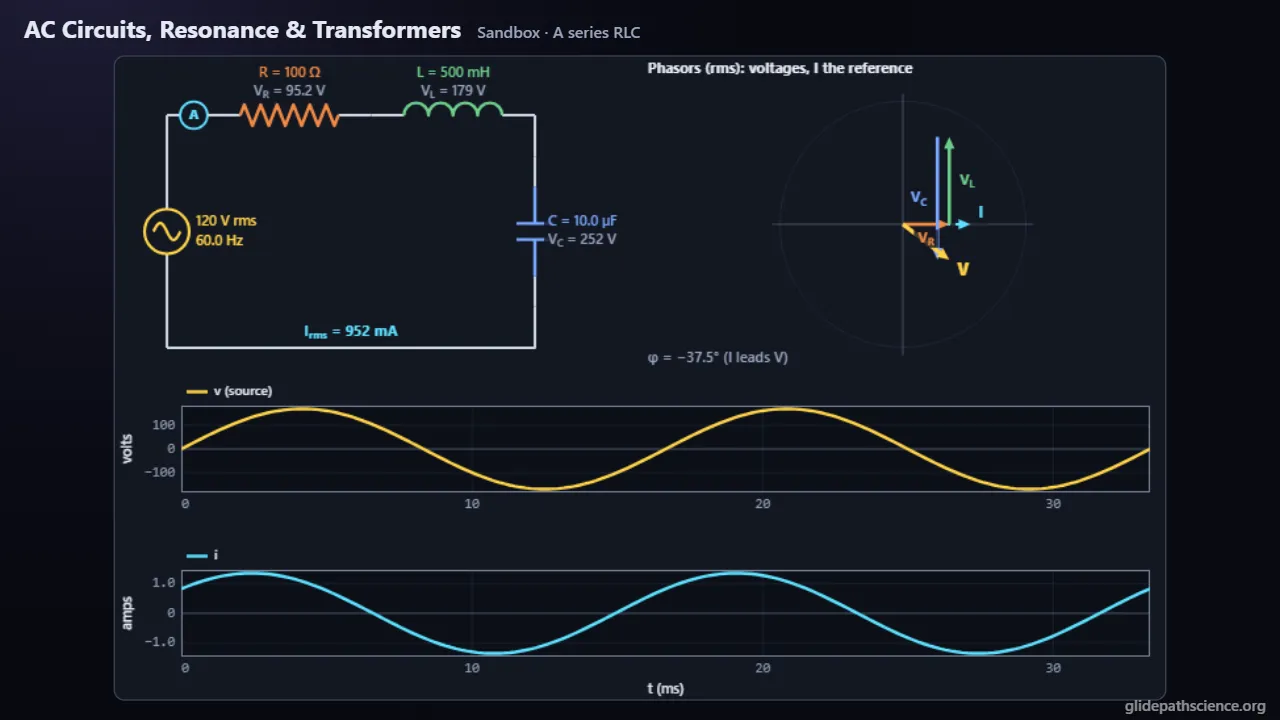
    • A series circuit of a 100 Ω resistor, a 500 mH coil and a 10.0 µF capacitor on a 120 V, 60 Hz source, with its phasor diagram showing the current leading by 37.5° and scope traces of the source voltage and the current.New

      AC Circuits, Resonance & Transformers

      Drive resistors, capacitors and coils with a sine wave, watch the current lead or lag on a scope and as phasors, sweep through resonance, and see why power lines run at high voltage.
      • Electricity & Magnetism
      • Engineering
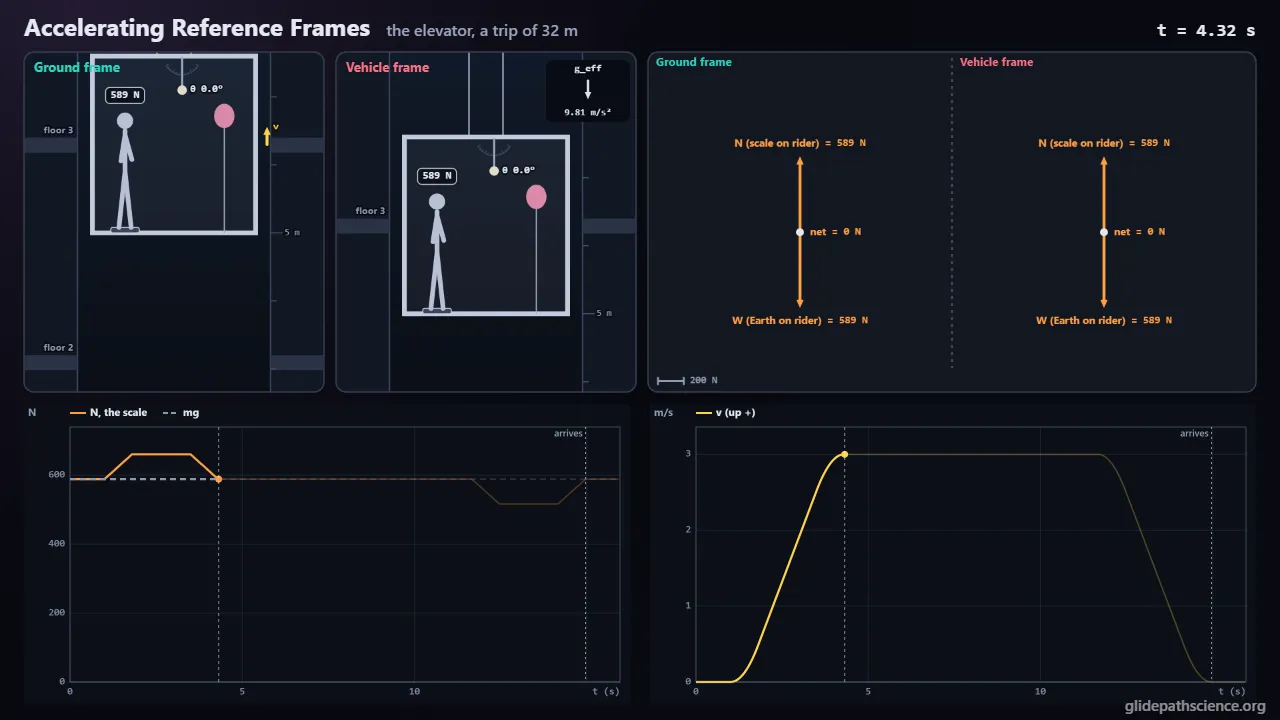
    • An elevator seen from the ground and from inside, with a scale reading the rider's apparent weight through the trip.New

      Accelerating Reference Frames

      Ride an elevator on a bathroom scale and drive a van with a plumb bob, a balloon and coffee, seen from the ground and from inside: apparent weight, fictitious forces, effective gravity and rotating frames.
      • Mechanics
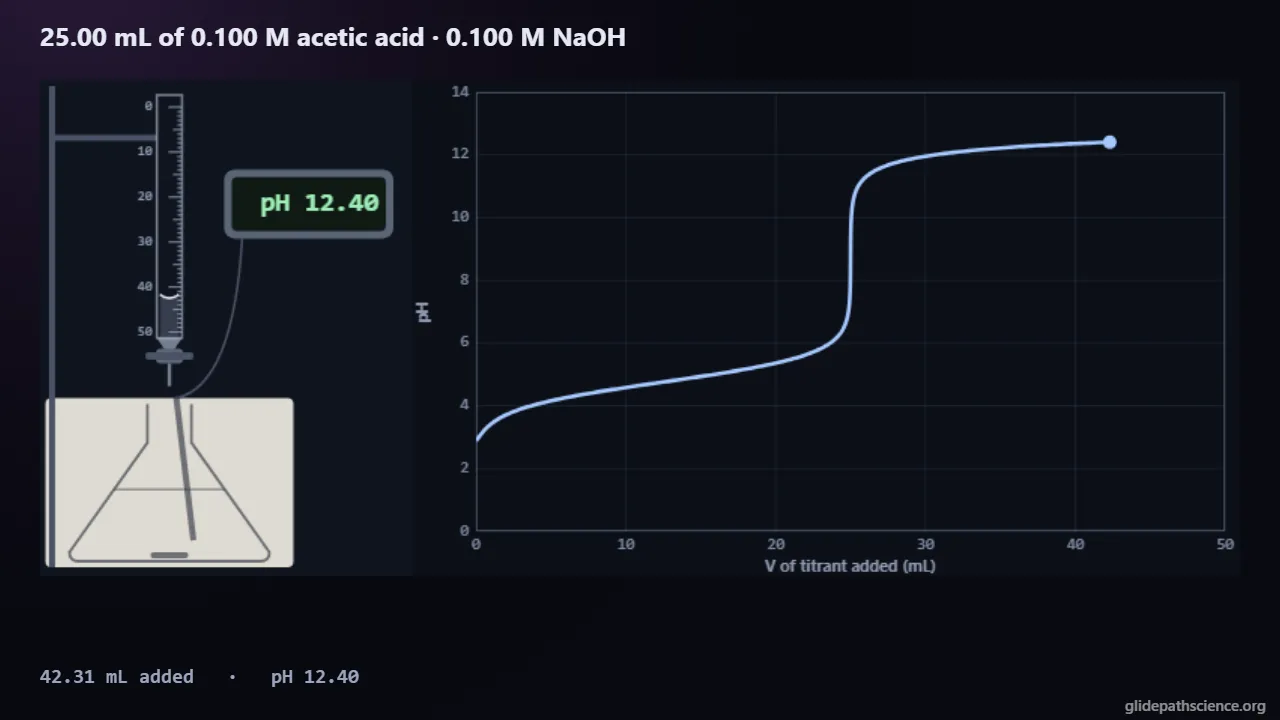
    • A buret over a flask of acetic acid with a pH meter reading 12.40, beside the titration curve: pH rising slowly through the buffer region, jumping near 25 mL at equivalence, and leveling off near pH 12.New

      Acid–Base Titration Lab

      Titrate acids and bases with a buret and a pH meter: see why equivalence is not neutral, how buffers resist, how to choose an indicator, and how to get Vₑ, the concentration and Kₐ from noisy data.
      • Chemistry
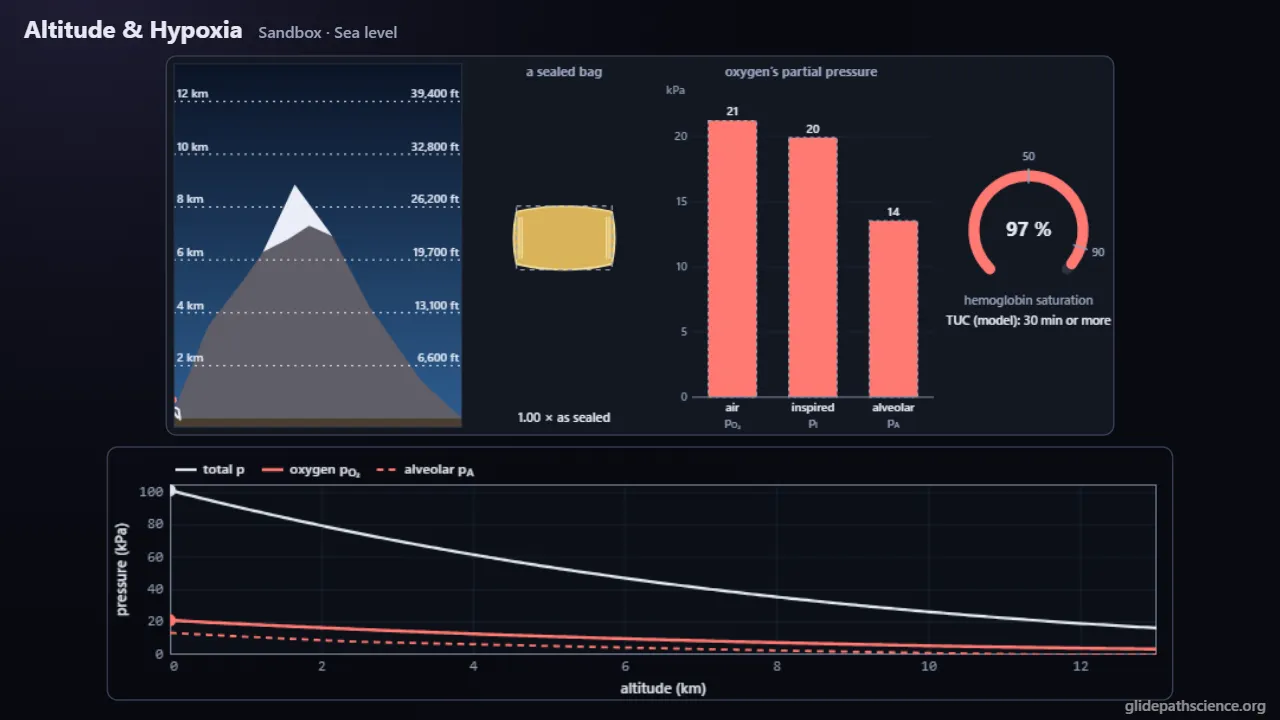
    • A mountain beside an altitude scale at sea level, with a sealed bag, bars for oxygen’s partial pressure in the air, the inspired air and the lung, a hemoglobin saturation gauge at 97 %, and a chart of pressure falling with altitude.New

      Altitude & Hypoxia

      Climb to 12,200 m and watch the air thin: oxygen’s partial pressure falls, hemoglobin holds on then lets go, sealed bags swell, and useful consciousness shrinks to seconds; then lose a cabin’s pressure.
      • Biology
      • Earth & Atmospheric Science
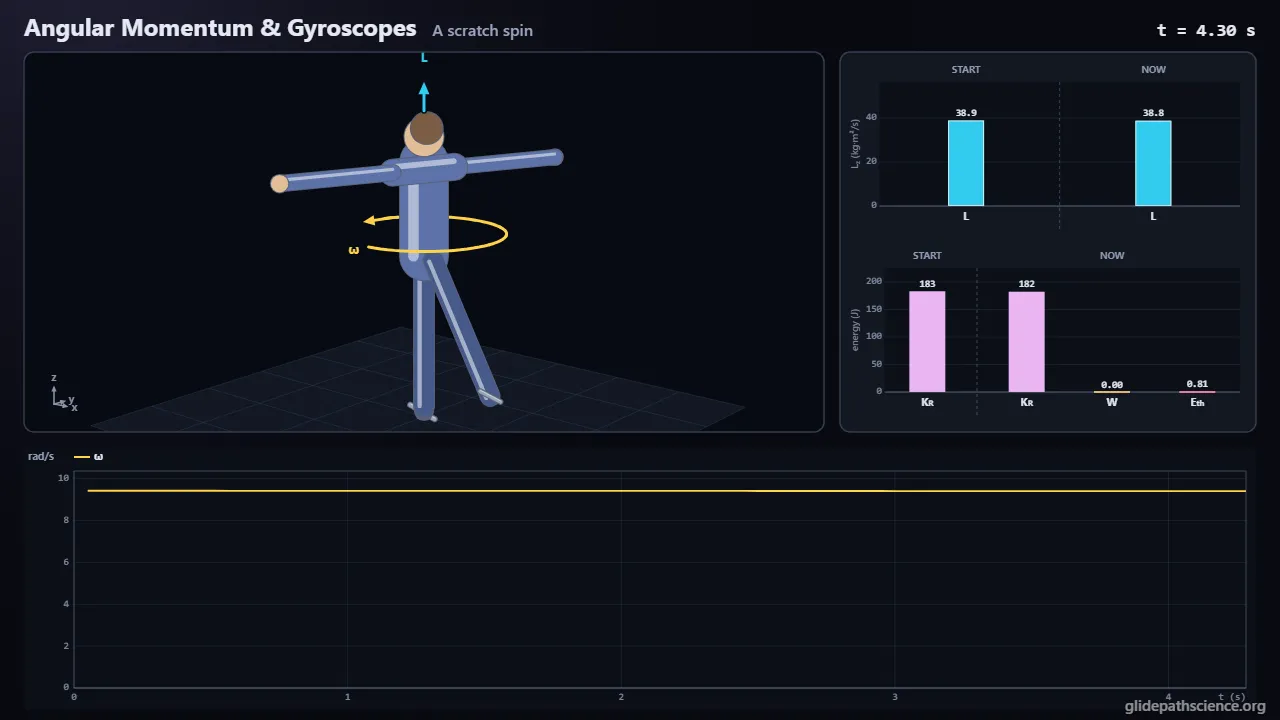
    • A figure skater spinning with arms out, her angular momentum drawn as an arrow up the spin axis, beside bar charts of L and the kinetic energy from start to now, and a steady graph of her spin rate.New

      Angular Momentum & Gyroscopes

      Spin a skater, flip a wheel on a turntable and release a gyroscope: angular momentum is conserved, a torque turns it into precession, and pilots fly by gyro instruments.
      • Mechanics
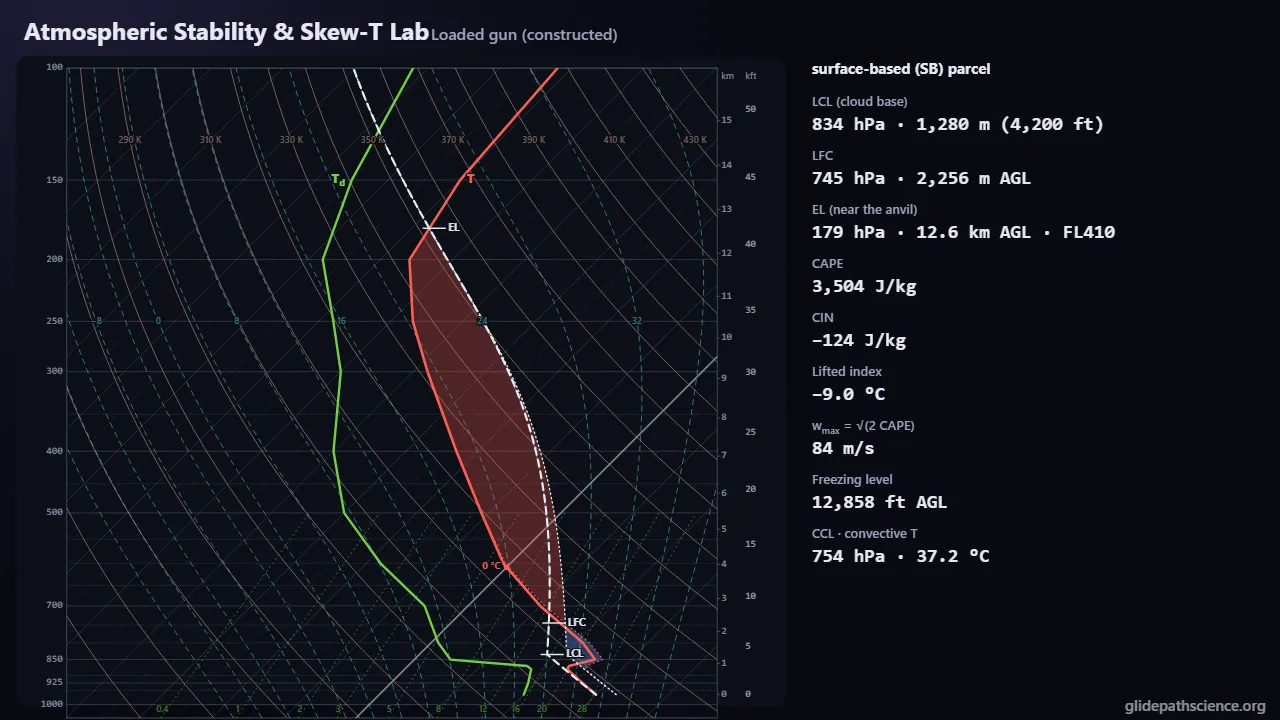
    • A Skew-T diagram of a loaded-gun sounding, with the temperature and dewpoint profiles, the rising parcel, and the shaded CAPE and CIN areas, beside readouts of the LCL, LFC, EL and CAPE.New

      Atmospheric Stability & Skew-T Lab

      Read a weather-balloon sounding on a skew-T log-P diagram: lift parcels to the cloud base, LFC and anvil, measure CAPE and CIN as areas, and read storms, icing and cloud bases.
      • Earth & Atmospheric Science
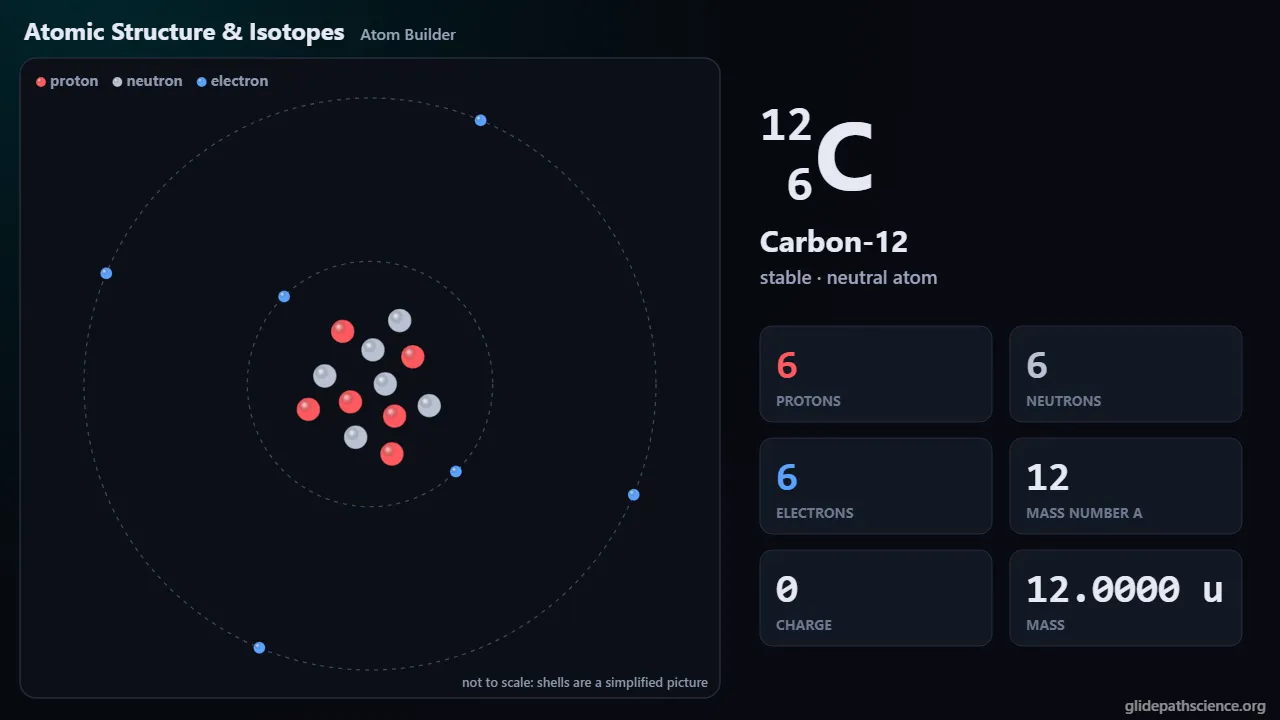
    • The Atom Builder showing carbon-12: six protons and six neutrons in the nucleus, six electrons on two shells, with the counts and the mass.New

      Atomic Structure & Isotopes

      Build atoms and ions particle by particle, read isotope notation, compute weighted average atomic masses, and measure real isotope abundances on a simulated mass spectrometer for hydrogen through krypton.
      • Chemistry
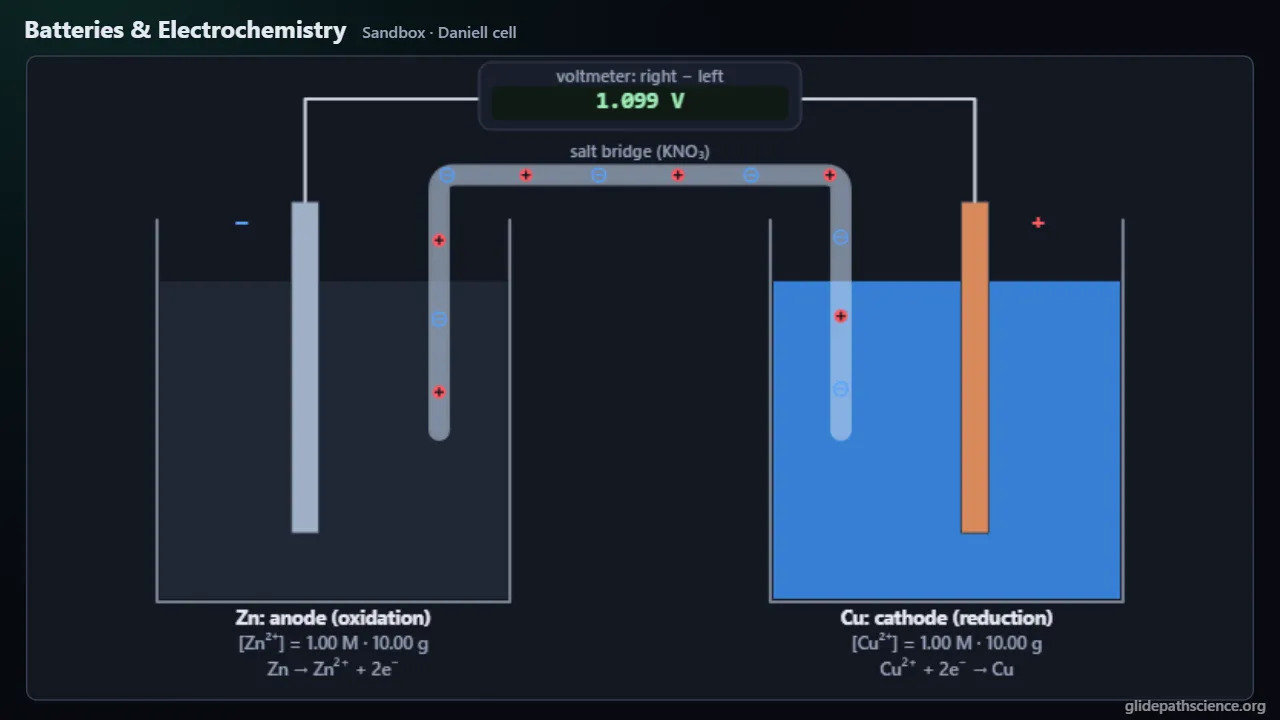
    • A Daniell cell: a zinc anode and a copper cathode in 1.00 M solutions joined by a potassium nitrate salt bridge, with a voltmeter reading 1.099 V.New

      Batteries & Electrochemistry

      Build galvanic cells from metals and solutions, follow the voltage through the Nernst equation as a cell runs down, light an LED with lemons, and find where a battery’s energy really comes from.
      • Chemistry
      • Electricity & Magnetism
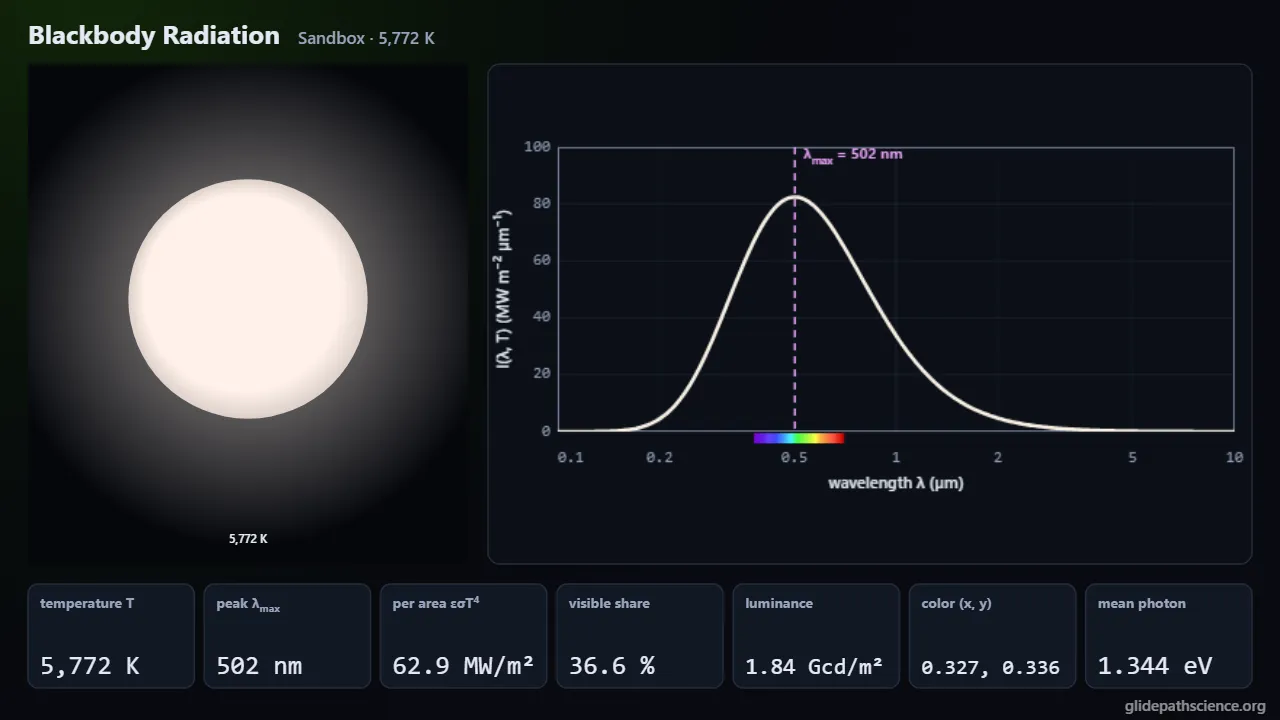
    • A body glowing white at 5,772 K, the Sun’s surface temperature, beside its Planck spectrum peaking at 502 nm over the visible band, with readouts of the peak wavelength, the power per area, the visible share and the color.New

      Blackbody Radiation

      Heat a body and watch its true color slide from red through white to blue: Wien’s and Stefan’s laws, the ultraviolet catastrophe and Planck’s quanta, a spectrometer bench, stars on an HR diagram, and the CMB.
      • Thermal & Modern Physics
      • Astronomy & Space Science
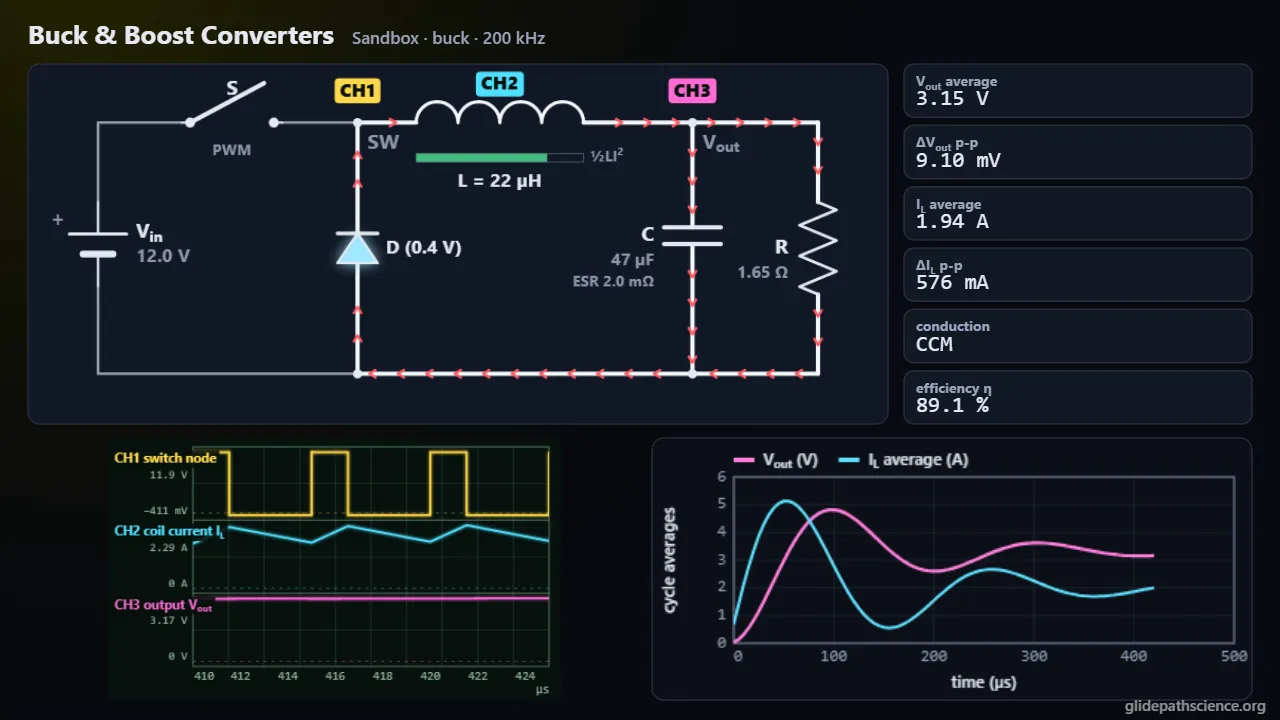
    • A buck converter stepping 12 V down to about 3.2 V: with its switch open, current circulates through the 22 µH coil, the diode, the 47 µF capacitor and a 1.65 Ω load, beside scope traces of the switch node, coil current and output, and the output settling over its first 400 µs.New

      Buck & Boost Converters

      A coil's kick sparks a gap; tamed by a diode, it runs buck, boost and inverting converters cycle by cycle: volt-second balance, ripple, energy books, a scope bench, a design desk and a closed-loop regulator.
      • Electricity & Magnetism
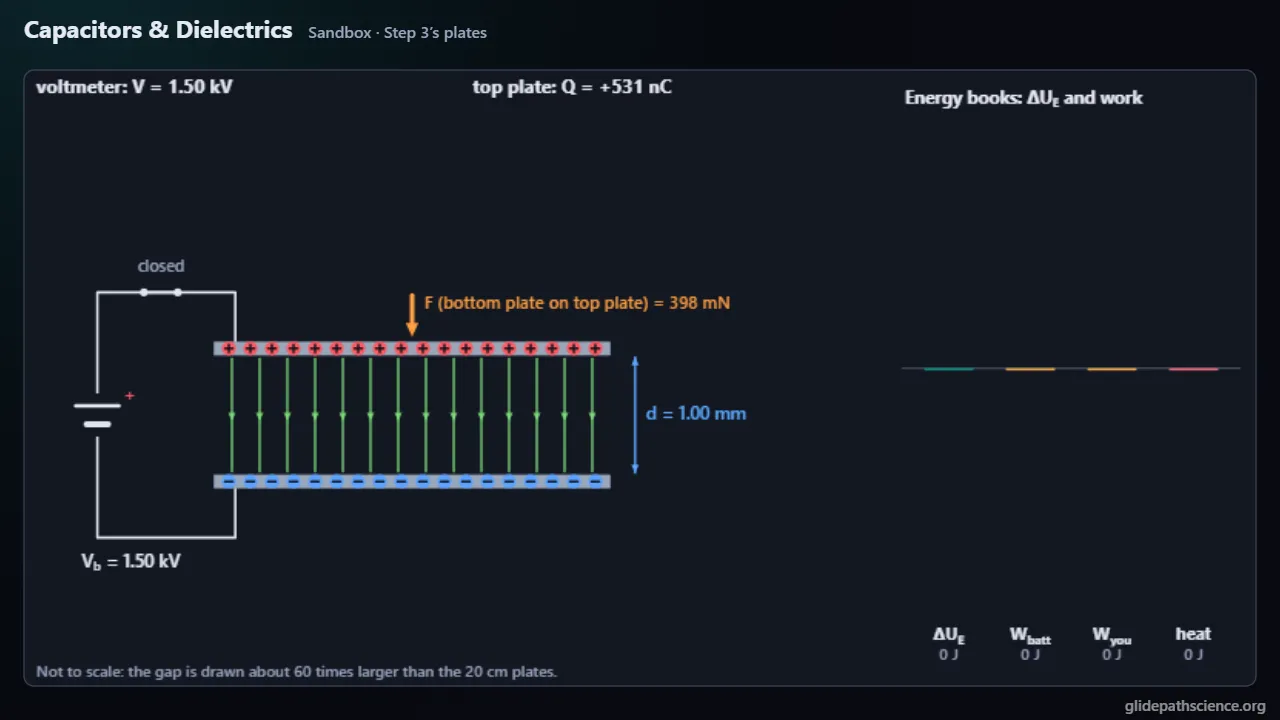
    • Two parallel plates wired to a 1.50 kV battery with the switch closed, rows of plus and minus charges on the plates, green field lines across the 1 mm gap, and the force between the plates marked.New

      Capacitors & Dielectrics

      Charge two plates, change their gap and area, and slide a dielectric between them, with the battery connected or not, to see what sets capacitance, where the energy lives, and what makes a spark.
      • Electricity & Magnetism
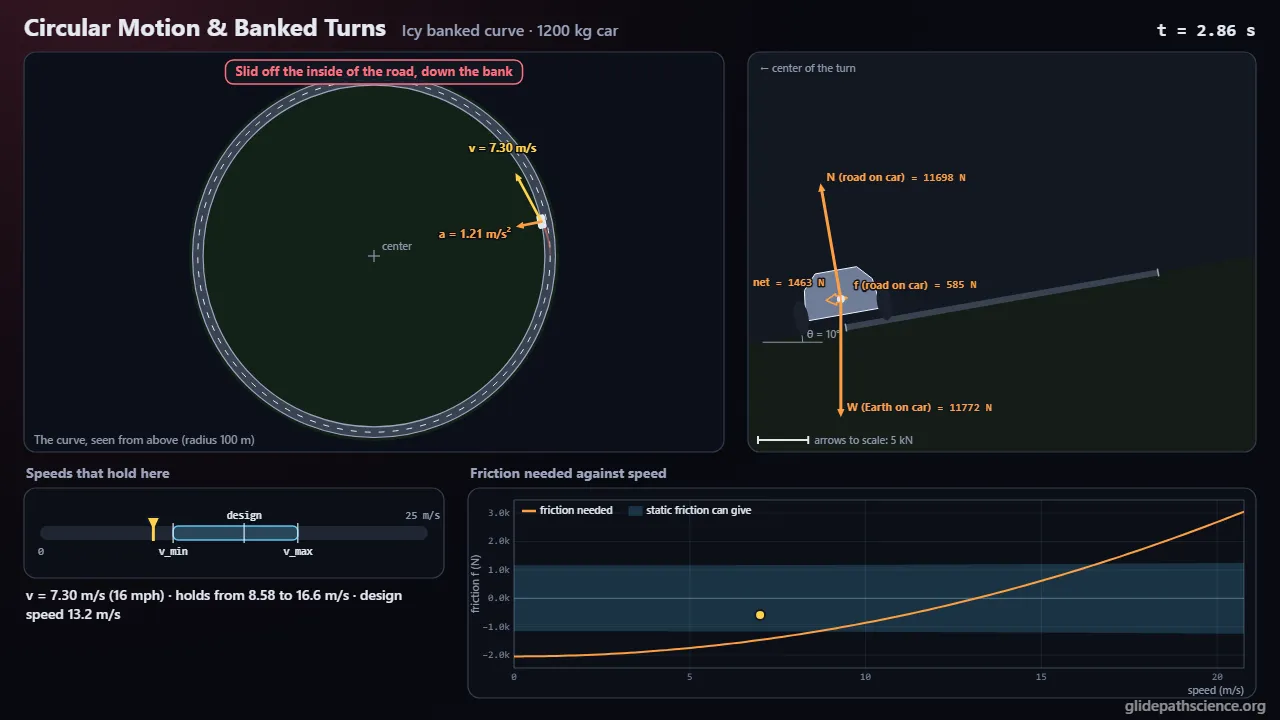
    • A car on a banked curve with the forces on it and the safe range of speeds for the road.New

      Circular Motion & Banked Turns

      Every turn needs a net force toward the center. Whirl a puck, swing a cone, ride a vertical circle and a rotor, and find the window of safe speeds on flat and banked curves, all from the ground.
      • Mechanics
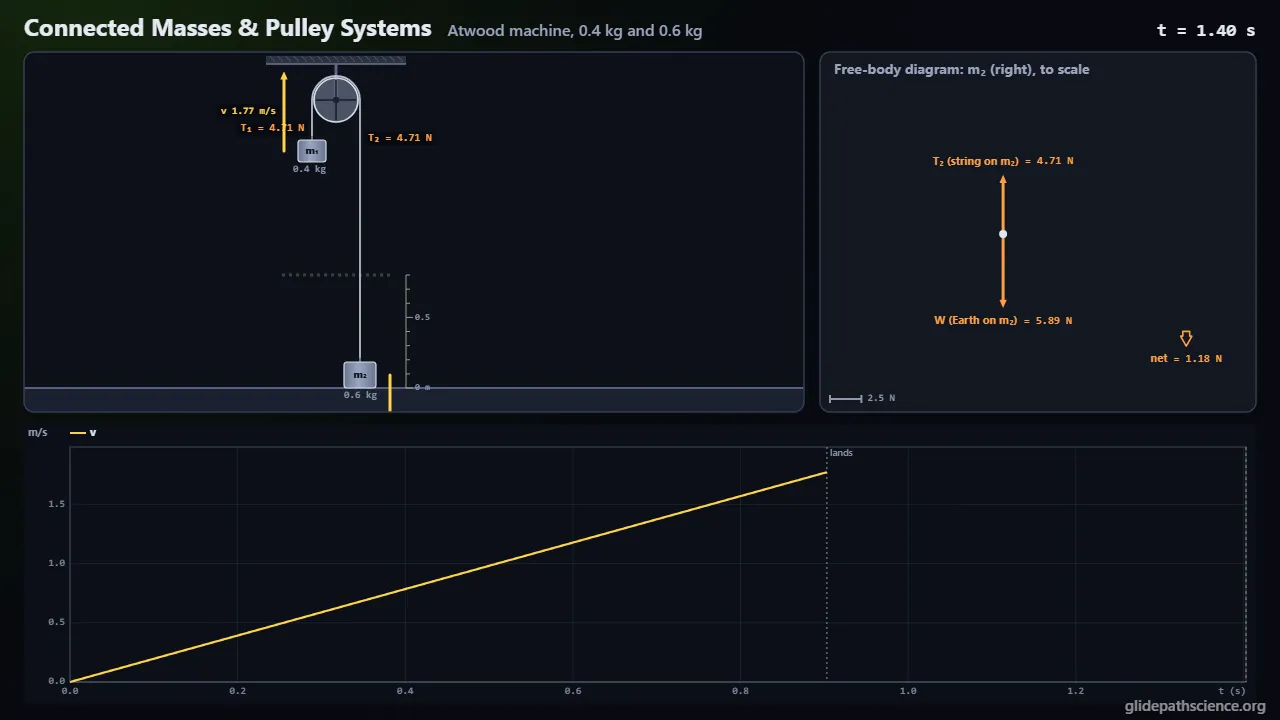
    • Two masses over a pulley, with the tension on each side and the acceleration of the system.New

      Connected Masses & Pulley Systems

      Hang masses over pulleys: Atwood machines, a train of carts, blocks pulled across tables and up ramps, heavy pulleys with unequal tensions, block and tackle, and a lab bench that measures g.
      • Mechanics
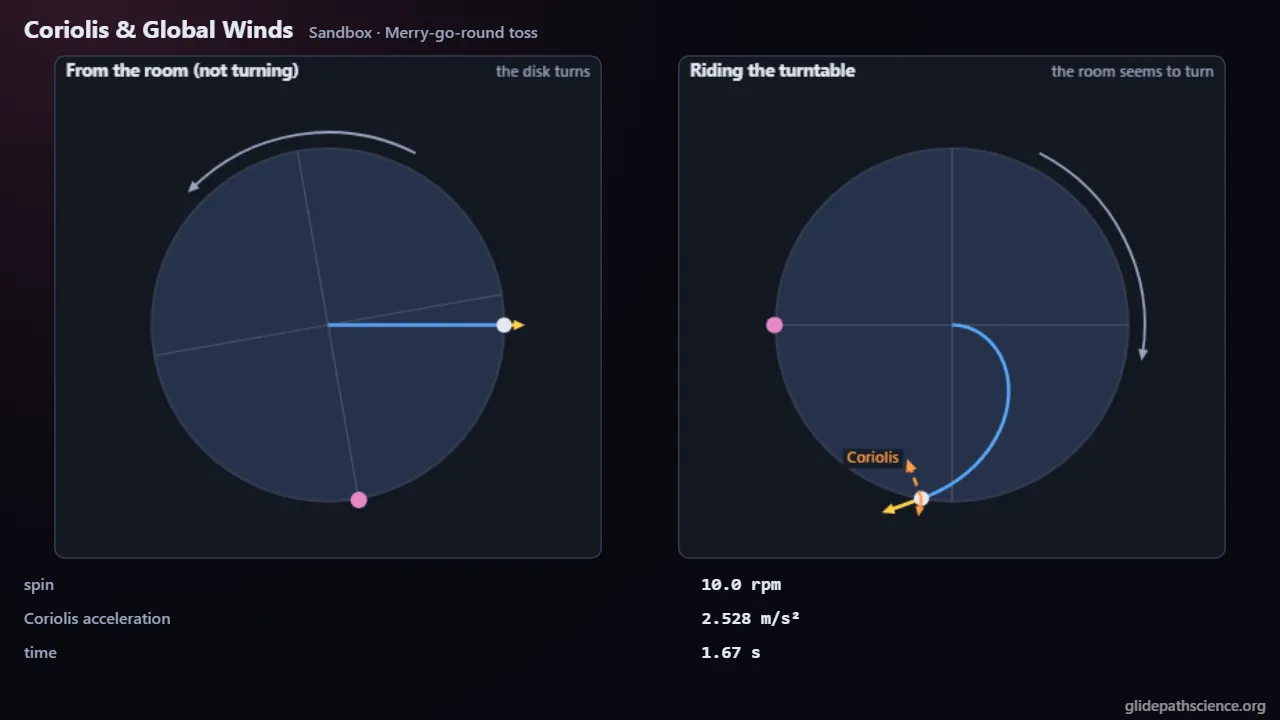
    • A turntable turning at 10 rpm seen side by side from the room, where a puck slides in a straight line, and from the rider’s seat, where its path curves and the Coriolis force is drawn.New

      Coriolis & Global Winds

      Watch a puck from the room and from a spinning turntable, then let air feel a pressure gradient and the Coriolis effect until it blows along the isobars, and see why storms spin.
      • Earth & Atmospheric Science
      • Mechanics
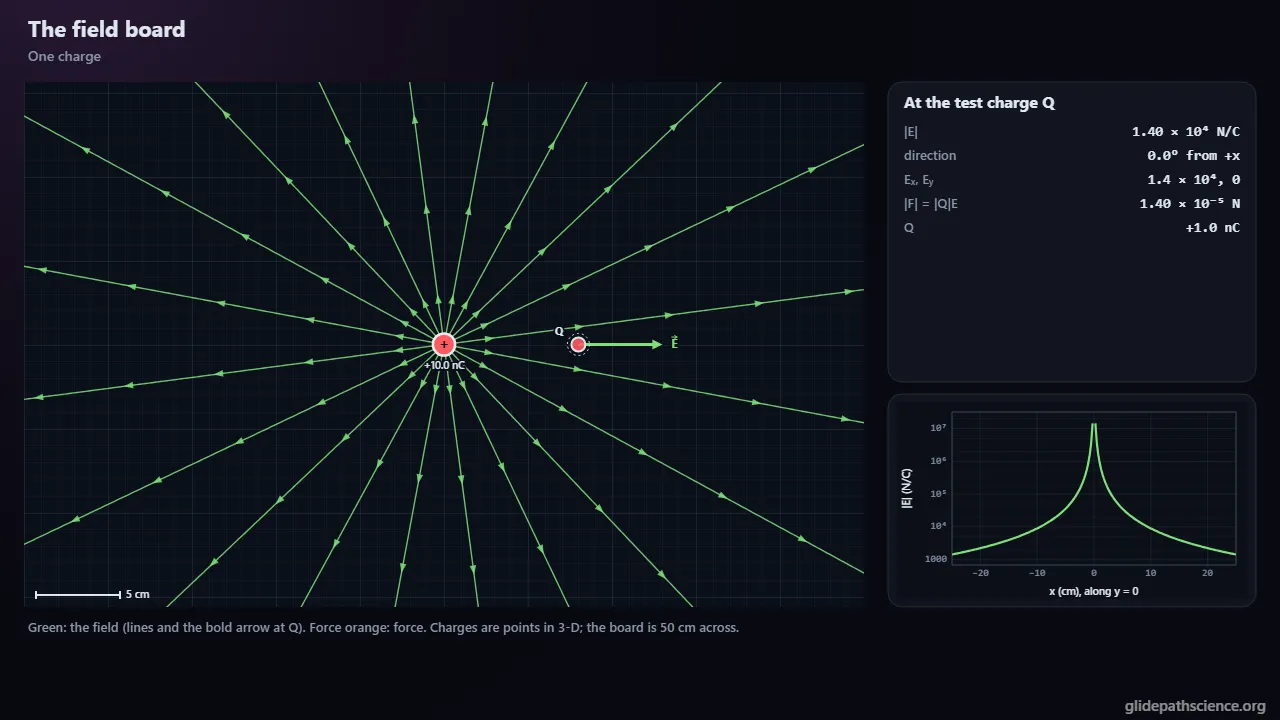
    • Field lines radiating from a +10 nC point charge on a field board, a test charge with its field arrow, readouts of the field and the force on it, and a chart of the field strength along a line through the charge.New

      Coulomb's Law & Electric Fields

      Charge objects by friction, contact, and induction, measure Coulomb’s inverse-square law on a torsion balance, and build electric fields from point charges with vectors, field lines, and a test charge.
      • Electricity & Magnetism
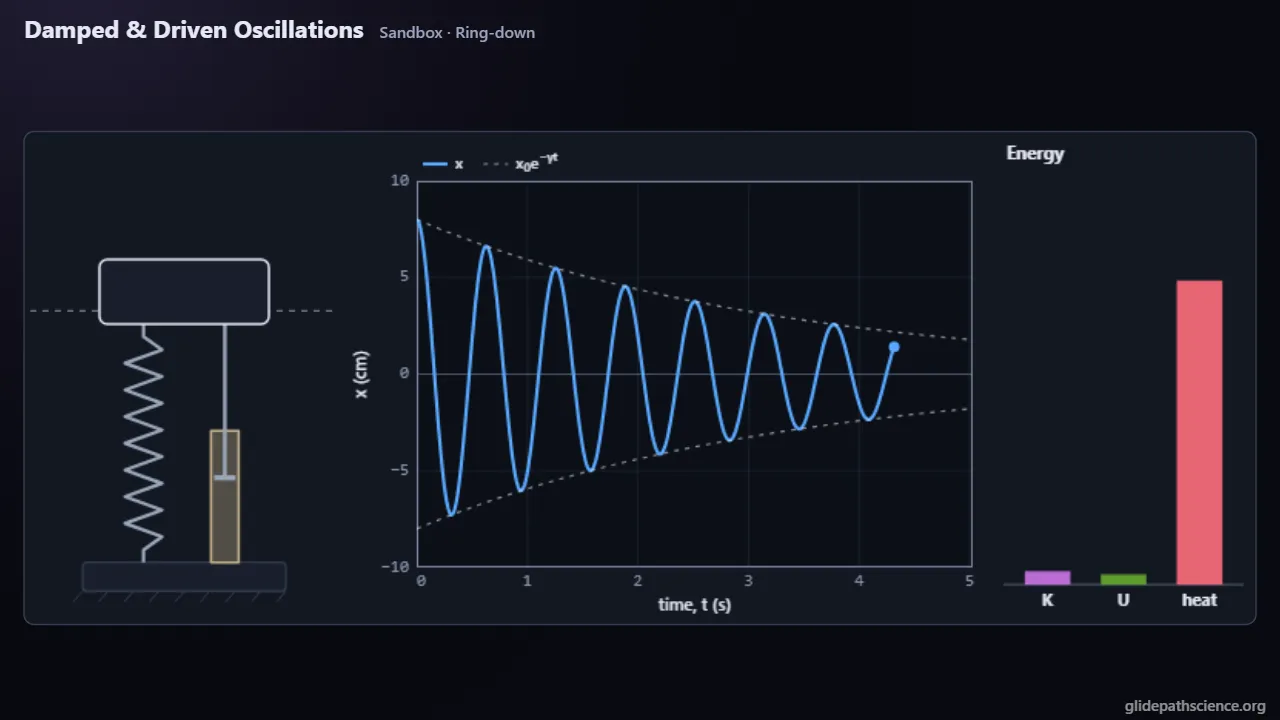
    • A 0.500 kg block on a spring beside a dashpot, a graph of its displacement ringing down inside a dashed exponential envelope at ζ = 0.03, and energy bars for kinetic energy, potential energy and heat.New

      Damped & Driven Oscillations

      Ring down a block and a car’s suspension with light, critical and heavy damping, then drive them through resonance to see the phase, the peak’s height, where the energy goes and how mounts isolate vibration.
      • Mechanics
      • Engineering
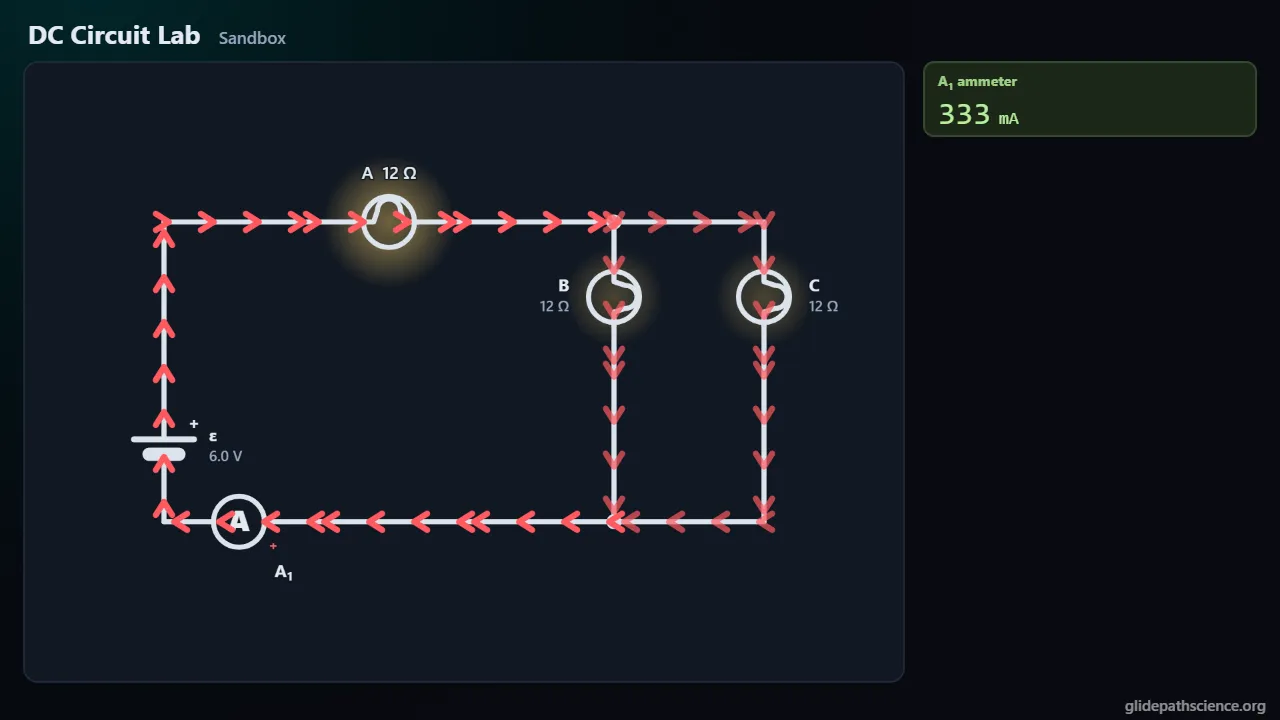
    • A 6.0 V battery lighting bulb A in series with bulbs B and C in parallel, with arrows tracing the current around the circuit and an ammeter reading 333 mA.New

      DC Circuit Lab

      Wire batteries, bulbs, resistors, switches, and meters on a phone-sized grid: current is not used up, a battery holds a voltage, and every meter is part of the circuit. Then a lab bench, a breadboard, and mystery boxes.
      • Electricity & Magnetism
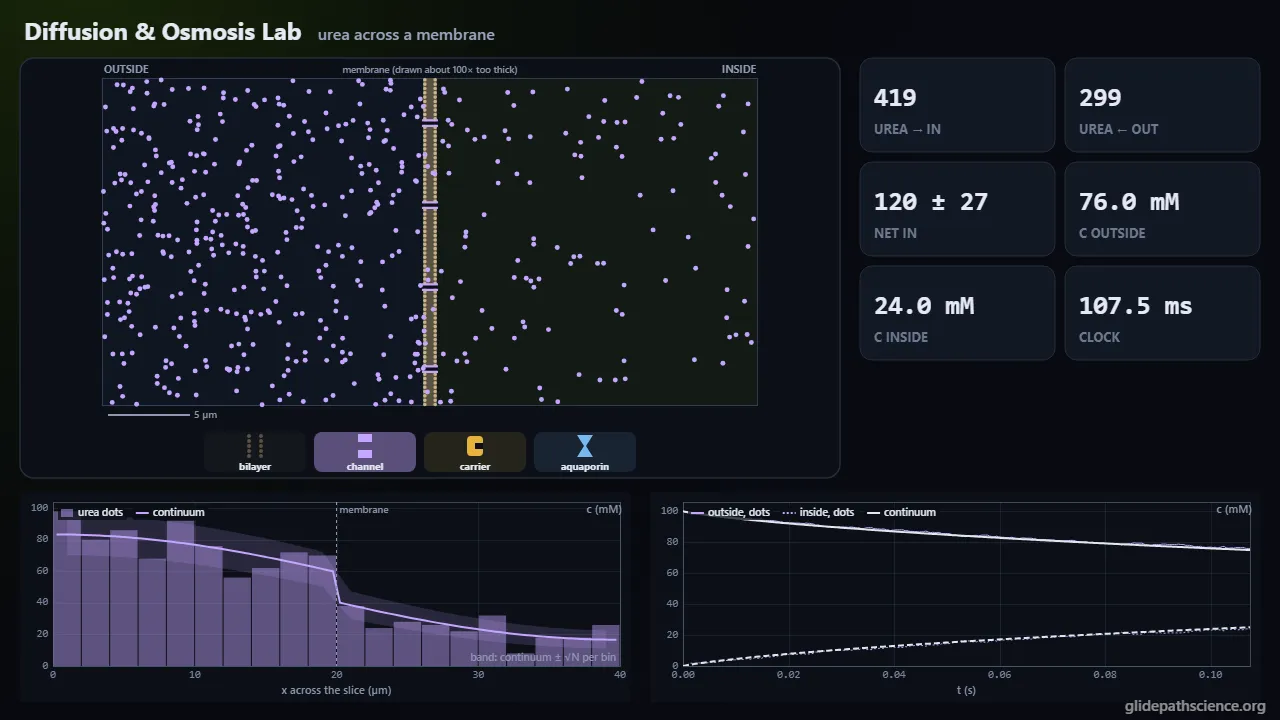
    • Urea molecules crossing a membrane through channels, beside live counts of the crossings and charts of concentration across the slice and over time.New

      Diffusion & Osmosis Lab

      Molecules random-walk across a membrane through the bilayer, channels, carriers and aquaporins. Count crossings both ways, measure diffusion and saturation, and watch cells swell, shrink, burst or push back.
      • Biology
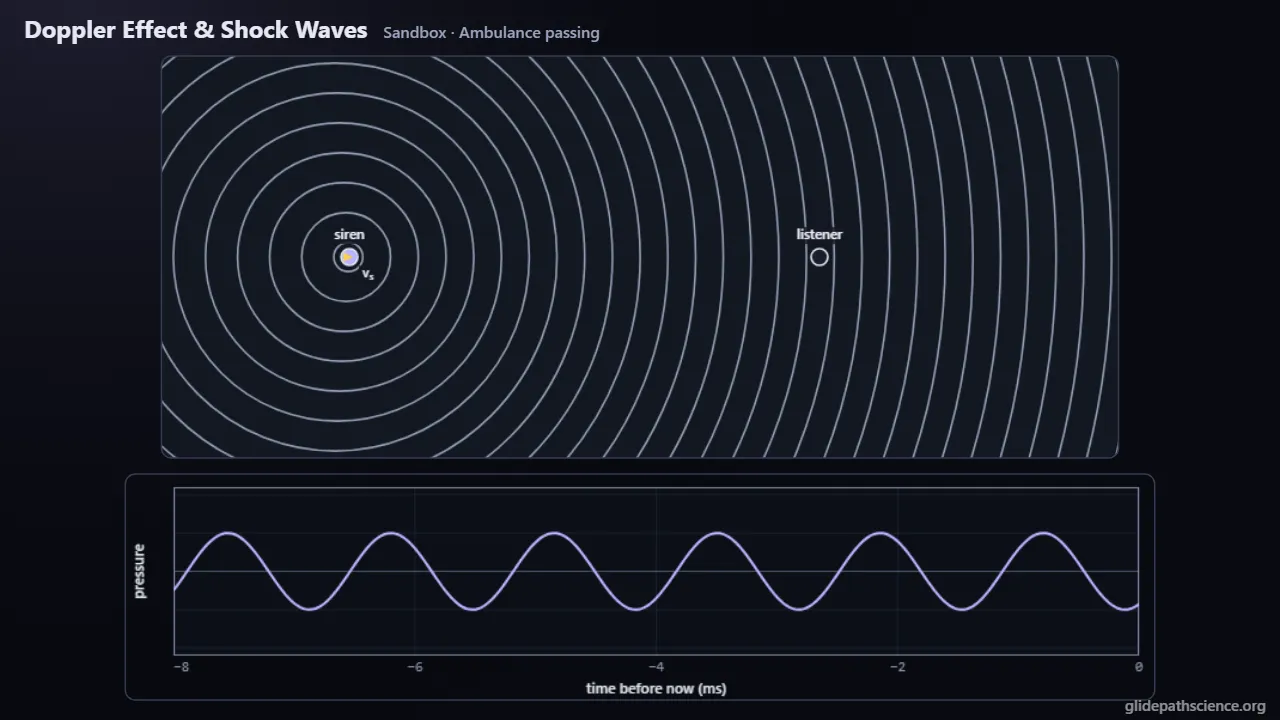
    • A street seen from above with a siren moving toward a listener, its circular wavefronts crowded ahead of it and spread out behind, above a chart of the sound pressure against time.New

      Doppler Effect & Shock Waves

      Drive a siren past a listener and watch its crests bunch ahead and stretch behind, push it past Mach 1 into a shock cone, clock cars with radar, and read a galaxy’s redshift.
      • Waves & Optics
      • Astronomy & Space Science
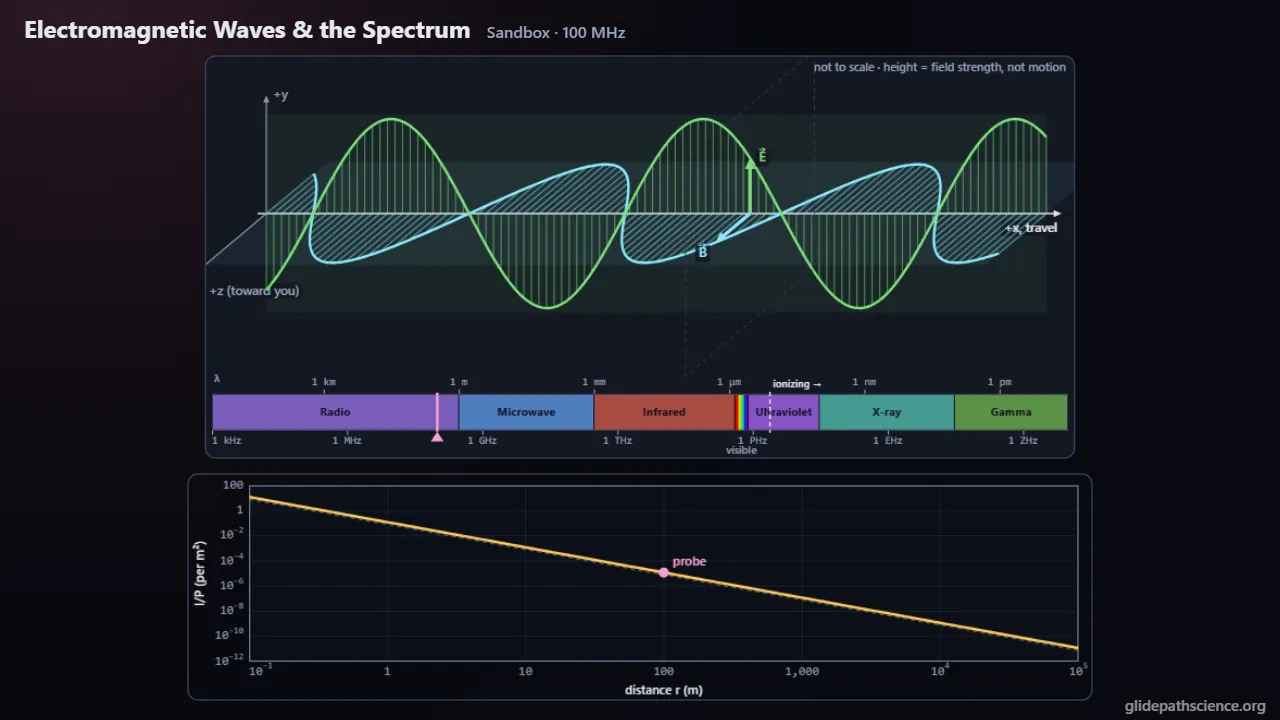
    • A 100 MHz radio wave drawn in three dimensions with its electric field in green and its magnetic field in blue, perpendicular and in step, above a spectrum bar from radio to gamma rays marking where it falls, and a chart of intensity falling with distance.New

      Electromagnetic Waves & the Spectrum

      Jerk a charge and watch the kink in its field race outward, launch waves from an antenna, tune from radio to gamma rays, find where photons ionize, and fly a light sail.
      • Electricity & Magnetism
      • Waves & Optics
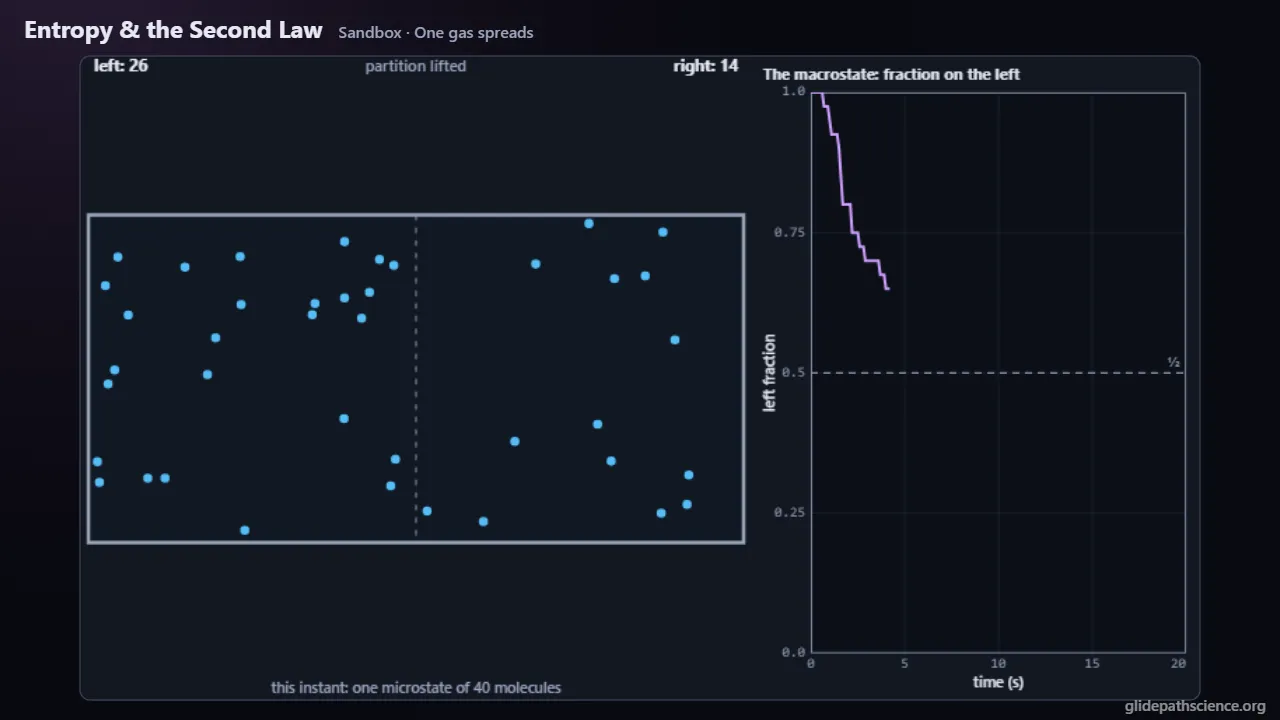
    • A box of 40 molecules seconds after its partition was lifted, most still on the left, beside a chart of the fraction on the left falling from 1 toward one half.New

      Entropy & the Second Law

      Count the ways coins can land and molecules can sit, watch a gas spread and never come back, let two solids share energy until their temperatures match, and stretch a rubber band that warms.
      • Thermal & Modern Physics
      • Chemistry
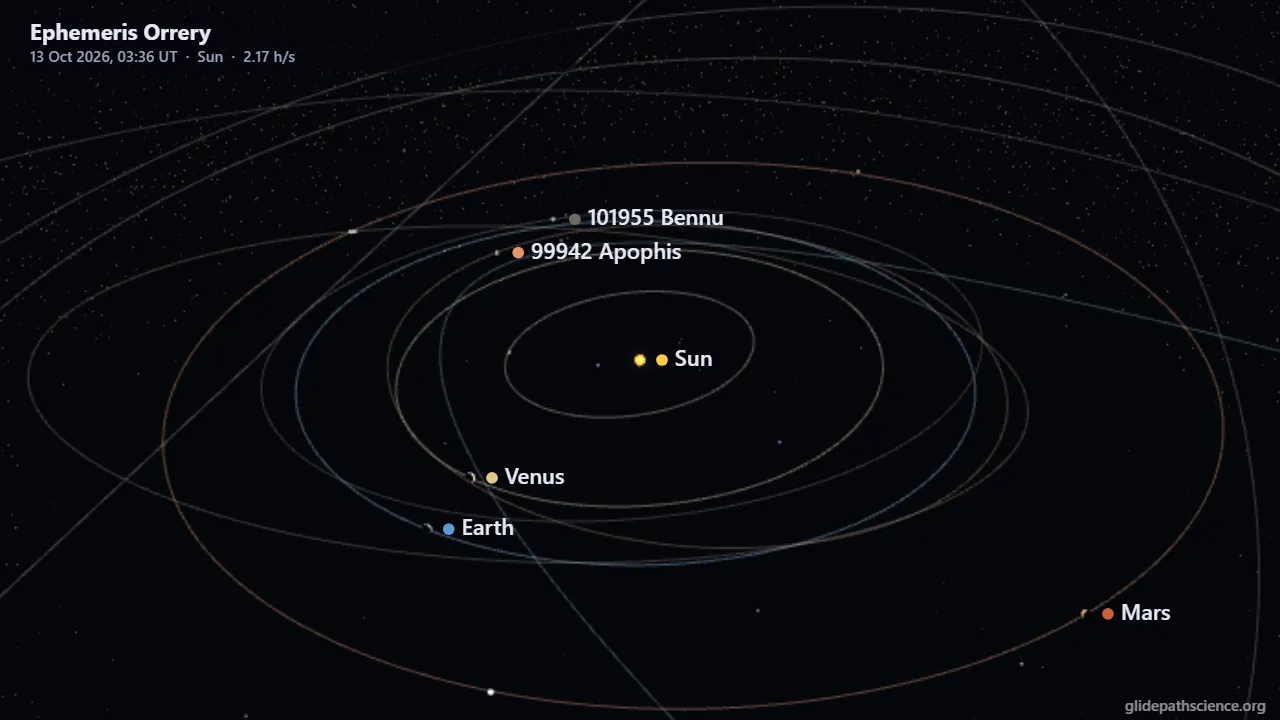
    • The inner solar system seen at an angle: the Sun, Venus, Earth and Mars on their orbits, with the asteroids Apophis and Bennu, against a field of stars.New

      Ephemeris Orrery

      The solar system in its real positions on any date, from space and from Earth's center: tours, eclipses and oppositions, measuring tools, Kepler's laws and predictions.
      • Astronomy & Space Science
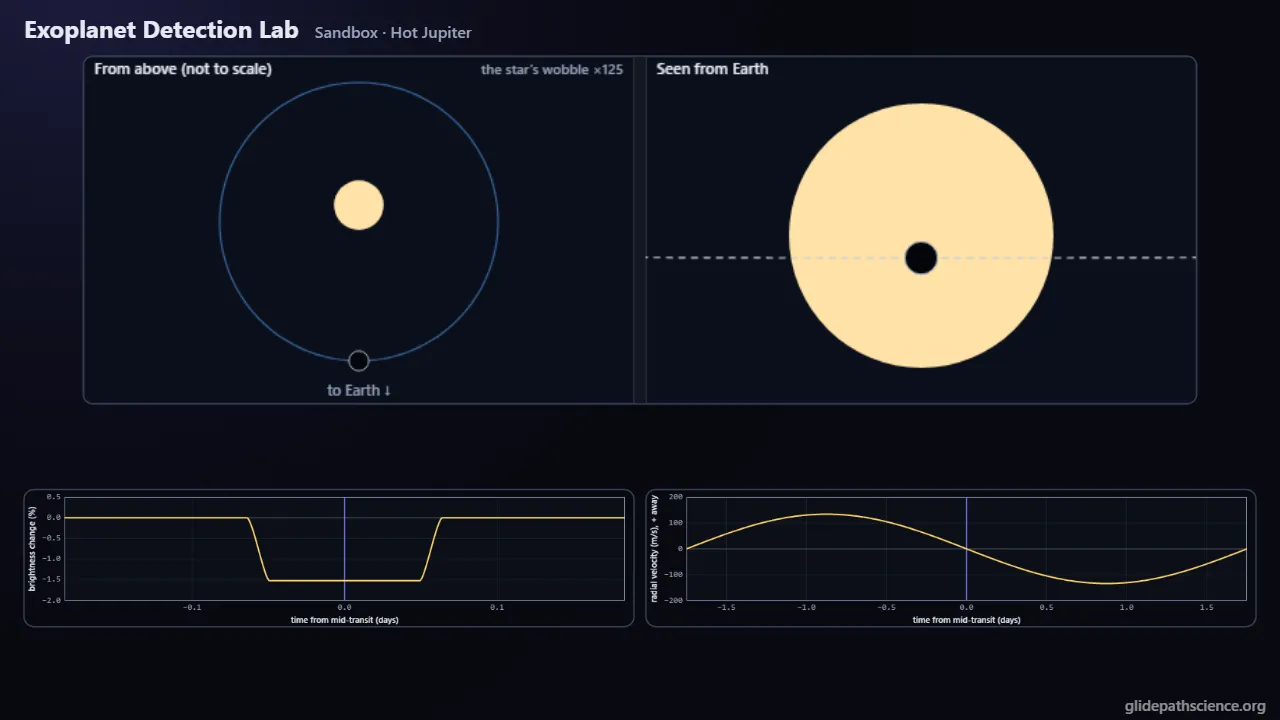
    • A hot Jupiter seen from above on its orbit and in front of its star’s disk, with the light curve dipping 1.5 % at mid-transit and the star’s radial-velocity curve swinging above and below zero on the same clock.New

      Exoplanet Detection Lab

      Watch a planet dim its star and make it wobble, read its size from the transit and its mass from the Doppler shift, fit noisy data, and hunt for planets among eclipsing binaries.
      • Astronomy & Space Science
      • Mechanics
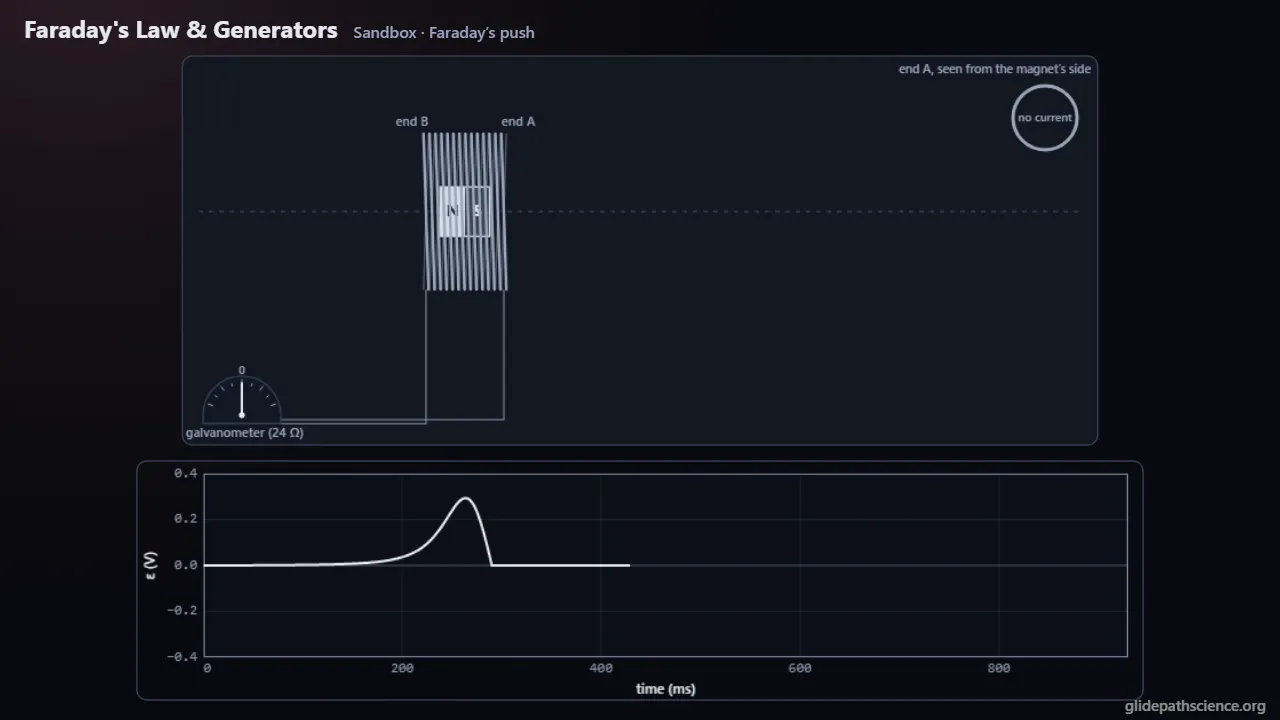
    • A bar magnet that has been pushed into a coil wired to a galvanometer, now at rest inside it with the needle back at zero, above a chart of the EMF against time showing the pulse that rose and fell as the magnet moved in.New

      Faraday's Law & Generators

      Push a magnet through a coil, slide a rod on rails, spin a generator and drop a magnet down a copper pipe: a changing flux drives an EMF that opposes the change.
      • Electricity & Magnetism
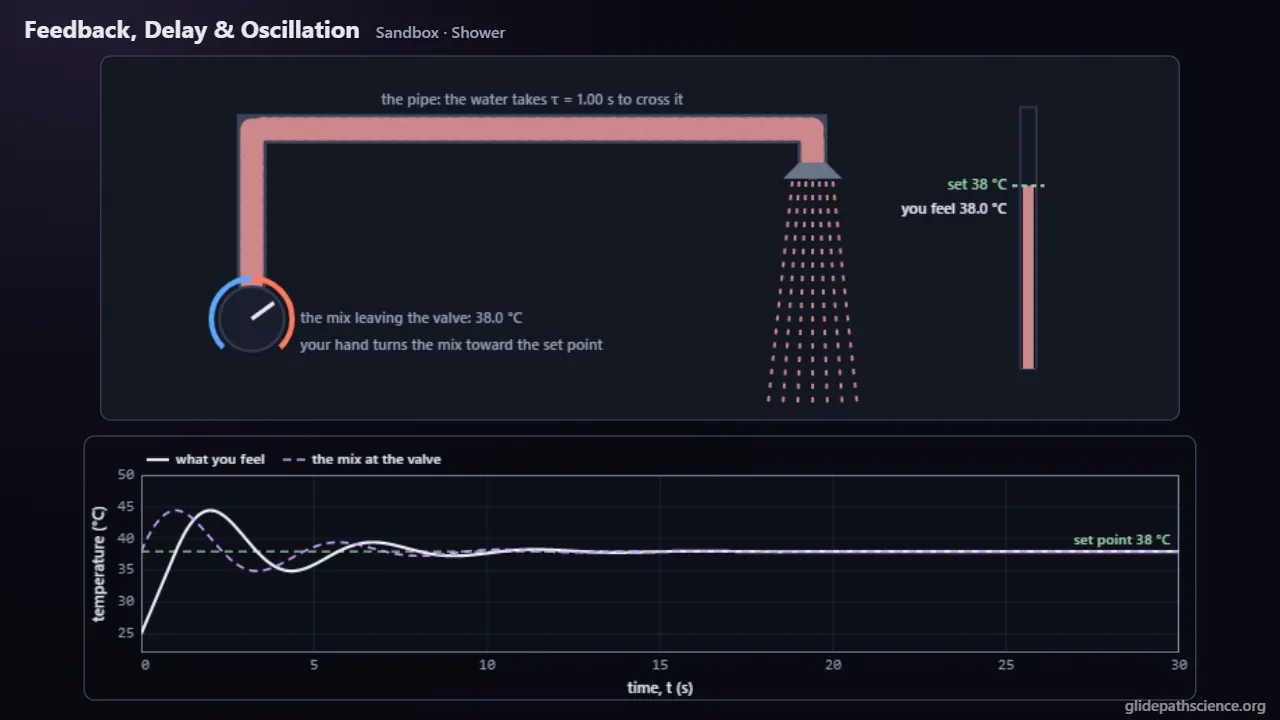
    • A shower whose water takes one second to cross the pipe, with a valve dial and a thermometer at the set point, above a chart of the water temperature overshooting 38 °C and ringing down as the mix at the valve leads it.New

      Feedback, Delay & Oscillation

      Turn a shower’s mix with water that arrives late and see a delayed loop settle, ring or run away past kτ = π/2; then measure your reaction time and balance a stick.
      • Engineering
      • Mathematics
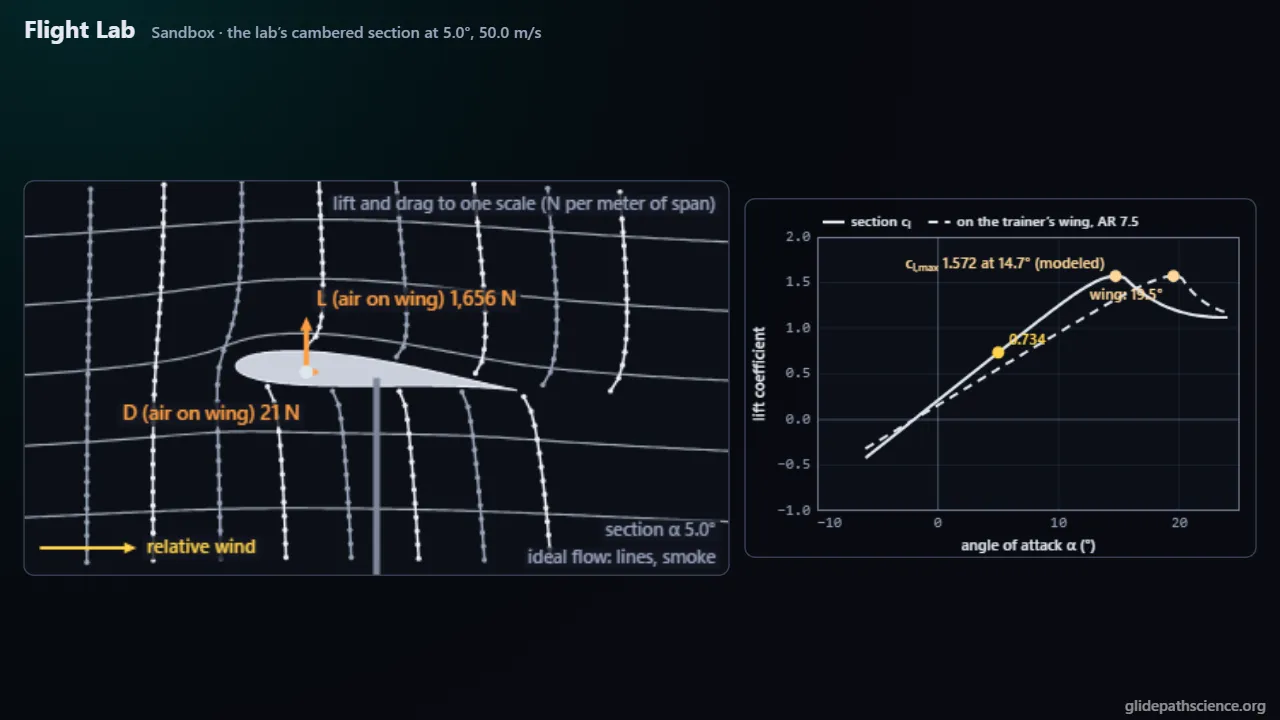
    • The wind tunnel: the lab’s cambered section at 5° in ideal-flow streamlines and smoke lines, with its lift and drag arrows, beside its lift curve against angle of attack, the section stalling near 14.7° and the trainer’s wing near 19.5°.New

      Flight Lab: Lift, Drag & Density Altitude

      Fly a wing through smoke, raise its angle of attack until the flow lets go, find the speed of least drag, and take an illustrative trainer off a hot, high runway: the same indicated airspeed, a much longer roll.
      • Engineering
      • Mechanics
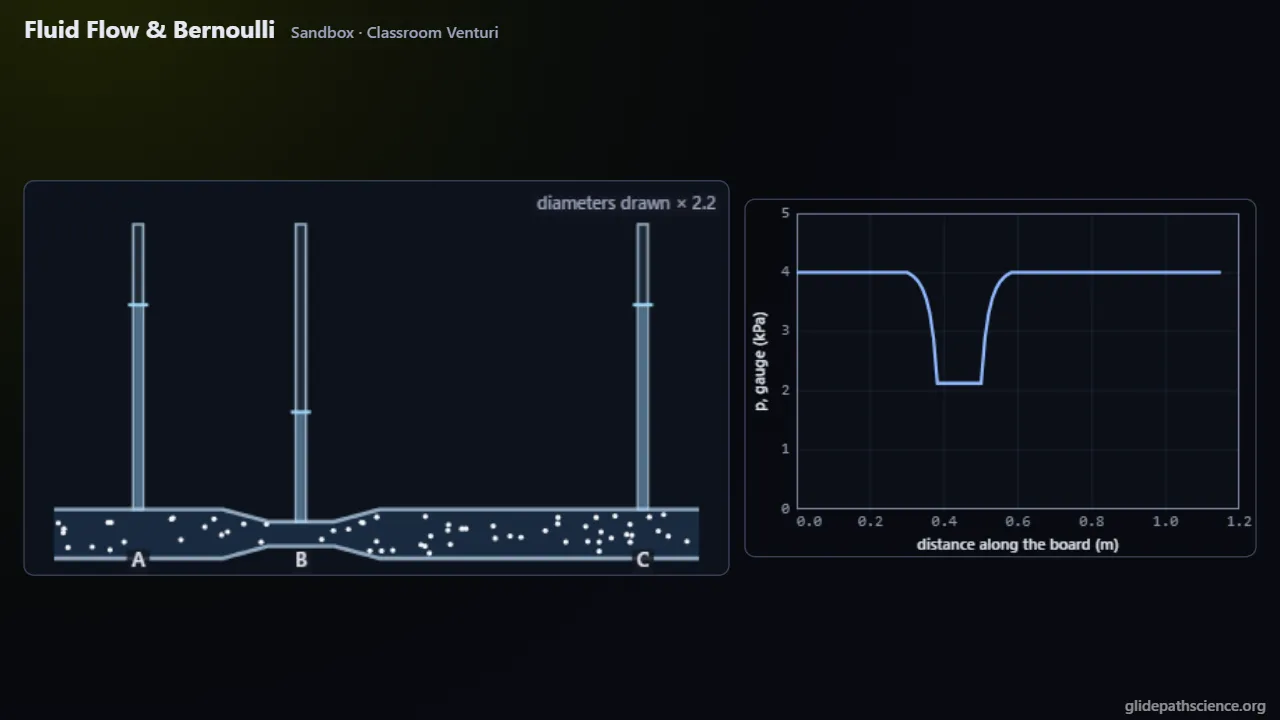
    • A classroom Venturi tube with tracer dots, its middle pressure column lower at the narrow throat, beside a graph of gauge pressure dipping from 4 kPa to about 2 kPa through the throat.New

      Fluid Flow & Bernoulli

      Push water through pipes and constrictions: continuity speeds it up, Bernoulli’s equation lowers its pressure, meters read flow and airspeed, and a narrowed artery costs pressure.
      • Mechanics
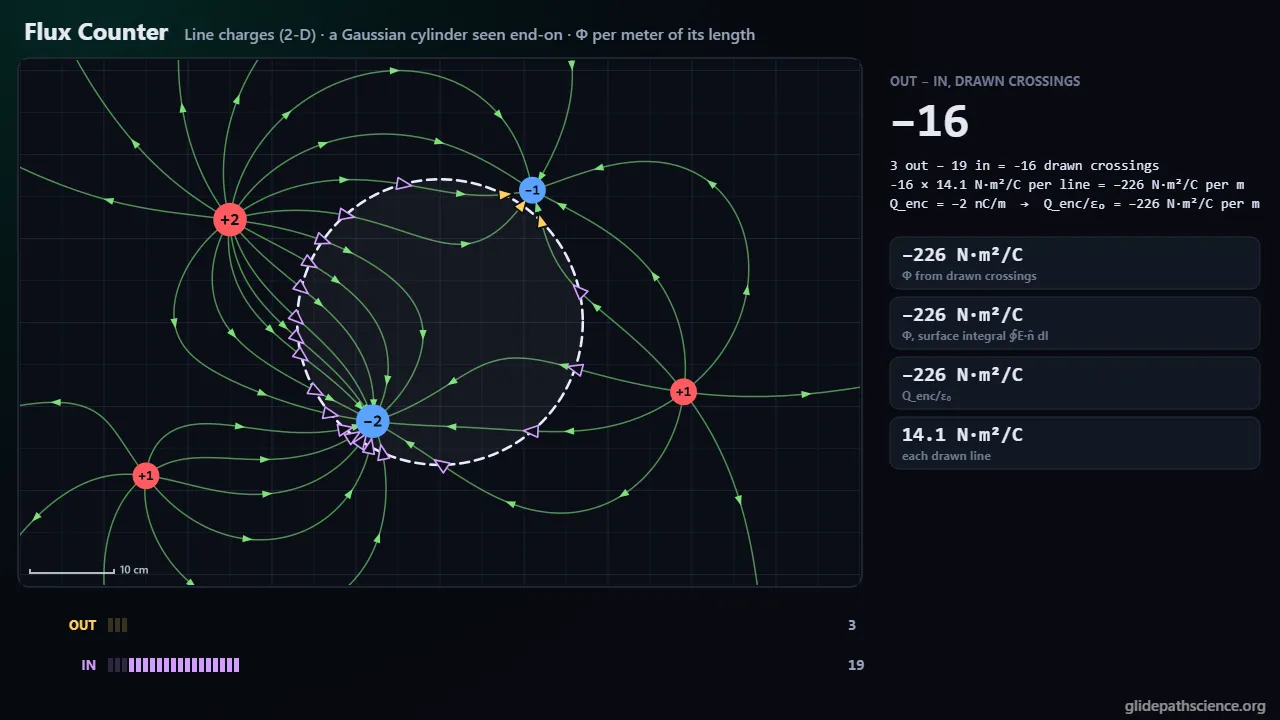
    • Field lines from four line charges crossing a dashed Gaussian surface, with the out-minus-in line count and the flux worked out three ways.New

      Flux Counter

      Count field lines through a closed surface you drag, then turn the count into Gauss’s law: flux, enclosed charge, and the fields of spheres, lines, sheets, and conductors.
      • Electricity & Magnetism
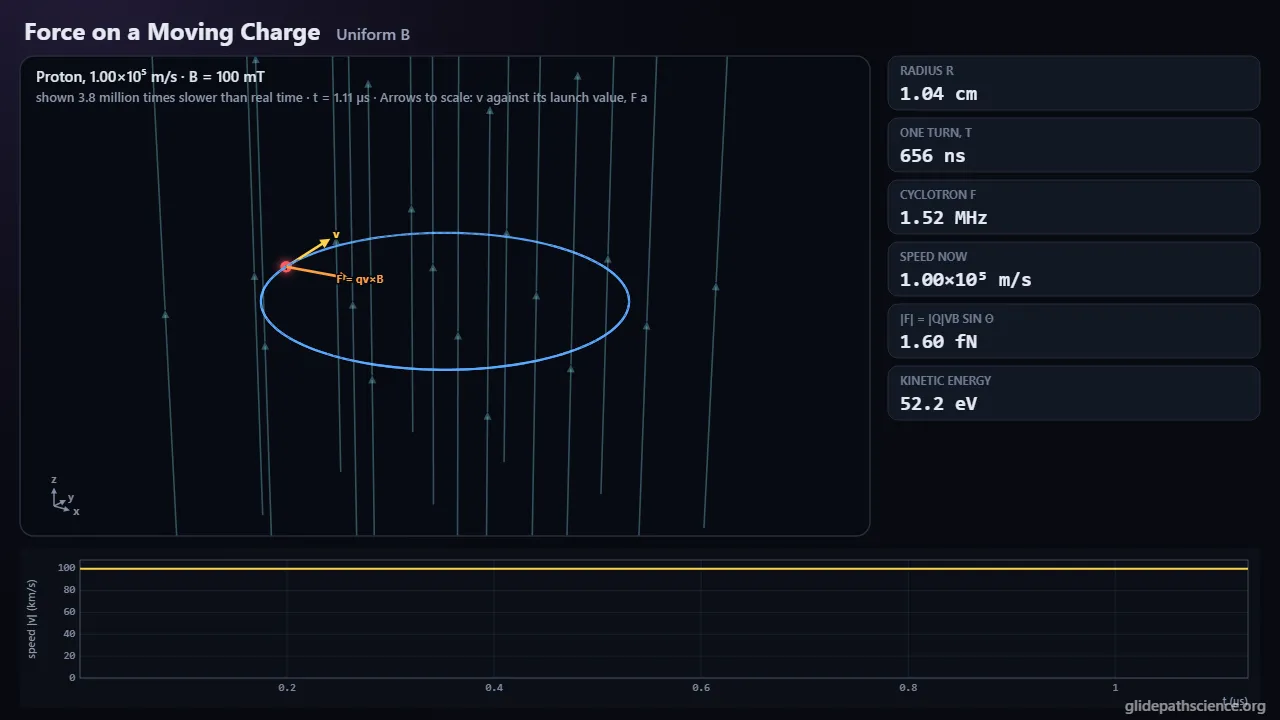
    • A proton circling in a uniform magnetic field, with its velocity and force arrows and readouts of radius, period, and energy.New

      Force on a Moving Charge

      Steer protons, electrons, and ions through magnetic and crossed electric fields in 3-D: circles, helices, a velocity selector, a mass spectrometer, a cyclotron, and an e/m measurement.
      • Electricity & Magnetism
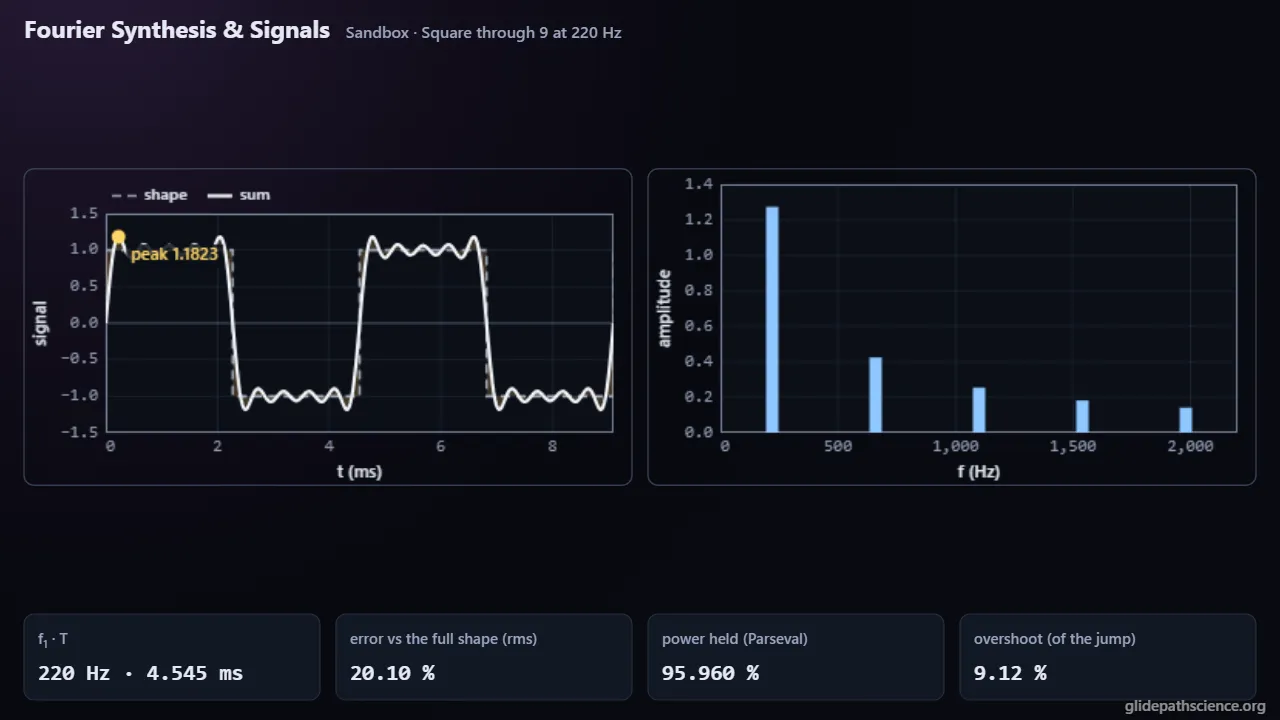
    • A square wave summed through its ninth harmonic at 220 Hz, rippling around the dashed square with its overshoot beside each jump marked, next to its spectrum of odd harmonics falling as 1/n.New

      Fourier Synthesis & Signals

      Build any periodic wave from sine waves and hear it: harmonics and timbre, phase, beats, filters, and a spectrum analyzer that shows bins, leakage and aliasing.
      • Mathematics
      • Waves & Optics
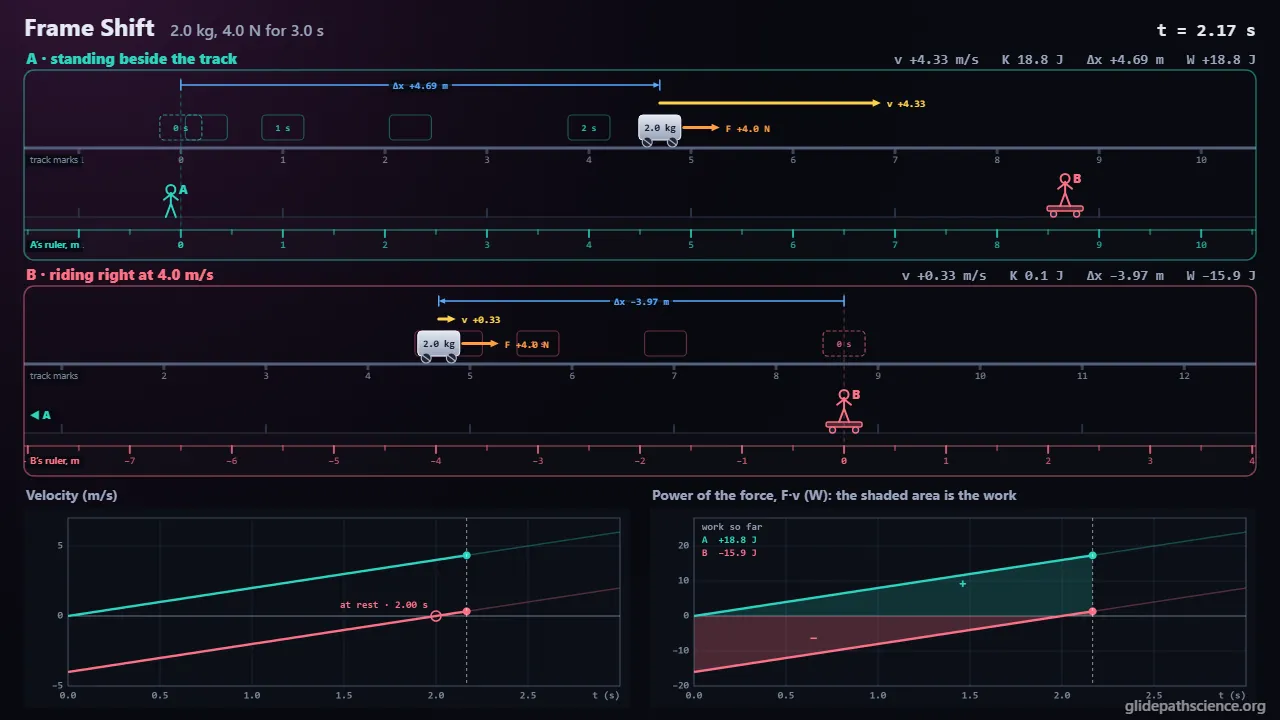
    • The same pushed cart seen by an observer beside the track and by one riding along, with velocity and power charts for both.New

      Frame Shift

      One cart, one push, two observers: see why velocity, displacement, kinetic energy, and work depend on the frame, while the work-energy theorem holds for every inertial observer.
      • Mechanics
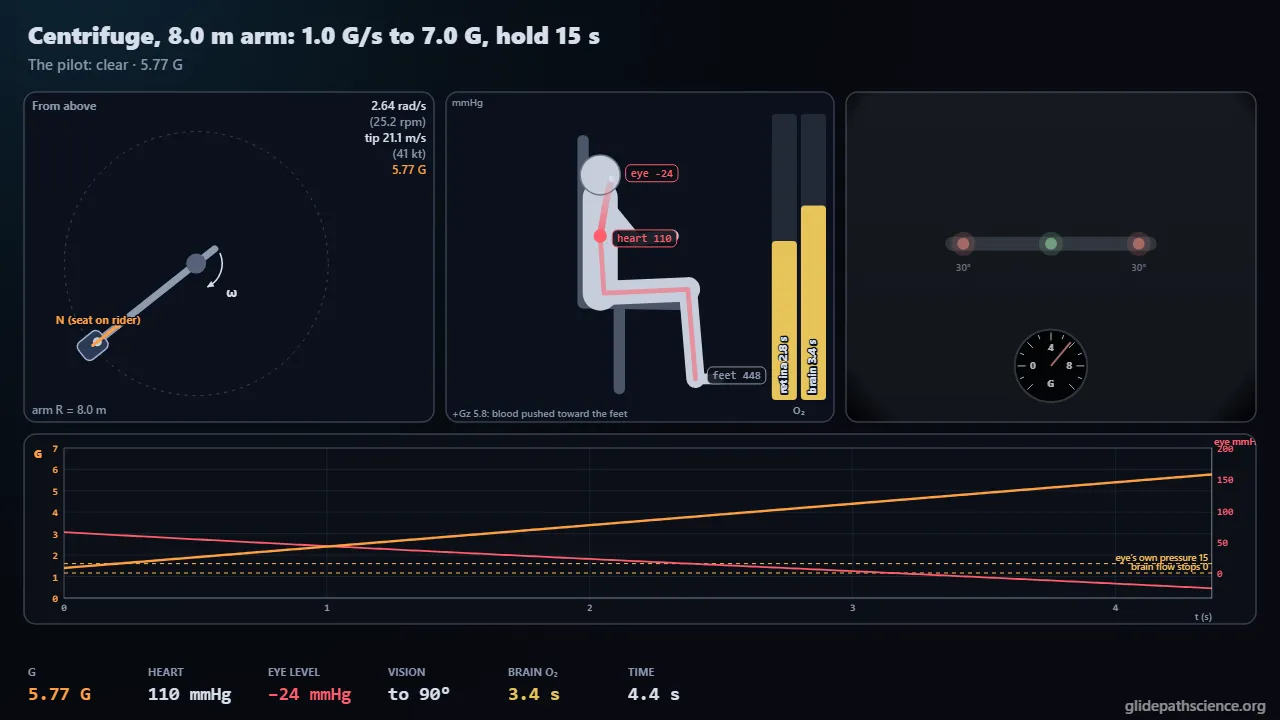
    • A centrifuge seen from above beside a seated pilot’s blood column with eye, heart, and feet pressures, oxygen-reserve bars, the pilot’s light bar and G meter, and a chart of G rising and eye-level pressure falling during a pull to 7 G.New

      G-Force & G-LOC Centrifuge

      Spin a pilot in a centrifuge or fly a tight turn: the G from bank, speed, and radius; the blood pressure left at eye level; gray-out, blackout, and G-LOC in order; and what a G-suit, straining, and a reclined seat add.
      • Biology
      • Mechanics
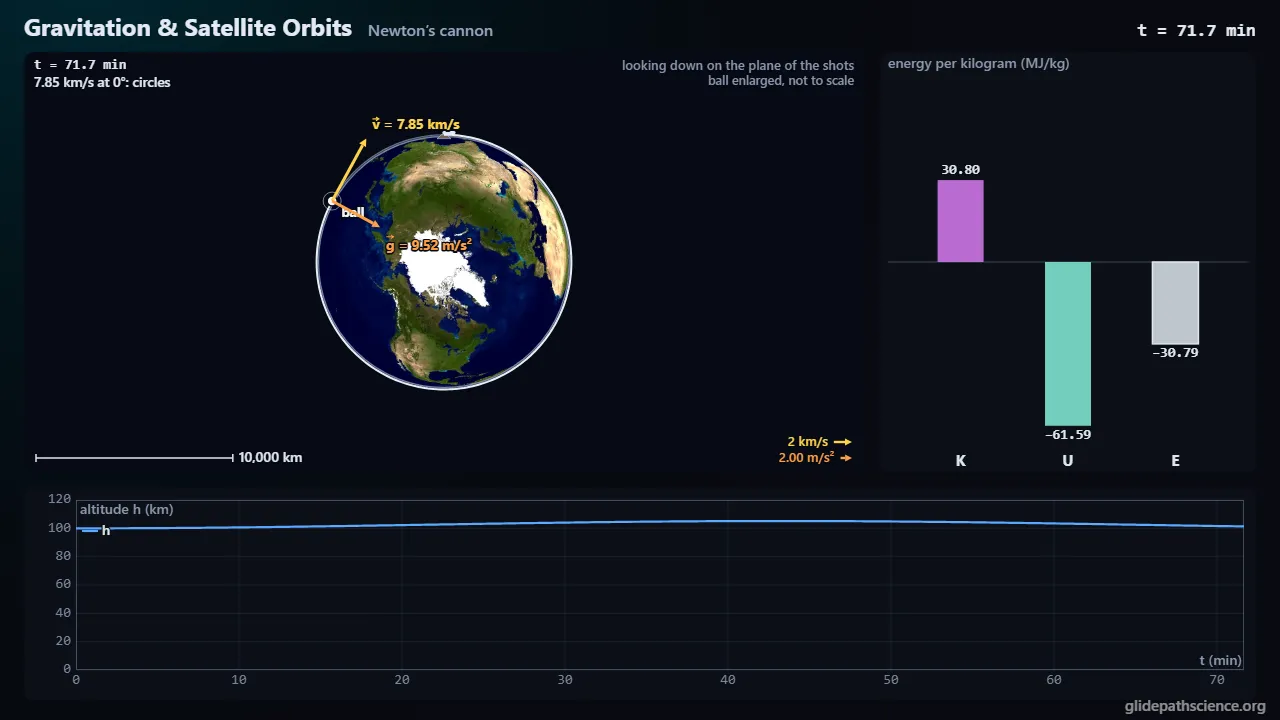
    • Newton’s cannon: a ball fired at 7.85 km/s falling around the Earth, seen from above its orbit, with its velocity and g = 9.52 m/s² arrows, energy bars and its altitude holding near 100 km for 72 minutes.New

      Gravitation & Satellite Orbits

      Fire Newton’s cannon faster and faster until the ball falls around the Earth: g with height and depth, orbital speed and period, geostationary orbits, escape, ellipses, Hohmann transfers, and G from a torsion balance.
      • Mechanics
      • Astronomy & Space Science
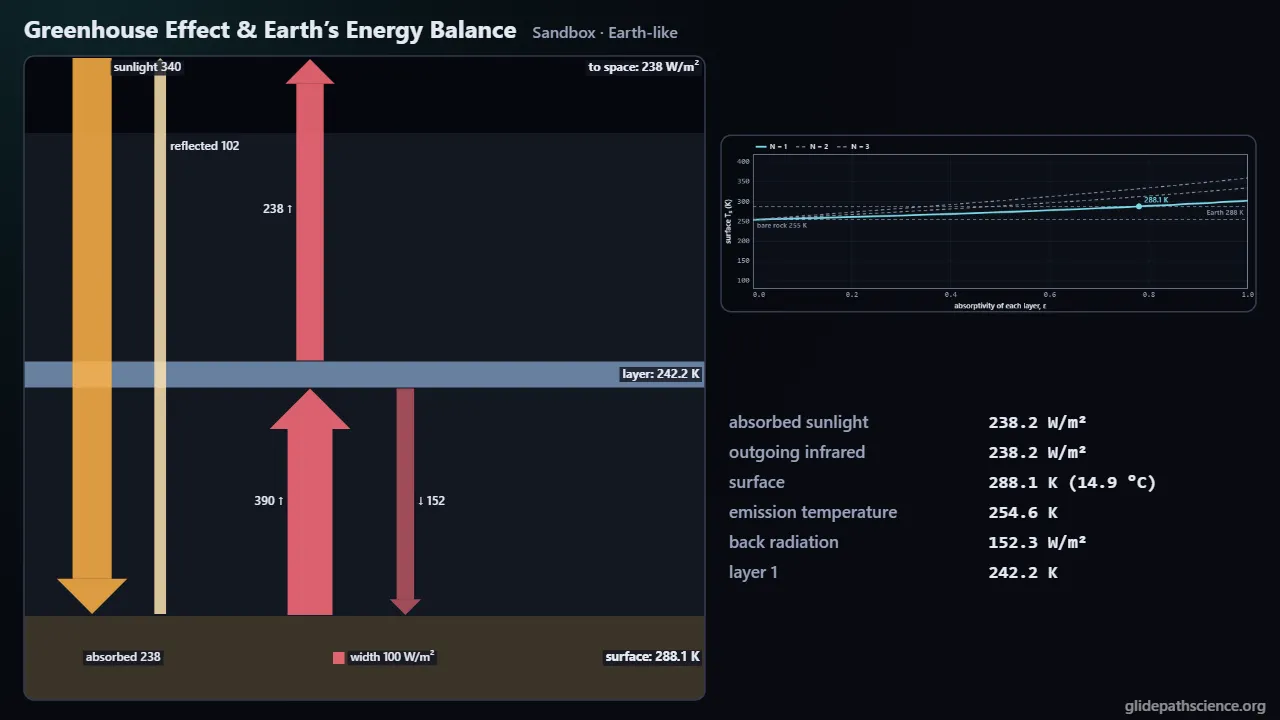
    • A column of atmosphere with one leaky layer, drawn with arrows as wide as their watts: sunlight in and reflected, the surface’s infrared rising, the layer radiating up to space and back down, and the surface in balance at 288 K.New

      Greenhouse Effect & Earth’s Energy Balance

      Balance the sunlight a planet absorbs against the infrared it radiates, then add albedo and layers that absorb infrared and watch the surface settle warmer, from bare rock at 255 K to Earth’s 288 K.
      • Earth & Atmospheric Science
      • Thermal & Modern Physics
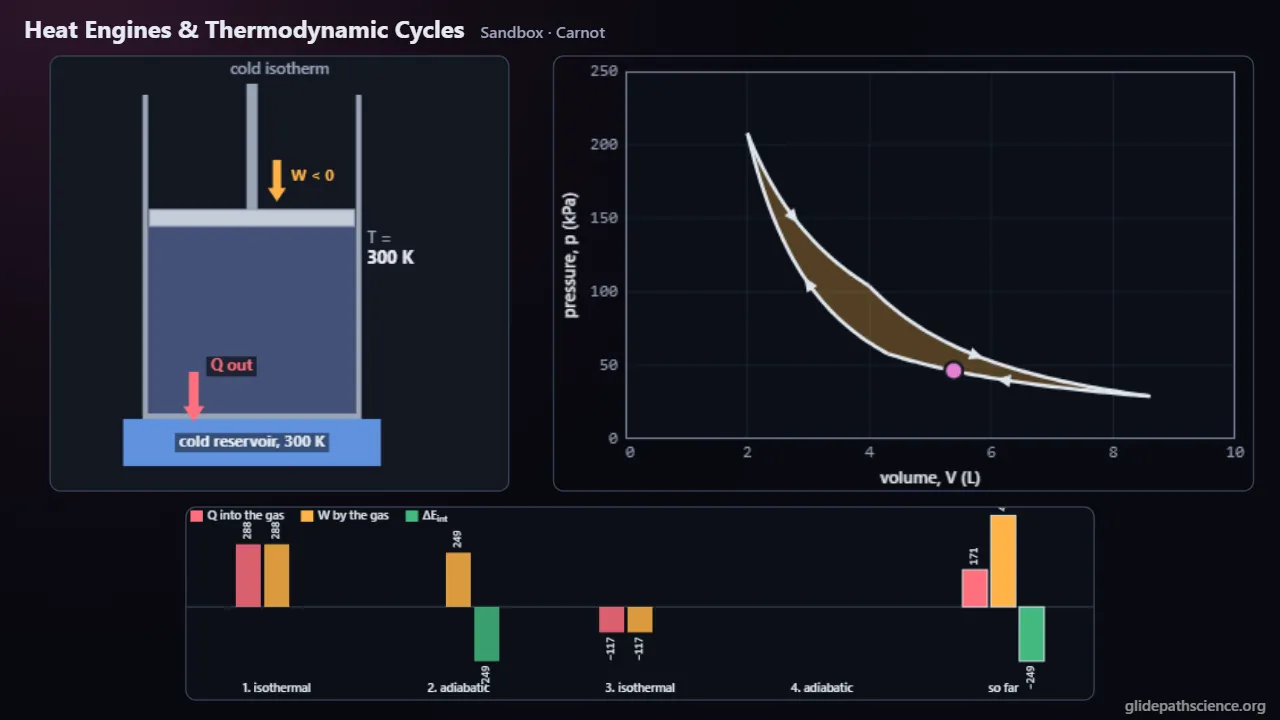
    • A helium Carnot cycle between 500 K and 300 K drawn as a clockwise loop on a pV diagram, beside a piston on the 300 K cold reservoir during its isothermal compression, and bar charts of heat, work and internal energy for each leg.New

      Heat Engines & Thermodynamic Cycles

      Drive a gas around loops on a pV diagram and keep its books leg by leg, then build Carnot, Otto, Diesel, Brayton and Stirling engines and run them backward as refrigerators and heat pumps.
      • Thermal & Modern Physics
      • Engineering
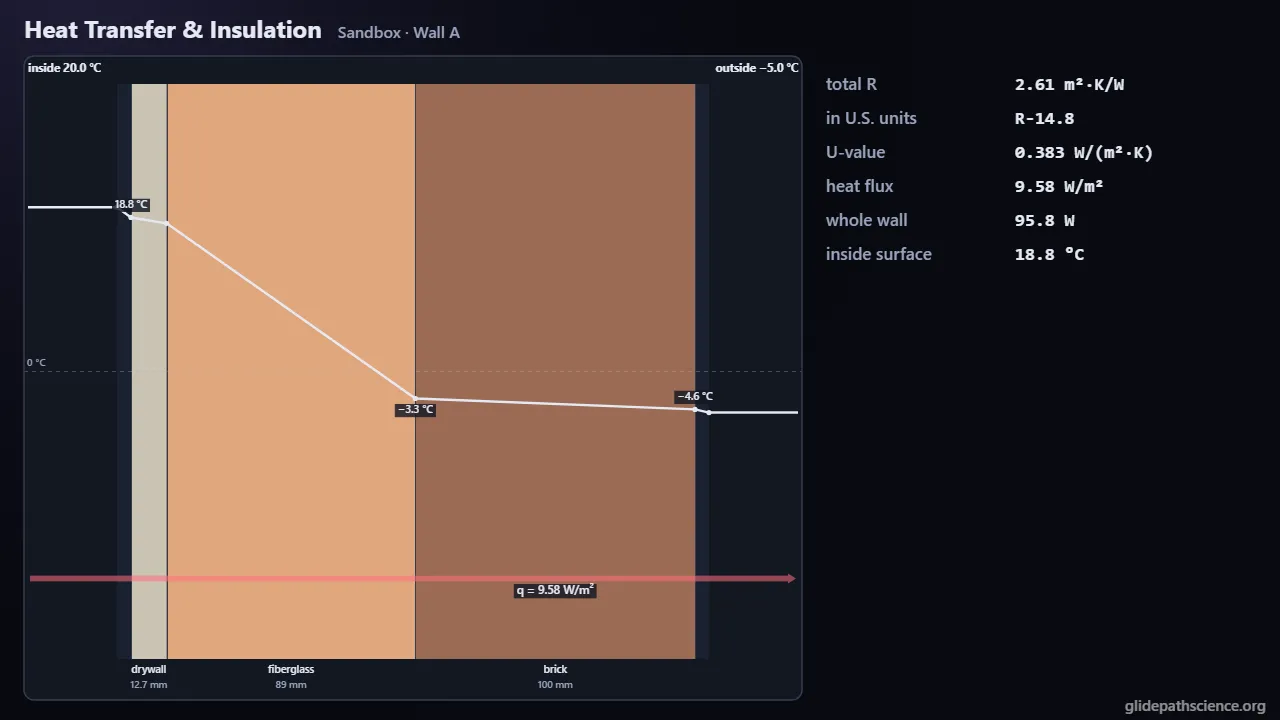
    • A three-layer wall of drywall, fiberglass and brick between a 20.0 °C room and −5.0 °C outdoors, with the temperature profile falling steeply across the fiberglass and the heat flux of 9.58 W/m² marked.New

      Heat Transfer & Insulation

      Stack a wall’s layers, choose a window’s panes and gas, and take a vacuum flask apart to see how conduction, convection and radiation carry heat from hot to cold, and how insulation slows it.
      • Thermal & Modern Physics
      • Engineering
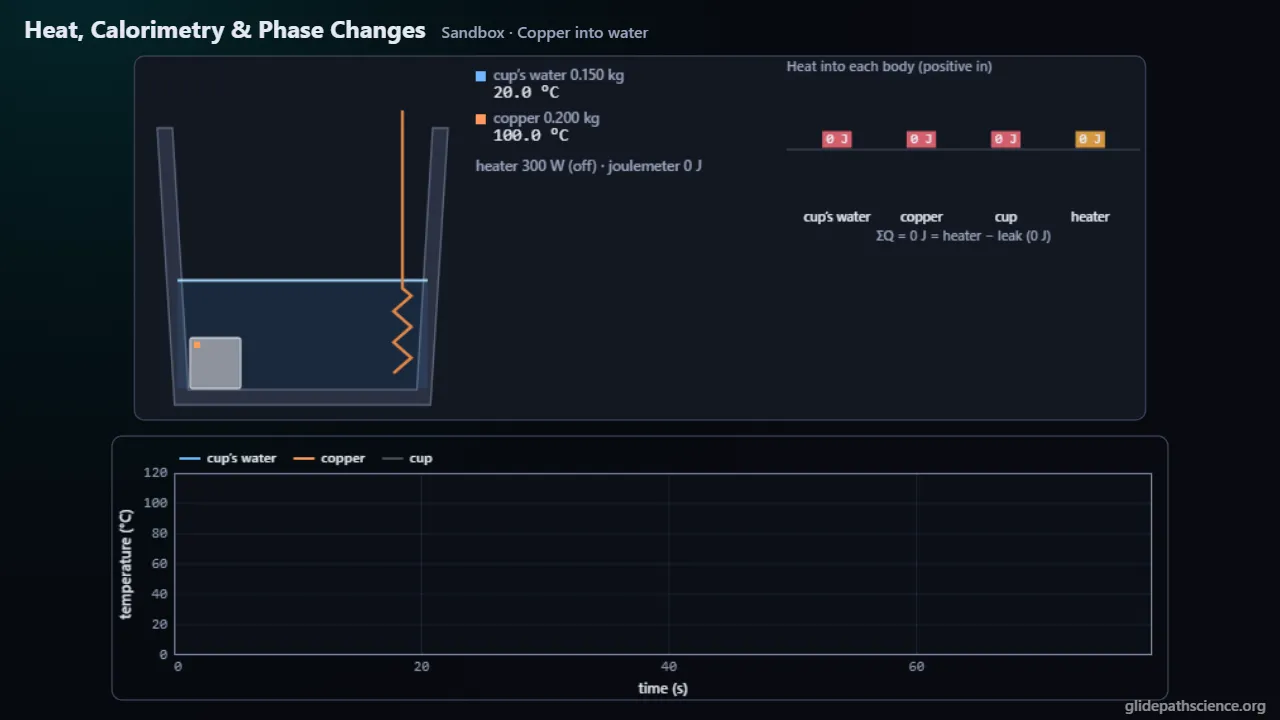
    • An insulated cup holding 0.150 kg of water at 20 °C with a 0.200 kg copper block at 100 °C just dropped in and a heater switched off, bars for the heat into each body, and an empty chart of temperature against time.New

      Heat, Calorimetry & Phase Changes

      Drop hot metals into a calorimeter to find specific heats, take ice to steam along a heating curve, and see why evaporation cools, what sets the dew point and why humid air feels hotter.
      • Thermal & Modern Physics
      • Chemistry
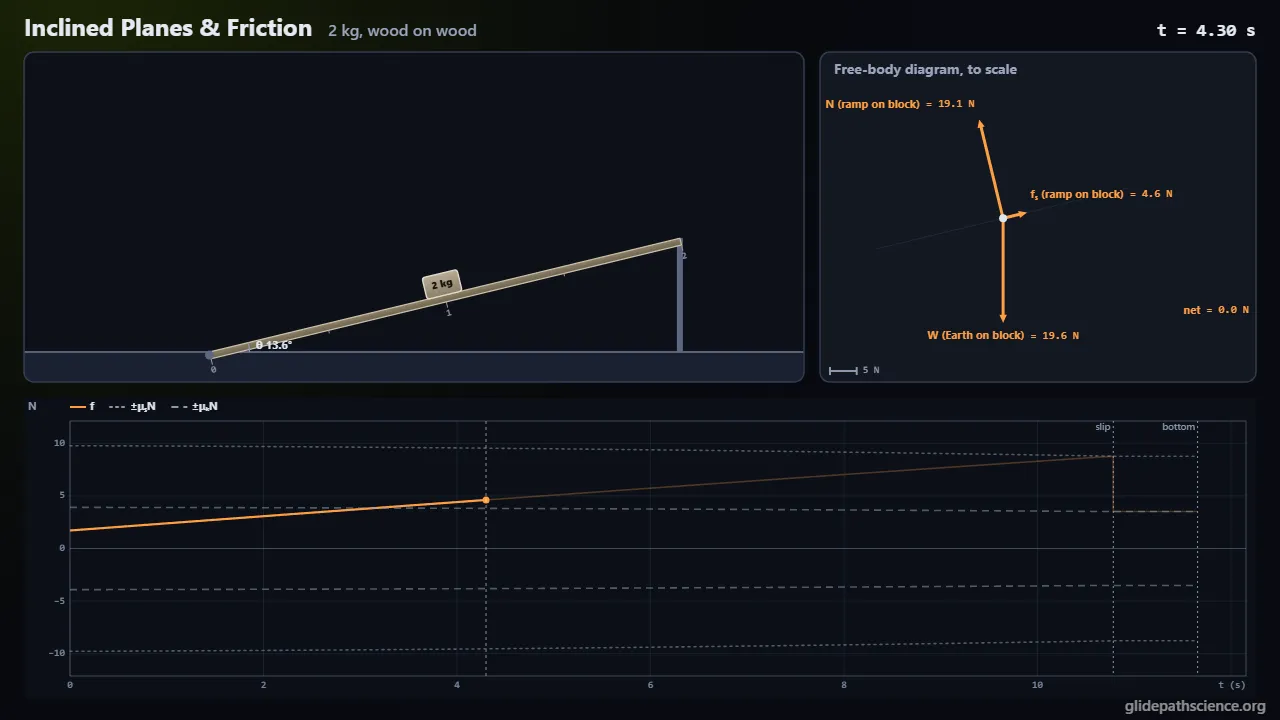
    • A 2 kg block on a wooden ramp with its force diagram (weight, the normal force, and static friction holding it), above a chart of friction against time up to the slip.New

      Inclined Planes & Friction

      Tilt a ramp until the block lets go: static and kinetic friction, the slipping angle, pushes up and down the slope, a ramp that just holds, stick-slip and rolling, all from one exact engine.
      • Mechanics
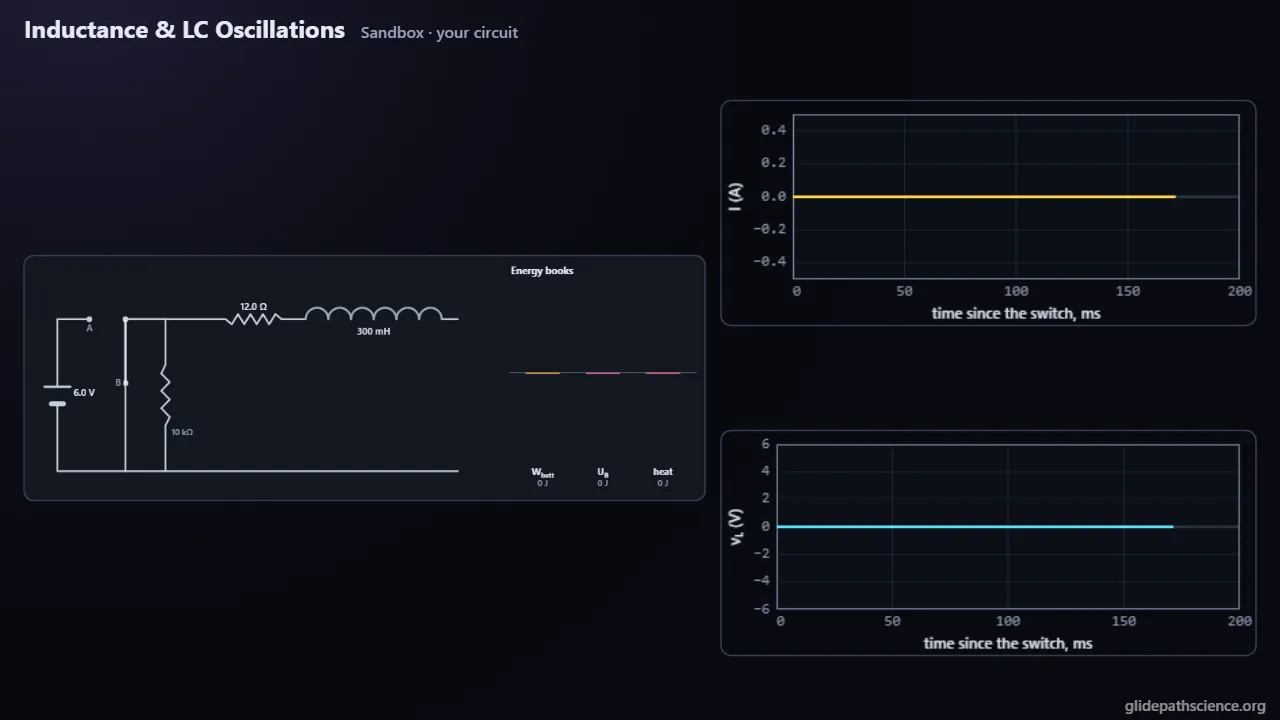
    • A circuit of a 6.0 V battery, a two-way switch, a 12 Ω resistor, a 300 mH coil and a 10 kΩ bleeder, above a two-channel scope for the coil’s current and voltage and bars for the energy books.New

      Inductance & LC Oscillations

      Switch a coil on and off to see its current rise slowly and its voltage kick, then trade its magnetic energy with a capacitor in an LC circuit that rings like a spring.
      • Electricity & Magnetism
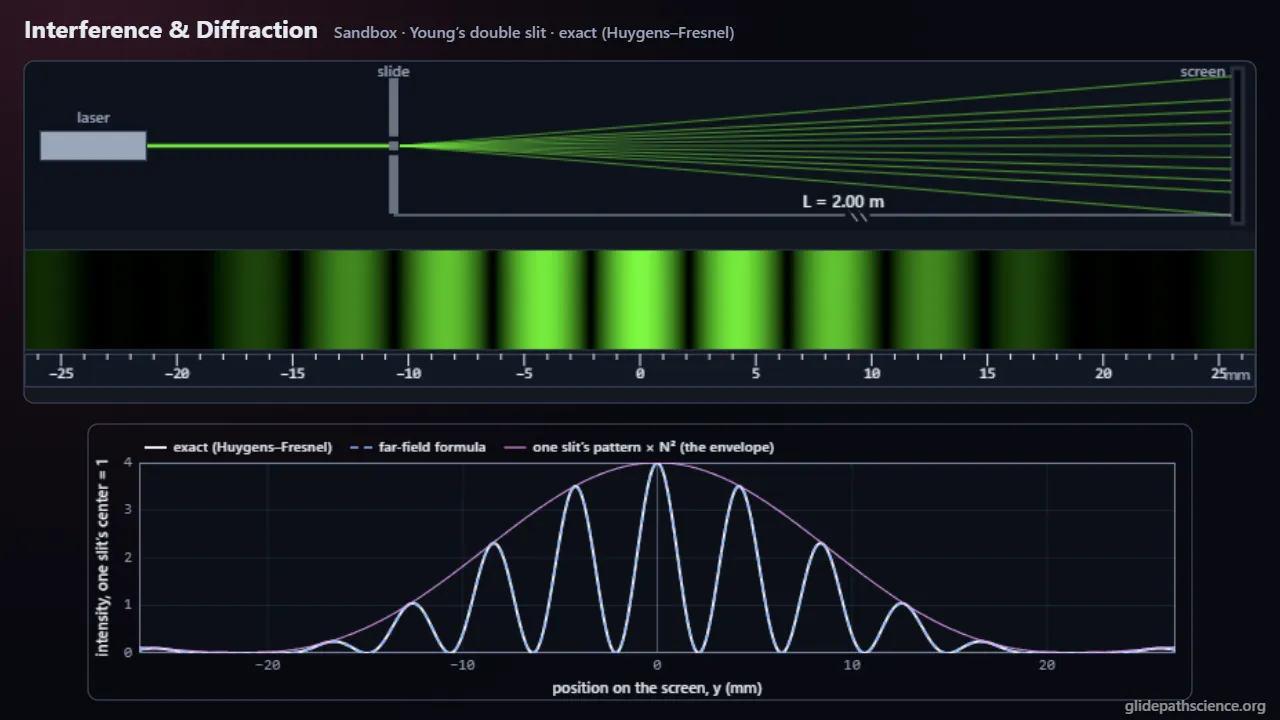
    • Young’s double slit in green laser light: the beams fanning from the slide to a screen 2.00 m away, bright and dark fringes on the screen, and the intensity curve under them, the exact Huygens–Fresnel sum on the far-field formula inside the one-slit envelope.New

      Interference & Diffraction

      Shine a laser through slits, gratings and holes and watch light add to darkness: Young’s fringes as a ruler for light, missing orders, soap films and lens coatings, and the Rayleigh limit of every instrument.
      • Waves & Optics
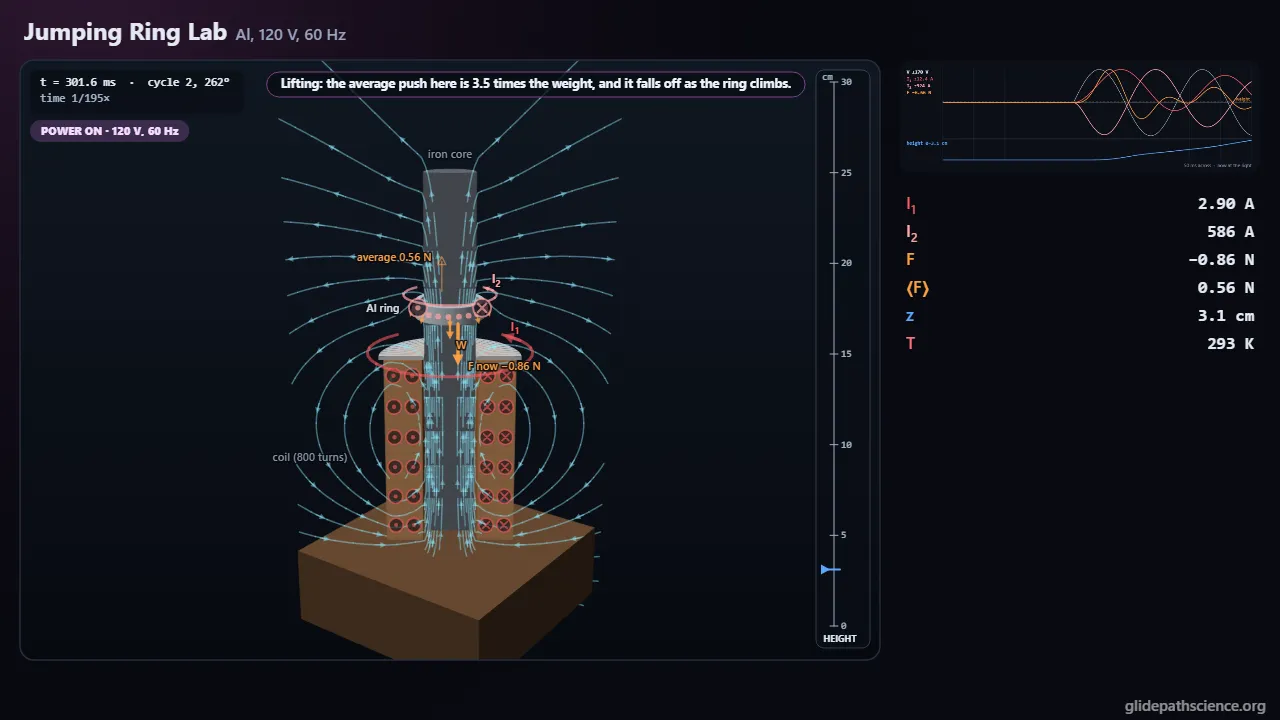
    • An aluminum ring lifting off an iron rod above a powered coil, with the magnetic field lines, the coil and ring currents marked, the push on the ring, and live readouts of the currents, force and height.New

      Jumping Ring Lab

      Close a switch and an aluminum ring leaps off an iron rod: see the flux, the induced current, the flared field that pushes the ring and the phase lag that makes the push add up.
      • Electricity & Magnetism
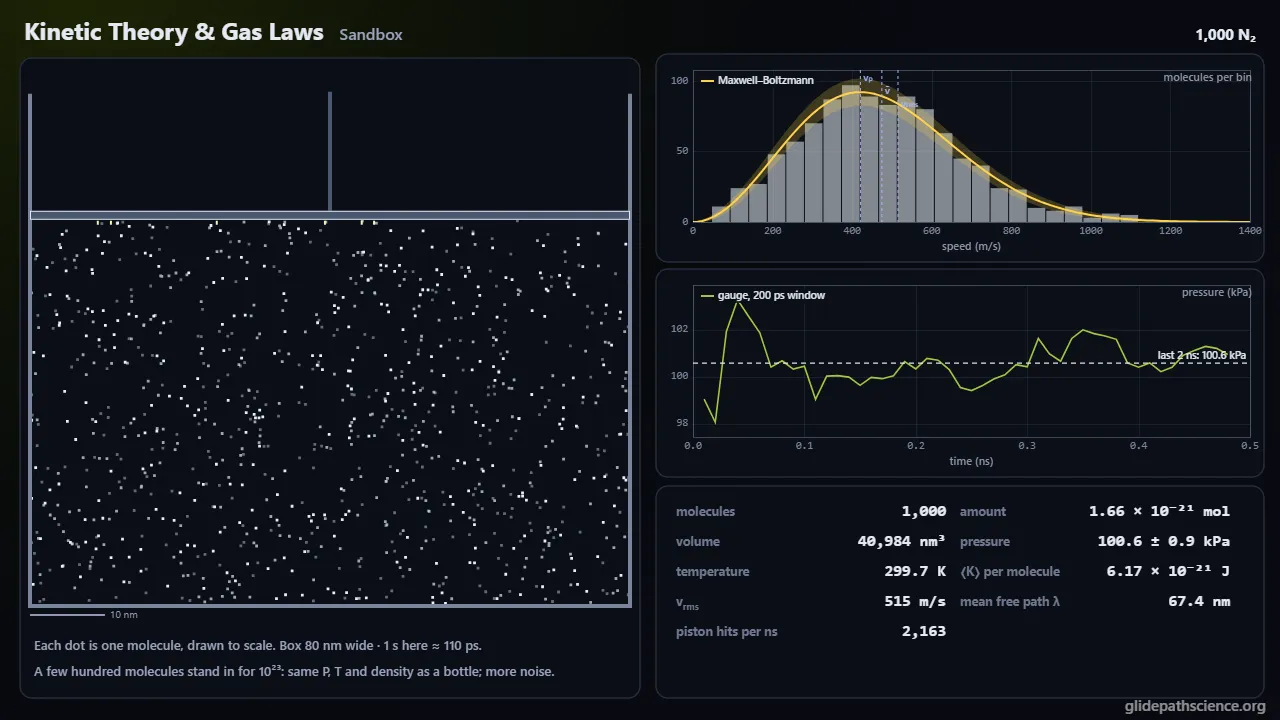
    • A thousand nitrogen molecules drawn to scale in an 80 nm box under a piston, with their speed histogram against the Maxwell–Boltzmann curve, a pressure gauge fluctuating near 100 kPa, and readouts of temperature, rms speed, and mean free path.New

      Kinetic Theory & Gas Laws

      Hundreds of real molecules at true size in an 80 nm box: pressure from their hits, the Maxwell–Boltzmann spread of speeds, and Boyle’s, Charles’s, Gay-Lussac’s, and Avogadro’s laws as experiments with real data.
      • Thermal & Modern Physics
      • Chemistry
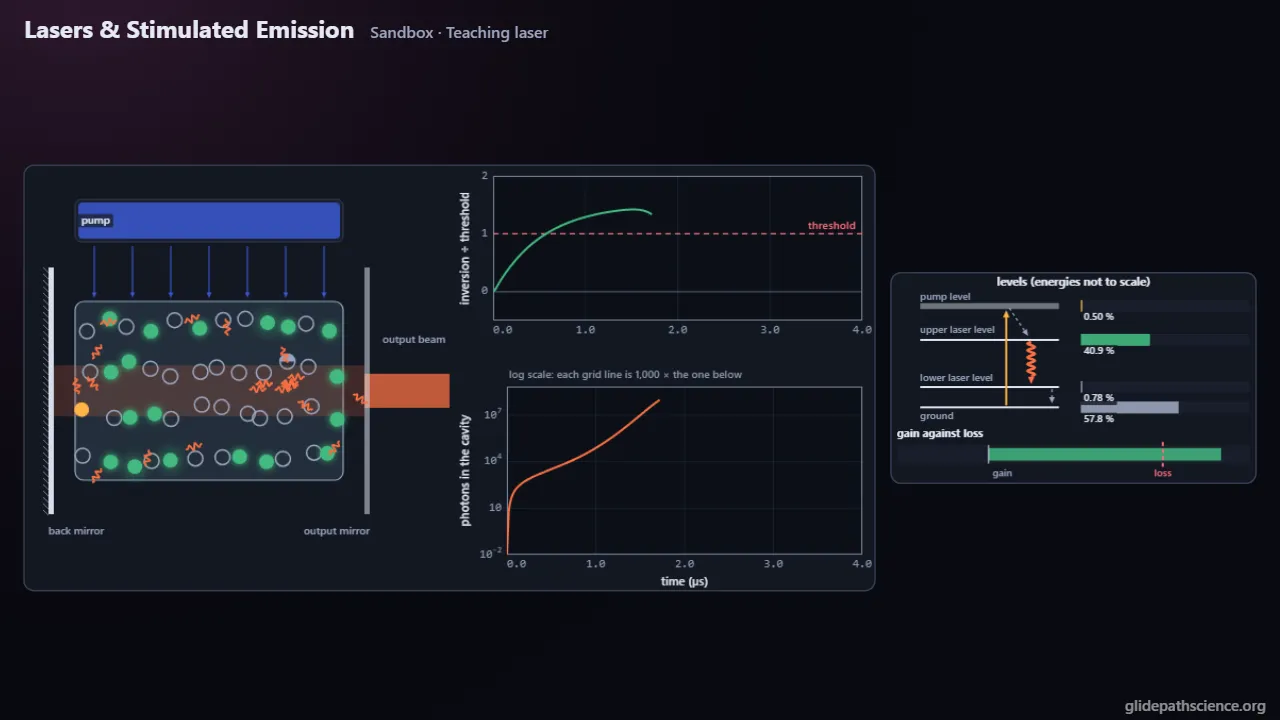
    • A gain medium between a back mirror and an output mirror, many of its atoms lit green in the upper laser level under a blue pump, beside charts of the inversion rising past threshold and the photons in the cavity climbing on a log scale.New

      Lasers & Stimulated Emission

      Pump atoms into a population inversion, watch stimulated emission build a coherent beam between two mirrors, find the threshold, and compare pumping schemes, cavity modes and laser light against lamp light.
      • Thermal & Modern Physics
      • Waves & Optics
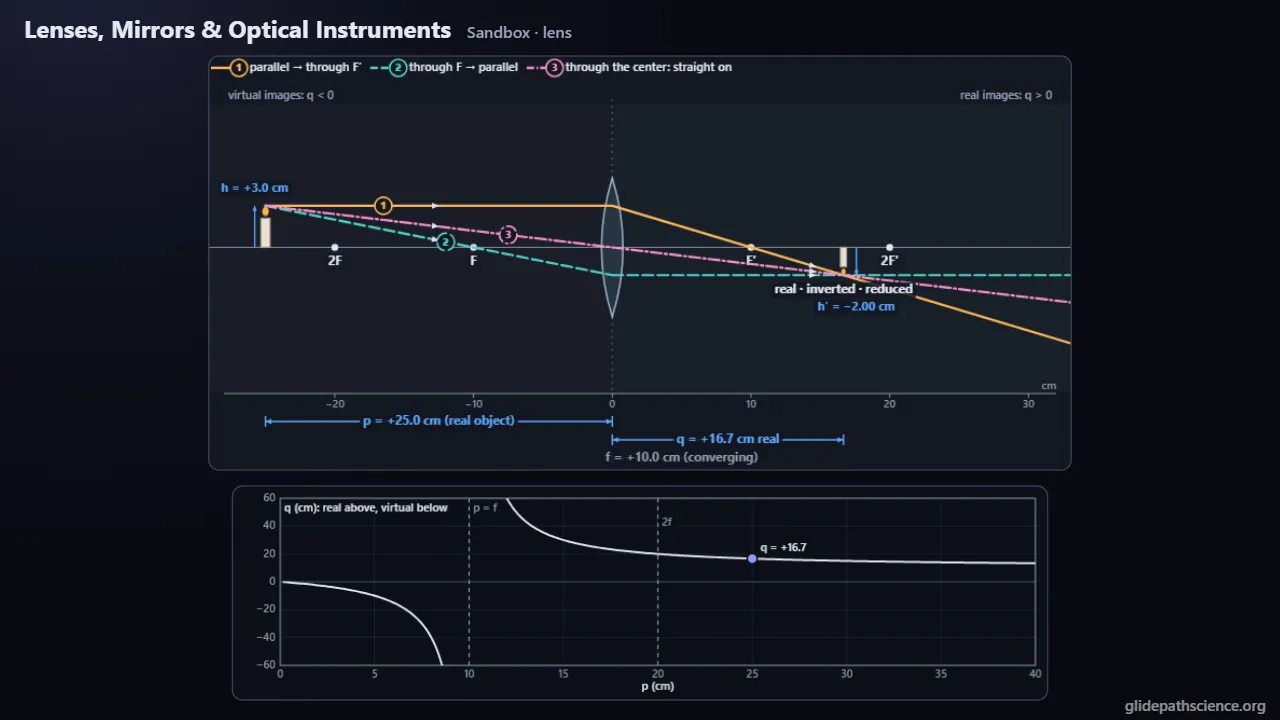
    • A converging lens on an optical bench forming a real, inverted image of a candle, with the three principal rays drawn in their own colors and the object and image distances marked as signed dimension lines.New

      Lenses, Mirrors & Optical Instruments

      Trace the three principal rays through mirrors and lenses to find every image, real or virtual, read its signs, then correct a model eye and build a magnifier, a microscope, a telescope and a camera.
      • Waves & Optics
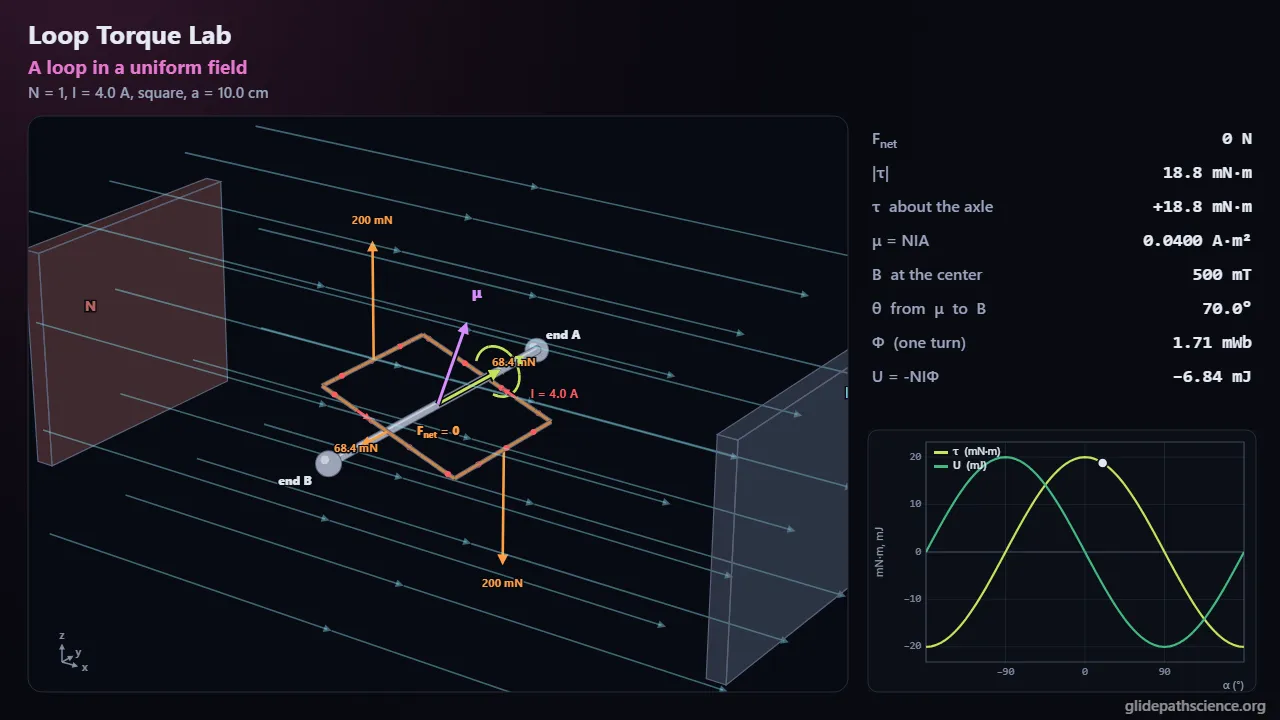
    • A square current loop on an axle between the poles of a magnet, with the forces on its sides and its magnetic moment drawn, readouts of zero net force but an 18.8 mN·m torque, and a chart of torque and energy against angle.New

      Loop Torque Lab

      Add up qv × B along a wire, then close it into a loop: in a uniform field the forces cancel but a torque remains. Slide it partway out of the field or near a magnet or wire, then run a motor and a meter.
      • Electricity & Magnetism
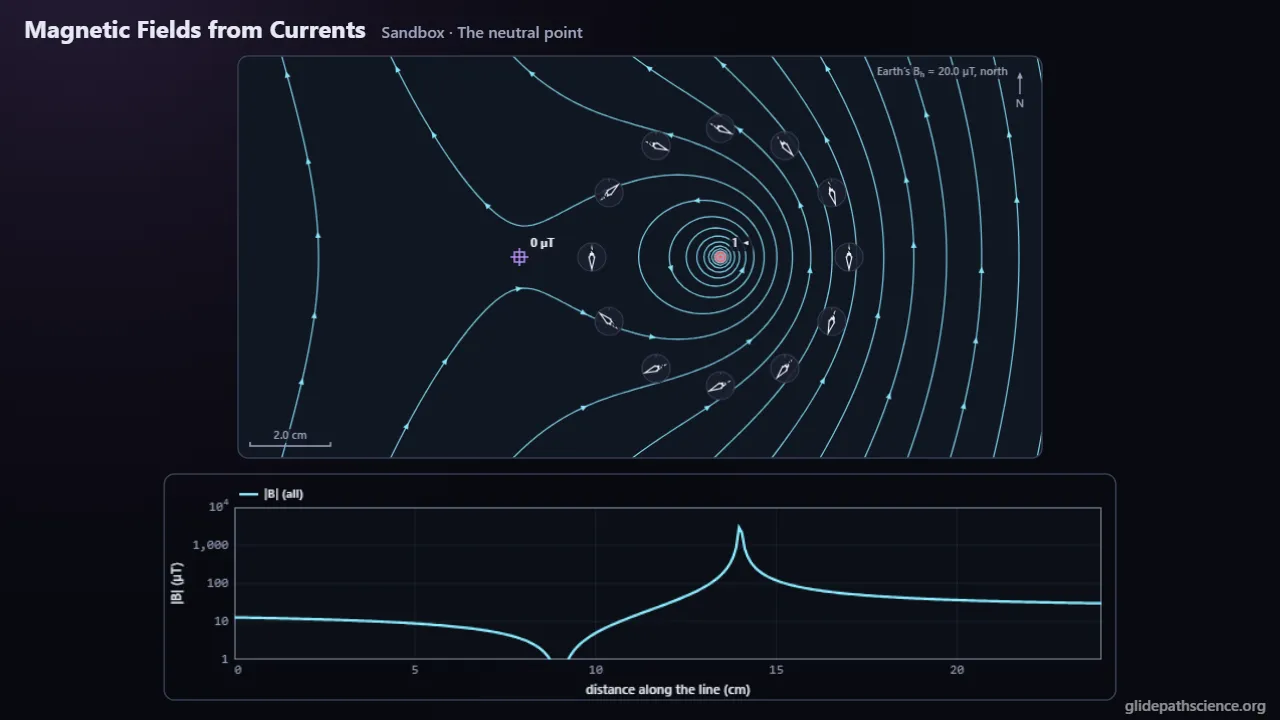
    • A tabletop seen from above with a 5 A current coming up through it, circular field lines bending in Earth’s northward field, a ring of compasses around the wire, and a probe at the neutral point where the field reads zero.New

      Magnetic Fields from Currents

      Map the field around wires, loops and solenoids with compasses and a probe, build Biot–Savart piece by piece, test Ampère’s law on paths you draw, and find the force between currents.
      • Electricity & Magnetism
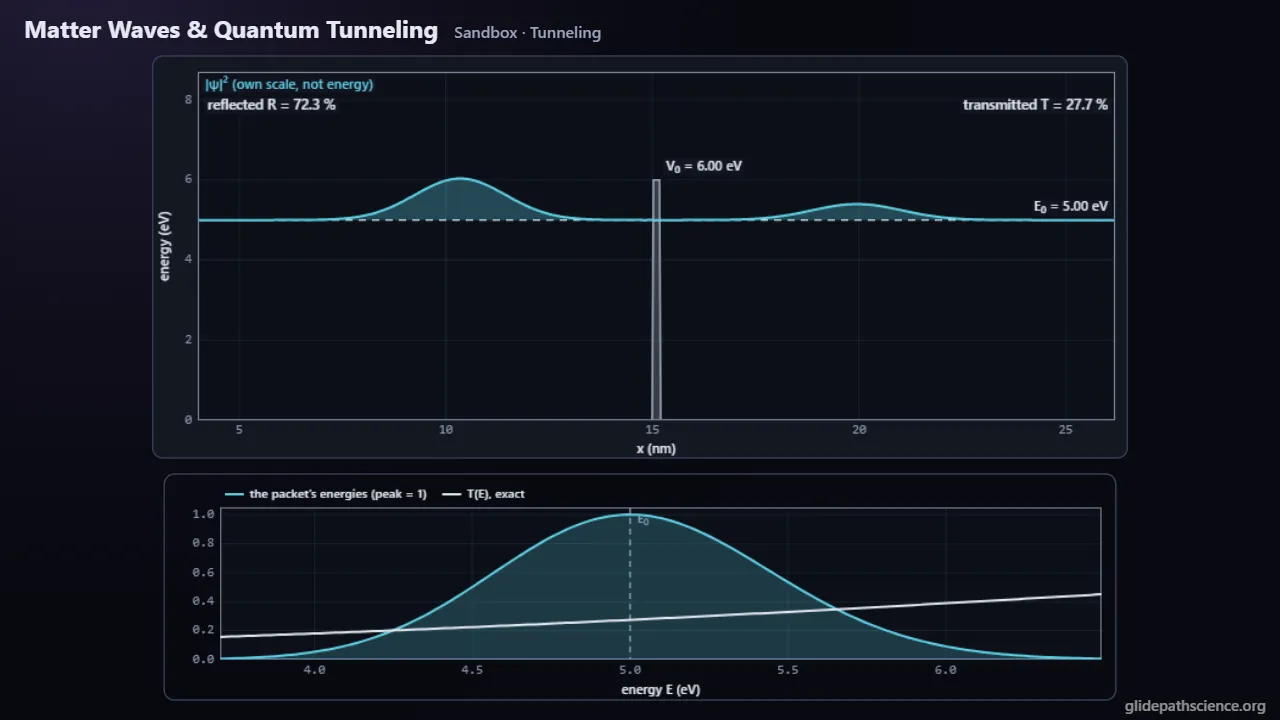
    • An electron wave packet that has met a thin barrier and split into a larger reflected part and a smaller transmitted part, with the barrier’s height and the packet’s energy marked and the packet’s spread of energies plotted below against the exact transmission.New

      Matter Waves & Quantum Tunneling

      Find an electron’s wavelength and diffract it from a crystal, trap it in a box to see its energy come in steps, then watch a wave packet tunnel through a barrier too high to climb.
      • Thermal & Modern Physics
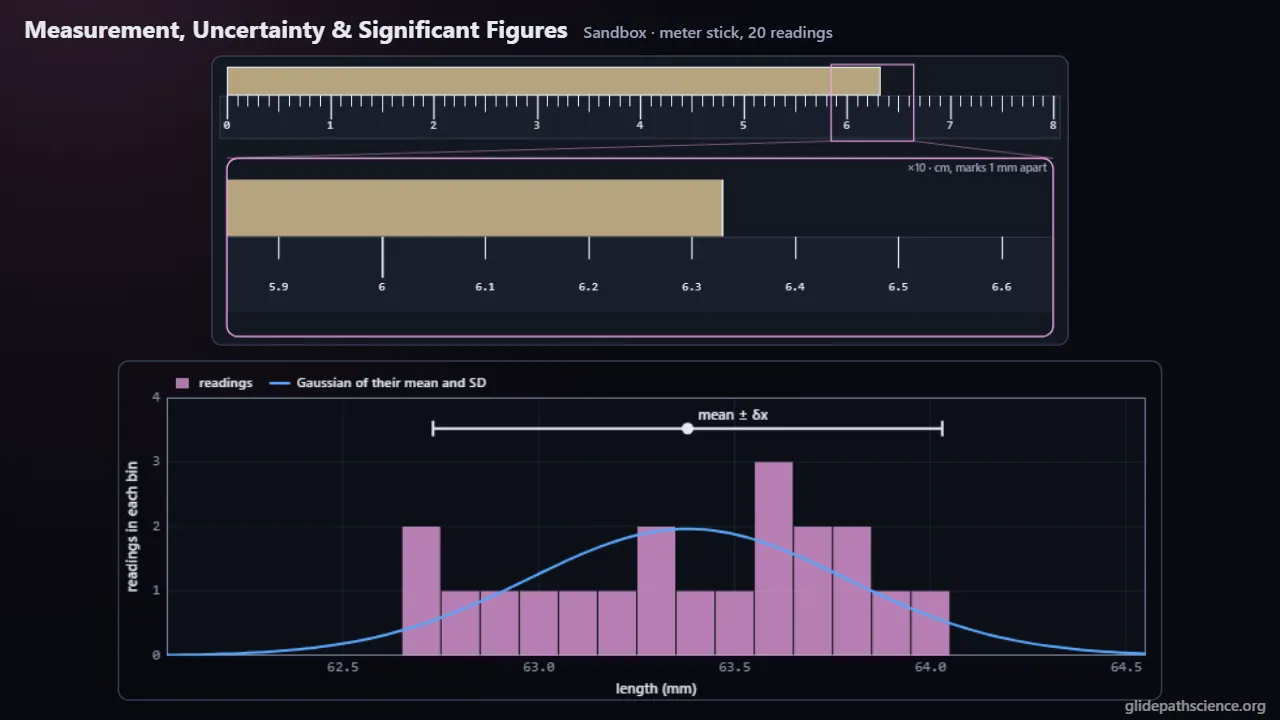
    • A meter stick against a wooden block with a magnified view of the block’s end near 6.3 cm, above a histogram of 20 readings with their Gaussian and the mean with its uncertainty bar.New

      Measurement, Uncertainty & Significant Figures

      Read a ruler, a vernier caliper, a micrometer and a stopwatch, repeat the readings, and carry their uncertainty through a formula to see what significant figures mean and when two results agree.
      • Mathematics
      • Mechanics
      • Chemistry
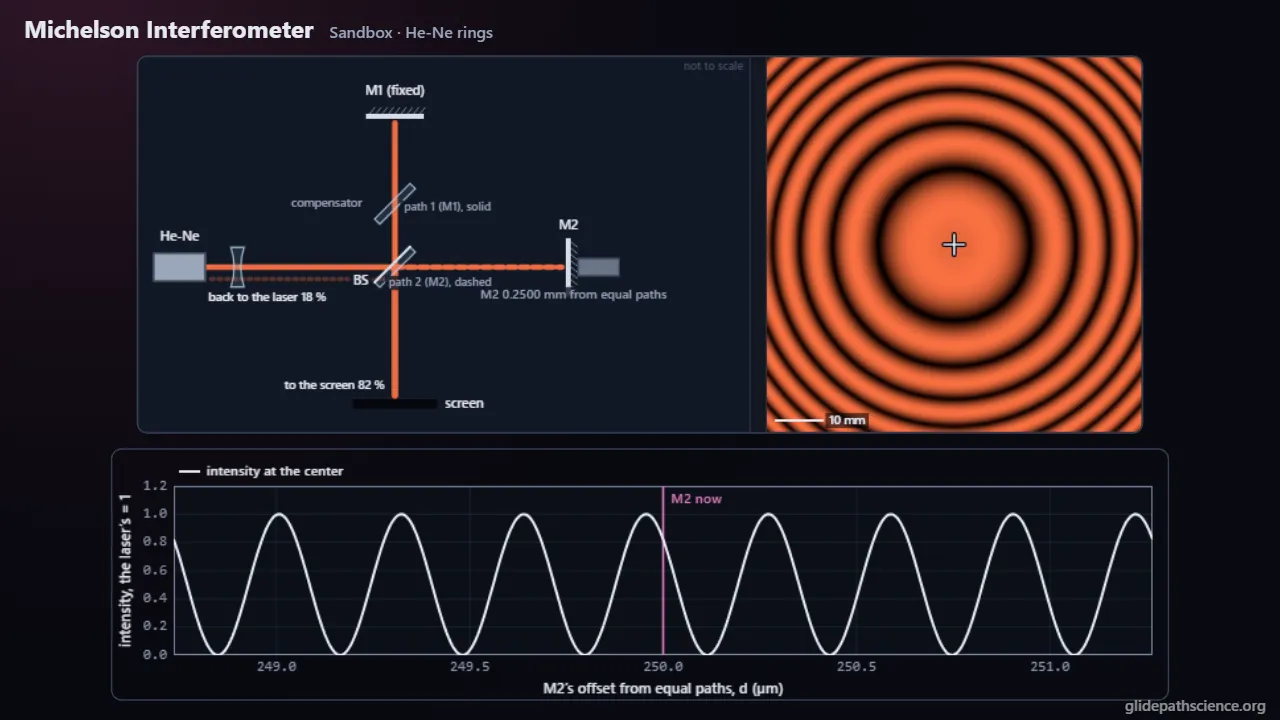
    • A He-Ne Michelson interferometer: the beamsplitter, compensator and two mirrors with path 1 solid and path 2 dashed, the circular fringes on the screen, and the center’s intensity rising and falling as mirror M2 moves near 250 µm.New

      Michelson Interferometer

      Split one beam into two arms: a quarter-wavelength mirror move turns bright to dark. Align it, count fringes to measure light, find white light’s zero, then scale it up to LIGO’s 4 km arms.
      • Waves & Optics
      • Thermal & Modern Physics
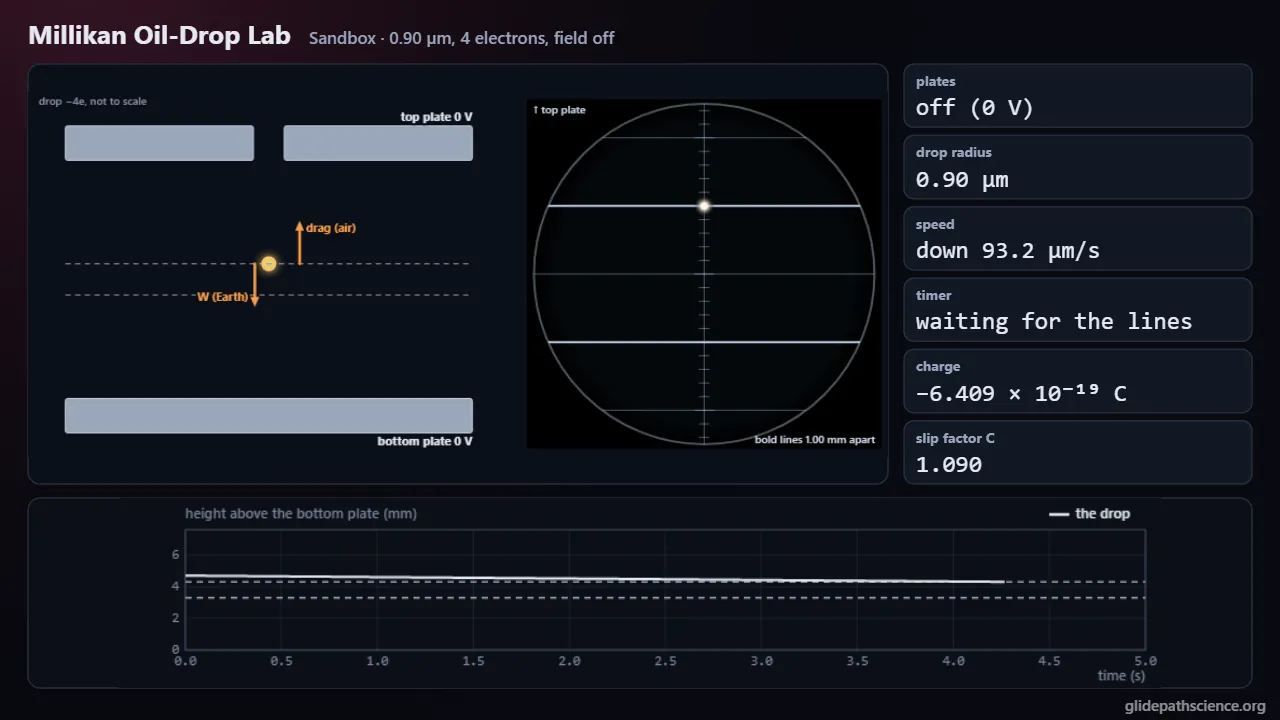
    • An oil drop between two plates with its weight and the air’s drag drawn on it, beside the microscope’s view of the drop between two timing lines 1.00 mm apart, with readouts of its radius, its speed falling at 93.2 µm/s and its charge of four electrons, and a chart of its height against time.New

      Millikan Oil-Drop Lab

      Measure the electron’s charge as Millikan did: time oil drops falling and rising through a microscope with your own stopwatch, find e with an honest uncertainty, and re-analyze his 1913 drops.
      • Electricity & Magnetism
      • Chemistry
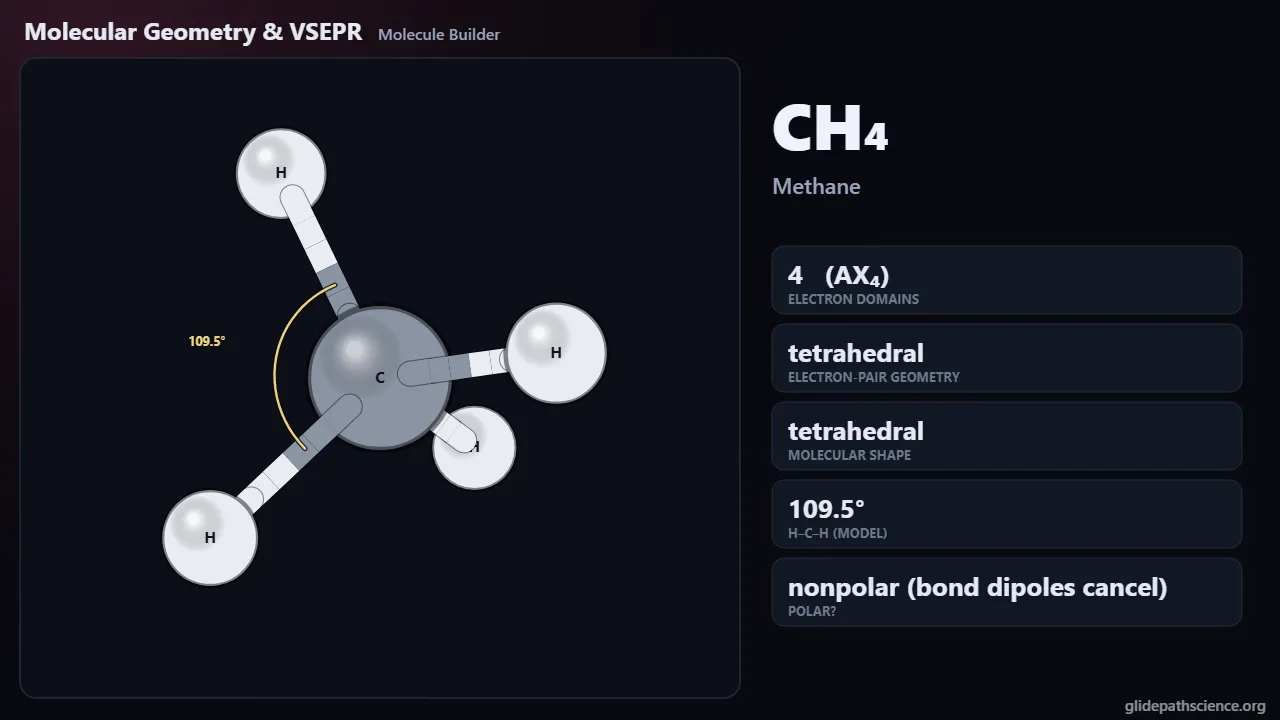
    • A 3-D model of methane, CH₄, with its 109.5° bond angle marked, beside its electron domains, electron-pair geometry, molecular shape and polarity.New

      Molecular Geometry & VSEPR

      Build molecules around a central atom and watch electron pairs relax into shape. Count domains from Lewis structures, see lone pairs squeeze angles, compare the model with measured molecules, and add bond dipoles in 3-D.
      • Chemistry
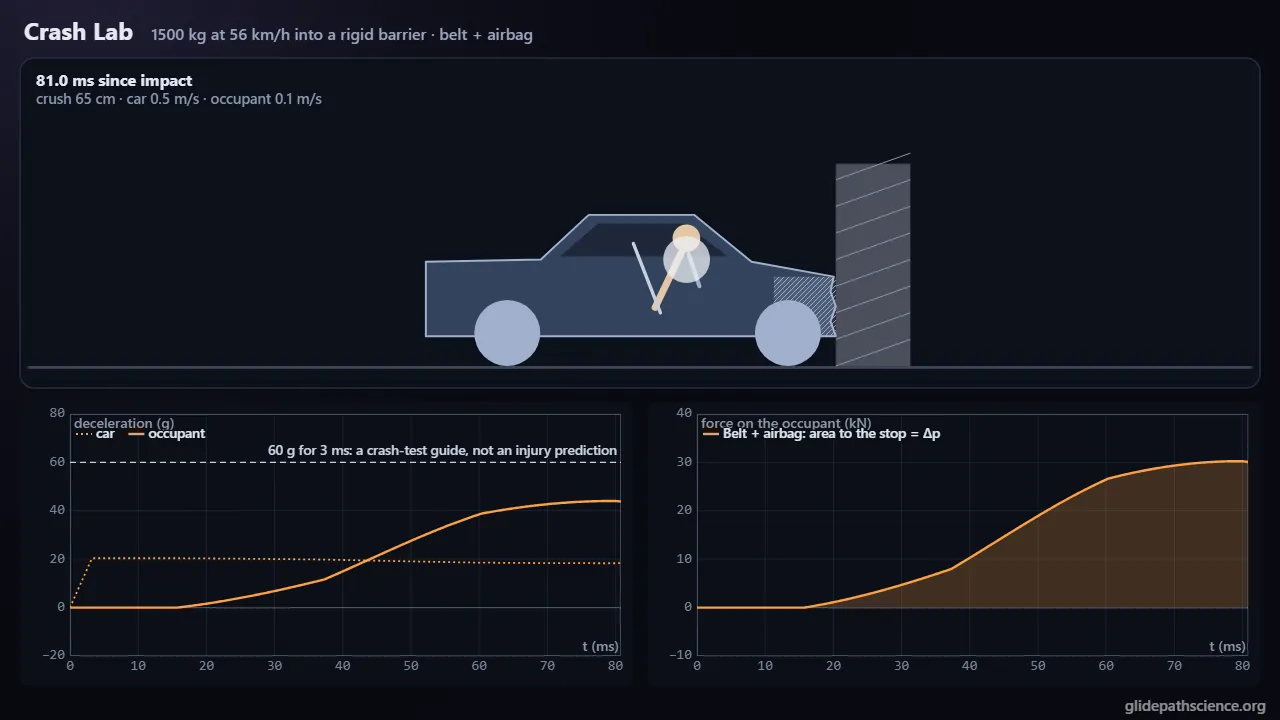
    • A car crashing into a rigid barrier with a belted occupant and an airbag, above charts of the car’s and the occupant’s deceleration and of the force on the occupant over the first 80 ms.New

      Momentum, Impulse & Collisions

      Collide carts and pucks from elastic to perfectly inelastic: total momentum holds while kinetic energy goes. Read impulse as the area under F(t), and see how crumple zones and belts spread the same Δp.
      • Mechanics
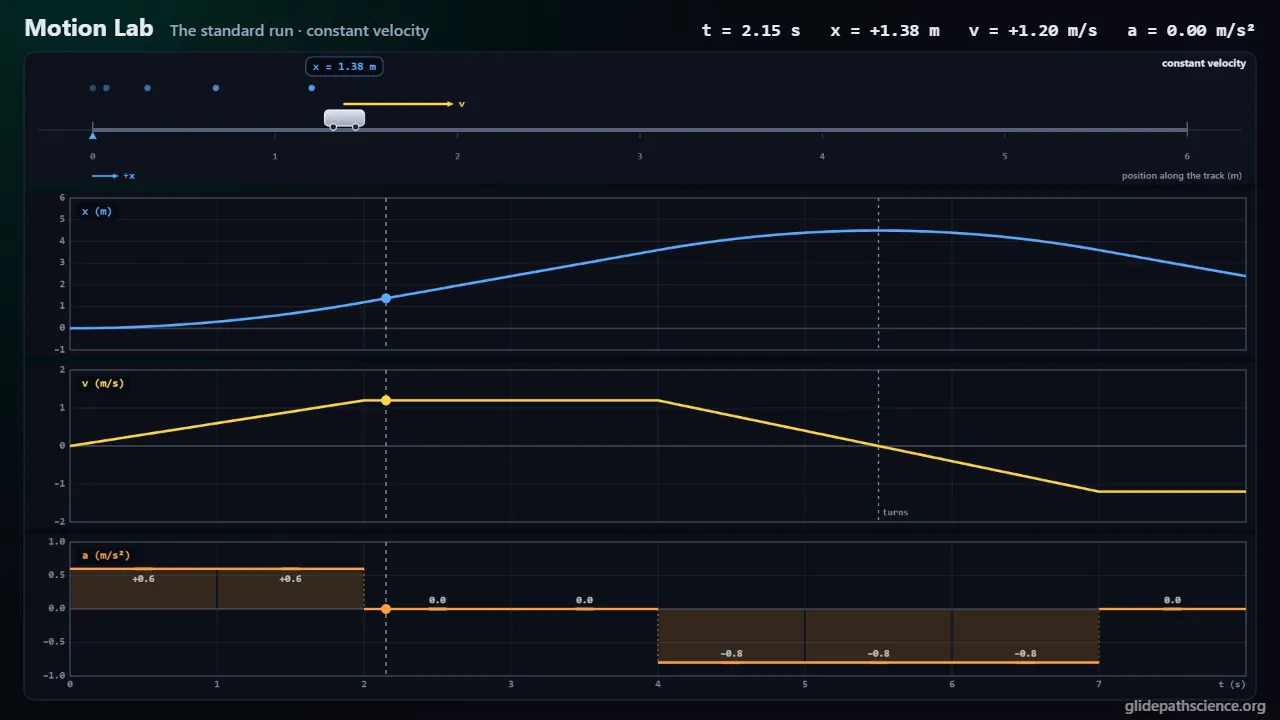
    • A cart on a track above its synchronized position, velocity and acceleration graphs, with a motion diagram.New

      Motion Lab

      One cart and three synchronized graphs: build a motion from its acceleration, read slopes and areas, match graphs by moving, and see why a motion detector's velocity and acceleration come out noisy.
      • Mechanics
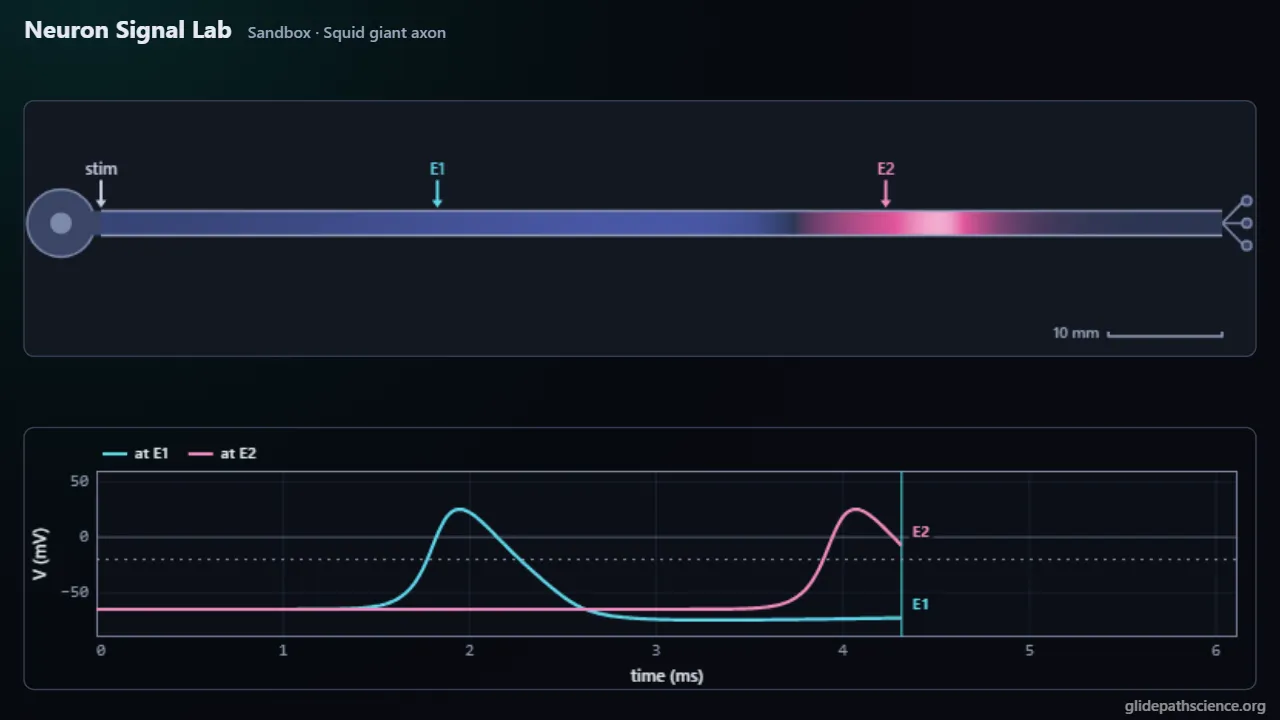
    • A squid giant axon drawn as a long bare fiber with a stimulus electrode at one end and two recording electrodes, E1 and E2, above a chart of the voltage along the axon at its −65 mV resting level.New

      Neuron Signal Lab

      Inject current into an axon and watch a passive signal fade within a few length constants, then fire it, time the action potential between two electrodes, wrap the axon in myelin and race it.
      • Biology
      • Electricity & Magnetism
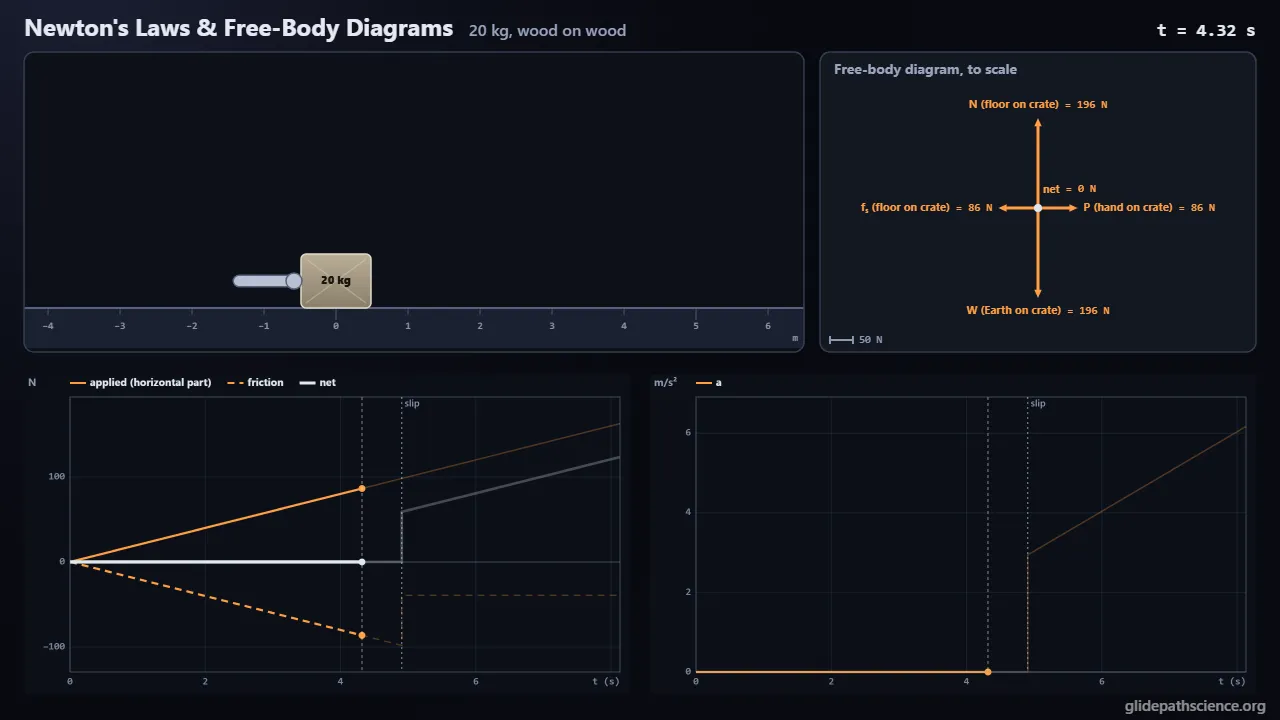
    • A crate on a wooden floor with its free-body diagram: force arrows labeled by agent, the net force drawn hollow, and the acceleration chart.New

      Newton's Laws & Free-Body Diagrams

      Push a crate, lift a bucket and jump on a force plate: name every force by its interaction, watch static friction match a push until it slips, and find the partner of every force.
      • Mechanics
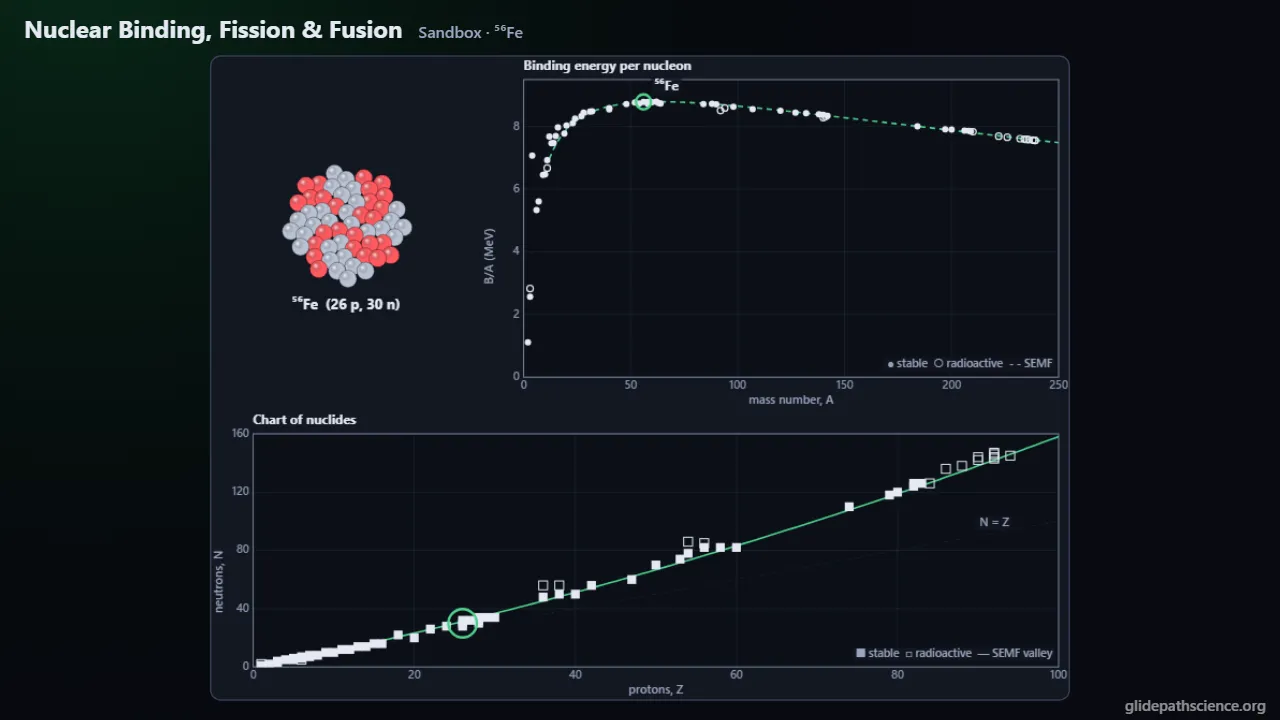
    • An iron-56 nucleus drawn as a cluster of red protons and gray neutrons beside the binding-energy-per-nucleon curve, with iron circled near its peak, and the chart of nuclides below with the valley of stability.New

      Nuclear Binding, Fission & Fusion

      Weigh a nucleus against its parts to find its binding energy, place any nuclide on the binding-energy curve, compose fission and fusion reactions, grow a chain reaction, and see how protons fuse in the Sun.
      • Thermal & Modern Physics
      • Astronomy & Space Science
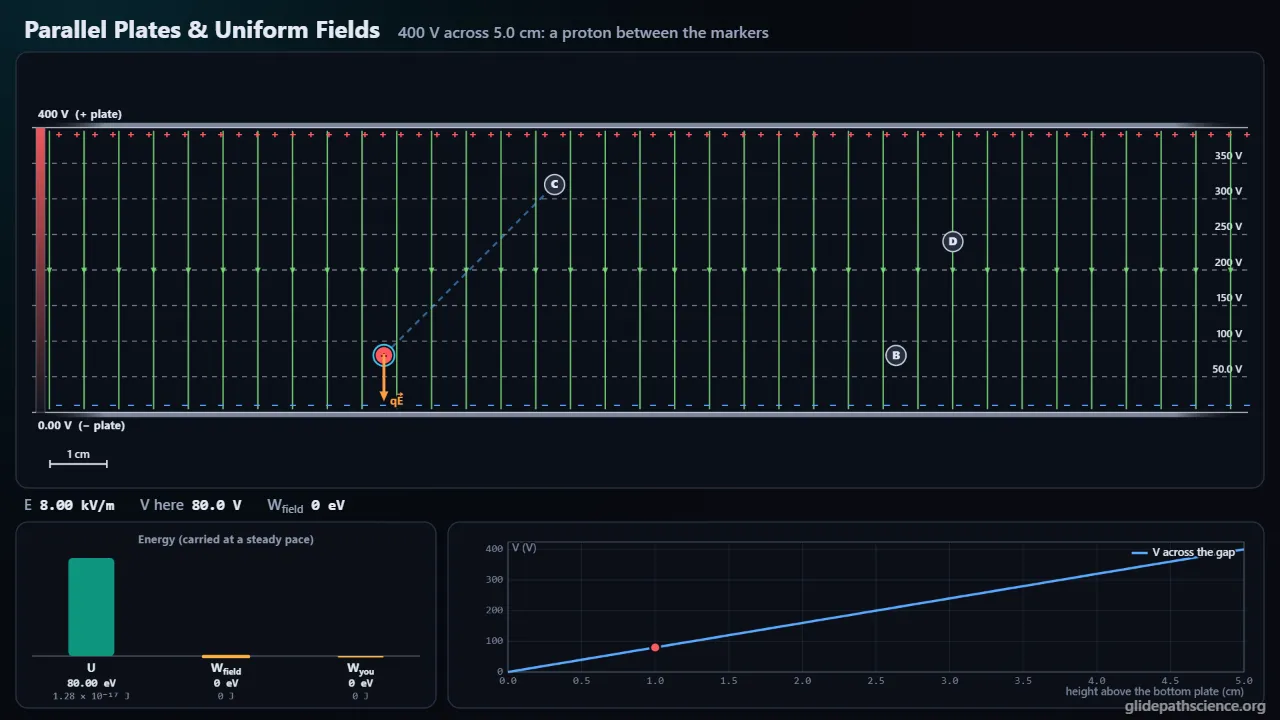
    • A proton between two charged plates at 400 V and 0 V, with vertical field lines, dashed equipotentials every 50 V, energy bars in electronvolts, and a chart of the potential rising steadily across the gap.New

      Parallel Plates & Uniform Fields

      Charge two plates and explore the uniform field between them: work and potential energy in electronvolts, beams fired onto a screen, fringe fields, and Millikan’s oil drops counted in whole electrons.
      • Electricity & Magnetism
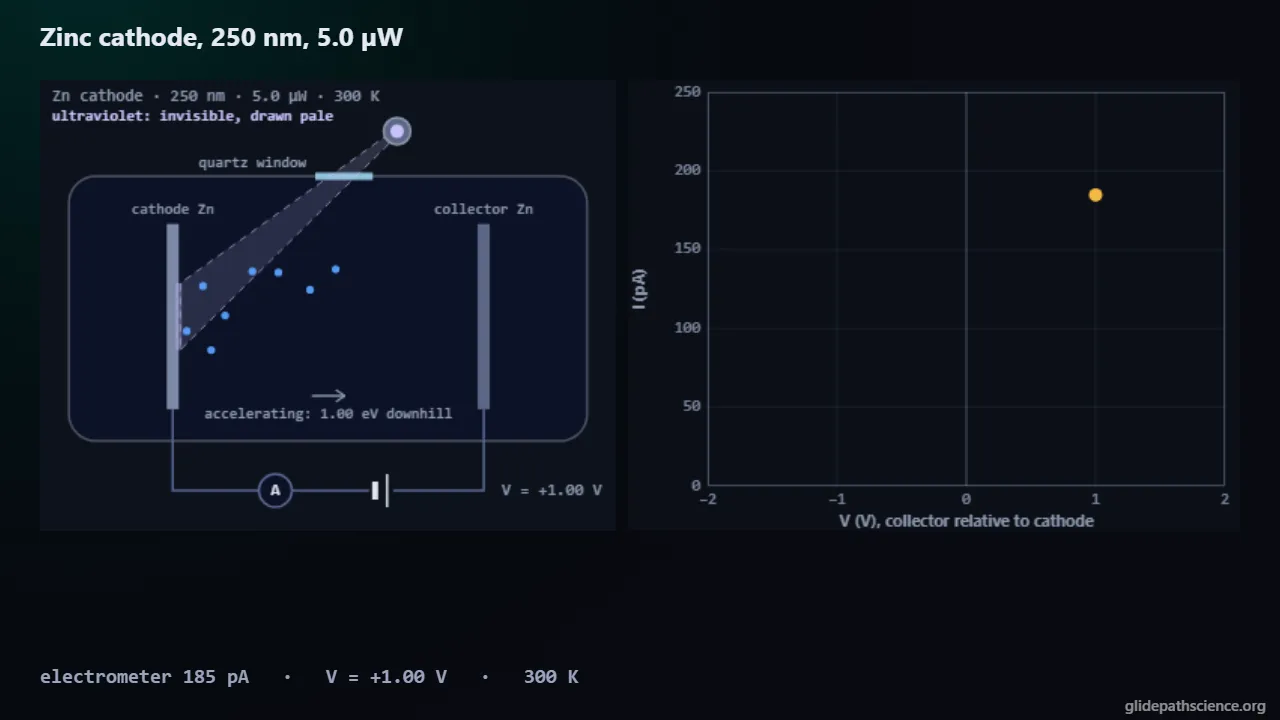
    • Ultraviolet light shining through a quartz window onto a zinc cathode and freeing electrons that cross to the collector, beside the graph of current against voltage.New

      Photoelectric Effect

      Shine light on a metal: electrons leave only above a threshold color, however bright the lamp. Stop them with a voltage, measure Planck's constant from a Millikan plot, and find whose work function the intercept gives.
      • Thermal & Modern Physics
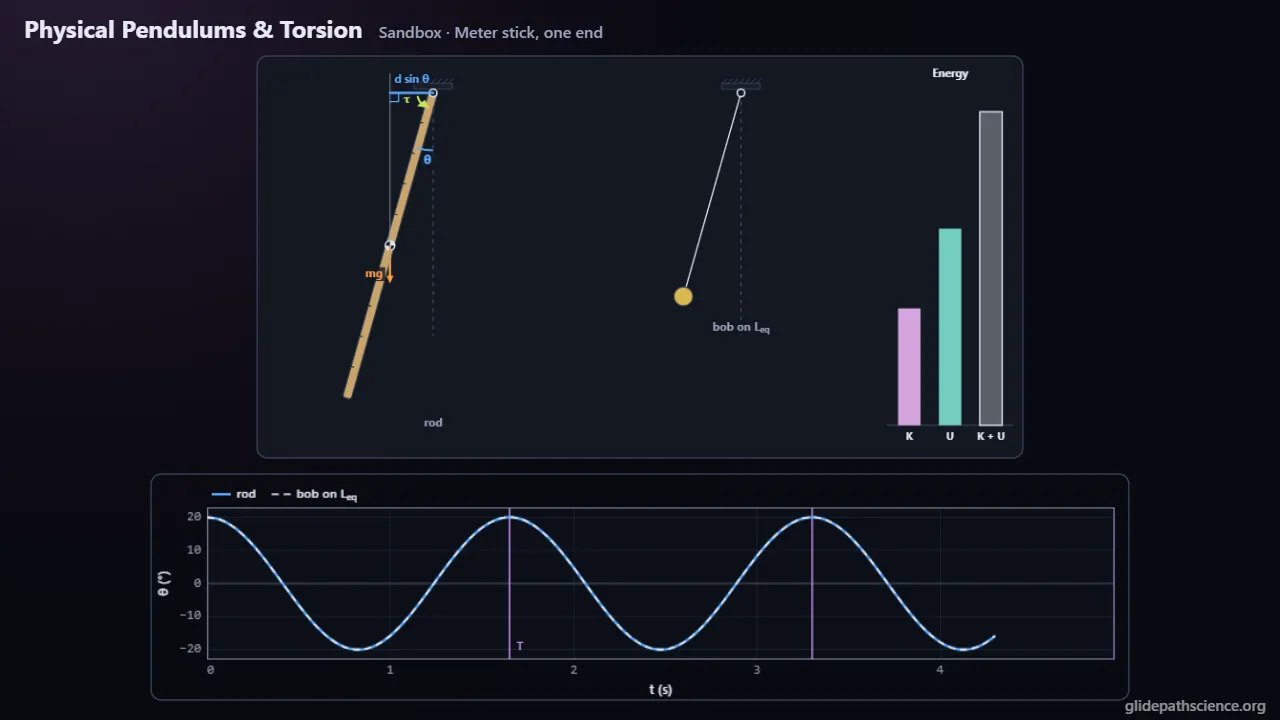
    • A meter stick swinging from a pivot at one end, released from 20°, with gravity’s torque and its lever arm marked, beside its equivalent simple pendulum and bars for its kinetic and potential energy.New

      Physical Pendulums & Torsion

      Swing rods, disks and hoops from different pivots to find where each swings fastest, tune a reversible pendulum to measure g, and weigh rotational inertia by twisting a wire.
      • Mechanics
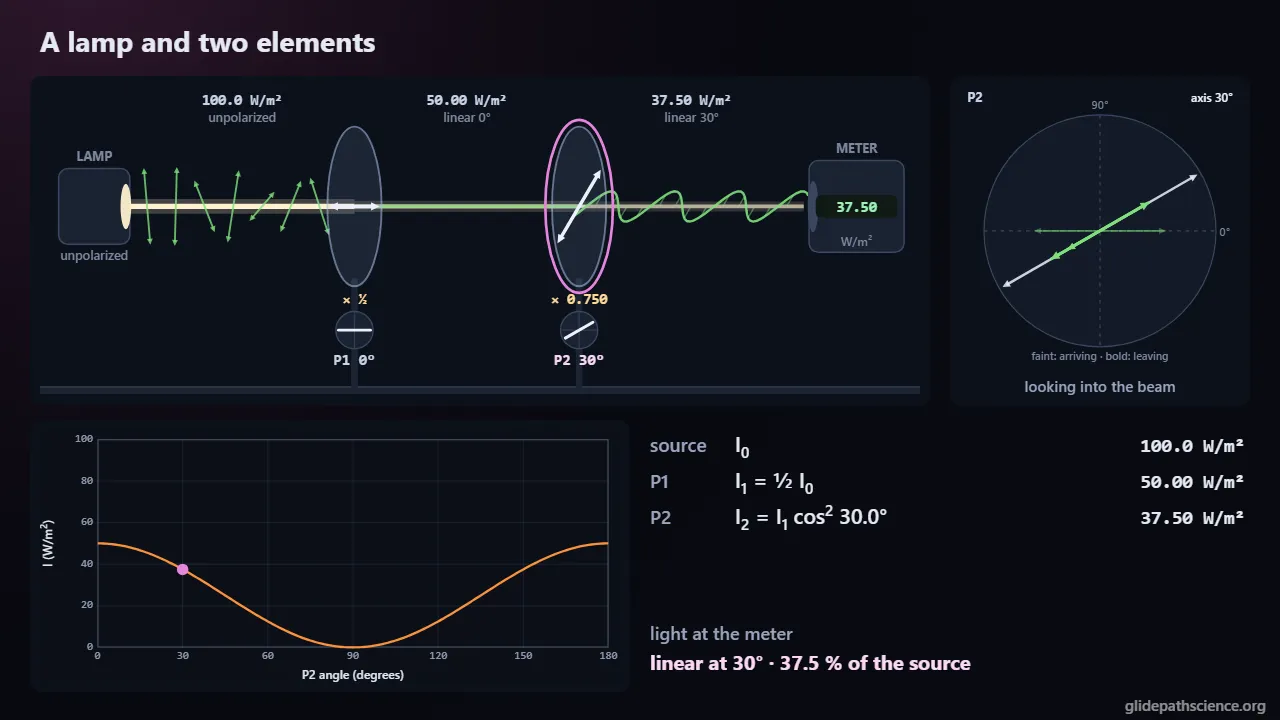
    • A lamp’s beam through two polarizers on a rail, with the field drawn along the beam, the meter reading, and a face-on dial of the second polarizer’s axis.New

      Polarization Lab

      Turn polarizers and watch light follow cos²θ: crossed polarizers go dark until a third brings it back. Find Brewster’s angle in the glare off water, map the polarized sky, and fit real light-meter data.
      • Waves & Optics
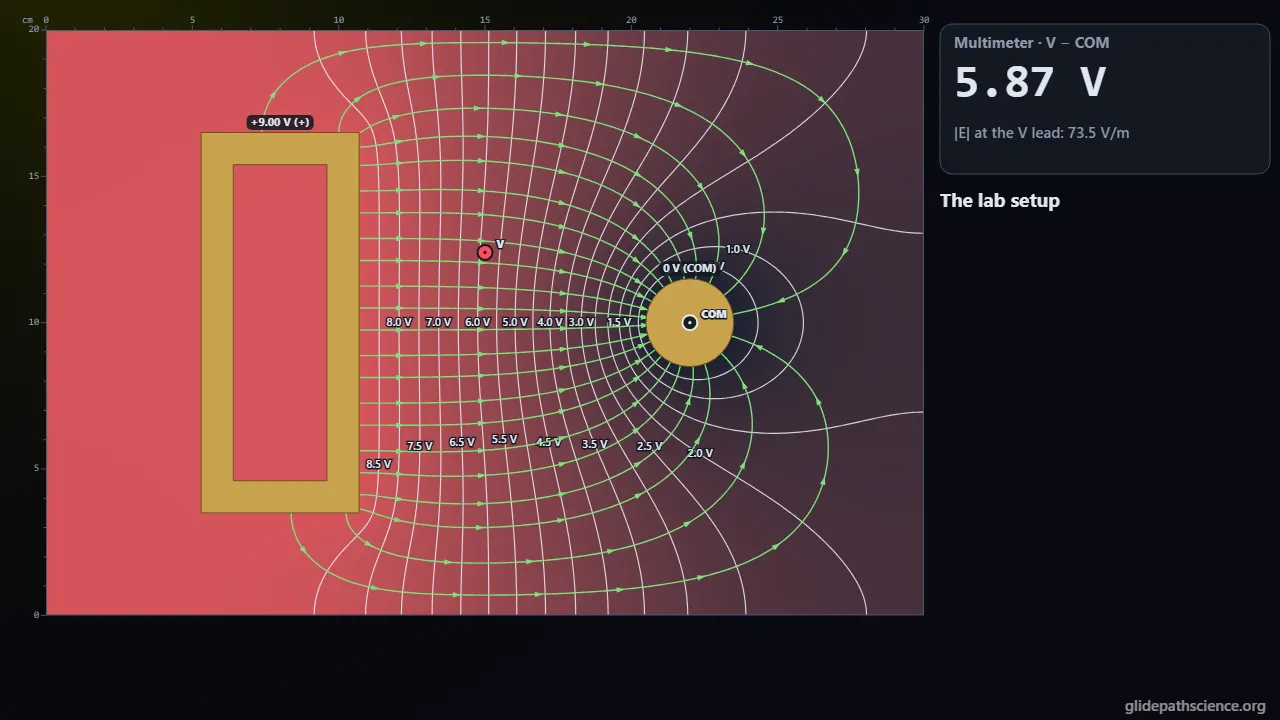
    • Conductive paper between a hollow brass frame at +9.00 V and a brass disc at 0 V, with equipotentials labeled every half volt, green field lines crossing them, and a multimeter reading the potential at its lead.New

      Potential Map

      Map equipotentials on conductive paper with a virtual multimeter, compare them with point charges, find field-free hollows and sharp points, and see how ECG leads read the heart.
      • Electricity & Magnetism
      • Biology
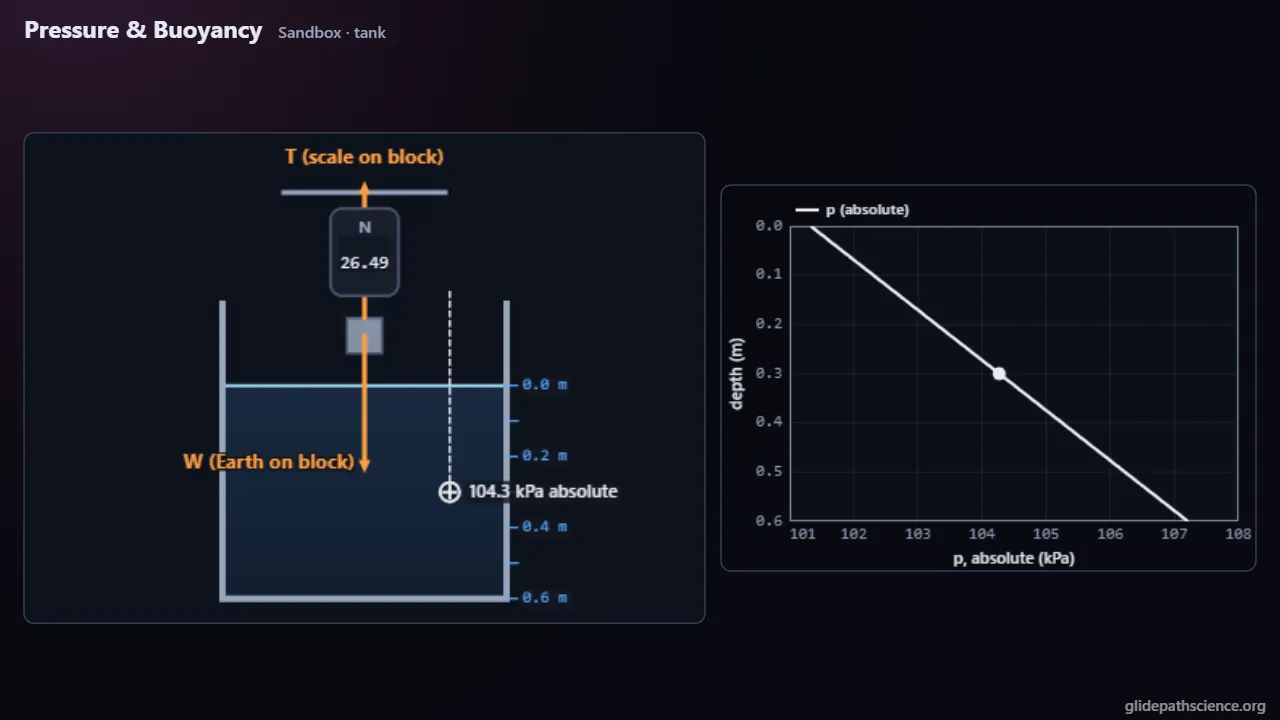
    • An aluminum block hanging from a spring scale above a tank of water, with the scale’s pull and the block’s weight drawn as arrows, a pressure probe 30 cm down, and a chart of pressure rising with depth.New

      Pressure & Buoyancy

      Dive into a tank with a pressure probe, lift a car with a hydraulic press, weigh a crown in water, load a barge to its marks and fly a hot-air balloon: pressure with depth, Pascal’s principle, buoyancy and stability.
      • Mechanics
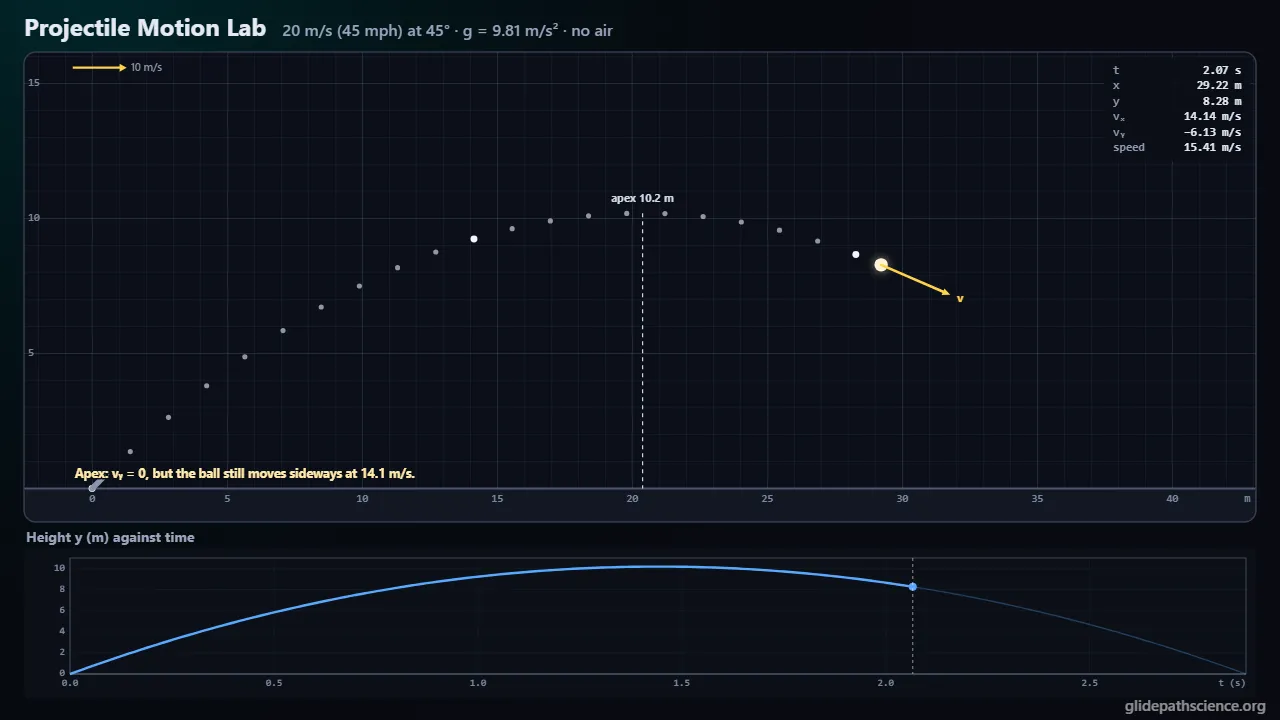
    • A projectile's path drawn as equal-time dots, with its apex marked and its velocity arrow, above a height-against-time chart.New

      Projectile Motion Lab

      Launch at any speed, angle and height, on Earth, Mars or the Moon, with or without air and wind. Compare paths, see drag pull the best angle below 45°, hit targets, and fit a launch to video data.
      • Mechanics
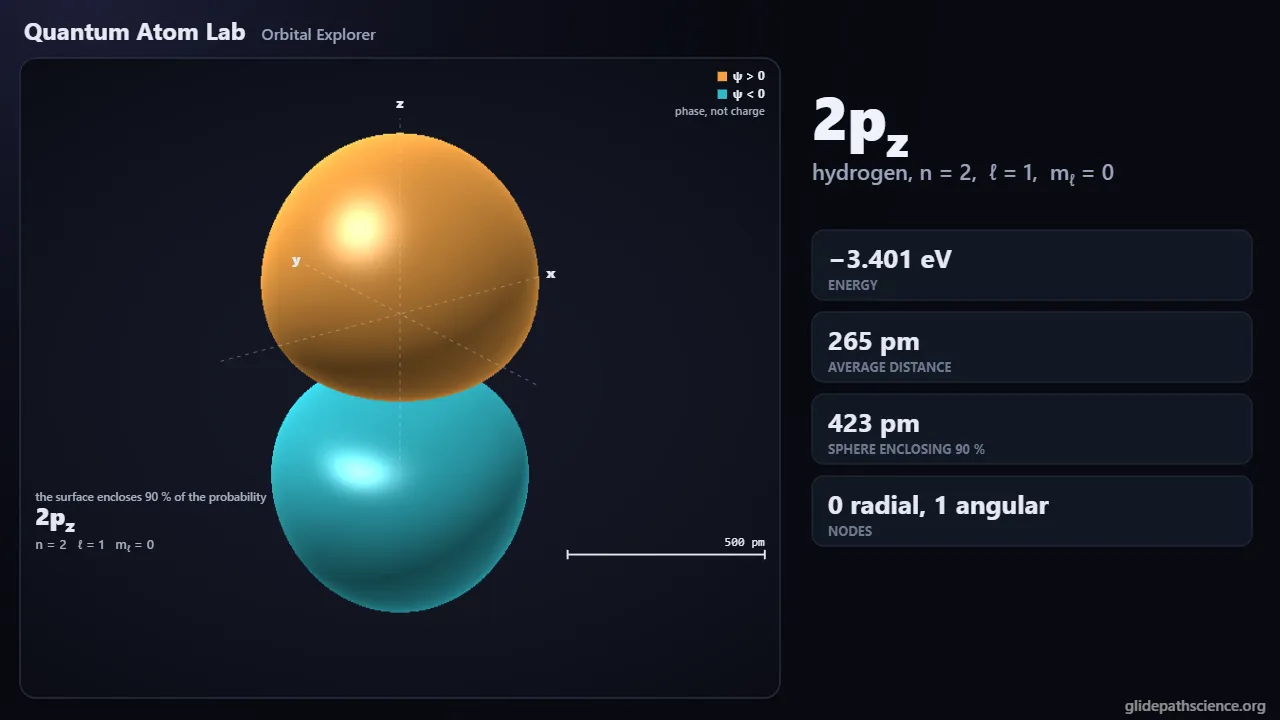
    • The hydrogen 2p orbital in 3-D: two lobes, orange where the wavefunction is positive and cyan where it is negative, with its energy, average distance and nodes beside it.New

      Quantum Atom Lab

      Follow the evidence from line spectra and Bohr's levels to electron waves, explore every hydrogen orbital from 1s to 4f in 3-D, and fill atoms from hydrogen to xenon to explain their ionization energies.
      • Chemistry
      • Thermal & Modern Physics
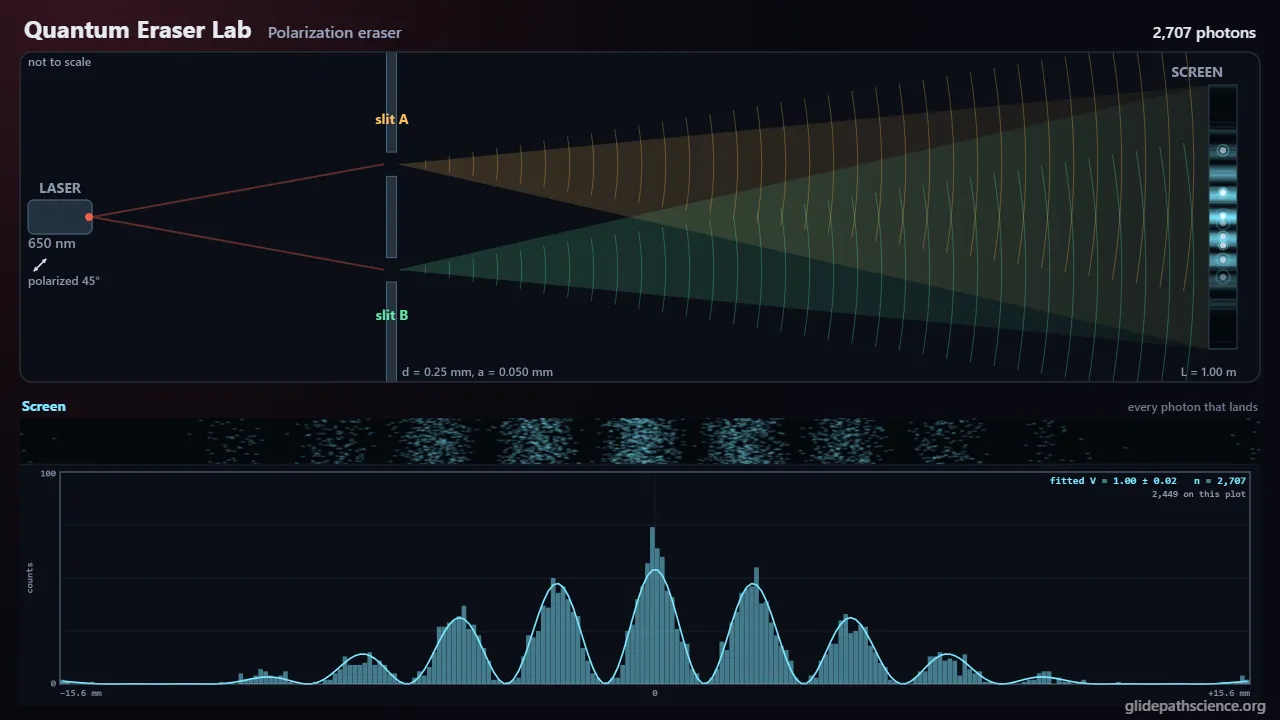
    • Laser light through two slits with polarizers, and the histogram of photons on the screen forming fringes.New

      Quantum Eraser Lab

      Tag the two paths through a double slit and the fringes vanish; erase the tag and they return, but only in a sorted or filtered subset of the photons, never in the whole pattern.
      • Waves & Optics
      • Thermal & Modern Physics
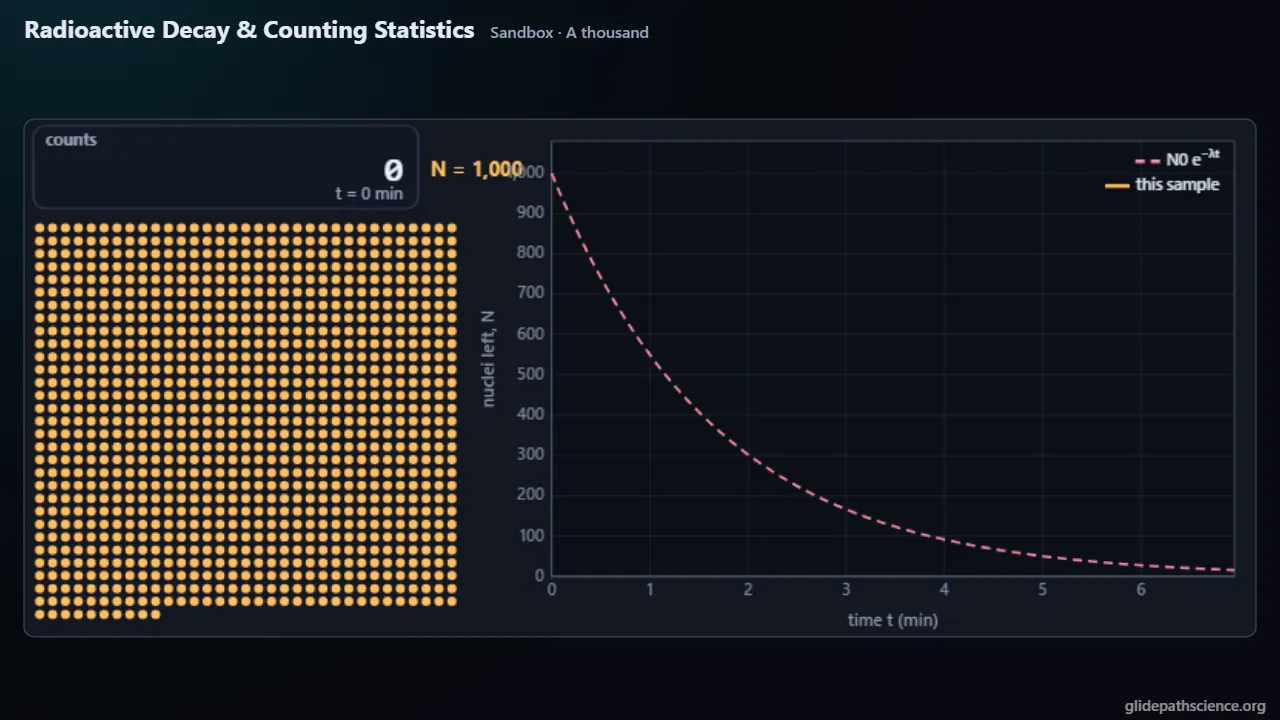
    • A grid of a thousand amber nuclei beside a Geiger counter’s readout and a chart of the nuclei left against time, with the exponential decay law drawn as a dashed curve.New

      Radioactive Decay & Counting Statistics

      Watch nuclei decay one at a time while a large sample keeps perfect time, then count with a Geiger counter, subtract background, learn how long to count, and date charcoal by its carbon-14.
      • Thermal & Modern Physics
      • Chemistry
      • Mathematics
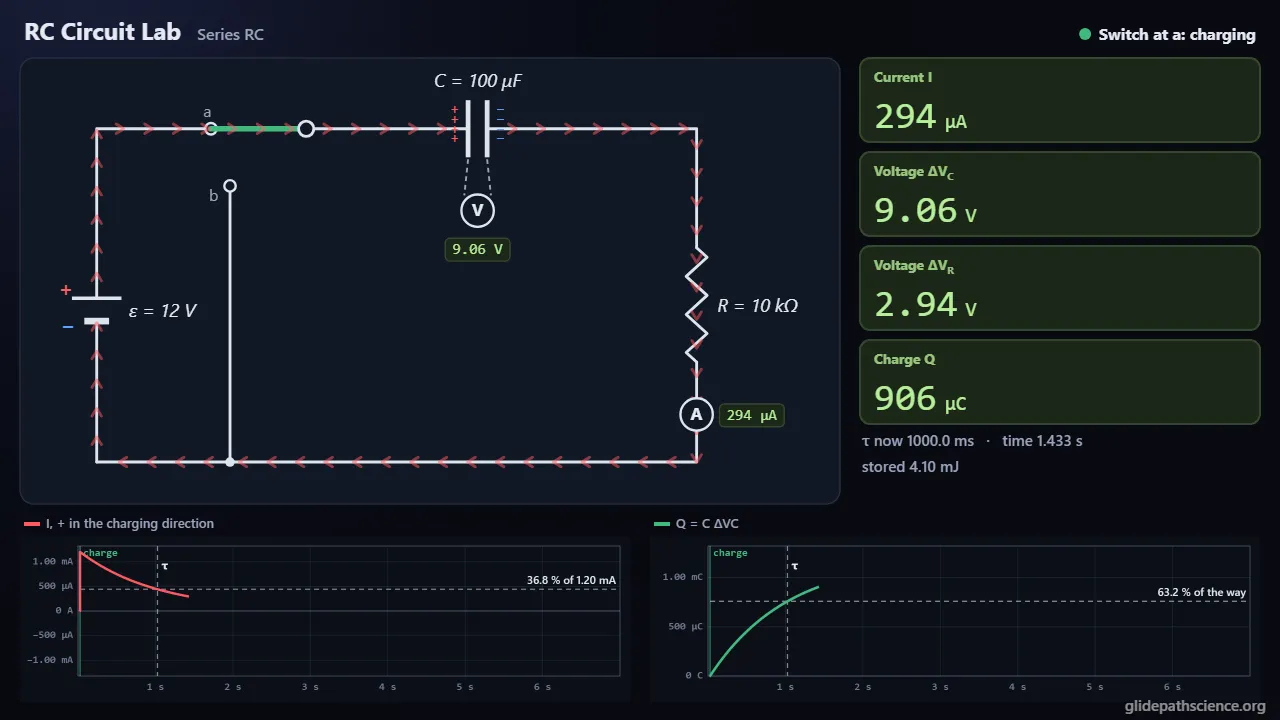
    • The RC Circuit Lab while a capacitor charges: the circuit board, its four meters, and charts of current and charge against time.New

      RC Circuit Lab

      Charge and discharge a capacitor through real circuits: time constants, the missing half of the energy, Thévenin equivalents, and meter loading.
      • Electricity & Magnetism
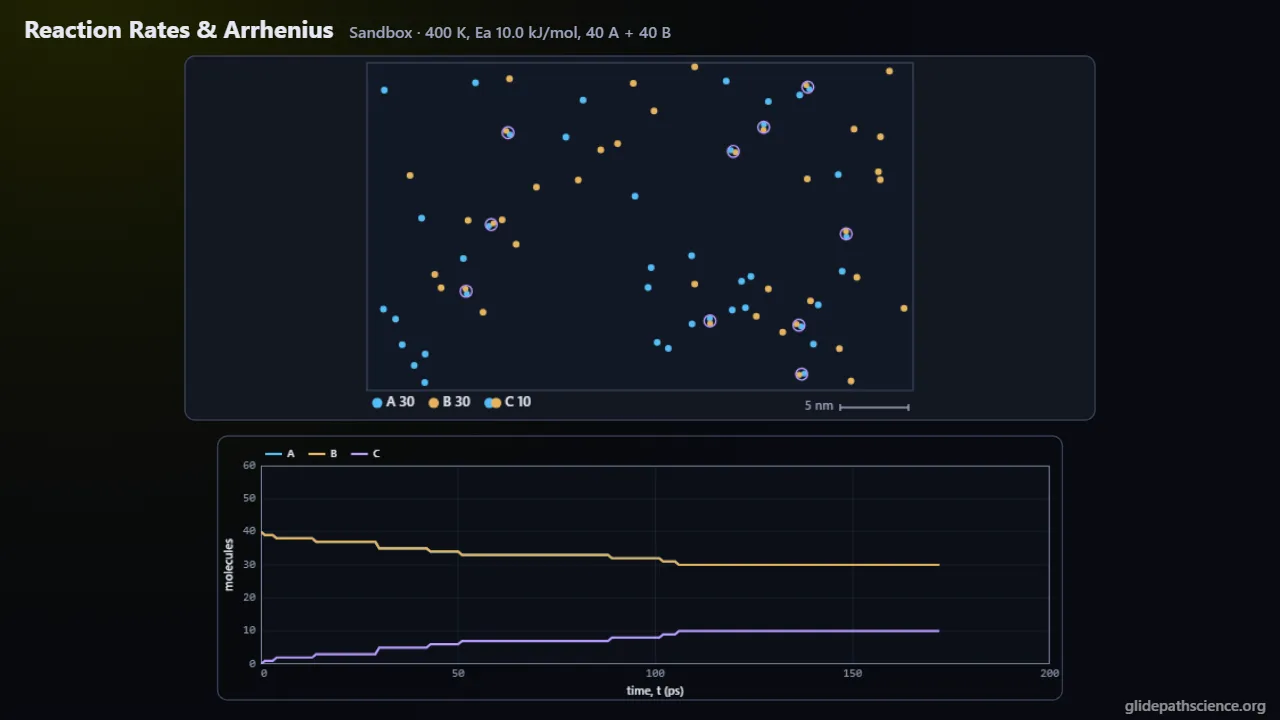
    • A box of blue A and orange B molecules at 400 K, with two-colored C molecules where pairs have reacted, above a chart of the numbers of A, B and C against time.New

      Reaction Rates & Arrhenius

      Watch molecules collide in a box and react only when they hit hard enough and the right way round, then find a rate law from initial rates and the activation energy from an Arrhenius plot.
      • Chemistry
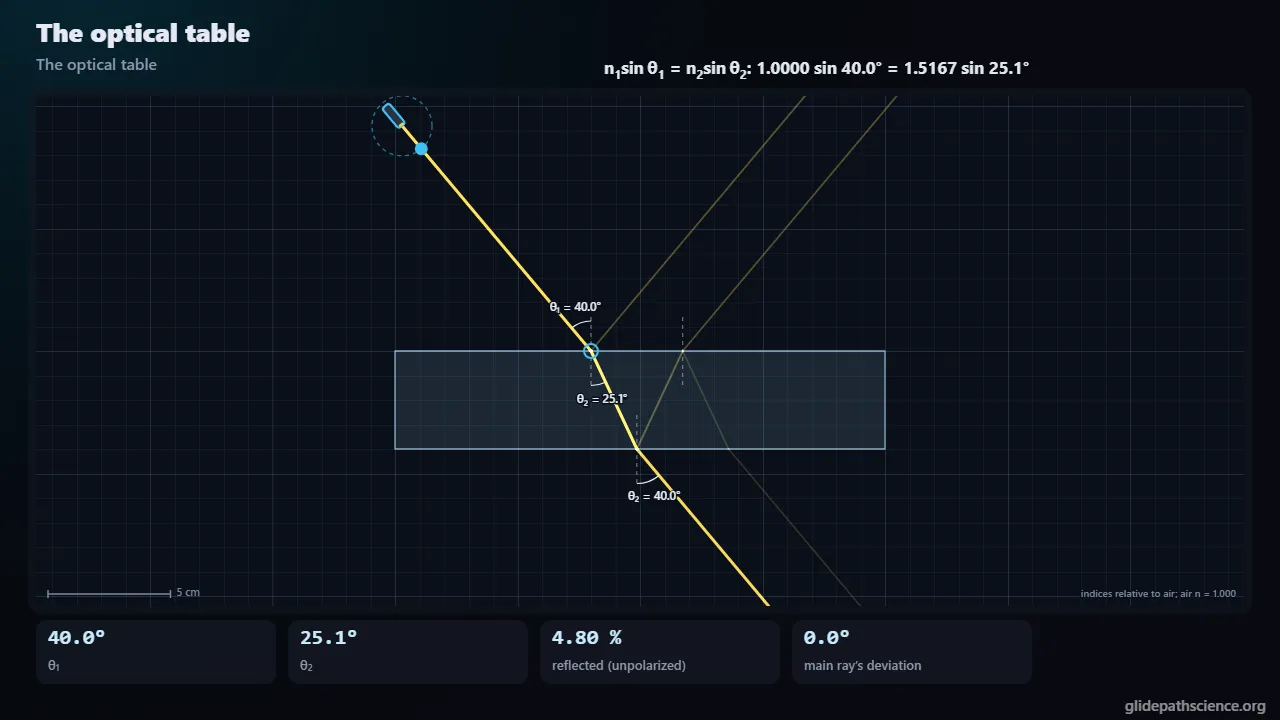
    • A laser beam bending into a glass block and out again on an optical table, with the angles from the normal labeled, Snell’s law written out with its numbers, and faint reflected rays.New

      Reflection & Refraction

      Shine rays at mirrors, blocks, and prisms: find where a mirror’s image really is, bend light with Snell’s law, trap it in a fiber by total internal reflection, and split sunlight into a spectrum and a rainbow.
      • Waves & Optics
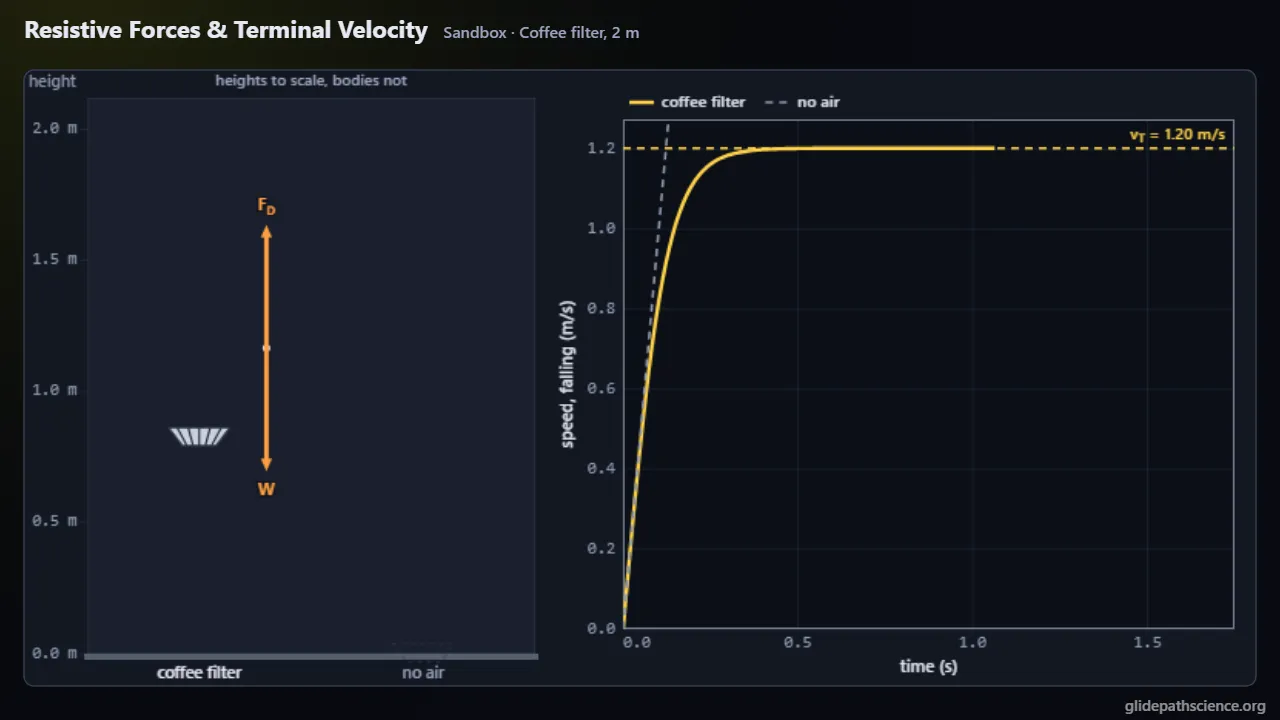
    • A coffee filter ready to drop from 2.00 m with its weight drawn and its drag still zero, beside a speed–time chart marked with its terminal speed of 1.20 m/s.New

      Resistive Forces & Terminal Velocity

      Drop a coffee filter, a steel ball, a raindrop or a skydiver and watch drag grow until it balances the weight, then compare linear and quadratic drag and fit the drag law to falling filters.
      • Mechanics
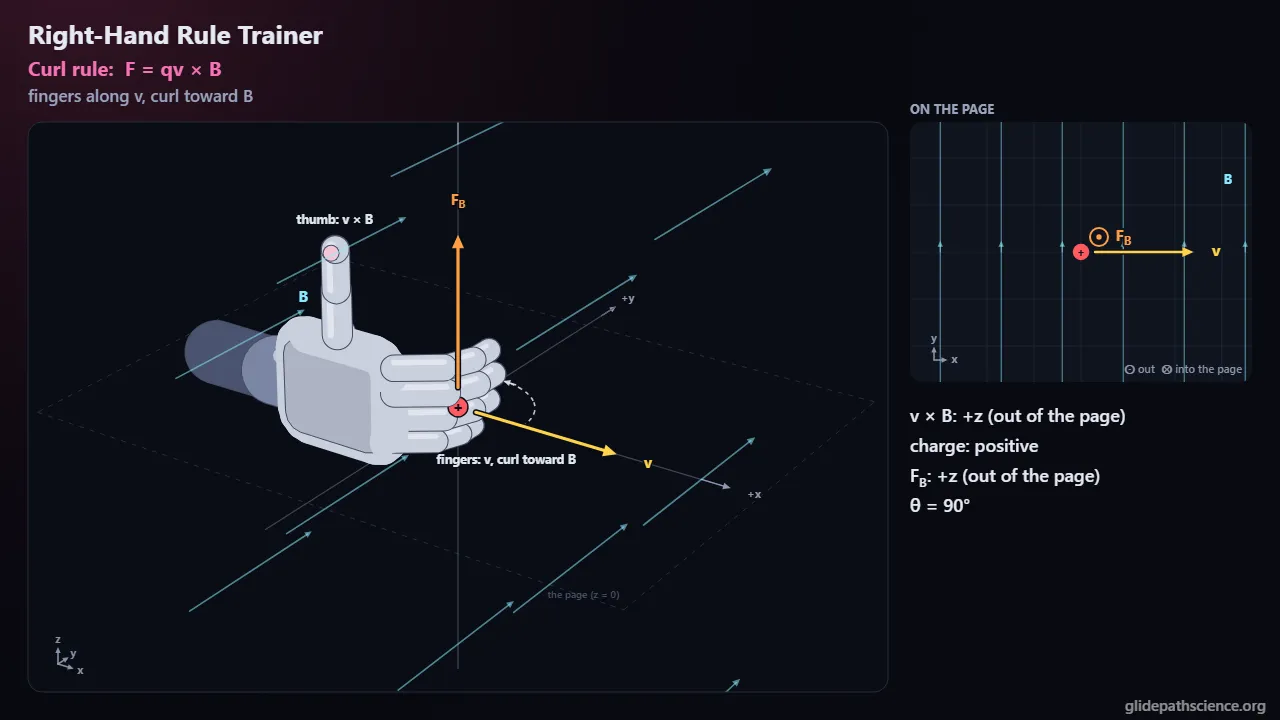
    • A 3-D right hand showing the curl rule, fingers along v curling toward B and the thumb along the force, beside the same scene drawn on the page with the force out of the page.New

      Right-Hand Rule Trainer

      Point, curl and grasp: practice every right-hand rule in magnetism with a 3-D hand, page diagrams and timed drills.
      • Electricity & Magnetism
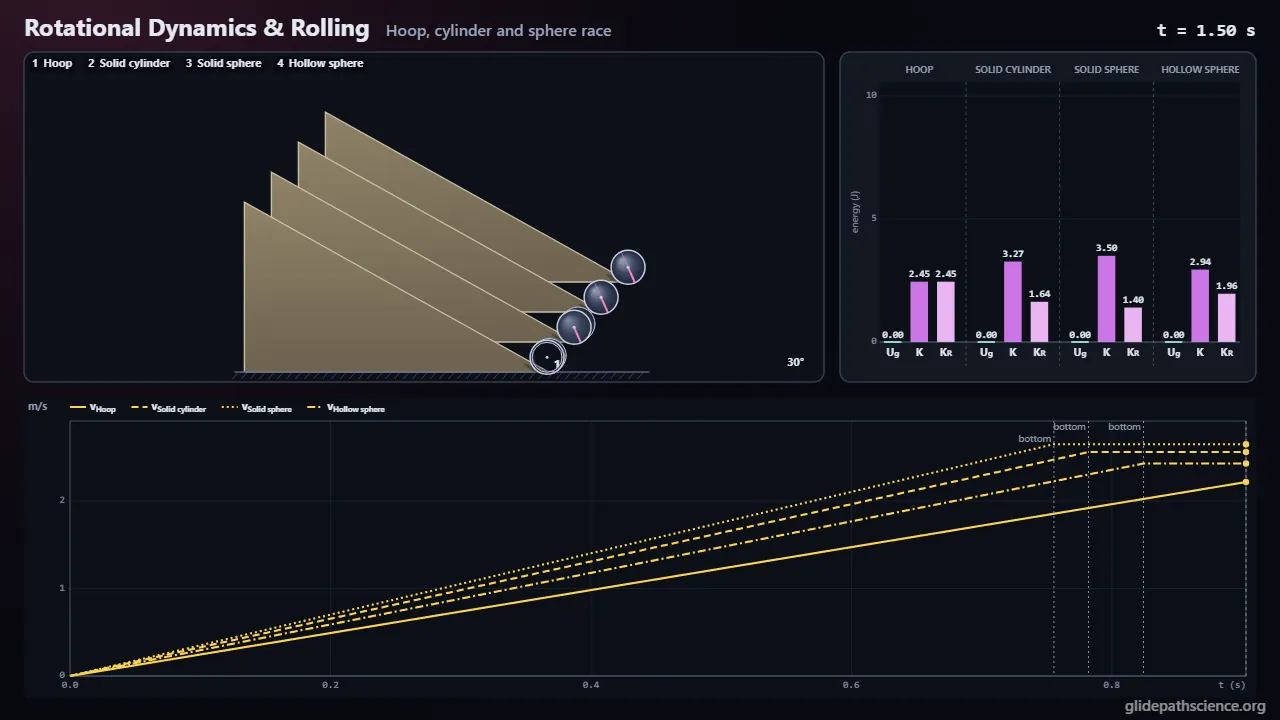
    • A hoop, a solid cylinder, a solid sphere and a hollow sphere racing down four 30° ramps, with energy bars for each and their speeds against time; the solid sphere reaches the bottom first.New

      Rotational Dynamics & Rolling

      Spin hoops, disks and spheres: torque and angular acceleration, moment of inertia by shape, a heavy pulley, rolling races where the hoop always loses, skids, backspin, a lab bench that measures I and a race track.
      • Mechanics
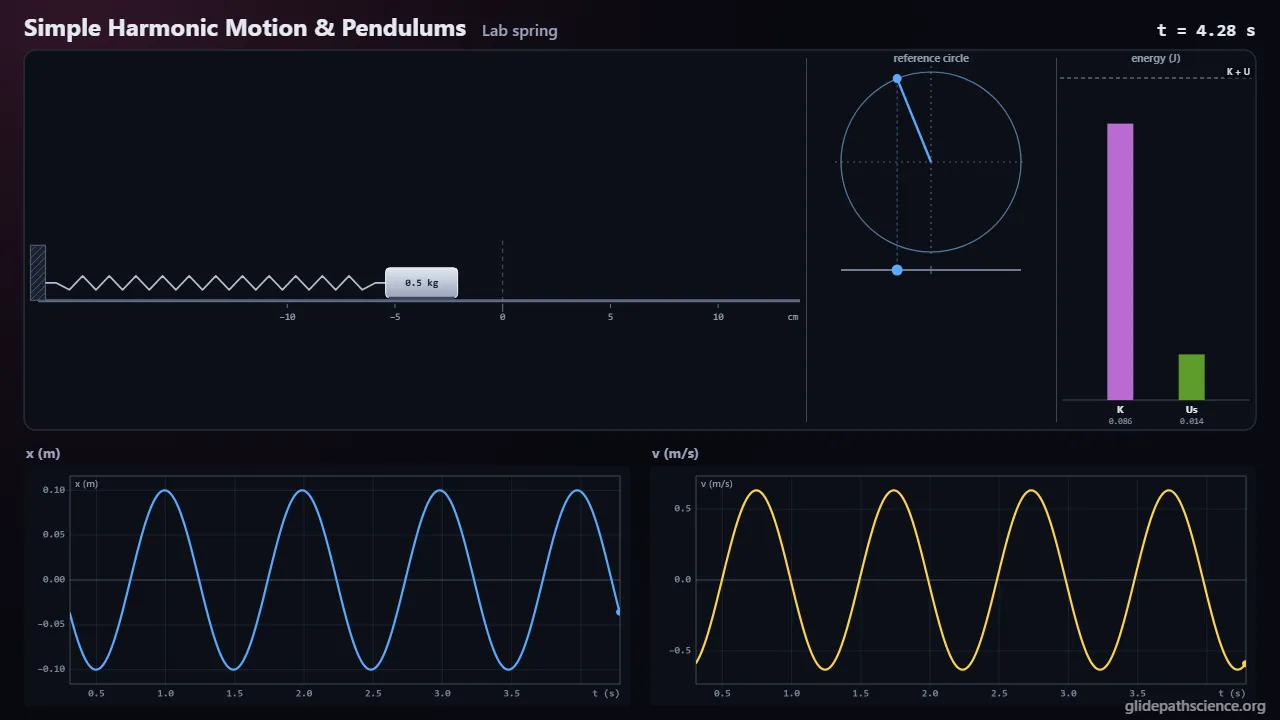
    • A mass on a spring with its reference circle and energy bars, above its position and velocity traces.New

      Simple Harmonic Motion & Pendulums

      Springs and pendulums keep time: read the period, see SHM as the shadow of circular motion, damp it, drive it to resonance, time a wide-swinging pendulum, and fit noisy sensor data.
      • Mechanics
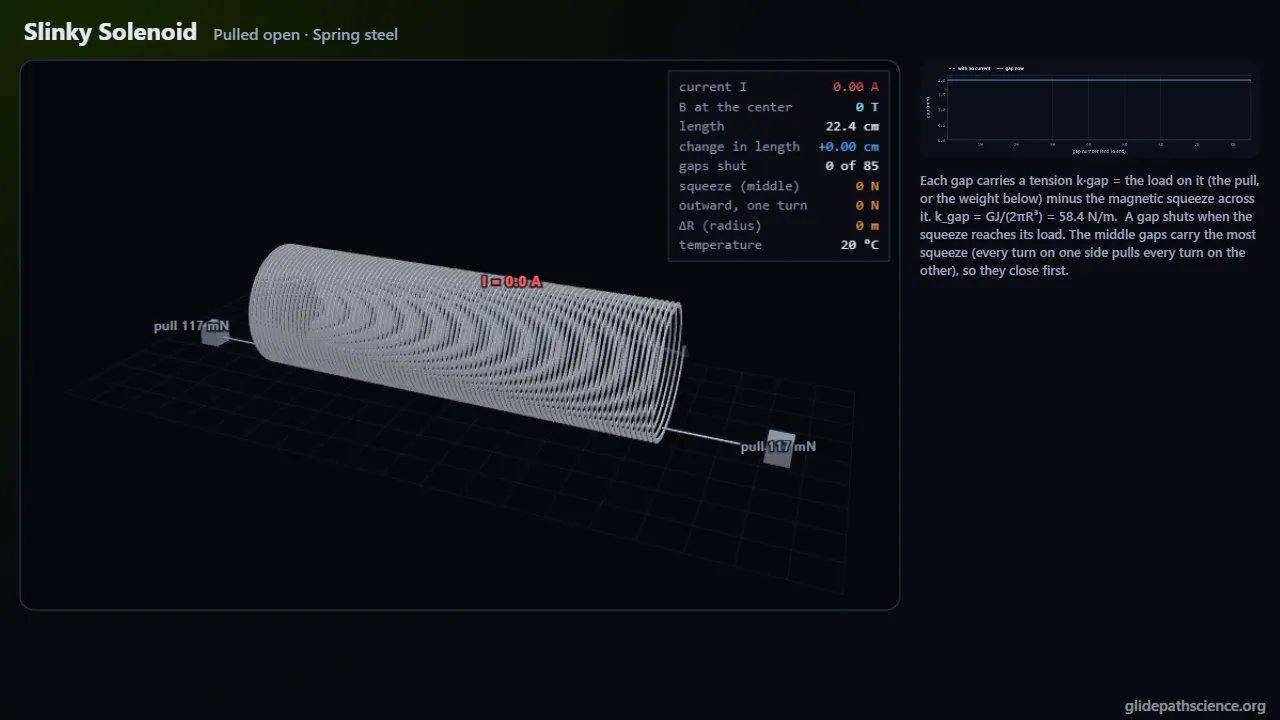
    • A steel coil in 3-D held open by a pull at each end, with readouts of current, field, and how many gaps are shut.New

      Slinky Solenoid

      Run a current through a Slinky: measure B = μ₀nI as you stretch it, then watch every turn pull every other turn until the coil snaps shut.
      • Electricity & Magnetism
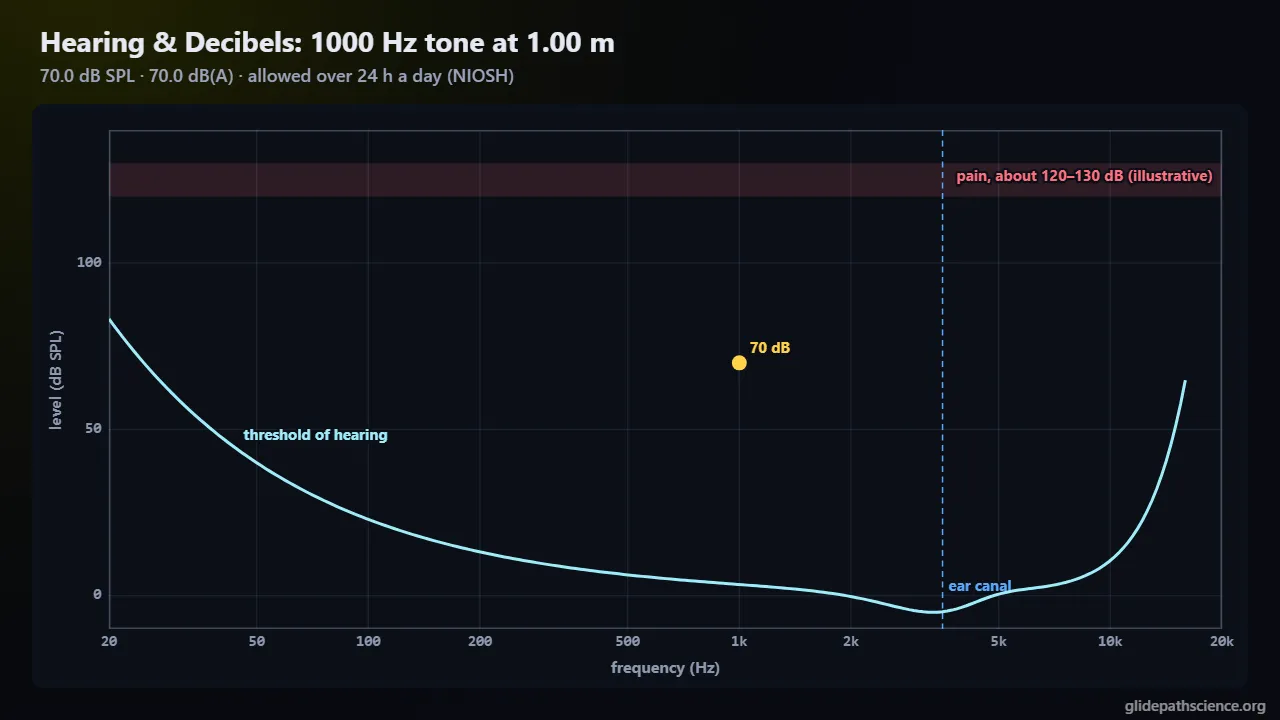
    • The threshold of hearing from 20 Hz to 20 kHz, dipping near the ear canal’s resonance, with a 1000 Hz tone at 70 dB marked and the region of pain shaded near 120 to 130 dB.New

      Sound & Resonance Tubes

      Find the resonances of open and closed tubes, measure the speed of sound, and predict it from the gas: air, helium, or CO₂. Then decibels, the ear’s range, and its 3 kHz resonance, with sound you can hear.
      • Waves & Optics
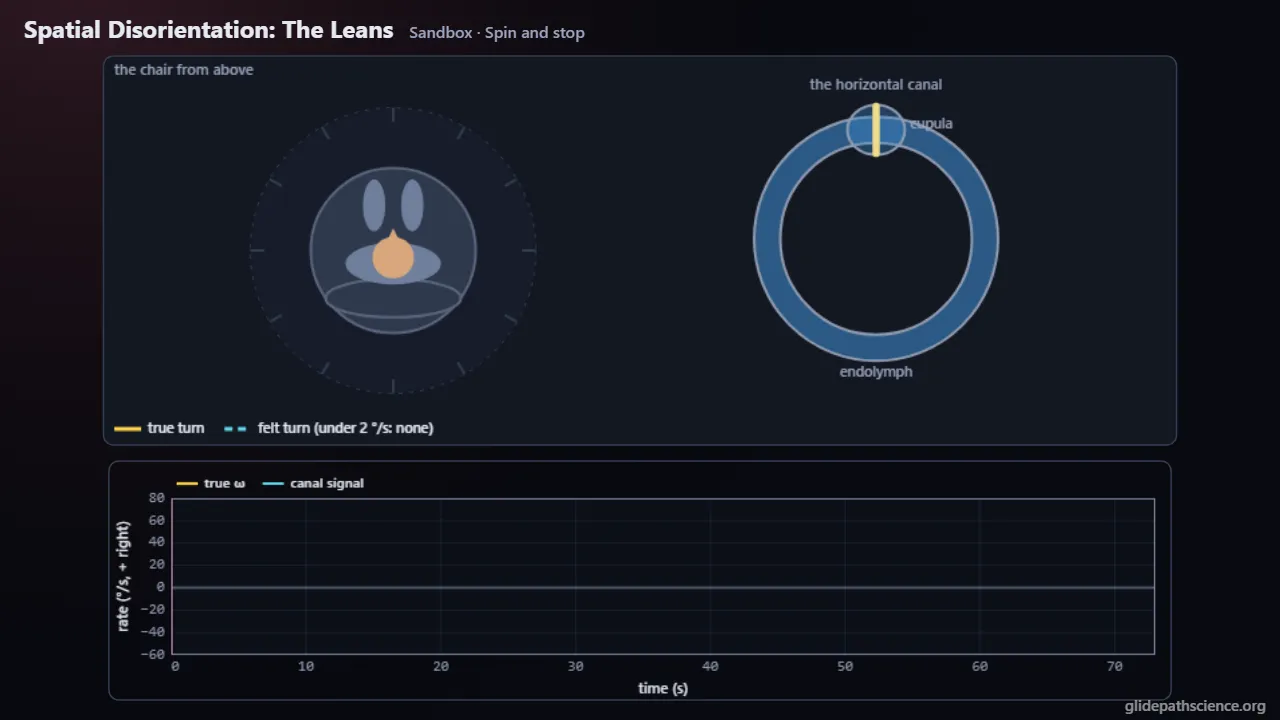
    • A rider on a rotating chair seen from above beside a drawing of the horizontal semicircular canal and its cupula, with a chart ready to plot the true rotation rate against what the canal reports.New

      Spatial Disorientation: The Leans

      Spin a chair and fly in cloud: the inner ear senses changes in rotation, not rotation, so a steady turn fades, a stop feels like turning back, and leveling the wings brings on the leans.
      • Biology
      • Mechanics
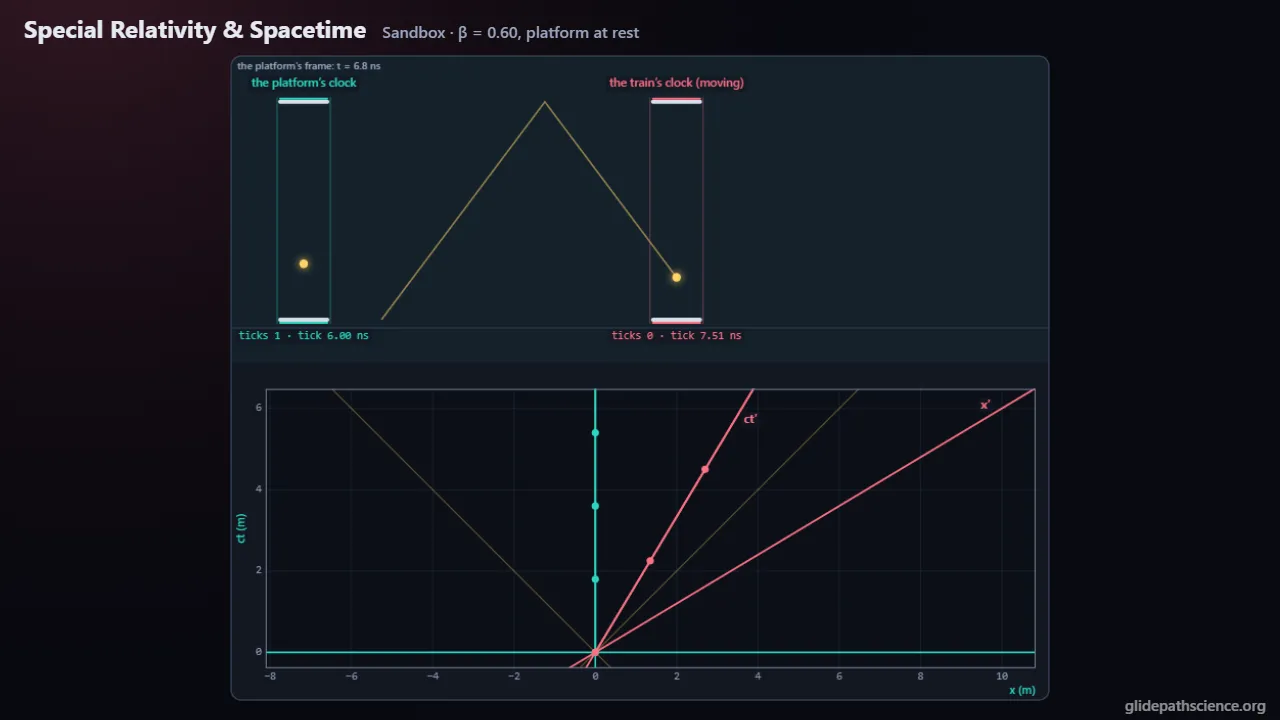
    • Two light clocks at 0.60c in the platform’s frame: the platform’s clock ticking every 6.00 ns and the moving train’s clock every 7.51 ns, its photon on a slanted path, above a spacetime diagram with the train’s tilted ct′ and x′ axes and light lines at 45°.New

      Special Relativity & Spacetime

      One speed of light for everyone, so clocks and rulers disagree: light clocks, time dilation, contraction, the lightning train, spacetime diagrams, a twin's voyage by birthday signals, muons and GPS clocks.
      • Thermal & Modern Physics
      • Astronomy & Space Science
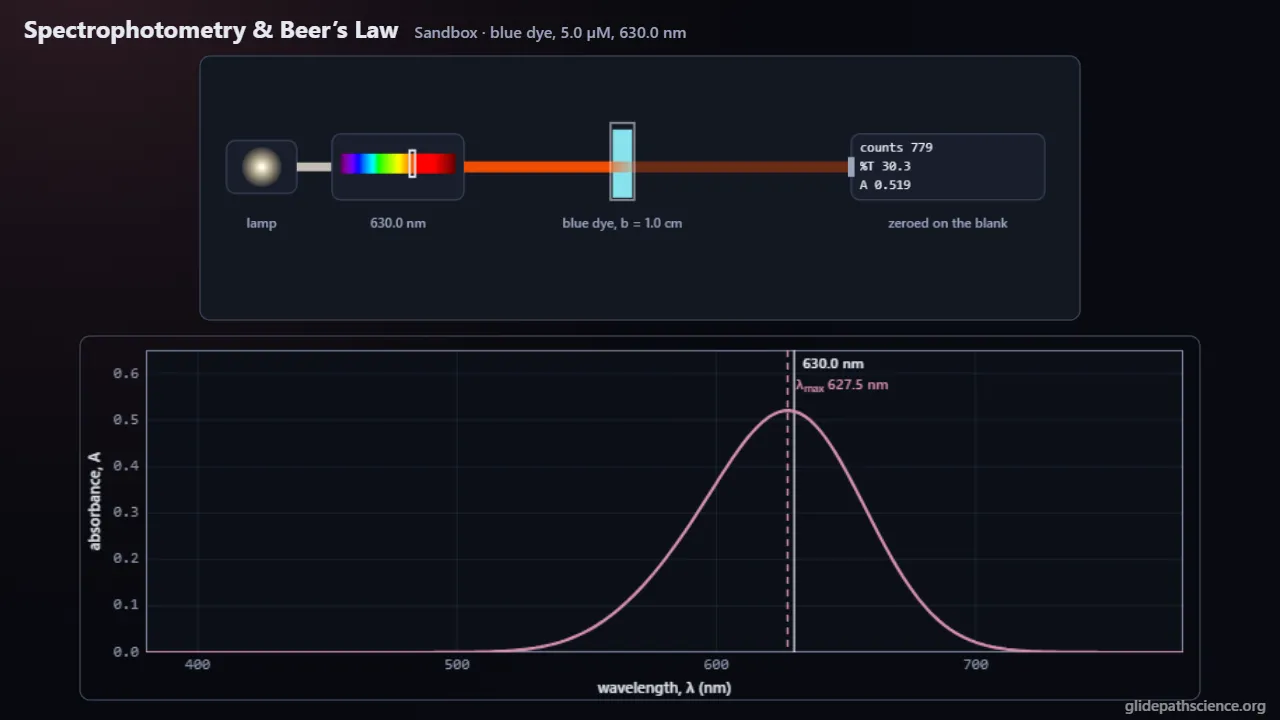
    • A single-beam spectrophotometer with a lamp, a monochromator set to 630 nm and a cuvette of blue dye, its detector reading 30.3 %T and an absorbance of 0.519, above the dye’s absorption spectrum peaking near 628 nm.New

      Spectrophotometry & Beer’s Law

      Shine one color of light through a dye, turn %T into absorbance, find λmax and watch A grow with concentration and path, then build a calibration line from standards and find an unknown.
      • Chemistry
      • Waves & Optics
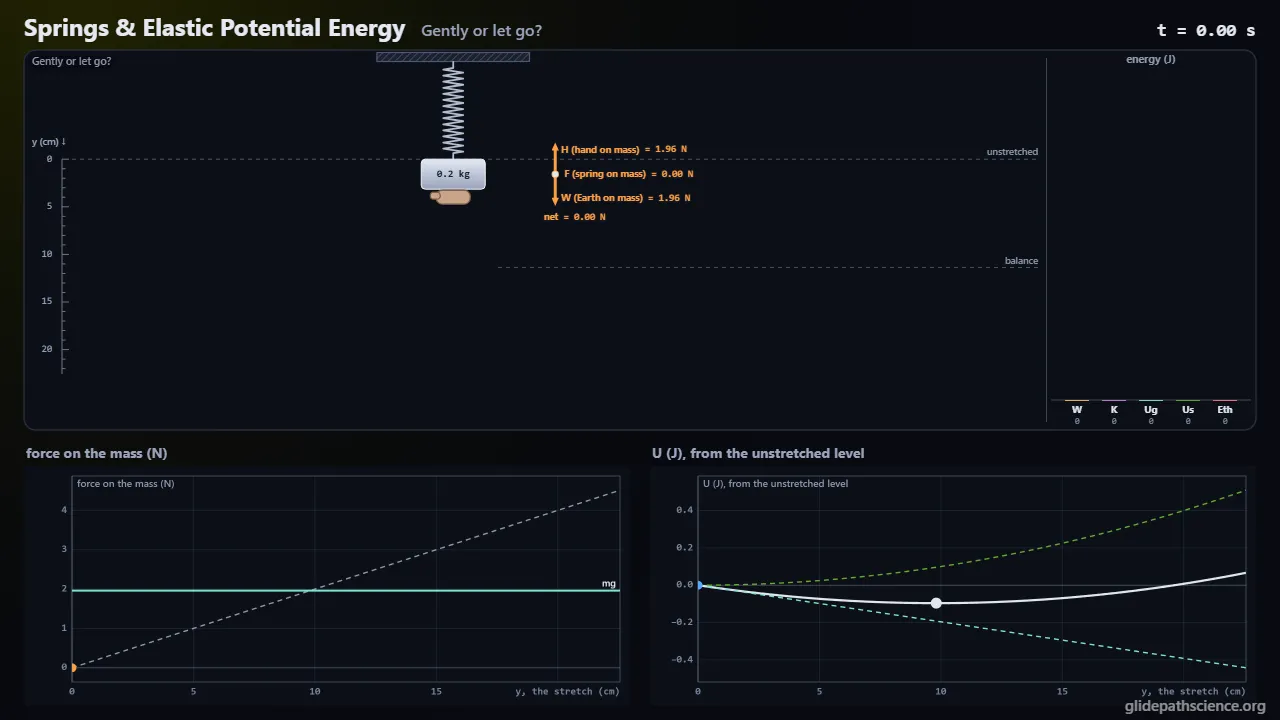
    • A spring stretched by a hand or a hanging mass, with force against stretch and the stored elastic energy.New

      Springs & Elastic Potential Energy

      Stretch, combine and hang springs: Hooke's law, series and parallel, energy as the area under F(x), the missing half, potential-energy wells and stability, and what real springs do.
      • Mechanics
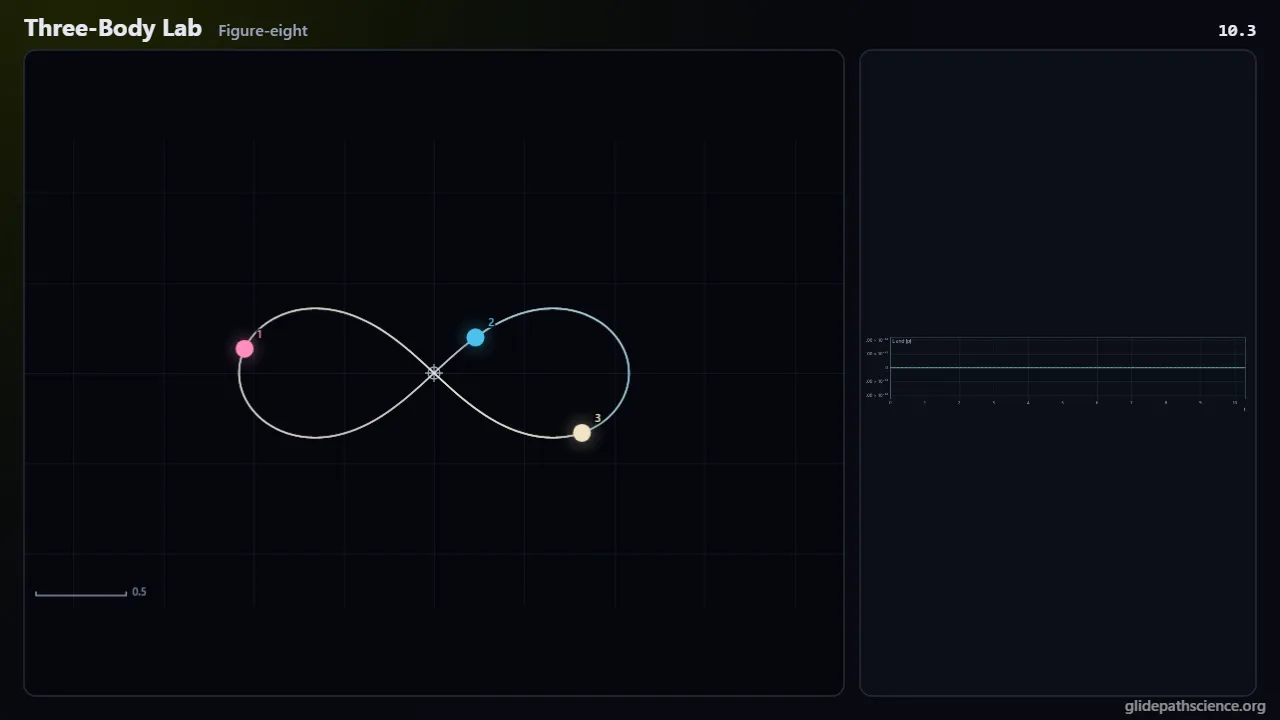
    • Three equal masses chasing one another around the figure-eight orbit, with the trail of the eight and an energy chart beside it.New

      Three-Body Lab

      Two bodies follow Kepler's ellipses; add a third and the formulas run out. Lagrange points, Trojan tadpoles, gravity assists, the figure-eight, measurable chaos, and the integrators that make orbits trustworthy.
      • Astronomy & Space Science
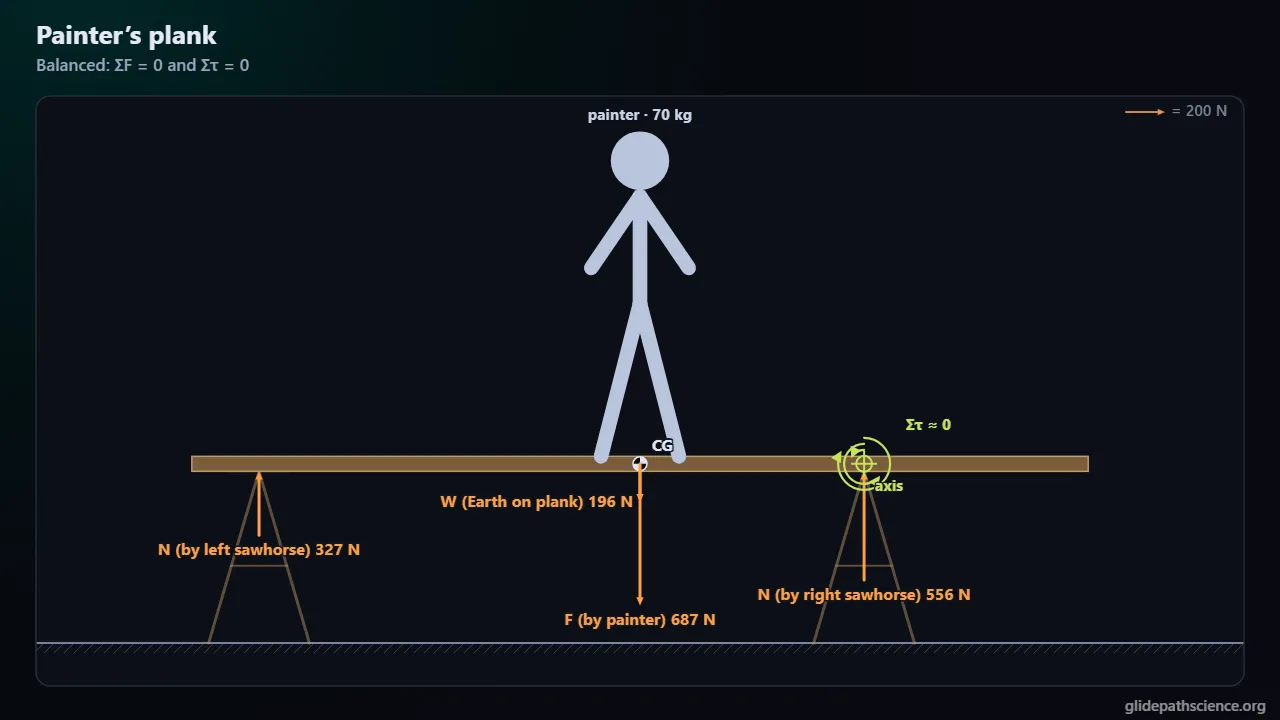
    • A painter standing on a plank across two sawhorses, with every force drawn and labeled by its agent, the plank’s center of gravity, and the torques about an axis at the right sawhorse summing to zero.New

      Torque & Static Equilibrium

      Push a door, balance a seesaw, hang a sign from a strut, climb a ladder until it slips, hold a dumbbell, and load an airplane inside its CG envelope: torque, both equilibrium conditions, and tipping.
      • Mechanics
      • Engineering
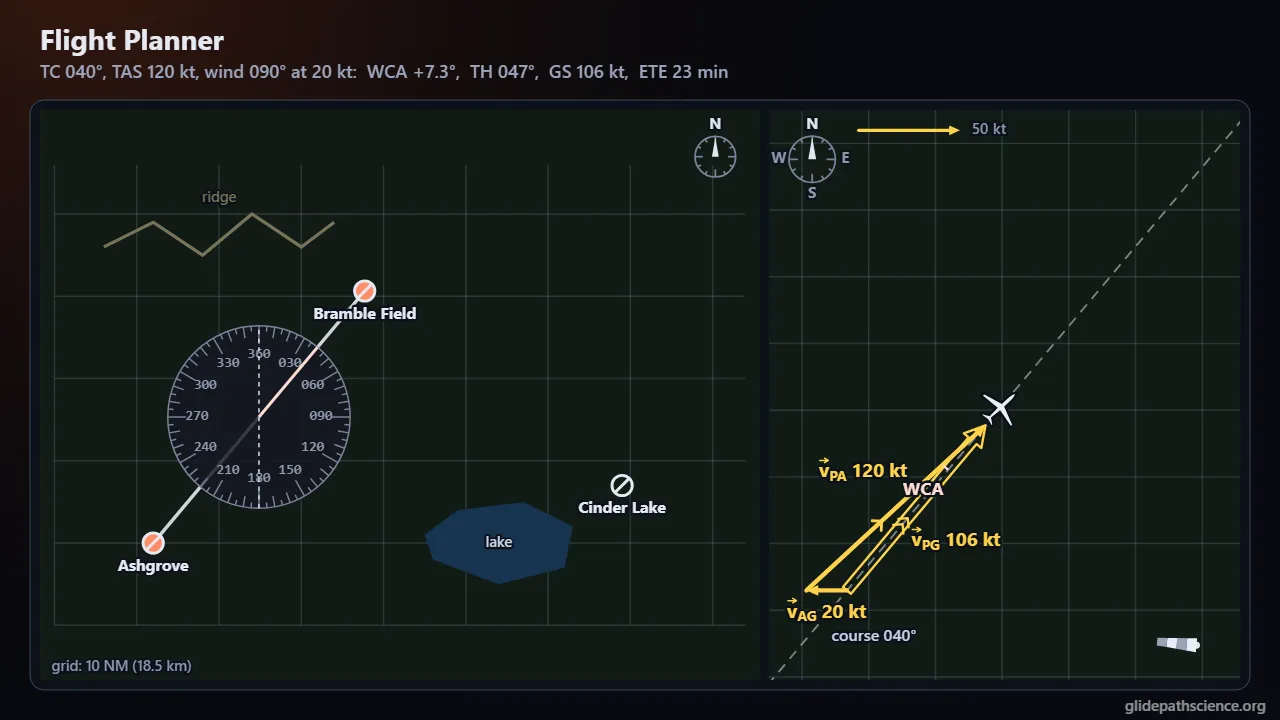
    • A fictional training chart with a course from Ashgrove to Bramble Field and a compass rose, beside the wind triangle of airspeed, wind, and groundspeed vectors that sets the wind correction angle.New

      Vectors, Relative Motion & Wind Triangles

      Add and resolve vectors by dragging, then use them: cross a river, watch rain from a moving car, spot a collision course, and plan a flight the way pilots do with the wind triangle.
      • Mechanics
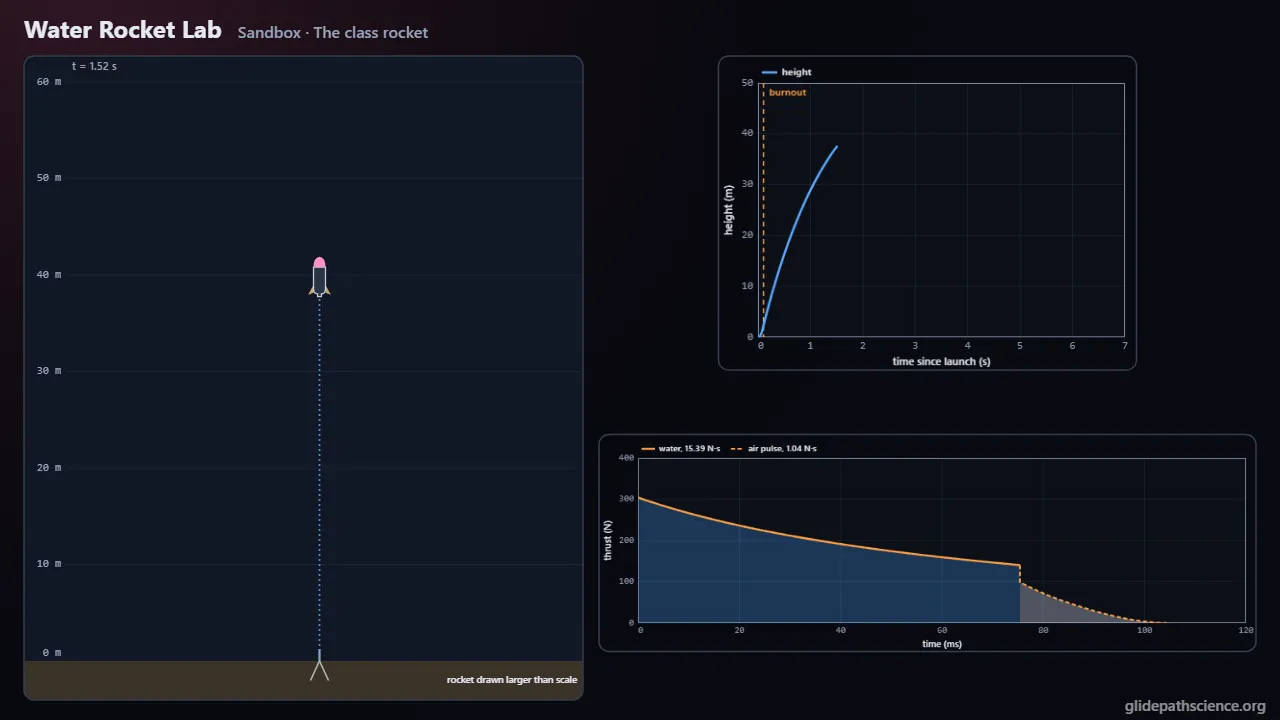
    • A bottle rocket lifting off its pad against a height scale to 60 m, beside a chart of height against time, for the class rocket with 33 % water at 400 kPa, which reaches an apogee of 45.9 m.New

      Water Rocket Lab

      Fill a bottle rocket, pump it up and launch it to see thrust as momentum flow, why the expanding air sets the burn, why there is a best fill, and how drag cuts the climb.
      • Engineering
      • Mechanics
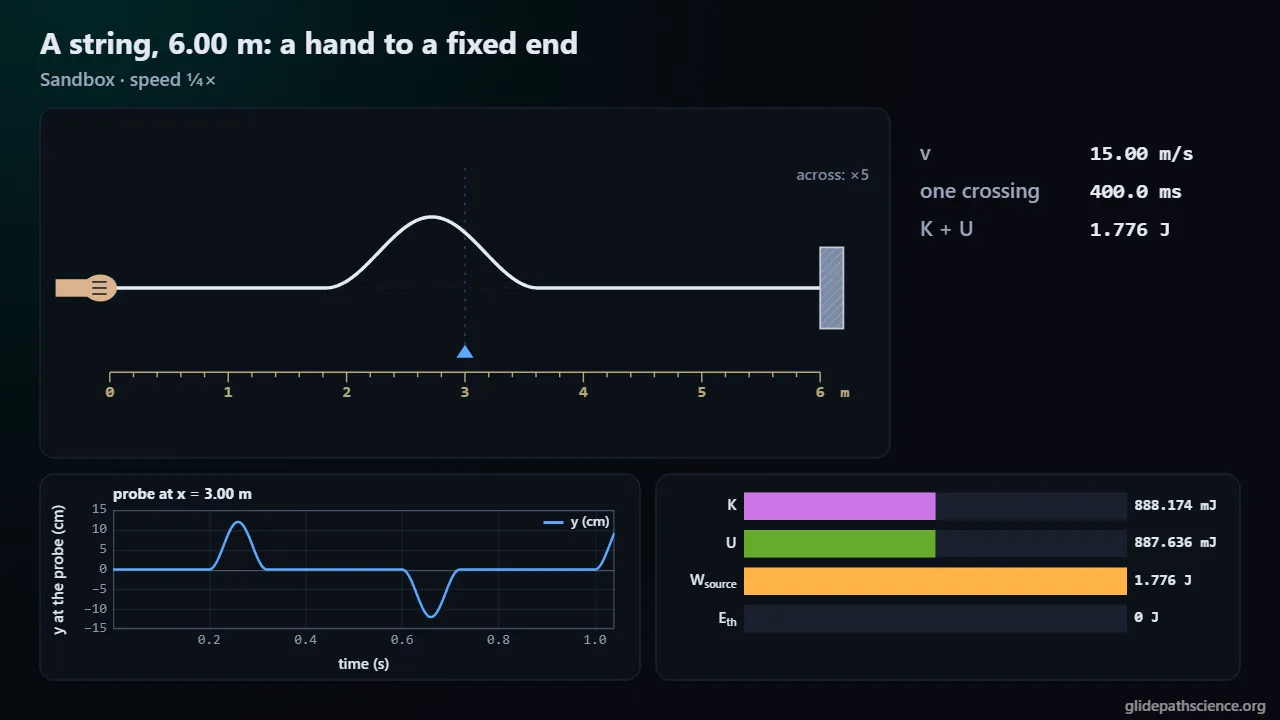
    • A pulse traveling along a 6 m string from a hand toward a fixed end, with the wave speed, a probe’s record of the pulse and its inverted reflection, and bars for kinetic and potential energy.New

      Waves on a String

      Send pulses down a string and a spring: see what sets their speed, how they reflect and pass through each other, and how standing waves pick out the harmonics; then measure them with a camera and a vibrator.
      • Waves & Optics
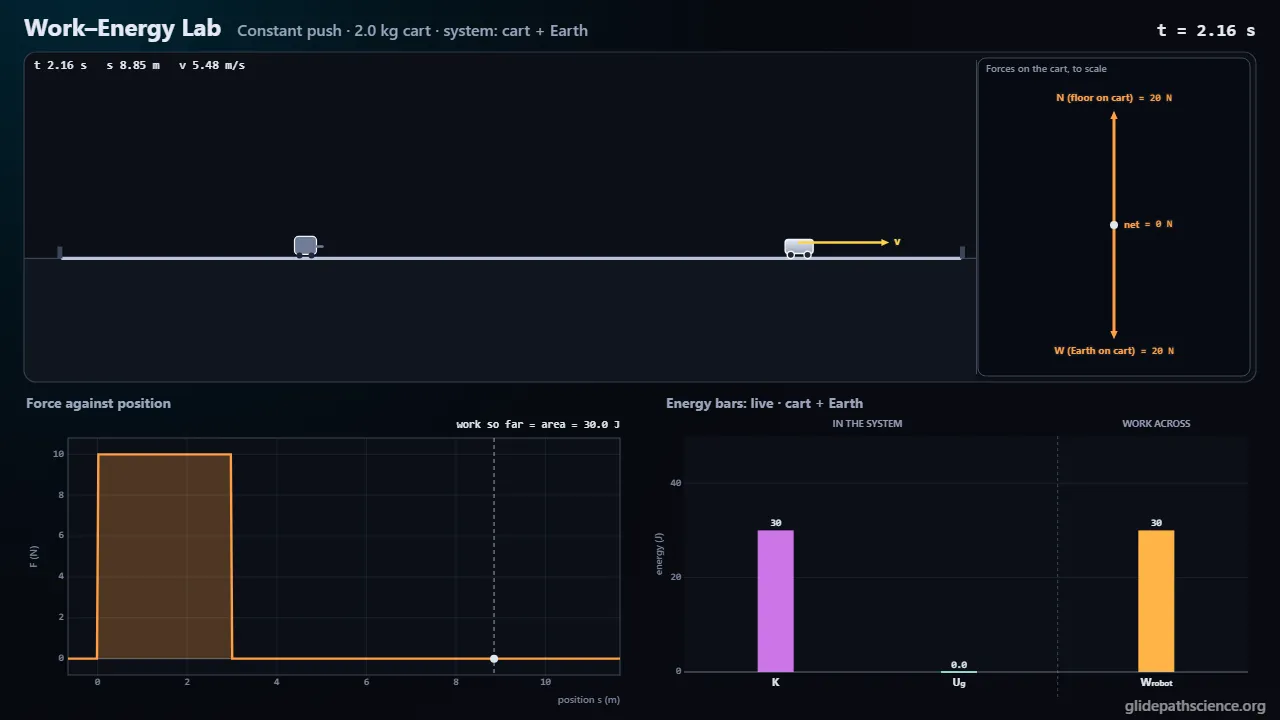
    • A pushed cart on a level track with its force diagram, the force-against-position chart with the work shaded, and live energy bars.New

      Work–Energy Lab

      Work as the area under F(x): push a cart with a force you draw, launch it with a spring, stop it with friction, and follow every joule between kinetic, potential and thermal energy in the system you choose.

      • Mechanics