
NewVersion 1.1
Heat, Calorimetry & Phase Changes
Drop hot metals into a calorimeter to find specific heats, take ice to steam along a heating curve, and see why evaporation cools, what sets the dew point and why humid air feels hotter.
About this simulation
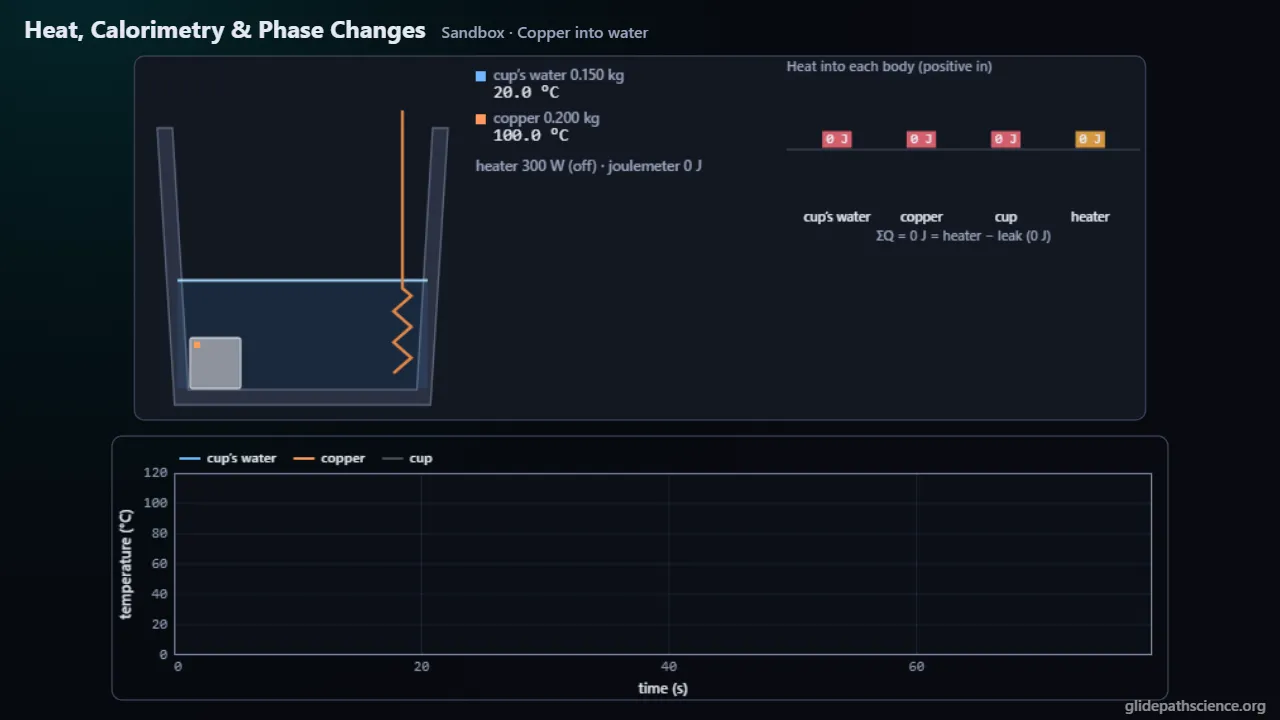
Where does the heat go while the thermometer stands still? Students fill an insulated cup with water and up to three samples, hot metals, ice, steam, glass or stone, each with its own thermometer, then stir, heat and watch the temperatures meet while the heat books close. A guided walkthrough at two levels runs from thermal equilibrium and kelvins through Q = mcΔT, mixing, finding a specific heat, latent heat and ice to steam, to ice in a drink and sweat on a humid day; the Advanced track adds Dulong–Petit, the leak correction, supercooling, Clausius–Clapeyron, phase diagrams and the wet bulb. A Calorimetry Bench reproduces a school lab, noisy probe and leaky calorimeter included, to name five unknown metals; a Heating Curve takes water from ice to steam at sea level, in Denver, on Everest or in a pressure cooker; and a Humidity Lab reads humidity, dew points and the wet bulb with a sling psychrometer. A concept challenge and a prediction lab with fresh numbers round it out.
What you'll learn
- Distinguish temperature, which evens out when bodies touch, from heat, which is energy moving because of a temperature difference, and from internal energy, which is what a body holds.
- Use Q = mcΔT, and the rule that the heats in an insulated calorimeter add to zero, to find a final temperature or a specific heat.
- Use Q = mL to explain the plateaus of a heating curve, mixtures that end partly melted, and boiling points that move with pressure.
- Explain why evaporation cools, as the fastest molecules leave, and why the wet-bulb temperature is the floor for evaporative cooling on a humid day.
What you can do
- Guided walkthroughStep-by-step, in Intro and Advanced tracks.
- SandboxEvery control of the model, to explore freely.
- Virtual labA realistic experiment with measurement noise and data analysis.
- Concept checksQuestions about ideas and vocabulary, with no calculating.
- PredictionCommit to a prediction, then see the result.
- Classroom demoProjector mode and recordable clips for slides.
- Works offlineA single downloadable file, verified to run without a network.
Before you start
- Energy, power and the joule
- Mass, and reading a graph of a quantity against time
- For the Advanced track: exponentials and logarithms, and simple integrals
Run or download
Run it in your browser
Nothing to install and no account. Works on laptops, Chromebooks, tablets, and phones.
Launch Heat, Calorimetry & Phase ChangesDownload for offline use
One HTML file (736 kB) that opens in any modern browser with no network: for rooms with unreliable Wi-Fi, or to keep a copy.
Download the fileFile details and checksum
- File
heat-calorimetry-phase-changes-v1.1.html- Version
- 1.1, released November 15, 2026
- Build
7d0ed50- Size
- 753,190 bytes
- SHA-256
de8730ef78aca6eee1701742c8bb7f0d4ddf0ecc3f763e54938ff8095a506c15- Offline
- Checked to run with all network access blocked.
The model and its limits
What the model assumes
- Each body is a material and a mass whose state is its enthalpy: its temperature rises linearly within a phase and stays flat across each phase change, so a body on a plateau carries the share already melted or boiled.
- Equilibrium is found exactly from the total enthalpy, plus the heater’s work and minus any leak, and every answer key comes from it.
- During a run, heat moves between bodies through stated conductances and every joule is booked on both sides, so the books close to rounding.
- Specific and latent heats are the textbook set (water 4186 J/(kg·K), 334 kJ/kg to melt ice, 2256 kJ/kg to boil water); vapor pressure follows the IAPWS formulations over water and ice.
- The Calorimetry Bench’s probe has noise and a lag, the bath and the starting water vary, and the calorimeter leaks a little, so repeated trials scatter like a real lab’s.
What it leaves out
- No temperature differences inside a body and no model of conduction, convection or radiation, so heating-curve plateaus stay flat and sharp-cornered at any power.
- No thermal expansion, no heat capacities that change with temperature (except on the Debye chart), no heats of solution or reaction, no superheating, and no evaporation from the cup during a run.
- Supercooling appears only as drawn curves, not in the cup’s runs.
- Molecules are shown as an energy distribution, not as a box of particles.
Cite this simulation
APA 7
Meier, D. (2026). Heat, Calorimetry & Phase Changes (Version 1.1) [Computer simulation]. Glidepath Science. https://glidepathscience.org/simulations/heat-calorimetry-phase-changes/
MLA 9
Meier, David. Heat, Calorimetry & Phase Changes. Version 1.1, Glidepath Science, 2026, glidepathscience.org/simulations/heat-calorimetry-phase-changes/.
AIP
D. Meier, Heat, Calorimetry & Phase Changes, version 1.1 (Glidepath Science, 2026), https://glidepathscience.org/simulations/heat-calorimetry-phase-changes/.
BibTeX
@misc{meier2026heatcalorimetryphasechanges,
  author       = {Meier, David},
  title        = {{Heat, Calorimetry & Phase Changes}},
  year         = {2026},
  publisher    = {Glidepath Science},
  version      = {1.1},
  note         = {Interactive simulation, version 1.1},
  howpublished = {\url{https://glidepathscience.org/simulations/heat-calorimetry-phase-changes/}},
  url          = {https://glidepathscience.org/simulations/heat-calorimetry-phase-changes/}
}
Credits and license
Created by Dr. David Meier, Glidepath Science.
Based on: OpenStax, University Physics Volume 2, by Samuel J. Ling, Jeff Sanny and William Moebs: Chapter 1, “Temperature and Heat” (§1.1, 1.2, 1.4 and 1.5), an open textbook licensed CC BY-NC-SA 4.0 (openstax.org). The order of topics and the notation follow it; the wording, numbers, figures and simulations are this lab’s own. No endorsement by OpenStax or the authors is implied.
Licensed under Creative Commons Attribution-NonCommercial-ShareAlike 4.0 International (CC BY-NC-SA 4.0). You may share and adapt it for noncommercial purposes, such as teaching, with credit and under the same license. Licensing and reuse
AI tools (Claude, from Anthropic, and ChatGPT, from OpenAI) were used in developing Glidepath Science and its simulations. Dr. David Meier reviewed, edited, and modified every release version.