
Interactive science simulations

Bring Science to Life

Explore scientific phenomena through interactive models, guided predictions, virtual experiments, and hands-on discovery.

  • Free to useNo accounts, no ads
  • Runs in your browserLaptops, Chromebooks, tablets, phones
  • Learn at your own paceHints, instant feedback, and two tracks

Selected from the library.

See the catalog

Featured simulation

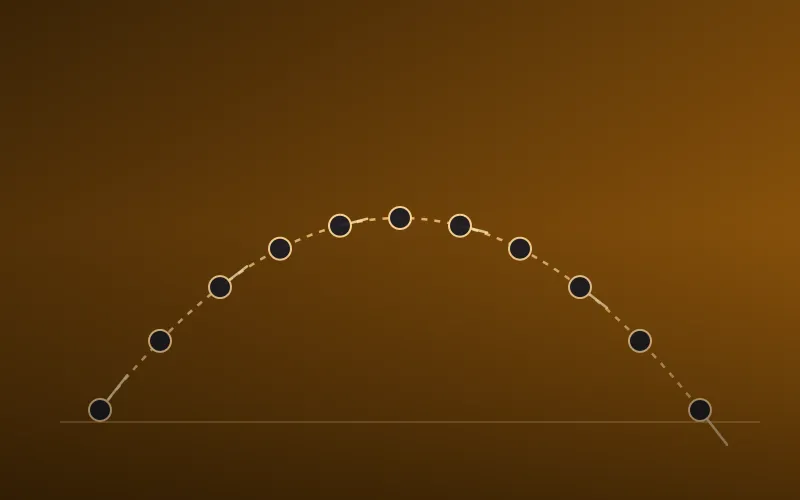
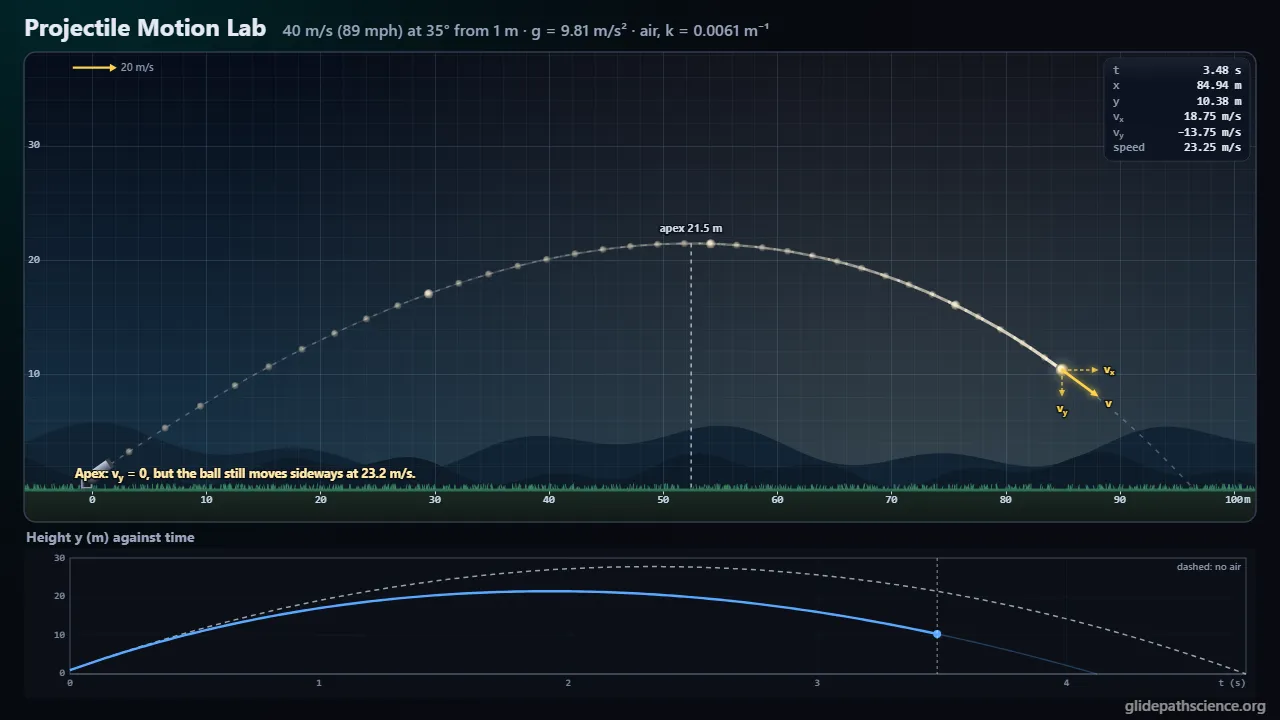
Projectile Motion Lab

Launch at any speed, angle and height, on Earth, Mars or the Moon, with or without air and wind. Compare paths, see drag pull the best angle below 45°, hit targets, and fit a launch to video data.

  • Guided walkthrough
  • Sandbox
  • Virtual lab
  • Concept checks
  • Prediction
  • Classroom demo
  • Works offline

Version 1.9  |  Released November 28, 2026

  • A buret on a ring stand over a flask on a stir plate with a pH meter, beside the S-shaped titration curve rising through the equivalence point.New

    Acid–Base Titration Lab

    Titrate acids and bases with a buret and a pH meter: see why equivalence is not neutral, how buffers resist, how to choose an indicator, and how to get Vₑ, the concentration and Kₐ from noisy data.

    • Chemistry
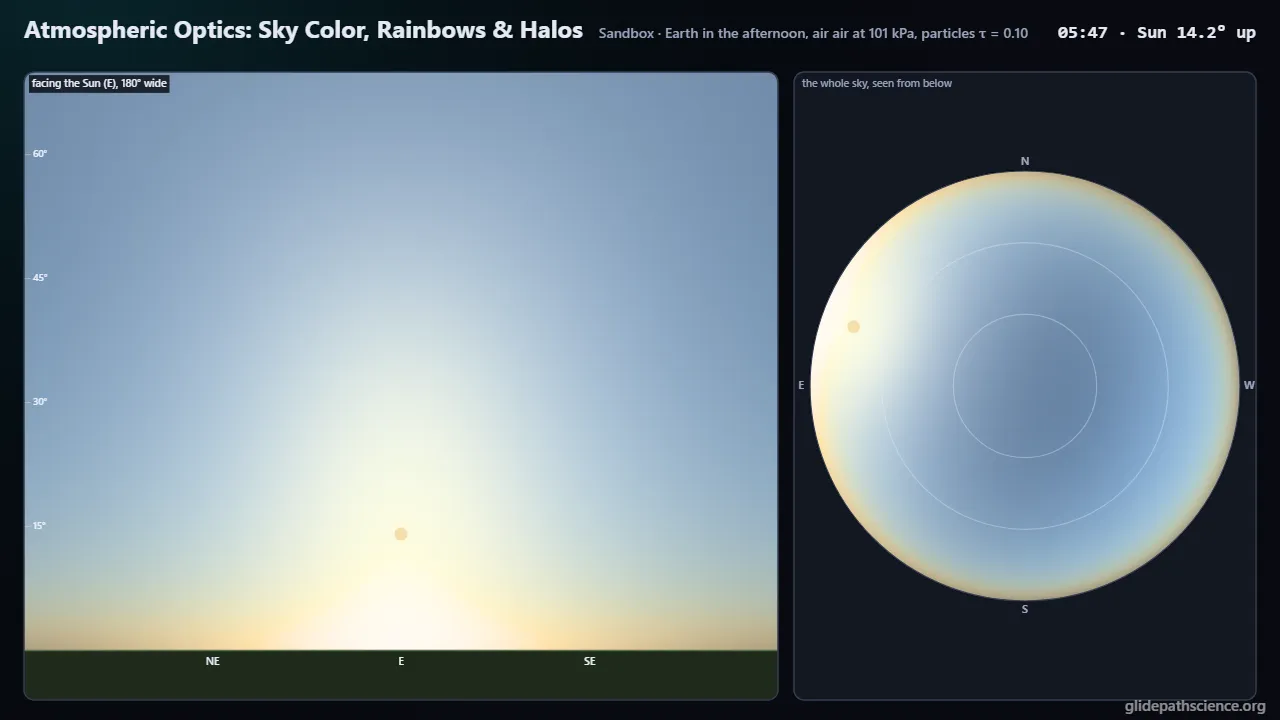
  • A sunlit afternoon sky toward the Sun and a whole-sky view from below, the sky's color computed from sunlight scattered by air.New

    Atmospheric Optics: Sky Color, Rainbows & Halos

    Paint a sky from the physics, from blue noon to red sunset on Earth, Mars, Titan and the Moon, then build the rainbow from Descartes to Airy and find halos and sun dogs from ice prisms.

    • Waves & Optics
    • Earth & Atmospheric Science
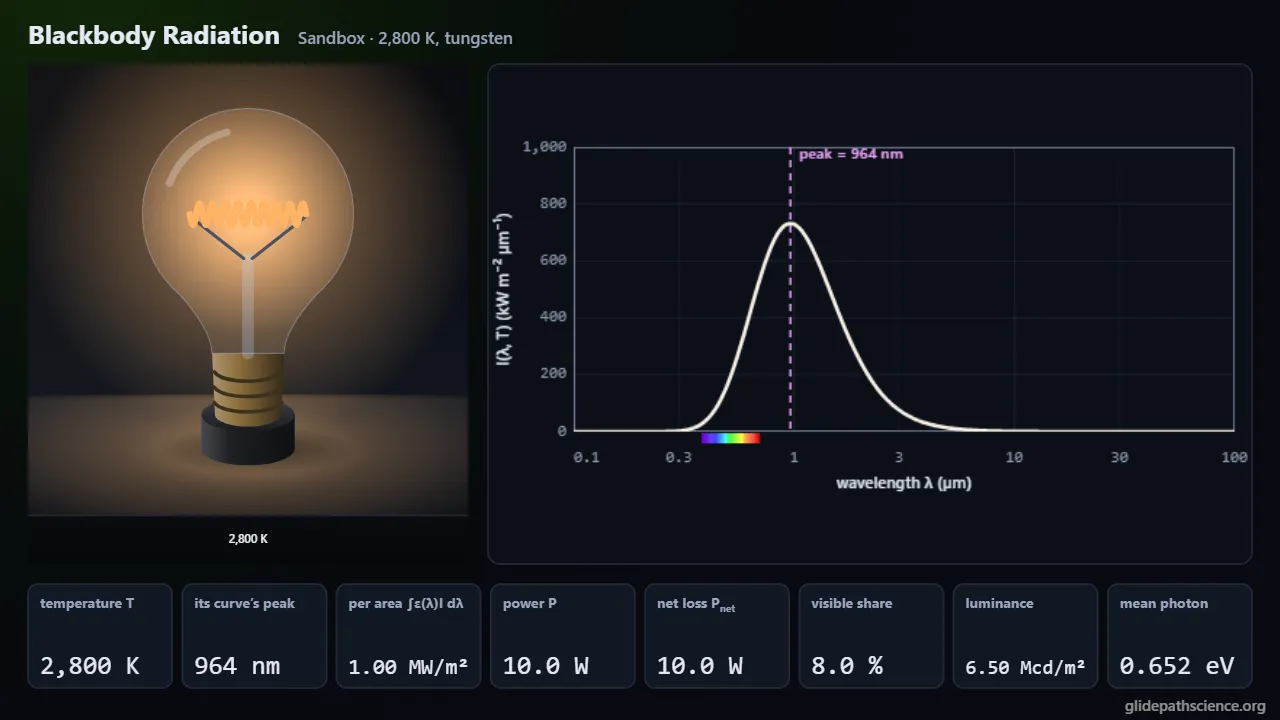
  • A light bulb glowing at 2,800 K on a bench in a dark room, its light pooling in the same warm color, beside its emission spectrum peaking in the near infrared just past the visible band.New

    Blackbody Radiation

    Heat a body and watch its true color slide from red through white to blue: Wien’s and Stefan’s laws, the ultraviolet catastrophe and Planck’s quanta, a spectrometer bench, stars on an HR diagram, and the CMB.

    • Thermal & Modern Physics
    • Astronomy & Space Science
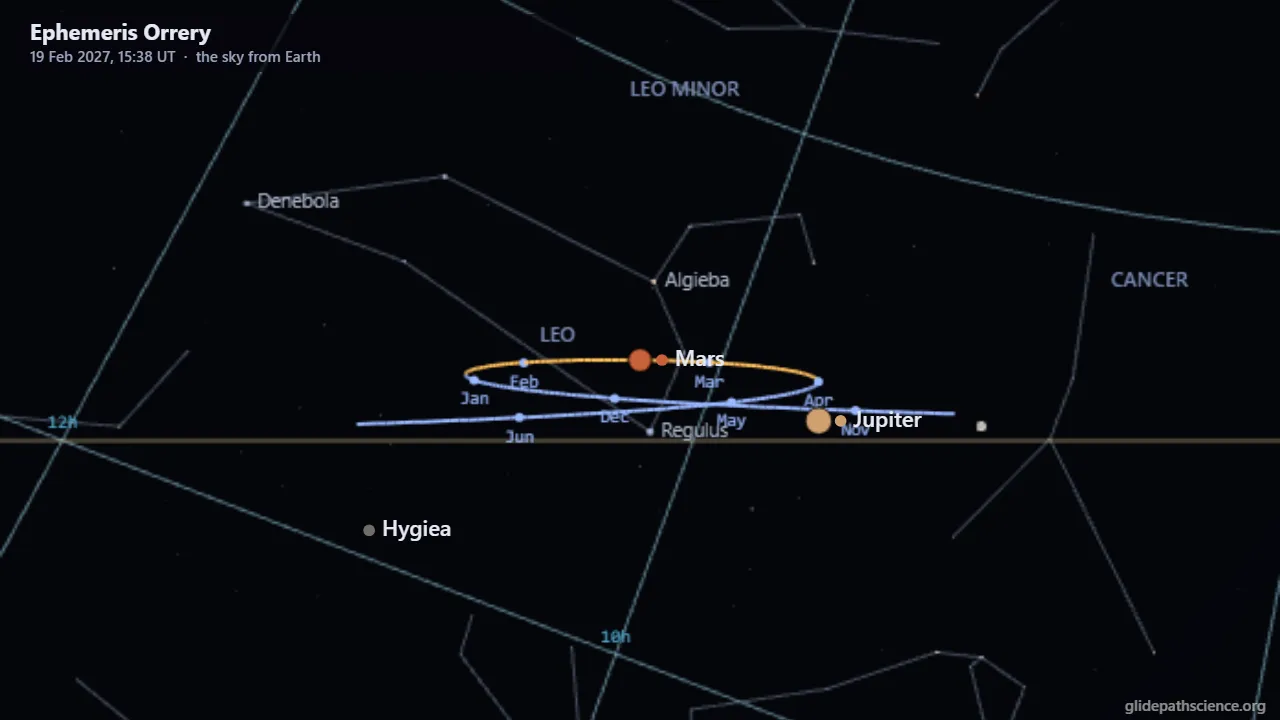
  • The sky from Earth on 19 February 2027, with Mars at opposition tracing its retrograde loop among the stars of Leo near Regulus, its path labeled by month, and Jupiter nearby.New

    Ephemeris Orrery

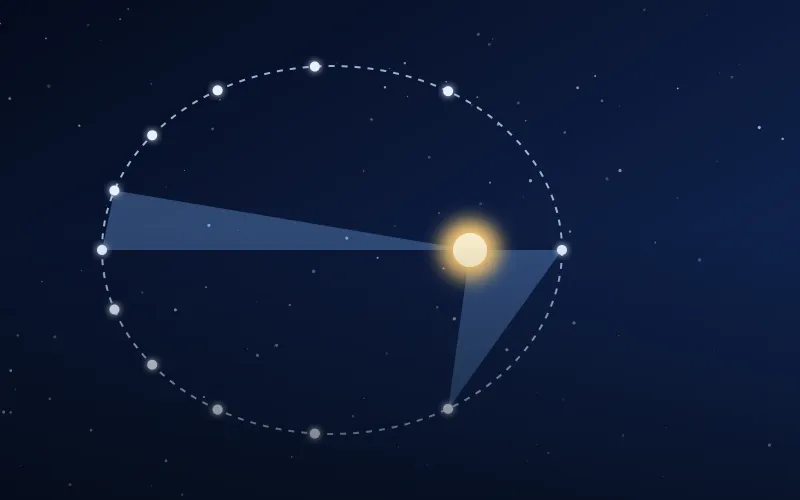
    The solar system in its real positions on any date, from space and from Earth's center: tours, eclipses and oppositions, measuring tools, Kepler's laws and predictions.

    • Astronomy & Space Science
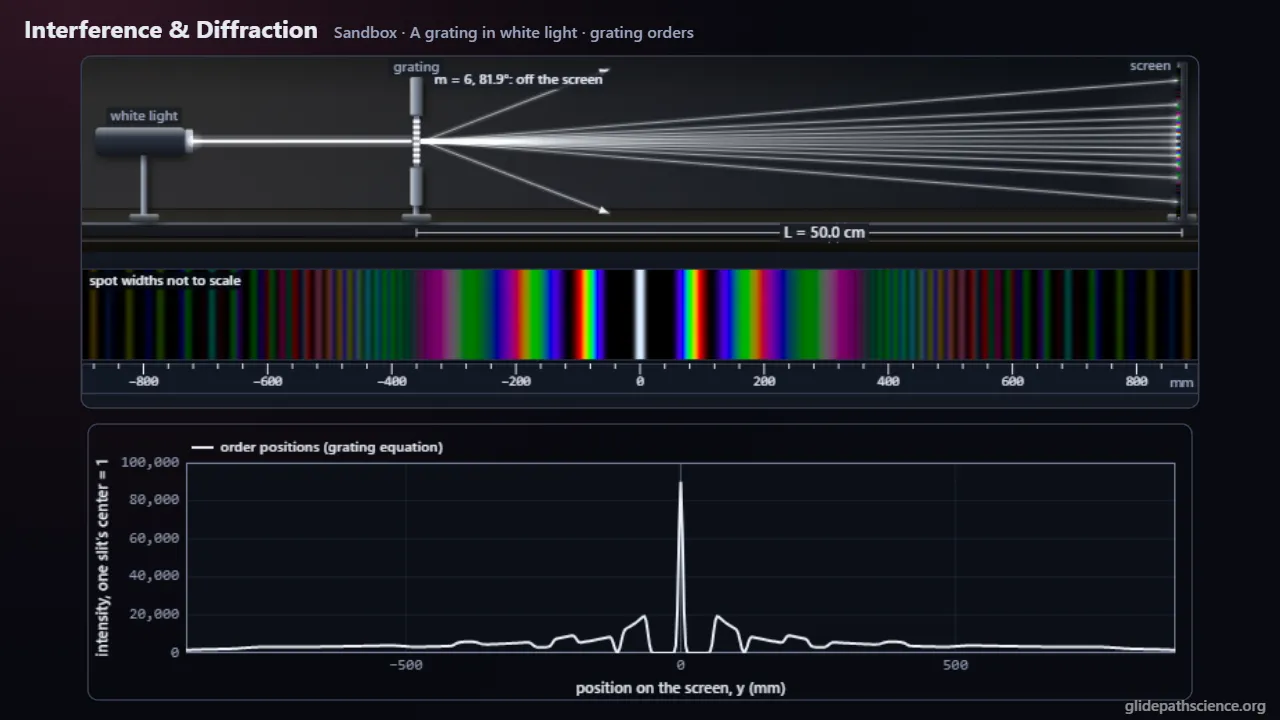
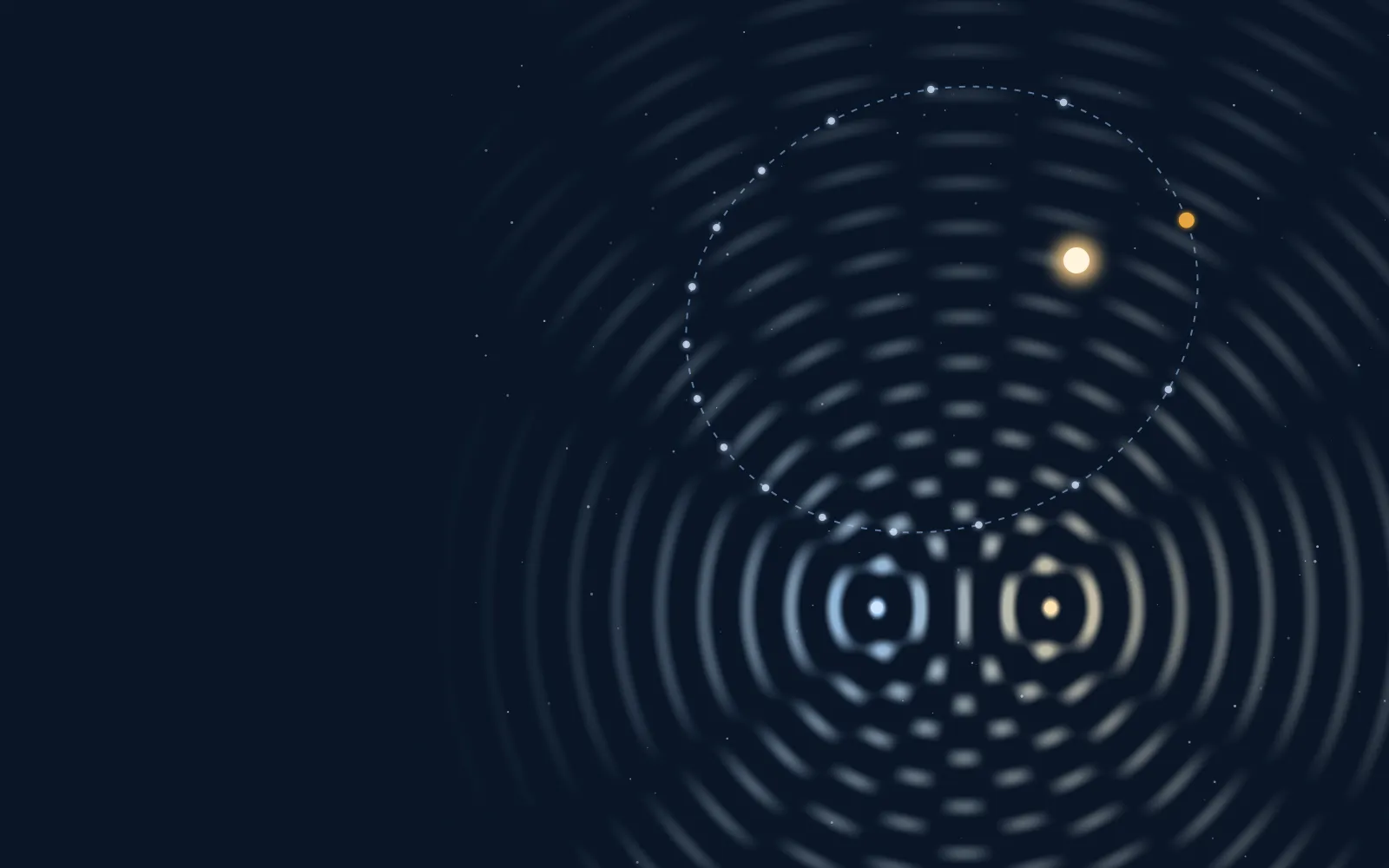
  • White light through a diffraction grating on an optical rail, spread into rainbow orders on the screen, above a chart of intensity across the screen.New

    Interference & Diffraction

    Shine a laser through slits, gratings and holes and watch light add to darkness: Young’s fringes as a ruler for light, missing orders, soap films and lens coatings, and the Rayleigh limit of every instrument.

    • Waves & Optics
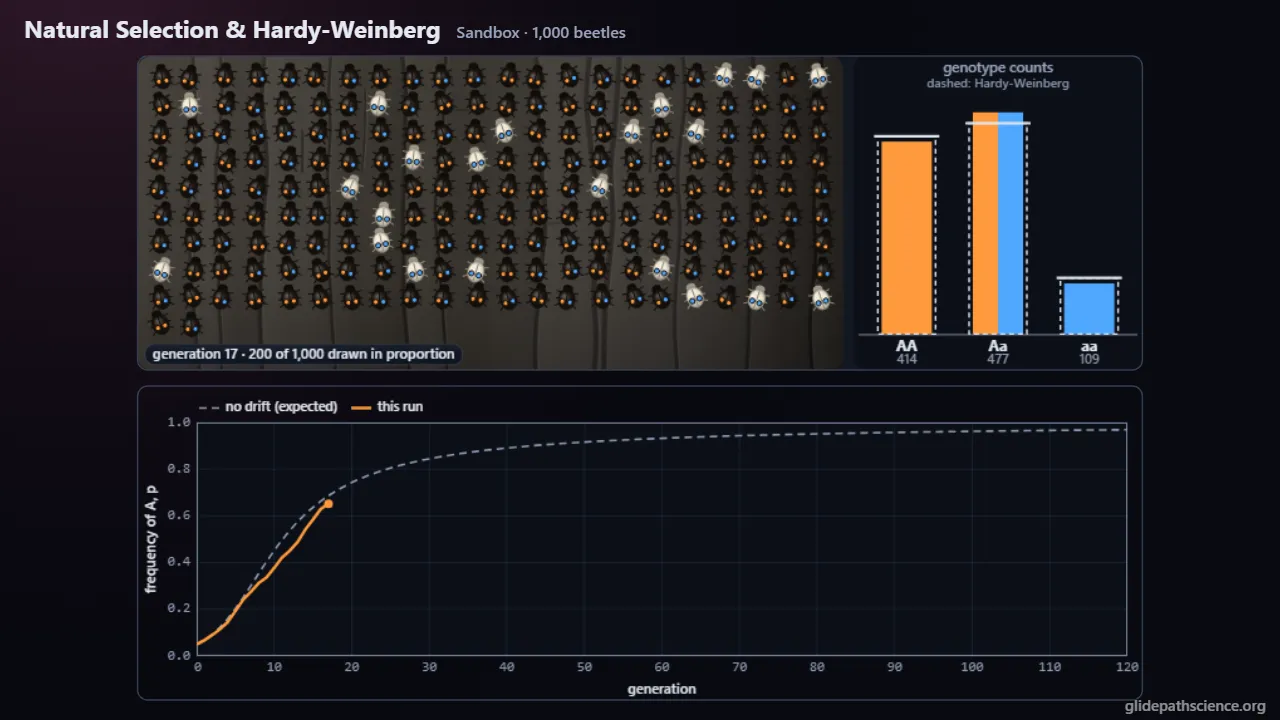
  • Dark and light beetles on soot-dark bark where birds eat the light ones, the dark beetles blending in and the light ones standing out, beside the genotype counts against Hardy–Weinberg expectations and the dark allele’s frequency rising over 17 generations.New

    Natural Selection & Hardy-Weinberg

    Watch beetles evolve as birds eat the ones they can see, count alleles, test Hardy-Weinberg, and see drift, mutation and gene flow change the allele frequency generation by generation.

    • Biology
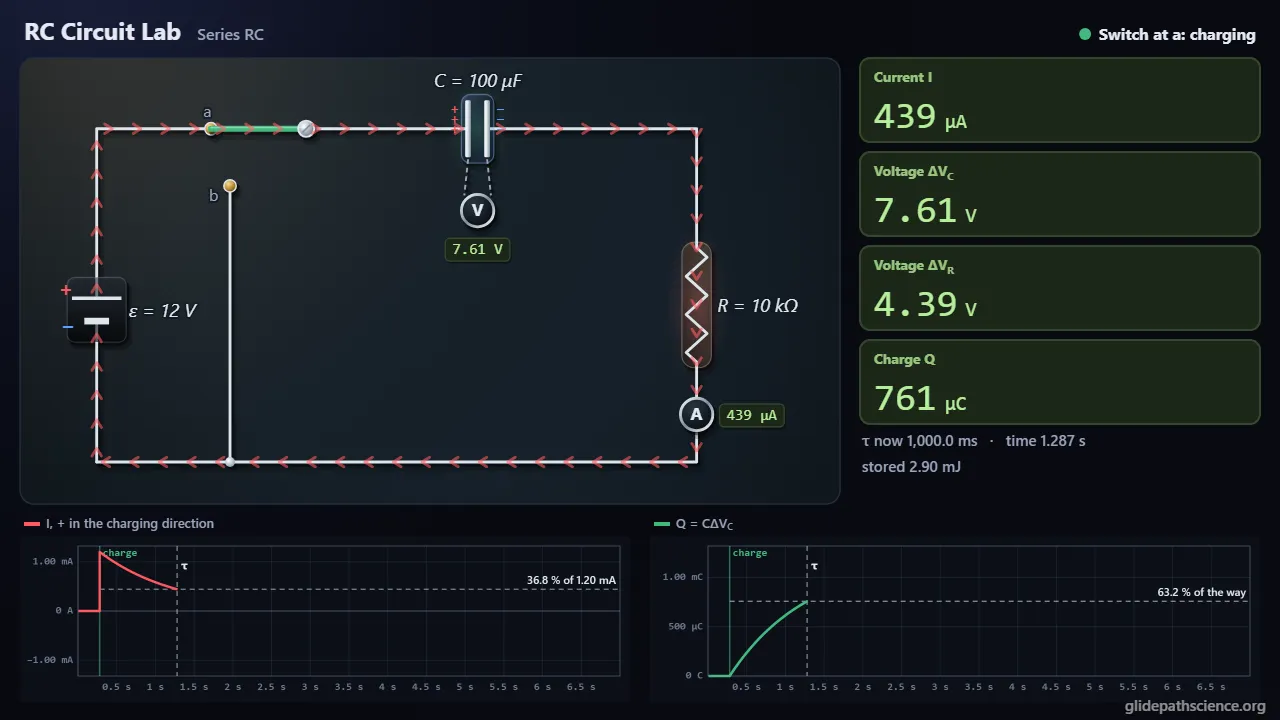
  • A series RC circuit on an electronics bench, the resistor glowing as the capacitor charges, beside current and charge curves marked at one time constant.New

    RC Circuit Lab

    Charge and discharge a capacitor through real circuits: time constants, the missing half of the energy, Thévenin equivalents, and meter loading.

    • Electricity & Magnetism

One path through every simulation

From first look to deeper understanding

Every Glidepath simulation is built the same way, so once you know one, you know them all.

  1. Walkthrough

    Guided steps that build the idea one piece at a time. Pick Intro or Advanced, and go at your own pace.

  2. Sandbox

    Every control is yours. Change anything and watch what happens.

  3. Specialized labs

    Hands-on extras where they help, like a lab bench with real measurement noise.

  4. Concept Challenge

    Test your intuition about ideas, directions, and shapes, with no calculator needed.

  5. Predict Lab

    Make a prediction, then run it and see. New numbers every time you play.

For students

Learning on your own?

You don't need a class or a teacher to start. Pick a simulation, play with it, and see what you can figure out. There's no account, no sign-up, and nothing to install.

How to get started
  • Start with the WalkthroughIt builds the idea step by step and checks your answers as you go.
  • Predict before you lookGuessing first, then checking, is how the idea sticks. Wrong guesses teach the most.
  • Stuck? Ask for a hintPrediction rounds offer a hint, and review links take you back to the step that explains the idea.
  • Save your progressNothing is saved when you close the page, so print or save your session report as a PDF first.

For educators

Made for teaching

Use a simulation live in lecture, assign it for homework, or build a lab around it. Students need no account and no installation: a link or a single file is all it takes.

Teaching with Glidepath
  • Project itProjector mode enlarges the text for the back row, in a dark or a light theme.
  • Clips for your slidesRerun and record the Sandbox at 720p or 1080p, or save a snapshot.
  • Field ManualThe model, its equations, and what it leaves out, inside every simulation.
  • Works offlineDownload one HTML file, checked to run with no network at all.
  • Session reportStudents print or save their progress as a PDF. Nothing is collected.
  • Reuse and citeFree for teaching under CC BY-NC-SA 4.0, with citations in four styles.

Our mission

Understanding, not just answers

Glidepath Science was conceived and developed by Dr. David Meier, a physicist and educator, to help students develop deeper scientific understanding through interactive simulations, powerful visualizations, guided predictions, experimentation, and quantitative reasoning.

Each simulation is checked against the physics before release, says plainly what its model leaves out, and keeps no record of the people who use it. New simulations arrive quickly, and each one keeps improving with feedback from students and teachers.

About Glidepath Science