
NewVersion 1.6
Projectile Motion Lab
Launch at any speed, angle and height, on Earth, Mars or the Moon, with or without air and wind. Compare paths, see drag pull the best angle below 45°, hit targets, and fit a launch to video data.
About this simulation
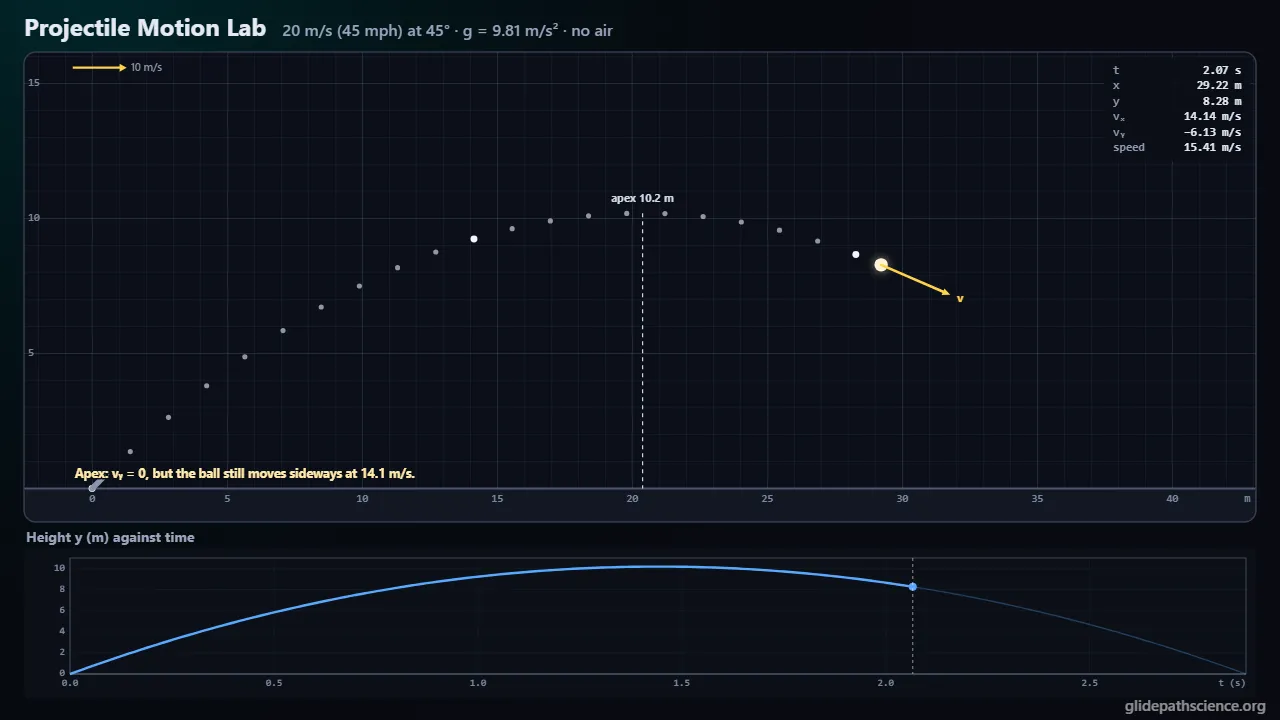
Projectile Motion Lab treats a launch as two motions sharing one clock: a steady horizontal motion and a vertical one that changes by g every second. Students watch equal-time dots, split launch velocities into components, find the apex, the time aloft and the range, launch from a height, and find the two angles that reach one spot. Then air gets a say: quadratic drag shortens and tilts the path and lowers the best angle, and wind matters only because there is air to push. The Advanced track derives the path's equation, the best angle from a height, aiming at a point and the envelope of all paths, works through monkey and hunter with and without drag, sets up quadratic drag and terminal speed, shows how the RK4 integrator handles a problem with no closed form, and fits launches to noisy video data with least squares. A Sandbox exposes every parameter, a Range Explorer plots range against angle in vacuum, with drag and with wind, and a Launch Fit lab bench analyzes frame-by-frame video with real measurement noise, hidden drag and camera scale errors. A single engine answers every question, and the whole simulation runs offline in one file.
What you'll learn
- Explain why a projectile's horizontal velocity stays constant without air while its vertical velocity changes by g each second, and use the two motions on one clock to find the time aloft, the apex and the range.
- Predict how the range depends on launch speed and angle, explain why 45° is best on level ground and complementary angles land together, and find the best angle and the two aiming angles from a height or to a point.
- Describe how quadratic air drag and wind change a trajectory, its symmetry and its best launch angle, and judge from kv₀²/g when air matters.
- Extract launch velocities and g from frame-by-frame video data by reading frames and by least-squares fits, and interpret fit standard errors and residual patterns, including those caused by drag or a camera scale error.
What you can do
- Guided walkthroughStep-by-step, in Intro and Advanced tracks.
- SandboxEvery control of the model, to explore freely.
- Virtual labA realistic experiment with measurement noise and data analysis.
- Concept checksQuestions about ideas and vocabulary, with no calculating.
- PredictionCommit to a prediction, then see the result.
- Classroom demoProjector mode and recordable clips for slides.
- Works offlineA single downloadable file, verified to run without a network.
Before you start
- One-dimensional motion with constant acceleration (x = x₀ + v₀t + ½at², v = v₀ + at)
- Resolving a vector into components with sine and cosine
- Solving a quadratic equation
- For the Advanced track: vectors, derivatives, and the idea of a numerical solution and of least-squares fitting
Run or download
Run it in your browser
Nothing to install and no account. Works on laptops, Chromebooks, tablets, and phones.
Launch Projectile Motion LabDownload for offline use
One HTML file (763 kB) that opens in any modern browser with no network: for rooms with unreliable Wi-Fi, or to keep a copy.
Download the fileFile details and checksum
- File
projectile-motion-lab-v1.6.html- Version
- 1.6, released November 15, 2026
- Build
794bcec- Size
- 781,350 bytes
- SHA-256
26985e184af2fe6b2fcbb3f15fe533723dd0a3a9bf4f33c17379c64fb6a5b3b5- Offline
- Checked to run with all network access blocked.
The model and its limits
What the model assumes
- The ball is a point mass; it lands when its center reaches the ground.
- Gravity is uniform: 9.81 m/s² on Earth, 3.71 m/s² on Mars, 1.62 m/s² on the Moon.
- Air drag is quadratic with a constant drag coefficient: a = −g ŷ − k|v − w|(v − w), with k = ρC_dA/2m and air density 1.20 kg/m³ on Earth.
- The wind is uniform and horizontal; it changes only when the user changes it.
- The motion is integrated by fourth-order Runge–Kutta at a 1 ms step with air (exact for the vacuum parabola); events are found inside a step by cubic Hermite interpolation.
- Launch Fit data are the engine's positions at each frame time plus seeded Gaussian noise; uncertainties are least-squares fit standard errors.
What it leaves out
- No spin: no Magnus lift or curve, so a baseball's best angle comes out near 41°, not the real 35°.
- The drag coefficient is constant: the drag crisis near Reynolds numbers of 2–3 × 10⁵ is left out.
- No wind shear, crosswind or turbulence; buoyancy is left out (about 0.2 % of a baseball's weight, 1.5 % of a ping-pong ball's).
- No bouncing or rolling, no change of g with height, a flat Earth with no rotation (no Coriolis effect).
- Linear (Stokes) drag is described but not simulated.
- Energy bookkeeping and launchers on moving carts are not covered.
- The balls' drag coefficients and the other everyday values are typical figures still to be checked against a named source.
Cite this simulation
APA 7
Meier, D. (2026). Projectile Motion Lab (Version 1.6) [Computer simulation]. Glidepath Science. https://glidepathscience.org/simulations/projectile-motion-lab/
MLA 9
Meier, David. Projectile Motion Lab. Version 1.6, Glidepath Science, 2026, glidepathscience.org/simulations/projectile-motion-lab/.
AIP
D. Meier, Projectile Motion Lab, version 1.6 (Glidepath Science, 2026), https://glidepathscience.org/simulations/projectile-motion-lab/.
BibTeX
@misc{meier2026projectilemotionlab,
  author       = {Meier, David},
  title        = {{Projectile Motion Lab}},
  year         = {2026},
  publisher    = {Glidepath Science},
  version      = {1.6},
  note         = {Interactive simulation, version 1.6},
  howpublished = {\url{https://glidepathscience.org/simulations/projectile-motion-lab/}},
  url          = {https://glidepathscience.org/simulations/projectile-motion-lab/}
}
Credits and license
Created by Dr. David Meier, Glidepath Science.
Licensed under Creative Commons Attribution-NonCommercial-ShareAlike 4.0 International (CC BY-NC-SA 4.0). You may share and adapt it for noncommercial purposes, such as teaching, with credit and under the same license. Licensing and reuse
AI tools (Claude, from Anthropic, and ChatGPT, from OpenAI) were used in developing Glidepath Science and its simulations. Dr. David Meier reviewed, edited, and modified every release version.