
NewVersion 1.6
Acid–Base Titration Lab
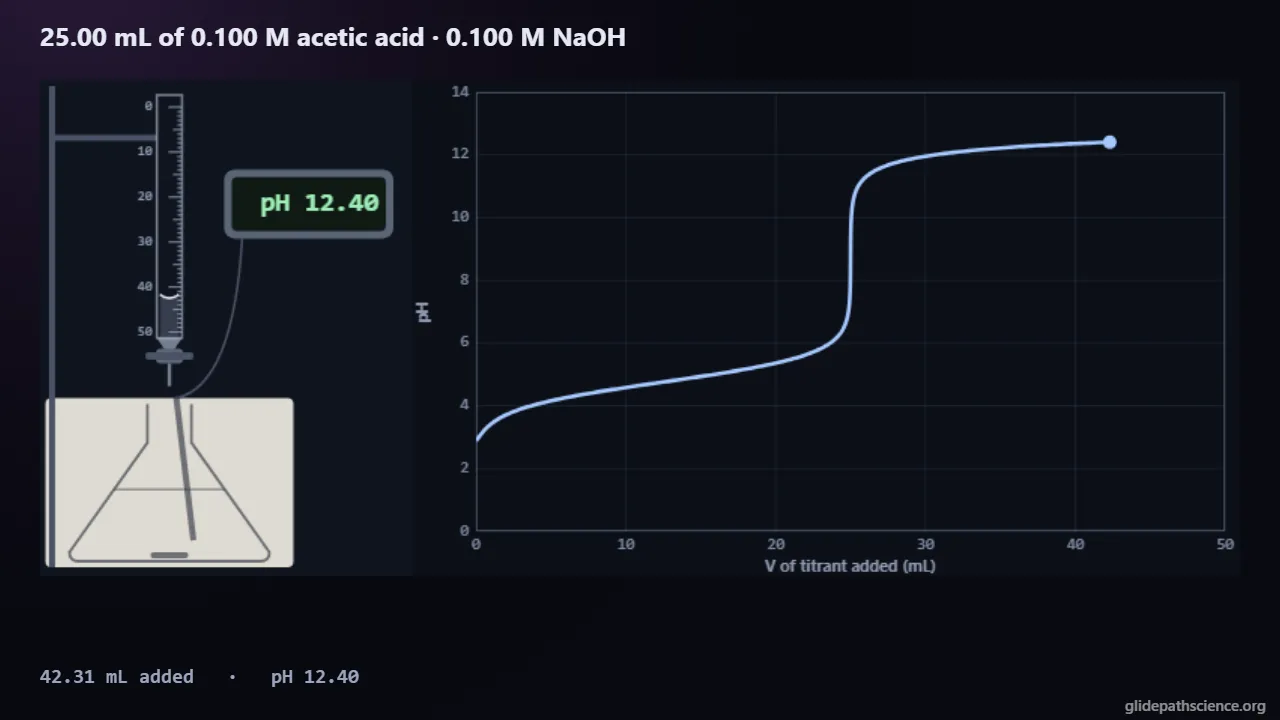
Titrate acids and bases with a buret and a pH meter: see why equivalence is not neutral, how buffers resist, how to choose an indicator, and how to get Vₑ, the concentration and Kₐ from noisy data.
About this simulation
Every curve in this lab is solved exactly from the charge balance, for strong, weak and polyprotic acids and bases, at any temperature from 0 to 60 °C, with optional activity corrections. A guided walkthrough at two levels builds from the equivalence point, the buffer region and the half-equivalence point to indicators, end points, derivatives, Gran plots, buffer capacity, activities and the glass electrode. The Sandbox titrates any of 25 analytes (or your own pKₐ values) with strong or weak titrants and overlays the derivative, species fractions, buffer capacity and the textbook shortcuts. The Titration Bench is a realistic lab: a Class A buret read by eye at the meniscus, an indicator judged against a white card (with a colorimeter readout as an accessible alternative), and a pH meter you calibrate, with noise, drift and settling, for standardizing NaOH with KHP, titrating an unknown in triplicate and finding Kₐ. A Species & Buffer Explorer, a Quick check, prediction rounds with fresh numbers, and activities (choosing an indicator, identifying a mystery acid, building a buffer) complete it. Runs entirely offline in one file.
What you'll learn
- Explain that the equivalence point is set by stoichiometry, and predict whether its pH is above, at or below 7 from what is left in the flask.
- Use the buffer region and the half-equivalence point (pH = pKₐ) to calculate the pH during a titration and to read pKₐ from a curve.
- Choose an indicator whose color change lies inside the jump, and estimate how far its end point falls from equivalence.
- Find the equivalence point, the concentration and Kₐ from noisy pH-meter data with derivatives and a Gran plot, and report each with an uncertainty that matches the data's scatter.
What you can do
- Guided walkthroughStep-by-step, in Intro and Advanced tracks.
- SandboxEvery control of the model, to explore freely.
- Virtual labA realistic experiment with measurement noise and data analysis.
- Concept checksQuestions about ideas and vocabulary, with no calculating.
- PredictionCommit to a prediction, then see the result.
- Classroom demoProjector mode and recordable clips for slides.
- Works offlineA single downloadable file, verified to run without a network.
Before you start
- Moles, molarity and dilution
- Writing balanced neutralization reactions
- The pH scale and logarithms
- Brønsted–Lowry acids and bases, and acid and base dissociation constants
- For the Advanced track: equilibrium expressions with several species, and basic least-squares fitting
Run or download
Run it in your browser
Nothing to install and no account. Works on laptops, Chromebooks, tablets, and phones.
Launch Acid–Base Titration LabDownload for offline use
One HTML file (859 kB) that opens in any modern browser with no network: for rooms with unreliable Wi-Fi, or to keep a copy.
Download the fileFile details and checksum
- File
acid-base-titration-lab-v1.6.html- Version
- 1.6, released November 15, 2026
- Build
e8eedd0- Size
- 879,567 bytes
- SHA-256
3eb72c183fe2011f99285e6aad2a5b554f0be33c699f773528c33e7c2adc9522- Offline
- Checked to run with all network access blocked.
The model and its limits
What the model assumes
- The exact charge balance is solved at every volume, with every species of every acid–base system, the strong ions, the indicator and water.
- Proton transfer is instantaneous; volumes add on mixing.
- Activities are ideal at the Intro level; at the Advanced level they follow the Davies equation, iterated with the ionic strength.
- The ion product of water follows the Harned–Robinson fit and each Kₐ moves with temperature by van 't Hoff from a tabulated enthalpy of ionization.
- Indicator colors come from Beer–Lambert absorbance in three color bands for both forms of each indicator, in front of a white card.
- On the Titration Bench, glassware tolerances, meter noise, drift and settling are illustrative values, drawn from a seeded random-number generator so a data set can be repeated exactly.
What it leaves out
- No exchange of carbon dioxide with the air, and no loss of CO₂ during a carbonate titration.
- No heat of neutralization, no volume change on mixing, and no heat-capacity term in the van 't Hoff equation.
- The Davies equation is not reliable above an ionic strength of about 0.5 M; no ion pairing or liquid-junction potentials.
- No glass-electrode alkaline or acid error, no precipitation, complexation, redox chemistry or non-aqueous solvents, and no polyborates.
- Indicator hues are approximate (three color bands, not full spectra), and the end point taken for each indicator is a convention.
- Drop mixing and electrode lag are drawn, not modeled from the chemistry.
Cite this simulation
APA 7
Meier, D. (2026). Acid–Base Titration Lab (Version 1.6) [Computer simulation]. Glidepath Science. https://glidepathscience.org/simulations/acid-base-titration-lab/
MLA 9
Meier, David. Acid–Base Titration Lab. Version 1.6, Glidepath Science, 2026, glidepathscience.org/simulations/acid-base-titration-lab/.
AIP
D. Meier, Acid–Base Titration Lab, version 1.6 (Glidepath Science, 2026), https://glidepathscience.org/simulations/acid-base-titration-lab/.
BibTeX
@misc{meier2026acidbasetitrationlab,
  author       = {Meier, David},
  title        = {{Acid–Base Titration Lab}},
  year         = {2026},
  publisher    = {Glidepath Science},
  version      = {1.6},
  note         = {Interactive simulation, version 1.6},
  howpublished = {\url{https://glidepathscience.org/simulations/acid-base-titration-lab/}},
  url          = {https://glidepathscience.org/simulations/acid-base-titration-lab/}
}
Credits and license
Created by Dr. David Meier, Glidepath Science.
Licensed under Creative Commons Attribution-NonCommercial-ShareAlike 4.0 International (CC BY-NC-SA 4.0). You may share and adapt it for noncommercial purposes, such as teaching, with credit and under the same license. Licensing and reuse
AI tools (Claude, from Anthropic, and ChatGPT, from OpenAI) were used in developing Glidepath Science and its simulations. Dr. David Meier reviewed, edited, and modified every release version.