
NewVersion 1.4
Blackbody Radiation
Heat a body and watch its true color slide from red through white to blue: Wien’s and Stefan’s laws, the ultraviolet catastrophe and Planck’s quanta, a spectrometer bench, stars on an HR diagram, and the CMB.
About this simulation
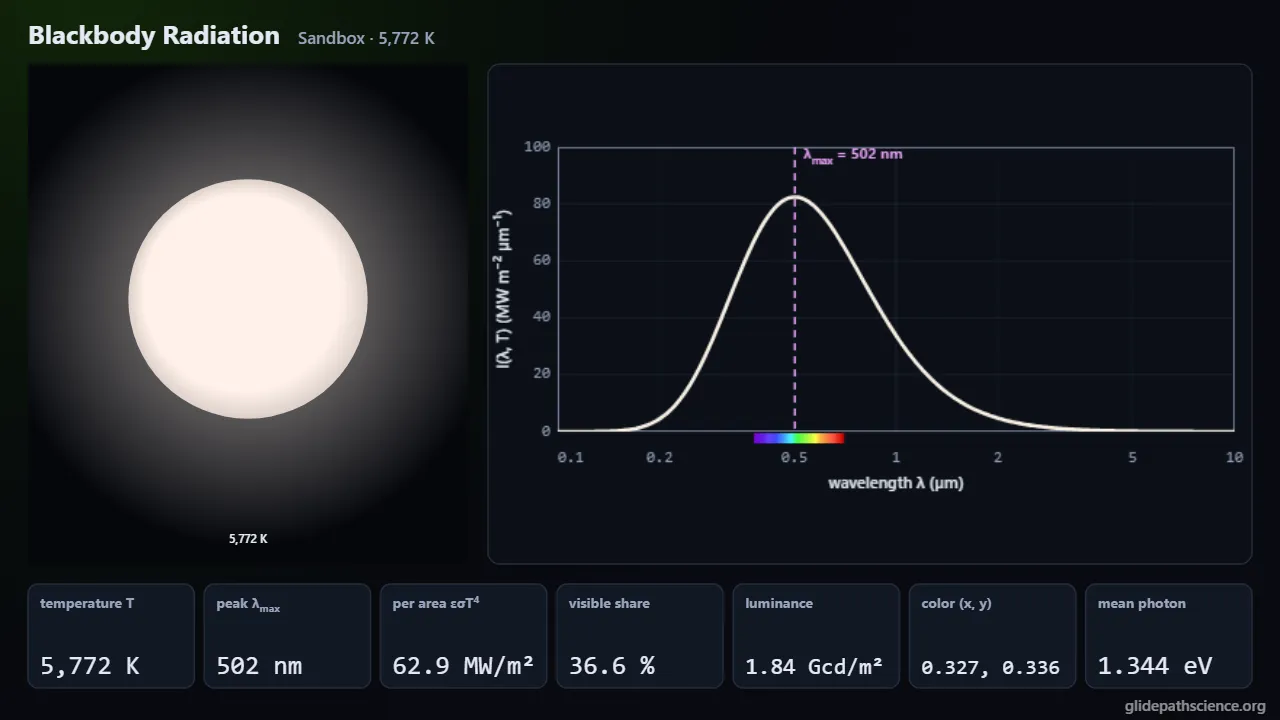
Every glow in this lab is the color the eye would see: the spectrum is integrated against the CIE 1931 color-matching functions and shown in sRGB, so a body’s color slides from dull red through orange and white to blue-white as it heats, and never passes through green. Planck’s law is computed exactly, with σ derived from h, c and k and every band’s share from an exact series. A guided walkthrough at two levels follows OpenStax University Physics Volume 3, §6.1: the glow and its color, Wien’s displacement law, Stefan’s law and net exchange with the surroundings, a person seen by a thermal camera, the light bulb’s visible share, the Rayleigh–Jeans law and its ultraviolet catastrophe, and Planck’s quantized oscillators. The Advanced track derives Planck’s law from cavity modes times the mean energy per mode, its Rayleigh–Jeans and Wien limits, the per-frequency peak, σ and the photon count from its integrals (2.701 kT per photon), Kirchhoff’s law, gray bodies and tungsten’s color temperature, a star’s radius from L = 4πR²σT⁴, and the cosmic microwave background and its expansion. The Sandbox heats any body from 2.5 K to 60,000 K, gray or selective, with its spectrum per wavelength, per frequency or in photons, a thermal camera’s view of a room and the color diagram with the Planckian locus. The Spectrometer Bench records a calibrator, a tungsten lamp or a star with a noisy, limited spectrometer and fits Planck’s law by maximum likelihood with honest error bars. The Star Lab places stars on an HR diagram with lines of constant radius and takes the CMB back to 3,000 K. The Mode Counter counts a cavity’s standing waves one by one and shows the classical energy running away while Planck’s converges. A Quick check, Rank the glow, Which curve?, prediction rounds with fresh numbers, Mystery star and Hit the color complete it, with a printable Guide. Runs entirely offline in one file.
What you'll learn
- Relate a hot body’s glow and the peak of its spectrum to its temperature with Wien’s law, and explain why nothing glows green.
- Use P = εσAT⁴ and the net exchange εσA(T⁴ − Tₛ⁴) for real surfaces and their surroundings.
- Explain the ultraviolet catastrophe and how Planck’s quanta, E = hf, resolve it; derive Planck’s law from cavity modes at the Advanced level.
- Find a star’s temperature from its spectrum or color and its radius from its luminosity, and describe the cosmic microwave background.
What you can do
- Guided walkthroughStep-by-step, in Intro and Advanced tracks.
- SandboxEvery control of the model, to explore freely.
- Virtual labA realistic experiment with measurement noise and data analysis.
- Concept checksQuestions about ideas and vocabulary, with no calculating.
- PredictionCommit to a prediction, then see the result.
- Classroom demoProjector mode and recordable clips for slides.
- Works offlineA single downloadable file, verified to run without a network.
Before you start
- Temperature in kelvins, power and energy
- The electromagnetic spectrum: wavelength, frequency and c = fλ
- For the Advanced track: integrals, exponentials and the Boltzmann factor
Run or download
Run it in your browser
Nothing to install and no account. Works on laptops, Chromebooks, tablets, and phones.
Launch Blackbody RadiationDownload for offline use
One HTML file (805 kB) that opens in any modern browser with no network: for rooms with unreliable Wi-Fi, or to keep a copy.
Download the fileFile details and checksum
- File
blackbody-radiation-v1.4.html- Version
- 1.4, released November 15, 2026
- Build
3cc72ad- Size
- 824,134 bytes
- SHA-256
44cf73c856c6d14ba2522ef09a1364fb5239a202c34106871e28d42c33537ad5- Offline
- Checked to run with all network access blocked.
The model and its limits
What the model assumes
- Planck’s law with the exact SI constants; σ = 2π⁵k⁴/(15c²h³) and Wien’s b from CODATA.
- Color from the CIE 1931 2° color-matching functions (5 nm) to sRGB; out-of-gamut colors moved toward white at constant luminance; brightness tone-mapped separately.
- Gray bodies, plus two illustrative selective emitters (tungsten and a selective solar absorber).
- Net exchange for a small body in large surroundings; Kirchhoff’s law at each wavelength.
- Spectrometers with illustrative response, resolution and dark rate; exact Poisson counts from seeded streams; a Poisson maximum-likelihood fit whose error bars were checked by Monte Carlo.
- Stars as blackbodies at their effective temperatures with approximate published luminosities; B − V through Gaussian stand-in filters, zero point set by the Sun.
- Exact counting of a perfectly conducting cubic cavity’s modes; the CMB at 2.725 K with T = 2.725(1 + z).
What it leaves out
- No atmosphere or intervening material; emissivity does not depend on angle or surface finish.
- Stars’ absorption lines, the Balmer jump and limb darkening are left out, so the model’s B − V differs from catalog values.
- One tone-mapping stands in for the eye’s adaptation; displays differ from sRGB.
- The thermal camera’s optics and calibration, and the spectrometer’s stray light and read noise, are left out.
- Equilibrium thermal radiation only: no lasers, fluorescence, LEDs or flame line emission.
Cite this simulation
APA 7
Meier, D. (2026). Blackbody Radiation (Version 1.4) [Computer simulation]. Glidepath Science. https://glidepathscience.org/simulations/blackbody-radiation/
MLA 9
Meier, David. Blackbody Radiation. Version 1.4, Glidepath Science, 2026, glidepathscience.org/simulations/blackbody-radiation/.
AIP
D. Meier, Blackbody Radiation, version 1.4 (Glidepath Science, 2026), https://glidepathscience.org/simulations/blackbody-radiation/.
BibTeX
@misc{meier2026blackbodyradiation,
  author       = {Meier, David},
  title        = {{Blackbody Radiation}},
  year         = {2026},
  publisher    = {Glidepath Science},
  version      = {1.4},
  note         = {Interactive simulation, version 1.4},
  howpublished = {\url{https://glidepathscience.org/simulations/blackbody-radiation/}},
  url          = {https://glidepathscience.org/simulations/blackbody-radiation/}
}
Credits and license
Created by Dr. David Meier, Glidepath Science.
Licensed under Creative Commons Attribution-NonCommercial-ShareAlike 4.0 International (CC BY-NC-SA 4.0). You may share and adapt it for noncommercial purposes, such as teaching, with credit and under the same license. Licensing and reuse
AI tools (Claude, from Anthropic, and ChatGPT, from OpenAI) were used in developing Glidepath Science and its simulations. Dr. David Meier reviewed, edited, and modified every release version.