
NewVersion 1.7
RC Circuit Lab
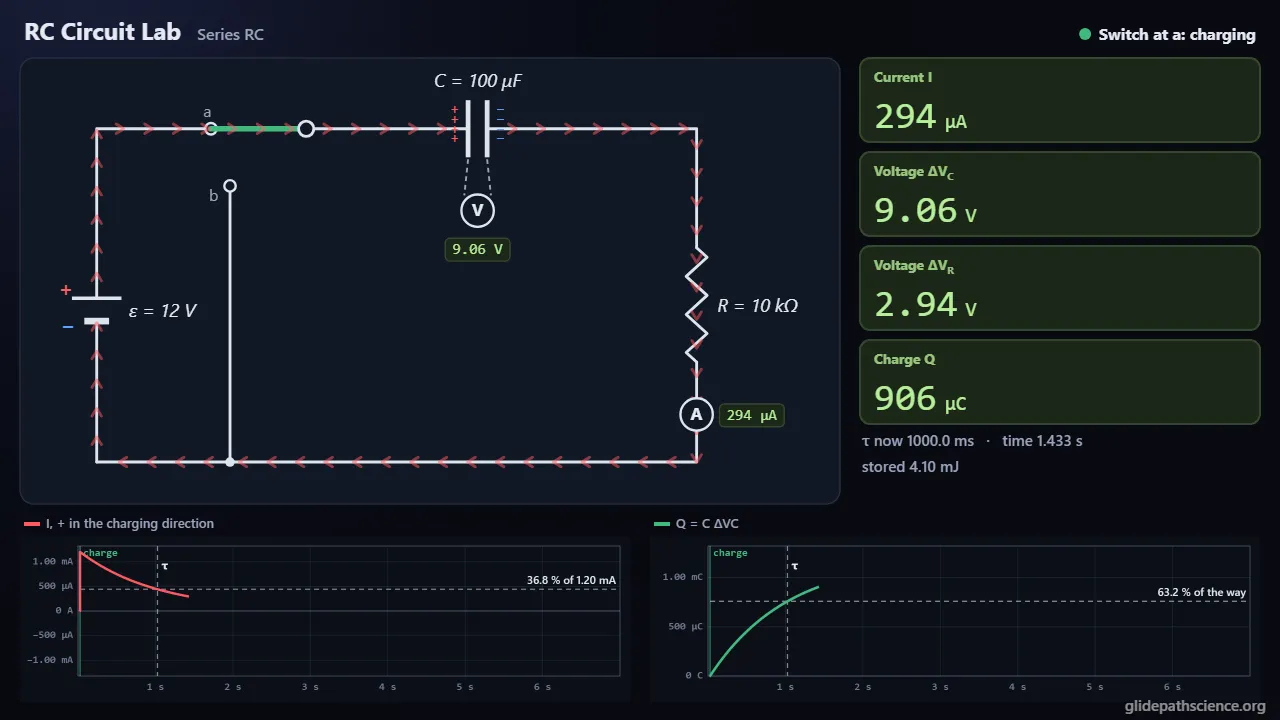
Charge and discharge a capacitor through real circuits: time constants, the missing half of the energy, Thévenin equivalents, and meter loading.
About this simulation
Flip the switch and watch charge pile up on the plates while the meters read and the curves draw themselves. Eight circuits, from a single resistor and capacitor to a bridge and a function generator, show why τ = RC sets every timescale, why a full capacitor acts like a break in the circuit, and why exactly half the energy a battery delivers to an empty capacitor ends up as heat, whatever the resistor. A noisy Lab Bench, a concept challenge, and a prediction lab with fresh numbers on every run round it out.
What you'll learn
- Use τ = RC to predict how fast a capacitor charges and discharges: after one τ the current is down to 36.8 % and the charge is 63.2 % of the way.
- Treat an empty capacitor as a wire at the first instant and a full one as a break in the circuit after a long time.
- Find the resistance a capacitor actually charges and discharges through, which can change when a switch moves.
- Explain why charging an empty capacitor from a battery turns half the delivered energy into heat, whatever the resistance.
What you can do
- Guided walkthroughStep-by-step, in Intro and Advanced tracks.
- SandboxEvery control of the model, to explore freely.
- Virtual labA realistic experiment with measurement noise and data analysis.
- Concept checksQuestions about ideas and vocabulary, with no calculating.
- PredictionCommit to a prediction, then see the result.
- Classroom demoProjector mode and recordable clips for slides.
- Works offlineA single downloadable file, verified to run without a network.
Before you start
- Ohm's law and Kirchhoff's loop rule
- Capacitance: Q = CV
- Exponential functions (the Advanced track also uses first-order differential equations)
Run or download
Run it in your browser
Nothing to install and no account. Works on laptops, Chromebooks, tablets, and phones.
Launch RC Circuit LabDownload for offline use
One HTML file (741 kB) that opens in any modern browser with no network: for rooms with unreliable Wi-Fi, or to keep a copy.
Download the fileFile details and checksum
- File
rc-circuit-lab-v1.7.html- Version
- 1.7, released November 15, 2026
- Build
6cd8d5e- Size
- 758,707 bytes
- SHA-256
158050b38efbfaa01f8b1e6d3ba48b504b1cd870c973680dd963186e4ded13d8- Offline
- Checked to run with all network access blocked.
The model and its limits
What the model assumes
- Ideal resistors, capacitors, and switches (no contact resistance and no bounce); the battery has no internal resistance and the function generator has 50 Ω.
- Kirchhoff's laws are solved by modified nodal analysis and the capacitor voltages are advanced by fourth-order Runge–Kutta; the energy books balance to about one part in 10⁸.
- In the Sandbox, parts are exactly their labels; the Lab Bench uses parts with realistic tolerances and a meter with 10 MΩ input resistance.
What it leaves out
- Electrolytic capacitor leakage and dielectric absorption are not modeled.
- Wire, switch-contact, and battery internal resistance are left out, so τ has no lower limit when R is tiny.
- Inductance and radiation are left out; they matter only when the resistance is tiny, when a real circuit rings instead of decaying smoothly.
Cite this simulation
APA 7
Meier, D. (2026). RC Circuit Lab (Version 1.7) [Computer simulation]. Glidepath Science. https://glidepathscience.org/simulations/rc-circuit-lab/
MLA 9
Meier, David. RC Circuit Lab. Version 1.7, Glidepath Science, 2026, glidepathscience.org/simulations/rc-circuit-lab/.
AIP
D. Meier, RC Circuit Lab, version 1.7 (Glidepath Science, 2026), https://glidepathscience.org/simulations/rc-circuit-lab/.
BibTeX
@misc{meier2026rccircuitlab,
  author       = {Meier, David},
  title        = {{RC Circuit Lab}},
  year         = {2026},
  publisher    = {Glidepath Science},
  version      = {1.7},
  note         = {Interactive simulation, version 1.7},
  howpublished = {\url{https://glidepathscience.org/simulations/rc-circuit-lab/}},
  url          = {https://glidepathscience.org/simulations/rc-circuit-lab/}
}
Credits and license
Created by Dr. David Meier, Glidepath Science.
Original version: Dr. Reni Ayachitula: the original RC Circuit Simulator, which this lab builds on: the circuit board, the switch you can click in the diagram, the LCD meters, and the current-flow animation.
Licensed under Creative Commons Attribution-NonCommercial-ShareAlike 4.0 International (CC BY-NC-SA 4.0). You may share and adapt it for noncommercial purposes, such as teaching, with credit and under the same license. Licensing and reuse
AI tools (Claude, from Anthropic, and ChatGPT, from OpenAI) were used in developing Glidepath Science and its simulations. Dr. David Meier reviewed, edited, and modified every release version.