
NewVersion 1.3
Ephemeris Orrery
The solar system in its real positions on any date, from space and from Earth's center: tours, eclipses and oppositions, measuring tools, Kepler's laws and predictions.
About this simulation
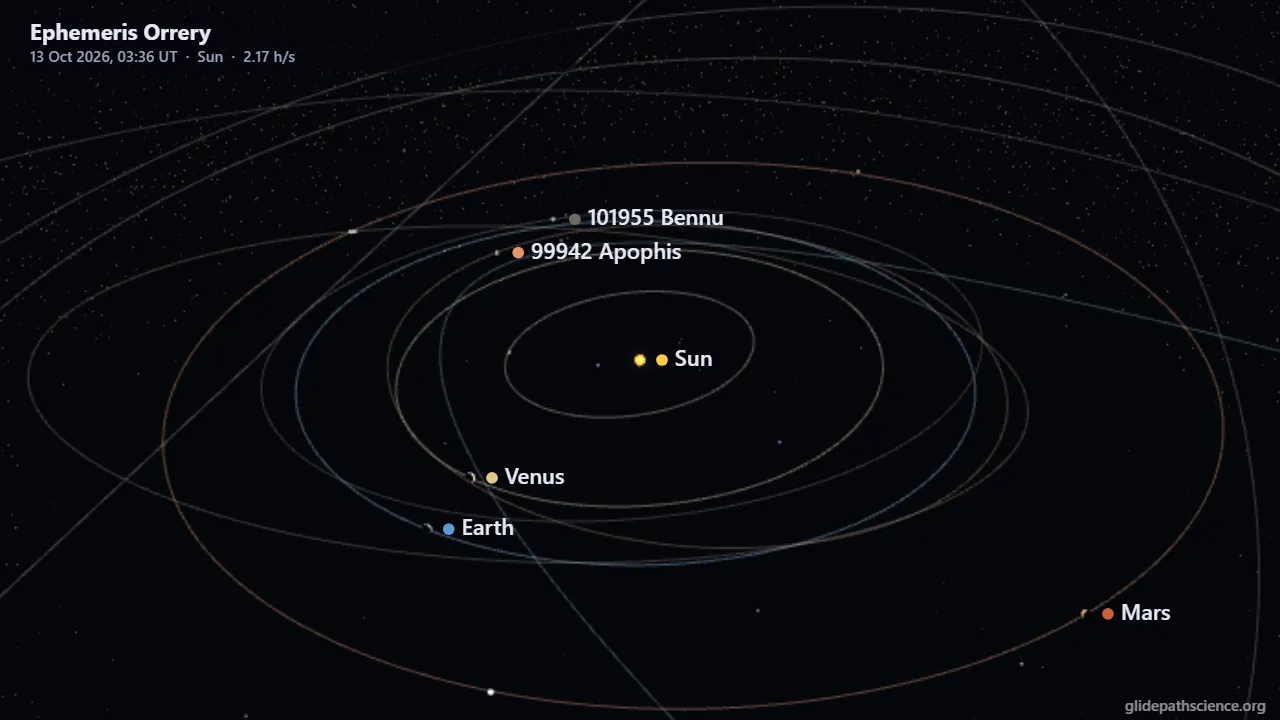
The planets, Pluto, our Moon and Jupiter's four large moons sit where they really were or will be on the date on the clock, from 3000 BC to AD 3000, and the asteroids, dwarf planets and Halley's comet follow JPL's orbits from 1900 to 2100. Students run time forward or backward, fly to any body, or stand at Earth's center and watch Mars loop backward against 9,096 real stars from the Yale Bright Star Catalogue, with the IAU constellations. Six narrated tours, each at an Intro and an Advanced level with check questions, cover Kepler's laws, retrograde motion, the phases of Venus, Galileo's moons, oppositions and synodic periods, and eclipse seasons. An event finder jumps to the next or previous opposition, conjunction, greatest elongation, stationary point, perihelion, equinox, Moon phase, eclipse (with its type) or ring-plane crossing, found from the orrery's own positions. A Measure panel gives distances, light times, speeds of approach, angular sizes and phases between any two bodies; a Kepler panel fits the third law to every body shown and weighs the Sun and Jupiter; eight prediction challenges on fresh dates ask students to commit before they see. Earth wears NASA's Blue Marble, and the asteroids and the comet follow JPL's integrated orbits.
What you'll learn
- Use Kepler's three laws to explain why orbits are ellipses with the Sun at a focus, why a planet moves fastest at perihelion, and how T² ∝ a³ gives the mass of the Sun or of a planet from its moons.
- Explain retrograde motion, the phases and changing size of Venus, and the timing of oppositions from the geometry of Earth overtaking or being overtaken by another planet, including the synodic period 1/S = |1/T⊕ − 1/T|.
- Explain why eclipses happen only in two seasons a year, near the nodes of the Moon's tilted orbit, and what makes a solar eclipse total, annular, hybrid or partial.
- Measure distances, light times and angular sizes between bodies on any date, and explain why a scale model must enlarge the bodies to show them.
What you can do
- Guided walkthroughStep-by-step, in Intro and Advanced tracks.
- SandboxEvery control of the model, to explore freely.
- Concept checksQuestions about ideas and vocabulary, with no calculating.
- PredictionCommit to a prediction, then see the result.
- Classroom demoProjector mode and recordable clips for slides.
- Works offlineA single downloadable file, verified to run without a network.
Before you start
- Newton's law of gravitation and circular motion
- Angles in degrees and radians, and right-triangle trigonometry
- Scientific notation and logarithms (for the Kepler plot)
Run or download
Run it in your browser
Nothing to install and no account. Works on laptops, Chromebooks, tablets, and phones.
Launch Ephemeris OrreryDownload for offline use
One HTML file (3.0 MB) that opens in any modern browser with no network: for rooms with unreliable Wi-Fi, or to keep a copy.
Download the fileFile details and checksum
- File
ephemeris-orrery-v1.3.html- Version
- 1.3, released November 15, 2026
- Build
75e95c3- Size
- 3,156,038 bytes
- SHA-256
afa42a07d8b803078a1bb3854c94be1950a1bfaaa4fe9b50f9e224bc983aef4a- Offline
- Checked to run with all network access blocked.
The model and its limits
What the model assumes
- The planets follow JPL's approximate Keplerian elements with their rates of change (E. M. Standish): good to about an arcminute for most planets and several arcminutes for Jupiter and Saturn from 1800 to 2050, with a second table for 3000 BC to AD 3000.
- The Moon follows the lunar theory in Meeus's Astronomical Algorithms (an abbreviation of ELP-2000/82); the clock shows Universal Time and the ephemerides run on Terrestrial Time, with ΔT from Espenak and Meeus.
- Jupiter's four large moons come from their mean longitudes with their largest periodic terms; the other moons have real sizes, distances, periods and orbit planes but illustrative places along their orbits.
- Asteroids, dwarf planets and Halley's comet follow JPL Horizons state vectors (1900–2100, retrieved 12 October 2026), interpolated by cubic Hermite curves through position and velocity; Apophis's 2029 Earth flyby is tabulated relative to Earth's center.
- Events (oppositions, elongations, stations, eclipses and others) are roots or extremes of functions of the orrery's own positions, refined numerically; eclipse types come from the shadow axis's distance from Earth's center and the umbra's length.
- Stars are the Bright Star Catalogue's J2000 positions with linear proper motion, precessed to the date by IAU 1976 precession; constellations use the IAU boundaries.
What it leaves out
- The sky view is from Earth's center: no horizon, no daylight, no atmosphere or refraction, and the Moon can sit up to a degree from where an observer on the surface sees it.
- Asteroids, dwarf planets and Halley's comet are not shown before 1900 or after 2100.
- Bodies are enlarged to be visible; at true scale they would be far smaller than a pixel.
- The asteroid and Kuiper belts are illustrative clouds, and Earth's clouds and night lights are illustrative.
- Aberration of starlight and nutation are left out of the sky view; relativity is left out.
- Event times for Jupiter and Saturn can be off by one to four hours, because their positions are good only to several arcminutes and they move slowly.
Cite this simulation
APA 7
Meier, D. (2026). Ephemeris Orrery (Version 1.3) [Computer simulation]. Glidepath Science. https://glidepathscience.org/simulations/ephemeris-orrery/
MLA 9
Meier, David. Ephemeris Orrery. Version 1.3, Glidepath Science, 2026, glidepathscience.org/simulations/ephemeris-orrery/.
AIP
D. Meier, Ephemeris Orrery, version 1.3 (Glidepath Science, 2026), https://glidepathscience.org/simulations/ephemeris-orrery/.
BibTeX
@misc{meier2026ephemerisorrery,
  author       = {Meier, David},
  title        = {{Ephemeris Orrery}},
  year         = {2026},
  publisher    = {Glidepath Science},
  version      = {1.3},
  note         = {Interactive simulation, version 1.3},
  howpublished = {\url{https://glidepathscience.org/simulations/ephemeris-orrery/}},
  url          = {https://glidepathscience.org/simulations/ephemeris-orrery/}
}
Credits and license
Created by Dr. David Meier, Glidepath Science.
Licensed under Creative Commons Attribution-NonCommercial-ShareAlike 4.0 International (CC BY-NC-SA 4.0). You may share and adapt it for noncommercial purposes, such as teaching, with credit and under the same license. Licensing and reuse
AI tools (Claude, from Anthropic, and ChatGPT, from OpenAI) were used in developing Glidepath Science and its simulations. Dr. David Meier reviewed, edited, and modified every release version.