NewVersion 1.2
Interference & Diffraction
Shine a laser through slits, gratings and holes and watch light add to darkness: Young’s fringes as a ruler for light, missing orders, soap films and lens coatings, and the Rayleigh limit of every instrument.
About this simulation
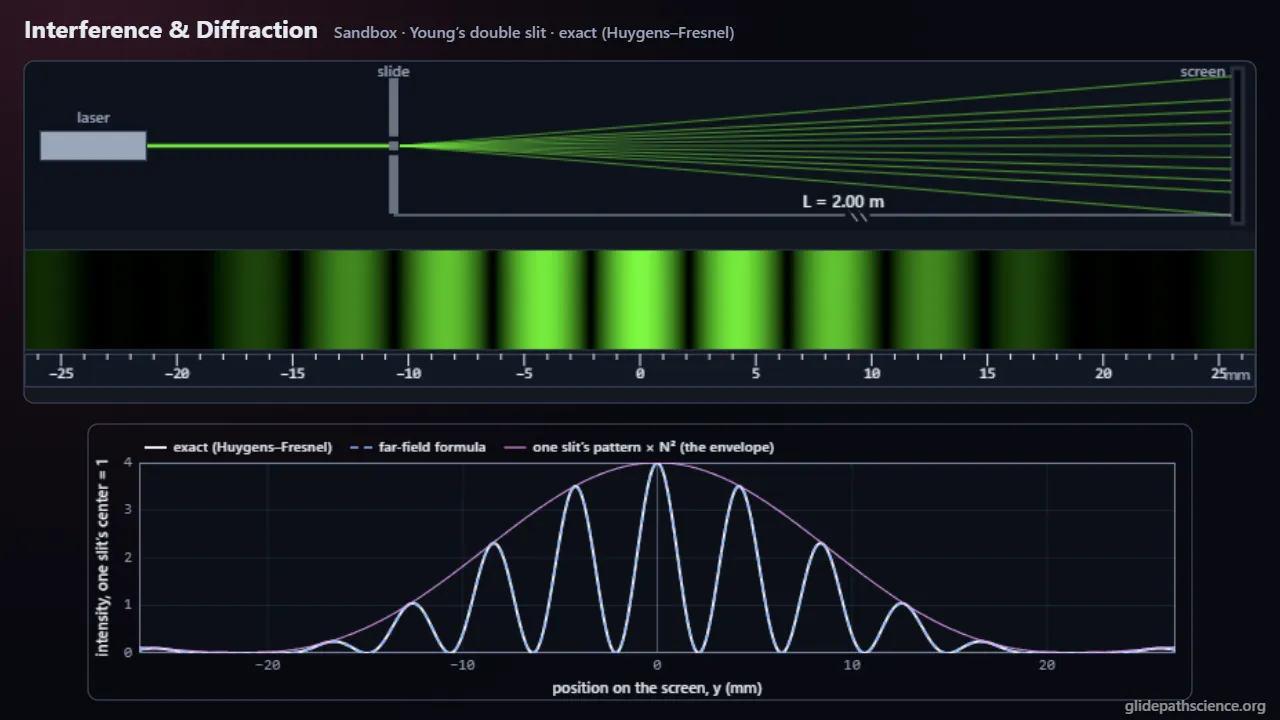
Every pattern on the screen names its model: the Huygens–Fresnel sum of the light through the slide where the sim computes it, with white light summed color by color, drawn in the light’s own color beside the far-field formula, with a gauge that says when the far-field formulas hold, and a labeled far-field preview where the near field is not computed. A guided walkthrough at two levels follows OpenStax University Physics Volume 3, chapters 3 and 4: two paths to one point, Young’s fringes, measuring a wavelength with a ruler, where the energy goes, many slits, the black soap film and the flip rule, soap-bubble colors, a lens coating, one slit’s spread, missing orders, gratings and white light, and the Rayleigh limit. The Advanced track adds phasors and the N-slit pattern, films at an angle and air wedges, the Sun’s coherence, the near field and the Arago spot, the envelope’s weight on each order, exact angles on a flat screen, resolving power, the Airy disk in a camera, the microscope’s limit and telescopes against the sky’s seeing. The Sandbox sets up one slit, two, many, a grating, a pinhole, two pinholes, a disk or a hair in any laser, sodium or white light at any distance, with the ripples from above and the phasors at the cursor. The Lab Bench measures a laser’s wavelength, a hair’s width and a disc’s track pitch with honest uncertainties. The Film Lab drains a soap film to black and designs coatings; the Resolution Lab resolves headlights, binary stars and microscope detail. A Quick check, Name the aperture, Count the flips, prediction rounds with fresh numbers, Mystery laser and Design the coating complete it, with a printable Guide. Runs entirely offline in one file.
What you'll learn
- Locate bright and dark fringes from the path difference, d sin θ = mλ, and measure a wavelength from the fringe spacing Δy = λL/d.
- Relate a slit’s width to the spread of its light, a sin θ = mλ, and explain the double slit’s envelope, missing orders and a grating’s spectra.
- Predict a thin film’s strongest and weakest reflections from its thickness, its index and the half-wave flips at its surfaces.
- Use θ_R = 1.22λ/D to find the finest detail an eye, a camera, a microscope or a telescope can resolve.
What you can do
- Guided walkthroughStep-by-step, in Intro and Advanced tracks.
- SandboxEvery control of the model, to explore freely.
- Virtual labA realistic experiment with measurement noise and data analysis.
- Concept checksQuestions about ideas and vocabulary, with no calculating.
- PredictionCommit to a prediction, then see the result.
- Classroom demoProjector mode and recordable clips for slides.
- Works offlineA single downloadable file, verified to run without a network.
Before you start
- Waves: wavelength, phase and superposition
- Refraction and the index of refraction
- For the Advanced track: trigonometry, complex numbers or phasors, and small-angle approximations
Run or download
Run it in your browser
Nothing to install and no account. Works on laptops, Chromebooks, tablets, and phones.
Launch Interference & DiffractionDownload for offline use
One HTML file (1.0 MB) that opens in any modern browser with no network: for rooms with unreliable Wi-Fi, or to keep a copy.
Download the fileFile details and checksum
- File
interference-diffraction-v1.2.html- Version
- 1.2, released November 15, 2026
- Build
f0adc92- Size
- 1,090,487 bytes
- SHA-256
93e94d0a6a3e6a2ebb645a9f008795b089fe12fea7ff8f9943c8bb2e778a6d46- Offline
- Checked to run with all network access blocked.
The model and its limits
What the model assumes
- Scalar waves of one wavelength, or incoherent sums of wavelengths; the beam a uniform plane wave over the slide (a finite beam for a hair).
- The Huygens–Fresnel sum with exact path lengths and Kirchhoff’s inclination factor (the paraxial Fresnel integrals at small angles) for slits, a pinhole and a disk, white light summed color by color; two pinholes and a grating near the slide shown as labeled far-field previews; far-field formulas compared beside it.
- Thin films by the characteristic matrix of every layer, s and p, at any angle; indices are constants.
- Colors through the CIE 1931 color-matching functions for white light and films; one wavelength in the library’s laser colors.
- Two-point images as sums of Airy patterns; seeing as a Gaussian blur; the draining soap film an illustrative model.
What it leaves out
- No polarization in diffraction; real slits’ thickness and edges, Gaussian beams and speckle are left out.
- No absorbing films, metals or dispersion in the films; a grating’s order heights are approximate (real gratings depend on their grooves).
- The atmosphere’s seeing is a Gaussian blur only; no adaptive optics or eye aberrations.
- X-ray diffraction, holography, interferometers and photons are left to other sims.
Cite this simulation
APA 7
Meier, D. (2026). Interference & Diffraction (Version 1.2) [Computer simulation]. Glidepath Science. https://glidepathscience.org/simulations/interference-diffraction/
MLA 9
Meier, David. Interference & Diffraction. Version 1.2, Glidepath Science, 2026, glidepathscience.org/simulations/interference-diffraction/.
AIP
D. Meier, Interference & Diffraction, version 1.2 (Glidepath Science, 2026), https://glidepathscience.org/simulations/interference-diffraction/.
BibTeX
@misc{meier2026interferencediffraction,
  author       = {Meier, David},
  title        = {{Interference & Diffraction}},
  year         = {2026},
  publisher    = {Glidepath Science},
  version      = {1.2},
  note         = {Interactive simulation, version 1.2},
  howpublished = {\url{https://glidepathscience.org/simulations/interference-diffraction/}},
  url          = {https://glidepathscience.org/simulations/interference-diffraction/}
}
Credits and license
Created by Dr. David Meier, Glidepath Science.
Licensed under Creative Commons Attribution-NonCommercial-ShareAlike 4.0 International (CC BY-NC-SA 4.0). You may share and adapt it for noncommercial purposes, such as teaching, with credit and under the same license. Licensing and reuse
AI tools (Claude, from Anthropic, and ChatGPT, from OpenAI) were used in developing Glidepath Science and its simulations. Dr. David Meier reviewed, edited, and modified every release version.