
NewVersion 1.1
Greenhouse Effect & Earth’s Energy Balance
Balance the sunlight a planet absorbs against the infrared it radiates, then add albedo and layers that absorb infrared and watch the surface settle warmer, from bare rock at 255 K to Earth’s 288 K.
About this simulation
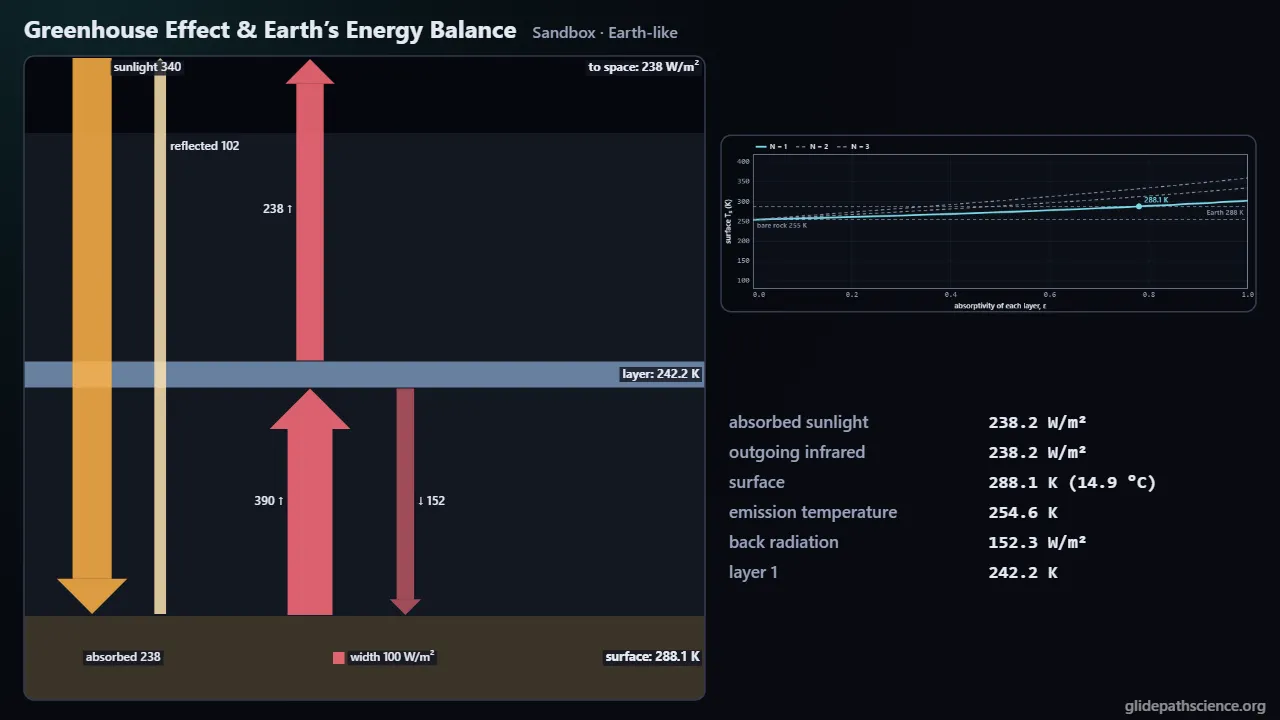
A planet settles where it radiates what it absorbs. Students balance (1 − α)S/4 against σT⁴ and find 255 K for an Earth with no atmosphere, then add a layer that absorbs infrared and radiates it both up and down, so the surface gets sunlight plus back radiation and settles warmer. A guided walkthrough at two levels covers the solar constant, why divide by four, albedo, visible light in and infrared out, one opaque layer and a leaky one; the Advanced track adds emission height, N layers, Kirchhoff’s law, an atmospheric window, radiative forcing from CO₂, the Planck response, feedbacks and the time to settle. The Sandbox draws a column of atmosphere with arrows as wide as their watts; students set the sunlight, albedo, layers and absorptivity, and watch the surface find its new balance. A Layer Stack balances every layer’s fluxes to the watt, an Albedo Map mixes ocean, forest, desert, ice and cloud, and Planet Compare runs the same model on Venus, Earth, the Moon and Mars. A concept challenge and a prediction lab round it out.
What you'll learn
- Explain that a planet settles where it radiates what it absorbs, (1 − α)S/4 = σTₑ⁴, which gives 255 K for Earth with no atmosphere.
- Explain how albedo, the fraction of sunlight reflected, never heats the planet, so more ice or cloud means less sunlight absorbed and a cooler balance.
- Explain why a layer that absorbs infrared radiates it both up and down, so the surface receives sunlight plus back radiation and settles warmer: 303 K under one opaque layer and 288 K under a leaky one.
- In the Advanced track, explain how more absorber cuts the outgoing infrared by a forcing ΔF, and how the planet warms by ΔF/λ over a time τ = C/λ to restore the balance.
What you can do
- Guided walkthroughStep-by-step, in Intro and Advanced tracks.
- SandboxEvery control of the model, to explore freely.
- Concept checksQuestions about ideas and vocabulary, with no calculating.
- PredictionCommit to a prediction, then see the result.
- Classroom demoProjector mode and recordable clips for slides.
- Works offlineA single downloadable file, verified to run without a network.
Before you start
- Energy, power and the watt
- Temperature in kelvins and the idea of thermal radiation
- For the Advanced track: the Stefan–Boltzmann law, linear equations and a first-order differential equation
Run or download
Run it in your browser
Nothing to install and no account. Works on laptops, Chromebooks, tablets, and phones.
Launch Greenhouse Effect & Earth’s Energy BalanceDownload for offline use
One HTML file (639 kB) that opens in any modern browser with no network: for rooms with unreliable Wi-Fi, or to keep a copy.
Download the fileFile details and checksum
- File
greenhouse-energy-balance-v1.1.html- Version
- 1.1, released November 15, 2026
- Build
f21d789- Size
- 654,510 bytes
- SHA-256
c8b728b158efd72b1e77c317803f681af6cf846e18ca9e00387ac71967740d6c- Offline
- Checked to run with all network access blocked.
The model and its limits
What the model assumes
- Global averages: one column stands for the whole planet, day and night, with sunlight spread evenly by the factor of four.
- Sunlight is absorbed only at the surface; the layers are clear to it, and the surface radiates as a blackbody.
- Each layer covers the whole planet, is isothermal and is gray in the infrared, absorbing and emitting a fraction ε (Kirchhoff’s law), with an optional window that no layer touches.
- In steady state each layer and the surface absorb what they emit; the engine solves the linear system and checks that energy closes at every layer and at the top.
- The time view gives only the surface a heat capacity, that of an ocean mixed layer, stepped with RK4 while the layers stay in balance.
What it leaves out
- No convection or latent heat, which carry about a quarter of the surface’s loss upward in the real atmosphere, and no lapse rate.
- No sunlight absorbed in the atmosphere and no cloud physics.
- No spectrum: real gases absorb in bands that saturate at their centers, which is why CO₂’s forcing grows as a logarithm; the model quotes that logarithm rather than deriving it.
- Feedbacks are a single number, the deep ocean is left out, and there is no geography, no seasons and no day and night.
Cite this simulation
APA 7
Meier, D. (2026). Greenhouse Effect & Earth’s Energy Balance (Version 1.1) [Computer simulation]. Glidepath Science. https://glidepathscience.org/simulations/greenhouse-energy-balance/
MLA 9
Meier, David. Greenhouse Effect & Earth’s Energy Balance. Version 1.1, Glidepath Science, 2026, glidepathscience.org/simulations/greenhouse-energy-balance/.
AIP
D. Meier, Greenhouse Effect & Earth’s Energy Balance, version 1.1 (Glidepath Science, 2026), https://glidepathscience.org/simulations/greenhouse-energy-balance/.
BibTeX
@misc{meier2026greenhouseeffectearthsenergybalance,
  author       = {Meier, David},
  title        = {{Greenhouse Effect & Earth’s Energy Balance}},
  year         = {2026},
  publisher    = {Glidepath Science},
  version      = {1.1},
  note         = {Interactive simulation, version 1.1},
  howpublished = {\url{https://glidepathscience.org/simulations/greenhouse-energy-balance/}},
  url          = {https://glidepathscience.org/simulations/greenhouse-energy-balance/}
}
Credits and license
Created by Dr. David Meier, Glidepath Science.
Licensed under Creative Commons Attribution-NonCommercial-ShareAlike 4.0 International (CC BY-NC-SA 4.0). You may share and adapt it for noncommercial purposes, such as teaching, with credit and under the same license. Licensing and reuse
AI tools (Claude, from Anthropic, and ChatGPT, from OpenAI) were used in developing Glidepath Science and its simulations. Dr. David Meier reviewed, edited, and modified every release version.