
NewVersion 1.5
Jumping Ring Lab
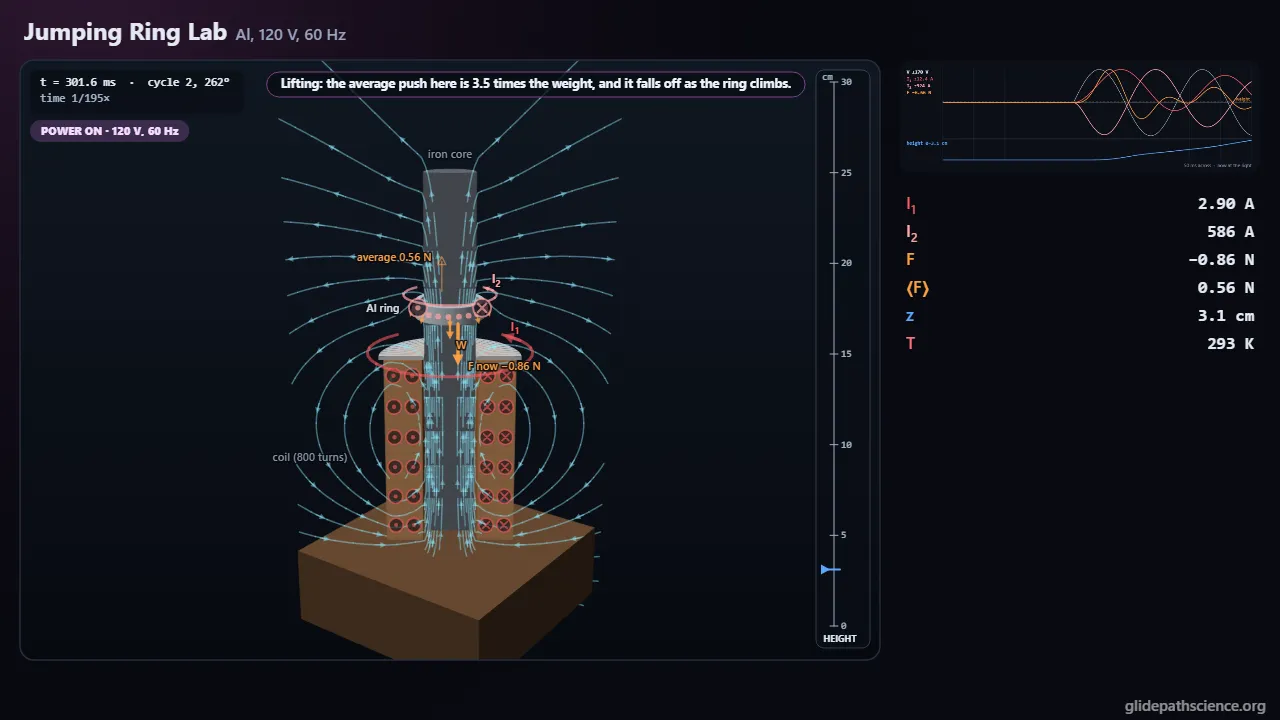
Close a switch and an aluminum ring leaps off an iron rod: see the flux, the induced current, the flared field that pushes the ring and the phase lag that makes the push add up.
About this simulation
Thomson's jumping ring, computed from the apparatus: a coil round an iron rod, every mutual inductance a sum over coaxial current filaments by Maxwell's formula, the rod a leaky flux conduit, and the coil and ring as two coupled circuits with their motional EMFs, the push coming from the magnetic co-energy and the energy books closing to a microjoule. A 3-D stage shows the field lines as contours of the flux function, recomputed every frame, with the coil and ring currents, the induced electric field, the flux through the ring and the push on it, slowed down where it matters and steppable a twenty-fourth of a cycle at a time. Students close the switch on aluminum, copper, brass and nichrome rings, at room temperature or soaked in liquid nitrogen, whole or slotted, on AC or DC, held down or dropped on, beside a twin bench. A Phase Lab draws the phasor triangle, the push and the heating against the ring current's lag, and the force landscape with its stable float; a Best Ring tab sweeps complete simulated jumps against ring height, voltage, frequency, temperature or metal to find the lag of 45 degrees that Tjossem and Brost measured; a Hover Bench has students float the ring at several voltages, read its height, fit the push's decay length and predict a new float. An Advanced track covers the coupled circuits, the co-energy force, flux cutting, the sin-squared-phi result, the cold ring, the best ring height, the energy books, the switching moment and the skin-depth limit of the model.
What you'll learn
- Use Faraday's law to find the EMF round a ring from the changing flux through it, and the ring's resistance to see why a tenth of a volt drives hundreds of amperes.
- Use Lenz's law to find the direction of the ring current and whether the ring is pushed or pulled, on AC, on DC switching and for a slotted ring.
- Explain why only the radial part of the field can lift a flat ring, and estimate the push from F = I₂ · 2πa · B_r.
- Explain why the ring current's phase lag makes the AC push average upward, and use ⟨F⟩ ∝ sin²φ to compare rings, temperatures and heights.
What you can do
- Guided walkthroughStep-by-step, in Intro and Advanced tracks.
- SandboxEvery control of the model, to explore freely.
- Virtual labA realistic experiment with measurement noise and data analysis.
- Concept checksQuestions about ideas and vocabulary, with no calculating.
- PredictionCommit to a prediction, then see the result.
- Classroom demoProjector mode and recordable clips for slides.
- Works offlineA single downloadable file, verified to run without a network.
Before you start
- Magnetic flux and the magnetic force on a current-carrying wire
- Resistance and resistivity; Ohm's law
- Sine waves and peak values
- For the Advanced track: inductance, phasors and complex impedance, and energy in magnetic fields
Run or download
Run it in your browser
Nothing to install and no account. Works on laptops, Chromebooks, tablets, and phones.
Launch Jumping Ring LabDownload for offline use
One HTML file (874 kB) that opens in any modern browser with no network: for rooms with unreliable Wi-Fi, or to keep a copy.
Download the fileFile details and checksum
- File
jumping-ring-lab-v1.5.html- Version
- 1.5, released November 15, 2026
- Build
530d811- Size
- 895,416 bytes
- SHA-256
576e4dc3f636f60ef2f101cb2b4d2ac9bfa1fb1f67e787580533eb2ea4e47913- Offline
- Checked to run with all network access blocked.
The model and its limits
What the model assumes
- A representative lecture-demonstration coil (800 turns, 2.0 Ω, 150 mm tall) round a 19 mm iron rod that extends 14 cm above it; the rings follow Tjossem and Brost (2011): 50.8 mm across with a 3.18 mm wall.
- Every mutual inductance is a sum over coaxial filaments by Maxwell's elliptic-integral formula; the coil is 180 filaments and the ring is sampled across its section.
- The iron rod is a leaky flux conduit: it multiplies the field inside the winding by 1 + κ and lets the flux leak out over a length λ (κ = 16 and λ = 5 cm, representative values chosen for the model).
- Coil and ring are two coupled lumped circuits with both motional EMFs; the push comes from the magnetic co-energy, so energy is conserved to better than a microjoule over a jump.
- The ring current is spread evenly across its wall; its resistivity and heat capacity follow its temperature, linear between 77 and 293 K.
- On the rod the ring stays centered and level and rubs lightly; once it clears the rod it is given a stated 0.4 m/s sideways drift, and a ring still over the rod on the way down is caught by it.
- The variac's output slews at 160 V/s; opening the switch is a 60 Ω resistor for that instant.
What it leaves out
- No core saturation or hysteresis: real iron saturates near 1.5–2 T, flagged above 1.5 T (low frequency and high voltage).
- No eddy-current or hysteresis losses in the iron.
- No skin or proximity effect: cold copper, and any good conductor at a few hundred hertz, is flagged where the skin depth reaches the wall.
- No tilt or wobble on the rod, and a ring that has left the rod is coupled as if on the axis until it falls past the rod's top.
- The coil does not heat; the arc at switch-off is modeled as a resistor.
- The rod's leakage length is chosen, not measured, so float heights are representative.
Cite this simulation
APA 7
Meier, D. (2026). Jumping Ring Lab (Version 1.5) [Computer simulation]. Glidepath Science. https://glidepathscience.org/simulations/jumping-ring-lab/
MLA 9
Meier, David. Jumping Ring Lab. Version 1.5, Glidepath Science, 2026, glidepathscience.org/simulations/jumping-ring-lab/.
AIP
D. Meier, Jumping Ring Lab, version 1.5 (Glidepath Science, 2026), https://glidepathscience.org/simulations/jumping-ring-lab/.
BibTeX
@misc{meier2026jumpingringlab,
  author       = {Meier, David},
  title        = {{Jumping Ring Lab}},
  year         = {2026},
  publisher    = {Glidepath Science},
  version      = {1.5},
  note         = {Interactive simulation, version 1.5},
  howpublished = {\url{https://glidepathscience.org/simulations/jumping-ring-lab/}},
  url          = {https://glidepathscience.org/simulations/jumping-ring-lab/}
}
Credits and license
Created by Dr. David Meier, Glidepath Science.
Licensed under Creative Commons Attribution-NonCommercial-ShareAlike 4.0 International (CC BY-NC-SA 4.0). You may share and adapt it for noncommercial purposes, such as teaching, with credit and under the same license. Licensing and reuse
AI tools (Claude, from Anthropic, and ChatGPT, from OpenAI) were used in developing Glidepath Science and its simulations. Dr. David Meier reviewed, edited, and modified every release version.