
NewVersion 1.4
Momentum, Impulse & Collisions
Collide carts and pucks from elastic to perfectly inelastic: total momentum holds while kinetic energy goes. Read impulse as the area under F(t), and see how crumple zones and belts spread the same Δp.
About this simulation
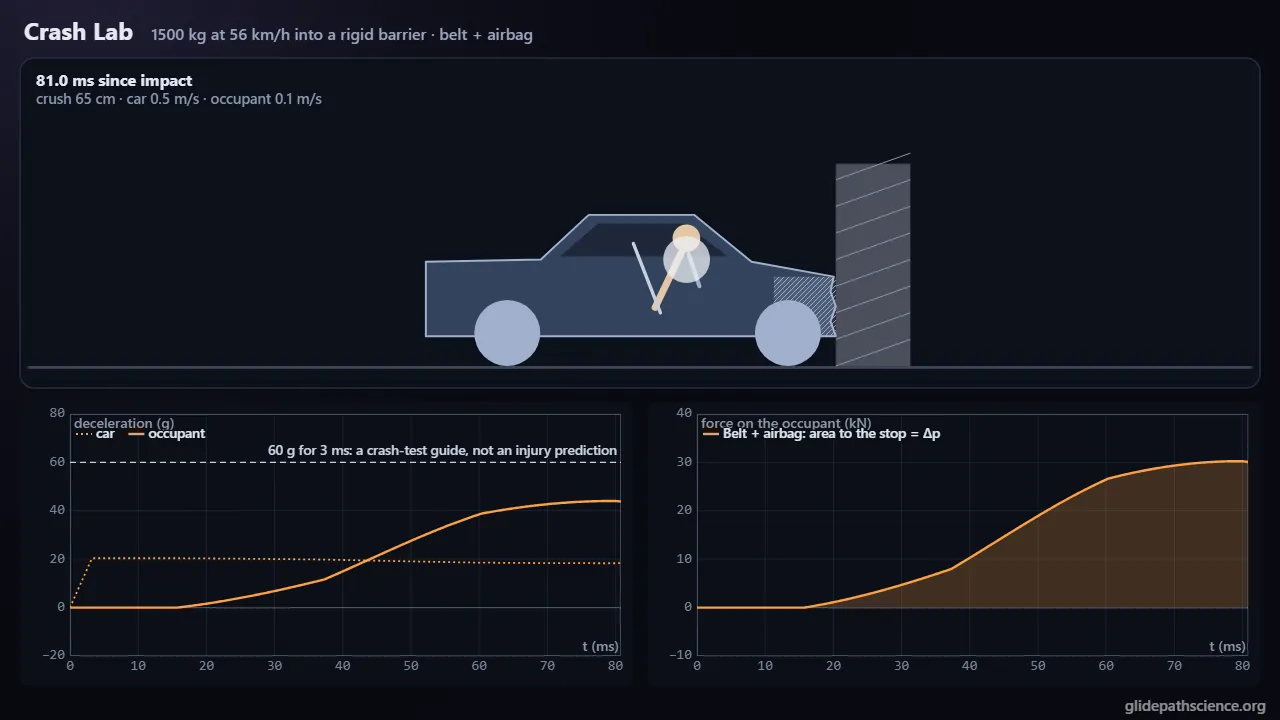
Two carts that collide push on each other equally hard for the same time, so their total momentum survives every collision; only the kinetic energy depends on the bounce. Students collide two to five carts on a track and two or three pucks on an air table through springs, rubber, Velcro, clay, or a bumper of their own, with slow motion through every millisecond-long contact, momentum and energy bars, force-sensor traces whose shaded area is the impulse, and a center-of-mass marker that glides straight through. A Crash Lab puts a car and its occupant through a rigid barrier, a second car, or a truck, with crumple zones, belts, slack, and airbags, and drops an egg, a phone, or a person onto concrete, carpet, or foam. A Collision Bench gives real-looking data: a force sensor to zero, sample rates from 50 to 2000 Hz, noise and a ±50 N range, and a motion detector, so students compare the impulse with mΔv, each with its uncertainty. The Advanced track covers F = dp/dt and the impulse approximation, the center-of-mass frame and reduced mass, restitution solved in general, a contact model and Hertz contact, Newton’s cradle, scattering by impact parameter, crumple-zone design, ride-down, and rocket propulsion.
What you'll learn
- Distinguish momentum, a vector, from kinetic energy, and explain why equal momenta can carry very different energies.
- Find impulse as the area under a force-time graph, equal to the change in momentum, and explain why a stiffer bumper means a larger force.
- Apply conservation of momentum to collisions and explosions in one and two dimensions, and classify collisions by their coefficient of restitution.
- Explain why the center of mass moves steadily through any collision, and why crumple zones, belts, and airbags reduce force without changing the change in momentum.
What you can do
- Guided walkthroughStep-by-step, in Intro and Advanced tracks.
- SandboxEvery control of the model, to explore freely.
- Virtual labA realistic experiment with measurement noise and data analysis.
- Concept checksQuestions about ideas and vocabulary, with no calculating.
- PredictionCommit to a prediction, then see the result.
- Classroom demoProjector mode and recordable clips for slides.
- Works offlineA single downloadable file, verified to run without a network.
Before you start
- Velocity and acceleration, and Newton’s laws of motion
- Kinetic energy
- Vector components, for the two-dimensional collisions
- For the Advanced track: calculus, and the idea of a reference frame
Run or download
Run it in your browser
Nothing to install and no account. Works on laptops, Chromebooks, tablets, and phones.
Launch Momentum, Impulse & CollisionsDownload for offline use
One HTML file (907 kB) that opens in any modern browser with no network: for rooms with unreliable Wi-Fi, or to keep a copy.
Download the fileFile details and checksum
- File
momentum-collisions-v1.4.html- Version
- 1.4, released November 15, 2026
- Build
bfc791d- Size
- 928,745 bytes
- SHA-256
20911f89ff0d5e2d43ce7f75198e9f0754c1d0a455998364ce7f350ecfe99c95- Offline
- Checked to run with all network access blocked.
The model and its limits
What the model assumes
- Bumpers are massless springs of stiffness k while they compress and k/e² while they recover, solved in closed form; Velcro and clay latch.
- Event-driven integration: exact free flight, closed-form isolated contacts, RK4 with located branch changes when contacts overlap; momentum is exact.
- Pucks are smooth discs with no spin; each contact acts along the line of centers at first touch.
- The crash model is one-dimensional with a one-body occupant, hysteretic crush, belt, airbag, and steering-wheel elements; its values are illustrative.
- The Collision Bench adds rolling resistance, a sensor with offset, noise, range, and response time, and a motion detector, all seeded.
What it leaves out
- No spin, rolling, or off-center hits on extended bodies, and no friction between pucks.
- No bumper mass, waves in the bodies, or speed-dependent restitution, except Hertz’s contact time.
- Friction appears only in the Collision Bench; no air drag.
- The occupant has no head or limbs, so there is no head-injury criterion; crash numbers are references, not injury predictions.
- Two vehicles share identical crush structures; no offset, side, or rollover crashes.
Cite this simulation
APA 7
Meier, D. (2026). Momentum, Impulse & Collisions (Version 1.4) [Computer simulation]. Glidepath Science. https://glidepathscience.org/simulations/momentum-collisions/
MLA 9
Meier, David. Momentum, Impulse & Collisions. Version 1.4, Glidepath Science, 2026, glidepathscience.org/simulations/momentum-collisions/.
AIP
D. Meier, Momentum, Impulse & Collisions, version 1.4 (Glidepath Science, 2026), https://glidepathscience.org/simulations/momentum-collisions/.
BibTeX
@misc{meier2026momentumimpulsecollisions,
  author       = {Meier, David},
  title        = {{Momentum, Impulse & Collisions}},
  year         = {2026},
  publisher    = {Glidepath Science},
  version      = {1.4},
  note         = {Interactive simulation, version 1.4},
  howpublished = {\url{https://glidepathscience.org/simulations/momentum-collisions/}},
  url          = {https://glidepathscience.org/simulations/momentum-collisions/}
}
Credits and license
Created by Dr. David Meier, Glidepath Science.
Based on: OpenStax, University Physics Volume 1, by Samuel J. Ling, Jeff Sanny and William Moebs: Chapter 9, “Linear Momentum and Collisions,” an open textbook licensed CC BY-NC-SA 4.0. The order of topics and the notation follow the chapter; the text, numbers, figures, and simulations are this lab’s own. No endorsement by the authors or OpenStax is implied.
Licensed under Creative Commons Attribution-NonCommercial-ShareAlike 4.0 International (CC BY-NC-SA 4.0). You may share and adapt it for noncommercial purposes, such as teaching, with credit and under the same license. Licensing and reuse
AI tools (Claude, from Anthropic, and ChatGPT, from OpenAI) were used in developing Glidepath Science and its simulations. Dr. David Meier reviewed, edited, and modified every release version.