
NewVersion 1.1
Heat Engines & Thermodynamic Cycles
Drive a gas around loops on a pV diagram and keep its books leg by leg, then build Carnot, Otto, Diesel, Brayton and Stirling engines and run them backward as refrigerators and heat pumps.
About this simulation
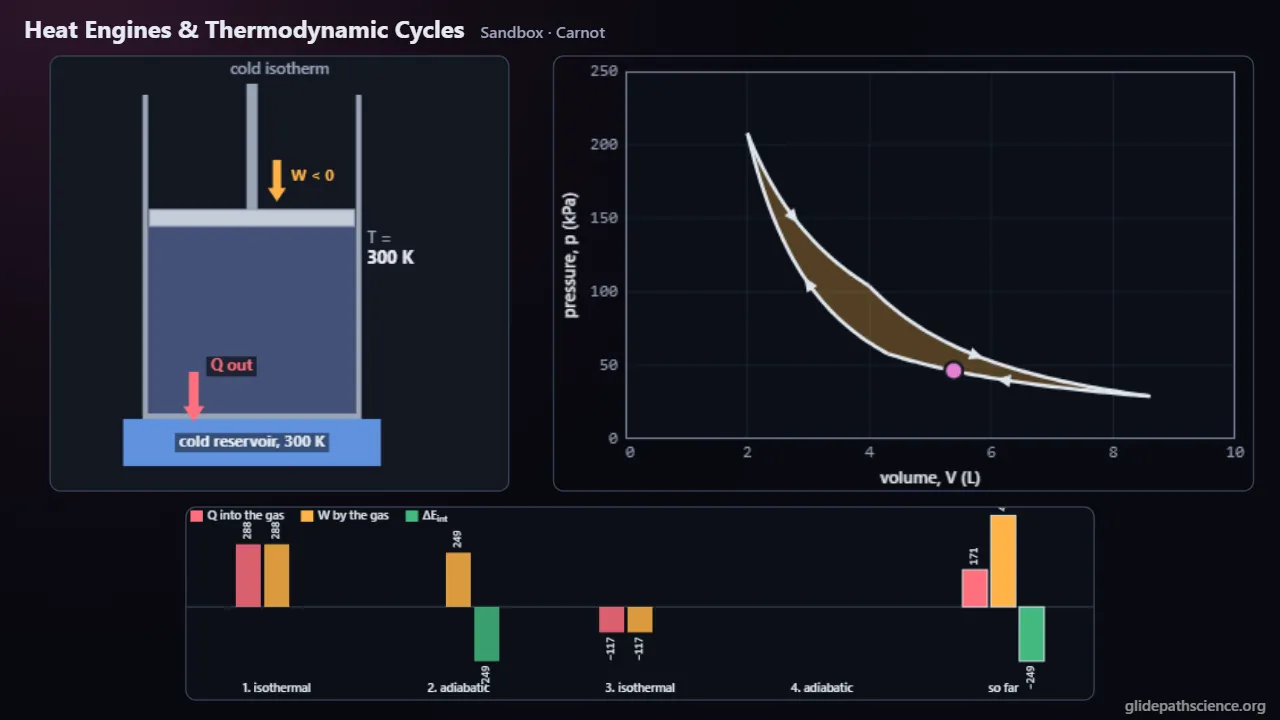
Why can no engine turn all its heat into work? Students build a cycle leg by leg, close the loop, run it and read its books: the work is the area inside, the internal energy comes back, and the heat in always beats the work out. A guided walkthrough at two levels runs from work as area through the first law and its signs, the four processes, heat capacities, efficiency and the refrigerator to the second law and Carnot’s limit; the Advanced track adds free and sudden expansions, the Otto, Brayton and Stirling cycles, entropy and efficiency at maximum power. An Engine Room runs Otto, Diesel, Brayton and Stirling engines beside their pV and T–S diagrams, with an Indicator Bench that measures a tabletop engine’s work from noisy sensors; a Molecular Engine drives five hundred argon atoms through a Carnot or Stirling cycle; and a Heat Pump Lab heats a house and opens a refrigerator in a closed kitchen. Concept challenges and a prediction lab with an inventor’s claim to test round it out.
What you'll learn
- Find work as the area under a path on a pV diagram, W = ∫p dV, positive when the gas expands, and explain why it depends on the path while the change in internal energy depends only on the end states.
- Keep the books with ΔE_int = Q − W on every leg, and fill in the table for constant-volume, constant-pressure, isothermal and adiabatic processes.
- Show that around a cycle ΔE_int = 0, so W = Q_h − Q_c and e = W/Q_h, and that no engine working between T_h and T_c beats 1 − T_c/T_h.
- Run a loop backward as a refrigerator or a heat pump, with K_R = Q_c/W and K_P = Q_h/W = K_R + 1, and explain why heat never flows from cold to hot on its own.
What you can do
- Guided walkthroughStep-by-step, in Intro and Advanced tracks.
- SandboxEvery control of the model, to explore freely.
- Virtual labA realistic experiment with measurement noise and data analysis.
- Concept checksQuestions about ideas and vocabulary, with no calculating.
- PredictionCommit to a prediction, then see the result.
- Classroom demoProjector mode and recordable clips for slides.
- Works offlineA single downloadable file, verified to run without a network.
Before you start
- The ideal gas law, pV = nRT
- Temperature in kelvins, heat, and the idea of internal energy
- For the Advanced track: integrals, natural logarithms, and entropy as heat over temperature
Run or download
Run it in your browser
Nothing to install and no account. Works on laptops, Chromebooks, tablets, and phones.
Launch Heat Engines & Thermodynamic CyclesDownload for offline use
One HTML file (858 kB) that opens in any modern browser with no network: for rooms with unreliable Wi-Fi, or to keep a copy.
Download the fileFile details and checksum
- File
heat-engines-cycles-v1.1.html- Version
- 1.1, released November 15, 2026
- Build
a335e71- Size
- 879,052 bytes
- SHA-256
74de64315a4a4806f32710e63ed59fc5313a862dcee82450273d2917eb2c44ec- Offline
- Checked to run with all network access blocked.
The model and its limits
What the model assumes
- The gas is ideal with a constant heat capacity (3/2 R per mole at constant volume for helium and argon, 5/2 R for nitrogen and air); pressures are in kPa and volumes in liters, so pV is in joules.
- Every leg is computed in closed form, returning the work, the heat, the change in internal energy and the change in entropy, and cycles close exactly; no engine beats Carnot between its own extremes.
- Irreversible steps (Advanced) are booked from the first law between equilibrium end states, never drawn as paths, and each books the entropy it makes.
- Reservoirs are ideal; the Engine Room’s cycles are air-standard, with heat added from outside in place of burning and no friction or leaks.
- The Molecular Engine is a particle simulation of real argon whose legs are only as isothermal or adiabatic as the piston’s speed allows; the Heat Pump Lab’s appliance is an illustrative fraction of Carnot’s limit.
What it leaves out
- No real gases or phase changes inside a cycle: a steam plant’s Rankine cycle and a refrigerant’s boiling and condensing are described, not modeled.
- Heat capacities do not change with temperature, and combustion, intake and exhaust, engine friction, heat lost through the walls and leaks are left out.
- Heat-flow rates enter only through one stated model of efficiency at maximum power, and reservoirs never warm or cool.
- Entropy’s statistical meaning, microstates and the arrow of time are left to Entropy & the Second Law.
Cite this simulation
APA 7
Meier, D. (2026). Heat Engines & Thermodynamic Cycles (Version 1.1) [Computer simulation]. Glidepath Science. https://glidepathscience.org/simulations/heat-engines-cycles/
MLA 9
Meier, David. Heat Engines & Thermodynamic Cycles. Version 1.1, Glidepath Science, 2026, glidepathscience.org/simulations/heat-engines-cycles/.
AIP
D. Meier, Heat Engines & Thermodynamic Cycles, version 1.1 (Glidepath Science, 2026), https://glidepathscience.org/simulations/heat-engines-cycles/.
BibTeX
@misc{meier2026heatenginesthermodynamiccycles,
  author       = {Meier, David},
  title        = {{Heat Engines & Thermodynamic Cycles}},
  year         = {2026},
  publisher    = {Glidepath Science},
  version      = {1.1},
  note         = {Interactive simulation, version 1.1},
  howpublished = {\url{https://glidepathscience.org/simulations/heat-engines-cycles/}},
  url          = {https://glidepathscience.org/simulations/heat-engines-cycles/}
}
Credits and license
Created by Dr. David Meier, Glidepath Science.
Based on: OpenStax, University Physics Volume 2, by Samuel J. Ling, Jeff Sanny and William Moebs: Chapter 3, The First Law of Thermodynamics, and Chapter 4, The Second Law of Thermodynamics (§4.1–4.6), an open textbook licensed CC BY-NC-SA 4.0 (openstax.org). The order of topics and the notation follow it (Eint, Q, W done by the gas, CV, Cp, γ, e, KR, KP); the wording, numbers, figures and simulations are this lab’s own. No endorsement by OpenStax or the authors is implied.
Licensed under Creative Commons Attribution-NonCommercial-ShareAlike 4.0 International (CC BY-NC-SA 4.0). You may share and adapt it for noncommercial purposes, such as teaching, with credit and under the same license. Licensing and reuse
AI tools (Claude, from Anthropic, and ChatGPT, from OpenAI) were used in developing Glidepath Science and its simulations. Dr. David Meier reviewed, edited, and modified every release version.