
NewVersion 1.1
Michelson Interferometer
Split one beam into two arms: a quarter-wavelength mirror move turns bright to dark. Align it, count fringes to measure light, find white light’s zero, then scale it up to LIGO’s 4 km arms.
About this simulation
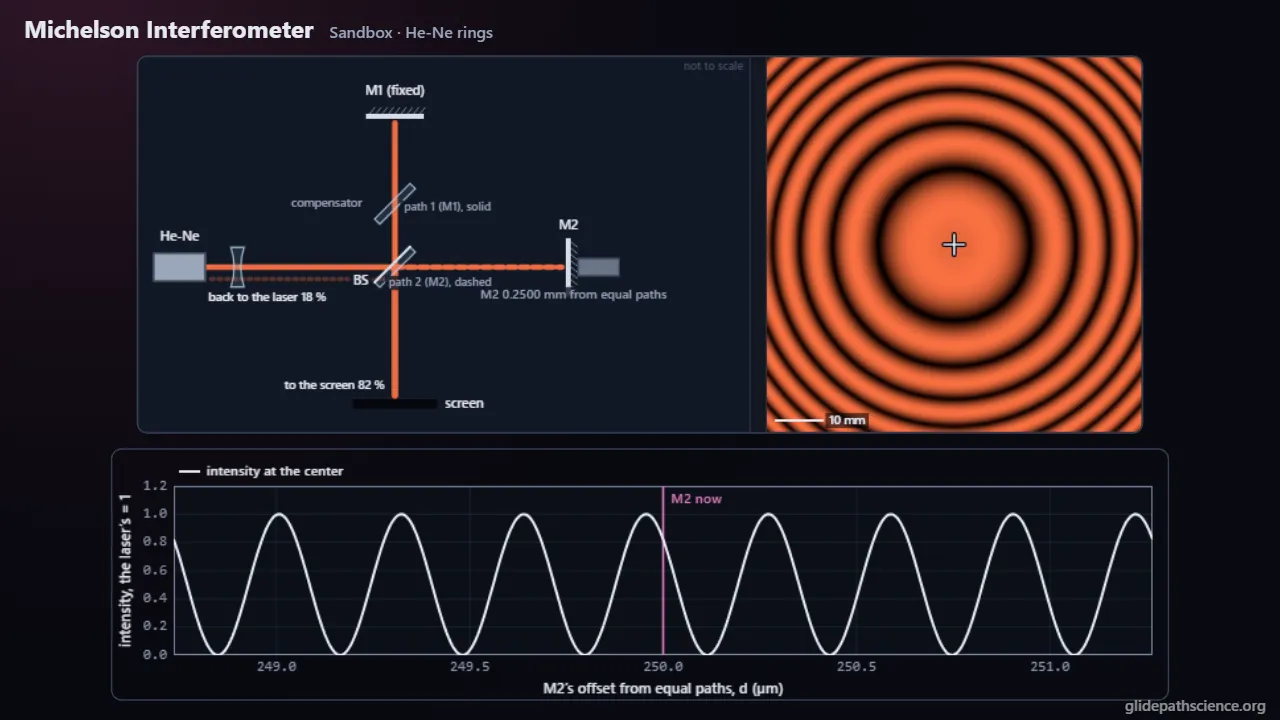
One instrument at two scales. On the bench, a beamsplitter sends a laser down two arms and back to one screen, where the beams add as waves: move a mirror by d and its light travels 2d more, so each half wavelength of travel sends one fringe past the center. A guided walkthrough at two levels follows OpenStax University Physics Volume 3’s section on the Michelson interferometer: two paths from one beam, the round trip, bright or dark, rings, counting fringes to measure a wavelength or a distance, alignment, white light and the zero, a gas cell, and LIGO scaled up. The Advanced track adds the two-beam intensity and visibility, ring orders, tilt fringes and the compensator, coherence length, the sodium doublet’s beats, Fourier-transform spectroscopy, a gas’s index, and LIGO in outline: strain and phase, the dark port, arm cavities, noise scaling and a chirp’s chirp mass. The Sandbox drives every knob, with both optical paths drawn and the light at each output port shown. The Alignment Bench starts misaligned each visit and takes the student through four stages to the white-light fringes. The Fringe Counter counts by hand or automatically, refuses a count that reverses, stops at the end of the mirror’s travel, keeps each reading’s settings, reads sodium’s splitting from its beats, and turns interferograms into spectra with an honest sampling limit. LIGO Scale-Up redraws the instrument at 4 km with a GW150914-style chirp, the dark port’s response, and labeled outline toggles for cavities, recycling and noise. A Quick check, prediction rounds with fresh numbers and staged hints, and a printable Guide complete it. Runs entirely offline in one file.
What you'll learn
- Explain why moving a mirror by d changes the path by 2d, and count fringes with N = 2d/λ.
- Measure a wavelength or a distance by counting fringes, and a gas’s index from 2ℓ(n − 1).
- Use white light to find equal paths, and relate fringe fading to the coherence length λ²/Δλ.
- Explain how LIGO, a Michelson with 4 km arms, turns a strain of 10⁻²¹ into a measurable signal.
What you can do
- Guided walkthroughStep-by-step, in Intro and Advanced tracks.
- SandboxEvery control of the model, to explore freely.
- Virtual labA realistic experiment with measurement noise and data analysis.
- Concept checksQuestions about ideas and vocabulary, with no calculating.
- PredictionCommit to a prediction, then see the result.
- Classroom demoProjector mode and recordable clips for slides.
- Works offlineA single downloadable file, verified to run without a network.
Before you start
- Superposition and path difference
- Wavelength, frequency and the speed of light
- For the Advanced track: phasors, the Fourier transform and exponentials
Run or download
Run it in your browser
Nothing to install and no account. Works on laptops, Chromebooks, tablets, and phones.
Launch Michelson InterferometerDownload for offline use
One HTML file (980 kB) that opens in any modern browser with no network: for rooms with unreliable Wi-Fi, or to keep a copy.
Download the fileFile details and checksum
- File
michelson-interferometer-v1.1.html- Version
- 1.1, released November 15, 2026
- Build
6a2fe80- Size
- 1,003,532 bytes
- SHA-256
5814dd9243ac0ae8092a3a30ea7ce46904c56117bf14455086ba5f793f106c61- Offline
- Checked to run with all network access blocked.
The model and its limits
What the model assumes
- Scalar waves and an ideal, lossless, non-polarizing 50/50 beamsplitter with symmetric coatings; the two output ports share the light.
- Exact two-source geometry for diverging beams, plane waves for collimated beams, Gaussian spots on the Alignment Bench.
- Sources as Gaussian spectral lines; white light as 31 bands of 10 nm; illustrative line widths.
- N-BK7 beamsplitter and compensator by Schott’s Sellmeier equation; dry air by Peck and Reeder; helium a typical refractivity.
- Fourier transforms of one-sided interferograms with a half-Hann window; the sampling limit 4δd enforced.
- LIGO in outline: the long-wavelength strain limit, illustrative cavity and recycling gains, textbook shot noise and illustrative seismic and thermal shapes, a leading-order chirp.
What it leaves out
- No polarization, coating phases, losses or scattering; mirrors are flat and sources are points.
- No air turbulence or vibration on the bench.
- LIGO’s signal recycling, squeezed light, radiation-pressure noise and control systems are left out, and its noise curve is illustrative, not measured.
- The chirp is a leading-order inspiral ending at an illustrative merger frequency, not a merger or ringdown simulation.
Cite this simulation
APA 7
Meier, D. (2026). Michelson Interferometer (Version 1.1) [Computer simulation]. Glidepath Science. https://glidepathscience.org/simulations/michelson-interferometer/
MLA 9
Meier, David. Michelson Interferometer. Version 1.1, Glidepath Science, 2026, glidepathscience.org/simulations/michelson-interferometer/.
AIP
D. Meier, Michelson Interferometer, version 1.1 (Glidepath Science, 2026), https://glidepathscience.org/simulations/michelson-interferometer/.
BibTeX
@misc{meier2026michelsoninterferometer,
  author       = {Meier, David},
  title        = {{Michelson Interferometer}},
  year         = {2026},
  publisher    = {Glidepath Science},
  version      = {1.1},
  note         = {Interactive simulation, version 1.1},
  howpublished = {\url{https://glidepathscience.org/simulations/michelson-interferometer/}},
  url          = {https://glidepathscience.org/simulations/michelson-interferometer/}
}
Credits and license
Created by Dr. David Meier, Glidepath Science.
Licensed under Creative Commons Attribution-NonCommercial-ShareAlike 4.0 International (CC BY-NC-SA 4.0). You may share and adapt it for noncommercial purposes, such as teaching, with credit and under the same license. Licensing and reuse
AI tools (Claude, from Anthropic, and ChatGPT, from OpenAI) were used in developing Glidepath Science and its simulations. Dr. David Meier reviewed, edited, and modified every release version.