
NewVersion 1.0
Water Rocket Lab
Fill a bottle rocket, pump it up and launch it to see thrust as momentum flow, why the expanding air sets the burn, why there is a best fill, and how drag cuts the climb.
About this simulation
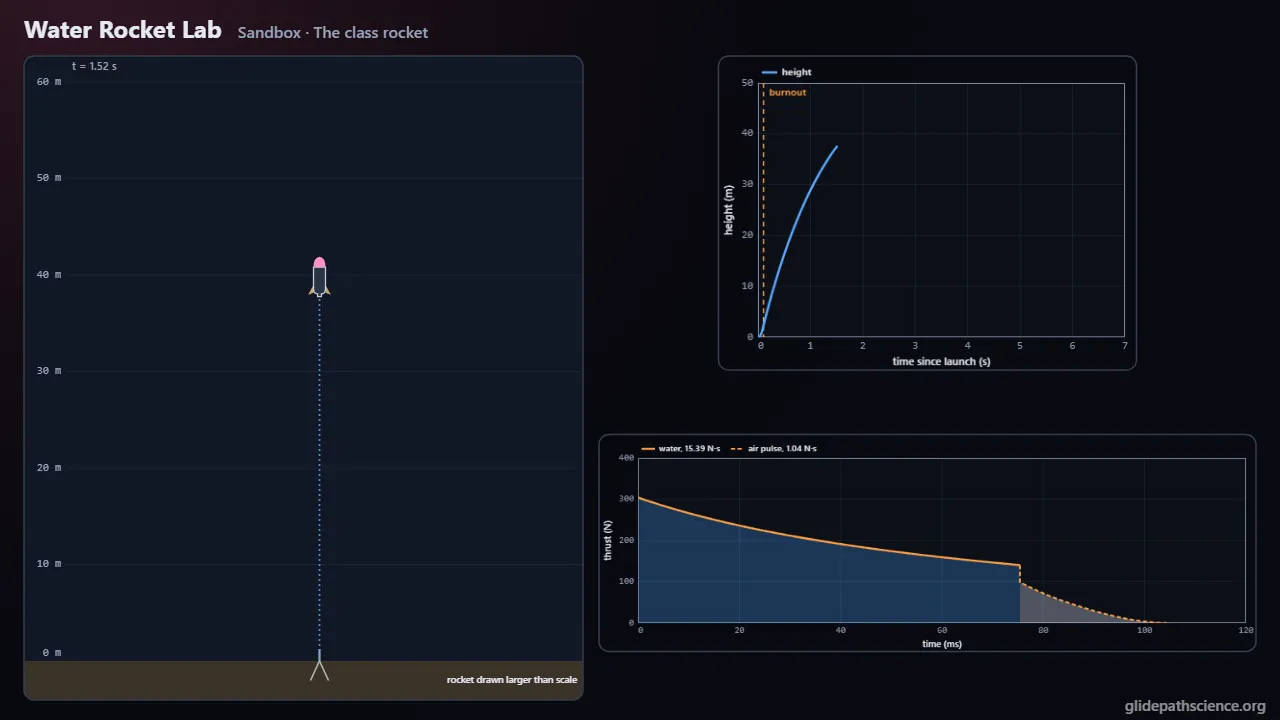
What makes a water rocket fly, and how full should it be? Students set the water fill, pump pressure, nozzle, dry mass, drag coefficient and launch angle, see each new flight at once beside the last, and watch the burn slowed 25 times. A guided walkthrough at two levels follows the three phases of a flight, the exit speed, thrust as momentum flow and why it is twice the pressure times the nozzle’s area, the expanding air, impulse, the best fill, the coast and drag; the Advanced track adds the rocket equation, the cooling air, the burn time, the expansion work, the air pulse, terminal speed, sensitivity and a design problem. A Fill Optimizer sweeps every fill against a student’s guess and maps the apogee over fill and pressure; a Thrust Curve fires the rocket on a test stand in slow motion; a Launch Log compares the model with launches that scatter and, in Advanced, fits the hidden drag coefficient. A concept challenge with Which flies higher?, and a prediction lab with Hit the target, round it out.
What you'll learn
- Explain thrust as momentum flow, F = (Δm/Δt)u = 2ΔpAₙ: the jet’s momentum per second, twice the gauge pressure times the nozzle’s area.
- Explain that the compressed air is the engine: as the water leaves, the air expands with pV^1.4 fixed, so its pressure, the jet’s speed and the thrust all fall and the air cools.
- Explain why there is a best fill: too little water throws too little mass and too much leaves too little air to throw it, so about 30 % flies highest for this rocket.
- Judge a model against real launches, see that drag about halves the climb, and fit the model’s least-known input, the drag coefficient, to the measured apogees.
What you can do
- Guided walkthroughStep-by-step, in Intro and Advanced tracks.
- SandboxEvery control of the model, to explore freely.
- Virtual labA realistic experiment with measurement noise and data analysis.
- Concept checksQuestions about ideas and vocabulary, with no calculating.
- PredictionCommit to a prediction, then see the result.
- Classroom demoProjector mode and recordable clips for slides.
- Works offlineA single downloadable file, verified to run without a network.
Before you start
- Newton’s laws, momentum and impulse
- Pressure, and algebra with square roots and powers
- For the Advanced track: derivatives and integrals, a logarithm, and a differential equation solved by separating variables
Run or download
Run it in your browser
Nothing to install and no account. Works on laptops, Chromebooks, tablets, and phones.
Launch Water Rocket LabDownload for offline use
One HTML file (725 kB) that opens in any modern browser with no network: for rooms with unreliable Wi-Fi, or to keep a copy.
Download the fileFile details and checksum
- File
water-rocket-lab-v1.0.html- Version
- 1.0, released November 15, 2026
- Build
9e05c42- Size
- 742,179 bytes
- SHA-256
9769dbeb376ddbac9ce524757fac1d5cfd3276cd7d8d9e05d343320998de8667- Offline
- Checked to run with all network access blocked.
The model and its limits
What the model assumes
- The water phase: exit speed u = √(2Δp/ρ), mass flow ρAₙu and thrust 2ΔpAₙ, with the air adiabatic (γ = 1.4) or, in Advanced, isothermal.
- After the water is gone, the air pulse is isentropic flow through the nozzle, choked above a pressure ratio of 1.89 and subsonic below; it can be switched off in Advanced.
- The coast has gravity and quadratic drag with one fixed drag coefficient on a 10.8 cm body in air of 1.20 kg/m³; after a 1.0 m launch rod the rocket points along its velocity.
- Fourth-order Runge–Kutta integration, with every change of phase, apogee and landing found by bisection, checked against an independent calculation.
- Typical values: a 2.00 L bottle with its 22 mm neck as the nozzle, 150 g dry, a drag coefficient of 0.40; the Launch Log’s scatter in pressure, pour and altimeter is illustrative.
What it leaves out
- The water column’s weight in the accelerating bottle is left out, so the early thrust is about 7 % low; the free surface’s speed, the jet’s contraction and the water’s viscosity are also ignored.
- The air is either perfectly adiabatic or perfectly isothermal, with no heat exchanged with the water and the walls and no fog.
- No fins or stability, spin, wind, parachutes, launch tubes or staging; the drag coefficient is the same at every speed, and the bottle never deforms.
- Pressures up to 600 kPa are for learning, not a safe working pressure: a real launch needs bottles made for carbonated drinks, a launcher with a remote release, eye protection, and the launcher’s and the school’s limits.
Cite this simulation
APA 7
Meier, D. (2026). Water Rocket Lab (Version 1.0) [Computer simulation]. Glidepath Science. https://glidepathscience.org/simulations/water-rocket-lab/
MLA 9
Meier, David. Water Rocket Lab. Version 1.0, Glidepath Science, 2026, glidepathscience.org/simulations/water-rocket-lab/.
AIP
D. Meier, Water Rocket Lab, version 1.0 (Glidepath Science, 2026), https://glidepathscience.org/simulations/water-rocket-lab/.
BibTeX
@misc{meier2026waterrocketlab,
  author       = {Meier, David},
  title        = {{Water Rocket Lab}},
  year         = {2026},
  publisher    = {Glidepath Science},
  version      = {1.0},
  note         = {Interactive simulation, version 1.0},
  howpublished = {\url{https://glidepathscience.org/simulations/water-rocket-lab/}},
  url          = {https://glidepathscience.org/simulations/water-rocket-lab/}
}
Credits and license
Created by Dr. David Meier, Glidepath Science.
Licensed under Creative Commons Attribution-NonCommercial-ShareAlike 4.0 International (CC BY-NC-SA 4.0). You may share and adapt it for noncommercial purposes, such as teaching, with credit and under the same license. Licensing and reuse
AI tools (Claude, from Anthropic, and ChatGPT, from OpenAI) were used in developing Glidepath Science and its simulations. Dr. David Meier reviewed, edited, and modified every release version.