
NewVersion 1.2
Lenses, Mirrors & Optical Instruments
Trace the three principal rays through mirrors and lenses to find every image, real or virtual, read its signs, then correct a model eye and build a magnifier, a microscope, a telescope and a camera.
About this simulation
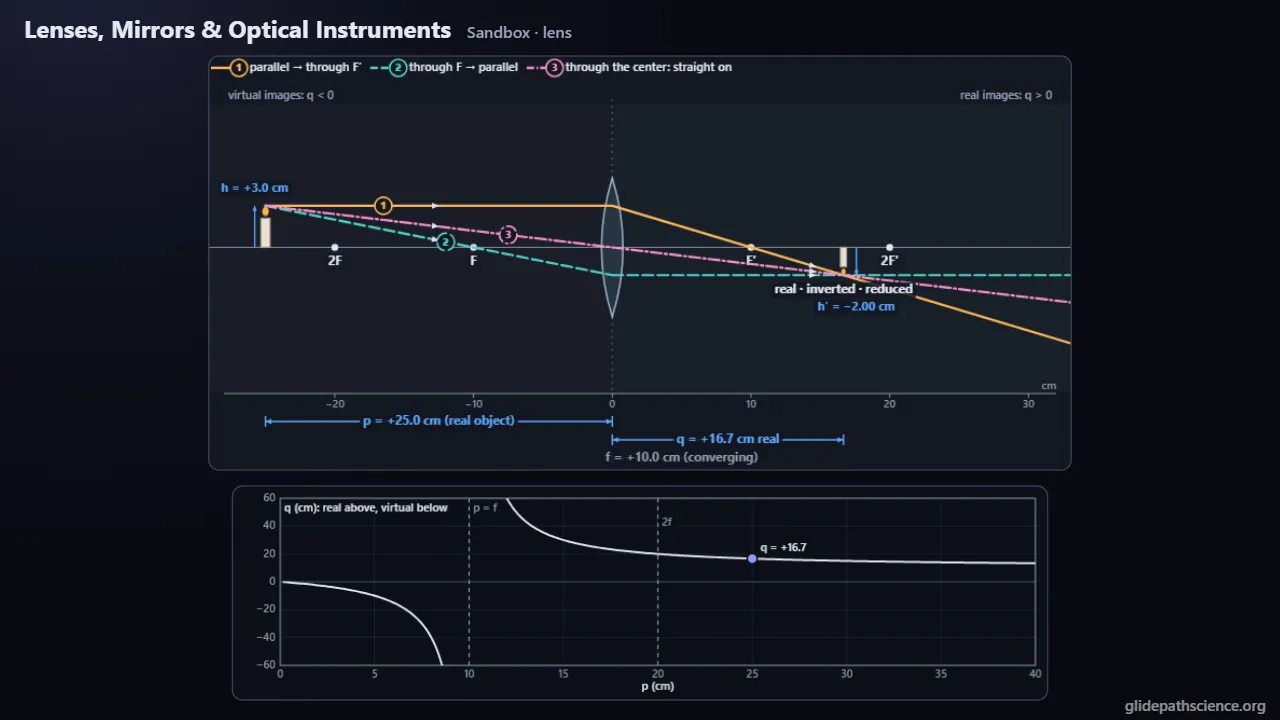
Where is the image, and is it really there? Students trace the principal rays one at a time through concave and convex mirrors and converging and diverging lenses, with every distance drawn as a signed dimension line, so the sign of q says real or virtual and the sign of M says upright or inverted. A real image is caught on a screen they drag along the bench; a virtual one cannot be, but an eye they drag finds it fixed in place. The thin-lens and mirror equations, 1/p + 1/q = 1/f with M = −q/p, follow from the drawings, and a curved surface, the lensmaker’s equation and two-element systems extend them. An Optics Bench takes noisy measurements to find a focal length from a fit, an Eye Lab fits glasses to near- and farsighted eyes, and an Instruments tab builds a magnifier, a compound microscope, Keplerian, Galilean and Newtonian telescopes and a camera, each with its angular magnification and its limits. A concept challenge with ray sketches and an eye-doctor round, and a prediction lab with fresh numbers on every run, round it out.
What you'll learn
- Locate the image of a mirror or a lens with the three principal rays, and decide from the drawing whether it is real or virtual, upright or inverted, enlarged or reduced.
- Use 1/p + 1/q = 1/f and M = −q/p with the real-is-positive sign convention, and read the signs of q and M as real or virtual and upright or inverted.
- Explain why a real image can be caught on a screen while a virtual one can only be seen by looking into the mirror or lens.
- Find the lens power, in diopters, that corrects a near- or farsighted eye, and the angular magnification of a magnifier, a microscope and a telescope.
What you can do
- Guided walkthroughStep-by-step, in Intro and Advanced tracks.
- SandboxEvery control of the model, to explore freely.
- Virtual labA realistic experiment with measurement noise and data analysis.
- Concept checksQuestions about ideas and vocabulary, with no calculating.
- PredictionCommit to a prediction, then see the result.
- Classroom demoProjector mode and recordable clips for slides.
- Works offlineA single downloadable file, verified to run without a network.
Before you start
- Similar triangles and algebra with fractions
- The law of reflection and Snell’s law (Reflection & Refraction)
- For the Advanced track: small-angle approximations, matrices, and refraction in a medium
Run or download
Run it in your browser
Nothing to install and no account. Works on laptops, Chromebooks, tablets, and phones.
Launch Lenses, Mirrors & Optical InstrumentsDownload for offline use
One HTML file (942 kB) that opens in any modern browser with no network: for rooms with unreliable Wi-Fi, or to keep a copy.
Download the fileFile details and checksum
- File
lenses-mirrors-instruments-v1.2.html- Version
- 1.2, released November 15, 2026
- Build
40b1df4- Size
- 964,268 bytes
- SHA-256
984e87428e8dc70cfe2740e1a8ab16e4acb5e82c774a52e5a5a3e8f341900b89- Offline
- Checked to run with all network access blocked.
The model and its limits
What the model assumes
- Two-dimensional geometric optics in the plane of the drawing; ideal mirrors and thin lenses follow the paraxial equations exactly, so the principal rays meet where the equations say.
- Real optics (the Advanced track and the Sandbox’s toggle) are traced exactly: Snell’s law at spherical surfaces, reflection at spherical or parabolic mirrors, with glass indices from published dispersion formulas.
- Distances use the real-is-positive convention: p > 0 for a real object, q > 0 for a real image, f > 0 for a concave mirror or converging lens.
- The eye uses a simple two-centimeter model in the Intro track and a reduced eye of 60 D in the Advanced track; accommodation follows an average amplitude for the age.
- Instrument magnifications are paraxial, with the near point at 25 cm; the Newtonian telescope’s numbers come from its unfolded equivalent.
What it leaves out
- No diffraction or interference: the Airy disk and resolution limits are in Interference & Diffraction; where a geometric blur falls below the Airy disk, the sim says so.
- Only rays in the drawing’s plane are traced, so there is no true astigmatism; coma and field curvature appear only as they come.
- One index stands for the eye’s graded crystalline lens; the eye models are for learning, not for testing vision or fitting glasses.
- No tilted or decentered elements, no aspheres other than the paraboloid, and no light lost at surfaces.
Cite this simulation
APA 7
Meier, D. (2026). Lenses, Mirrors & Optical Instruments (Version 1.2) [Computer simulation]. Glidepath Science. https://glidepathscience.org/simulations/lenses-mirrors-instruments/
MLA 9
Meier, David. Lenses, Mirrors & Optical Instruments. Version 1.2, Glidepath Science, 2026, glidepathscience.org/simulations/lenses-mirrors-instruments/.
AIP
D. Meier, Lenses, Mirrors & Optical Instruments, version 1.2 (Glidepath Science, 2026), https://glidepathscience.org/simulations/lenses-mirrors-instruments/.
BibTeX
@misc{meier2026lensesmirrorsopticalinstruments,
  author       = {Meier, David},
  title        = {{Lenses, Mirrors & Optical Instruments}},
  year         = {2026},
  publisher    = {Glidepath Science},
  version      = {1.2},
  note         = {Interactive simulation, version 1.2},
  howpublished = {\url{https://glidepathscience.org/simulations/lenses-mirrors-instruments/}},
  url          = {https://glidepathscience.org/simulations/lenses-mirrors-instruments/}
}
Credits and license
Created by Dr. David Meier, Glidepath Science.
Based on: OpenStax, University Physics Volume 3, by Samuel J. Ling, Jeff Sanny and William Moebs: Chapter 2, “Geometric Optics and Image Formation” (§2.2–2.8), an open textbook licensed CC BY-NC-SA 4.0 (openstax.org). The Intro track follows its order of topics and its sign convention; the notation, wording, numbers, figures and simulations are the sim’s own. No endorsement by OpenStax or the authors is implied.
Licensed under Creative Commons Attribution-NonCommercial-ShareAlike 4.0 International (CC BY-NC-SA 4.0). You may share and adapt it for noncommercial purposes, such as teaching, with credit and under the same license. Licensing and reuse
AI tools (Claude, from Anthropic, and ChatGPT, from OpenAI) were used in developing Glidepath Science and its simulations. Dr. David Meier reviewed, edited, and modified every release version.