
NewVersion 1.1
Capacitors & Dielectrics
Charge two plates, change their gap and area, and slide a dielectric between them, with the battery connected or not, to see what sets capacitance, where the energy lives, and what makes a spark.
About this simulation
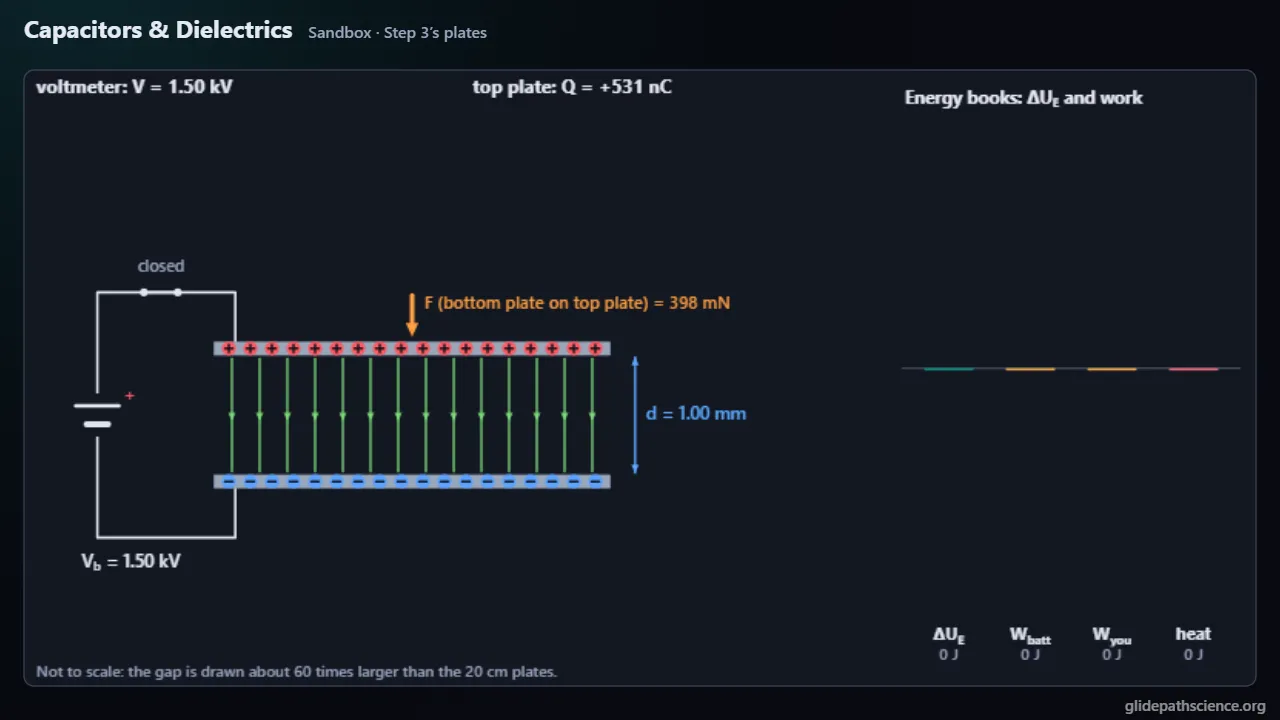
What does a capacitor hold, and where? Students charge two parallel plates from a battery, then widen the gap, shrink the overlap or slide in a slab of paper, mica or strontium titanate, with the switch closed or open, and watch the charge, voltage, field and energy respond while the energy books show what the battery and the hand supplied. A guided walkthrough at two levels runs from Q = CV and C = κε₀A/d through U = ½CV², the energy in the field, dielectrics, breakdown and series and parallel combinations; the Advanced track adds Gauss’s law, the edge field, forces by virtual work, bound charge, partly filled gaps and a liquid pulled up between plates. A Capacitance Bench measures ε₀ from a fit of C against 1/d and finds a mystery sheet’s κ with a noisy meter, and a Teardown opens a film capacitor, a ceramic chip, an electrolytic and a supercapacitor to show how they reach microfarads and farads. A concept challenge and a prediction lab with fresh numbers on every run round it out.
What you'll learn
- Explain why capacitance, C = Q/V = κε₀A/d, depends on the plates and what fills the gap, never on the charge or the voltage.
- Compute the stored energy U = ½CV² as the energy density ½ε₀E² times the volume between the plates, and predict what changes when the plates move with the battery connected or disconnected.
- Explain how bound charge on a dielectric’s faces cancels part of the field, so the capacitance grows by κ and a strong dielectric lets a capacitor reach a higher voltage before it breaks down.
- Combine capacitors in parallel, where the voltage is shared and capacitances add, and in series, where the charge is shared, reciprocals add and the smallest capacitor takes the largest voltage.
What you can do
- Guided walkthroughStep-by-step, in Intro and Advanced tracks.
- SandboxEvery control of the model, to explore freely.
- Virtual labA realistic experiment with measurement noise and data analysis.
- Concept checksQuestions about ideas and vocabulary, with no calculating.
- PredictionCommit to a prediction, then see the result.
- Classroom demoProjector mode and recordable clips for slides.
- Works offlineA single downloadable file, verified to run without a network.
Before you start
- Electric field and electric potential (voltage)
- Charge, current and batteries in simple circuits
- For the Advanced track: Gauss’s law, derivatives, and Kirchhoff’s rules for networks
Run or download
Run it in your browser
Nothing to install and no account. Works on laptops, Chromebooks, tablets, and phones.
Launch Capacitors & DielectricsDownload for offline use
One HTML file (926 kB) that opens in any modern browser with no network: for rooms with unreliable Wi-Fi, or to keep a copy.
Download the fileFile details and checksum
- File
capacitors-dielectrics-v1.1.html- Version
- 1.1, released November 15, 2026
- Build
b0c70f3- Size
- 948,668 bytes
- SHA-256
b49335a44521bdff1e75c9171c715101618ccdff7077f9ca2f42711f5d4fef98- Offline
- Checked to run with all network access blocked.
The model and its limits
What the model assumes
- Ideal parallel plates with no field outside the gap and air taken as κ = 1; a note gives how much the edge field would add for the plates on the stage, and a partly inserted slab is two layers in series beside an air region in parallel.
- Every move is quasi-static, with no kinetic energy anywhere: a connected battery does work VΔQ, and closing the switch on a capacitor at another voltage turns ½C(ΔV)² into heat in the wires.
- Forces come from virtual work: F = ½V² ∂C/∂d between the plates, and the same method for a slab or a liquid pulled up between plates.
- Breakdown compares each layer’s field with one dielectric strength per material (air 3.0 MV/m); a spark turns the stored energy into heat and discharges the plates.
- Networks are solved by nodes with every part starting uncharged; material values are typical ones at 20 °C, and the Advanced edge field is a two-dimensional solution for thin plates.
What it leaves out
- No charging in time (the RC Circuit Lab) and no AC behavior: reactance, equivalent series resistance, dielectric loss and frequency dependence are left out.
- No magnetic field or displacement current, and no dynamics: plates and slabs move without kinetic energy.
- Breakdown uses one value per material, without Paschen’s law for thin air gaps or the statistics of real sparks.
- Dielectrics are linear, with κ independent of the field, temperature and humidity; electrostriction, ferroelectrics and the chemistry of electrolytic and double-layer capacitors are not modeled.
Cite this simulation
APA 7
Meier, D. (2026). Capacitors & Dielectrics (Version 1.1) [Computer simulation]. Glidepath Science. https://glidepathscience.org/simulations/capacitors-dielectrics/
MLA 9
Meier, David. Capacitors & Dielectrics. Version 1.1, Glidepath Science, 2026, glidepathscience.org/simulations/capacitors-dielectrics/.
AIP
D. Meier, Capacitors & Dielectrics, version 1.1 (Glidepath Science, 2026), https://glidepathscience.org/simulations/capacitors-dielectrics/.
BibTeX
@misc{meier2026capacitorsdielectrics,
  author       = {Meier, David},
  title        = {{Capacitors & Dielectrics}},
  year         = {2026},
  publisher    = {Glidepath Science},
  version      = {1.1},
  note         = {Interactive simulation, version 1.1},
  howpublished = {\url{https://glidepathscience.org/simulations/capacitors-dielectrics/}},
  url          = {https://glidepathscience.org/simulations/capacitors-dielectrics/}
}
Credits and license
Created by Dr. David Meier, Glidepath Science.
Based on: OpenStax, University Physics Volume 2, by Samuel J. Ling, Jeff Sanny and William Moebs: The chapter “Capacitance” (Chapter 8, §8.1 “Capacitors and Capacitance” through §8.5 “Molecular Model of a Dielectric”), an open textbook licensed CC BY-NC-SA 4.0 (openstax.org). The Intro track follows its order of topics and its notation; the text, numbers, figures and simulations are this lab’s own. No endorsement by OpenStax or the authors is implied.
Licensed under Creative Commons Attribution-NonCommercial-ShareAlike 4.0 International (CC BY-NC-SA 4.0). You may share and adapt it for noncommercial purposes, such as teaching, with credit and under the same license. Licensing and reuse
AI tools (Claude, from Anthropic, and ChatGPT, from OpenAI) were used in developing Glidepath Science and its simulations. Dr. David Meier reviewed, edited, and modified every release version.