
NewVersion 1.3
Loop Torque Lab
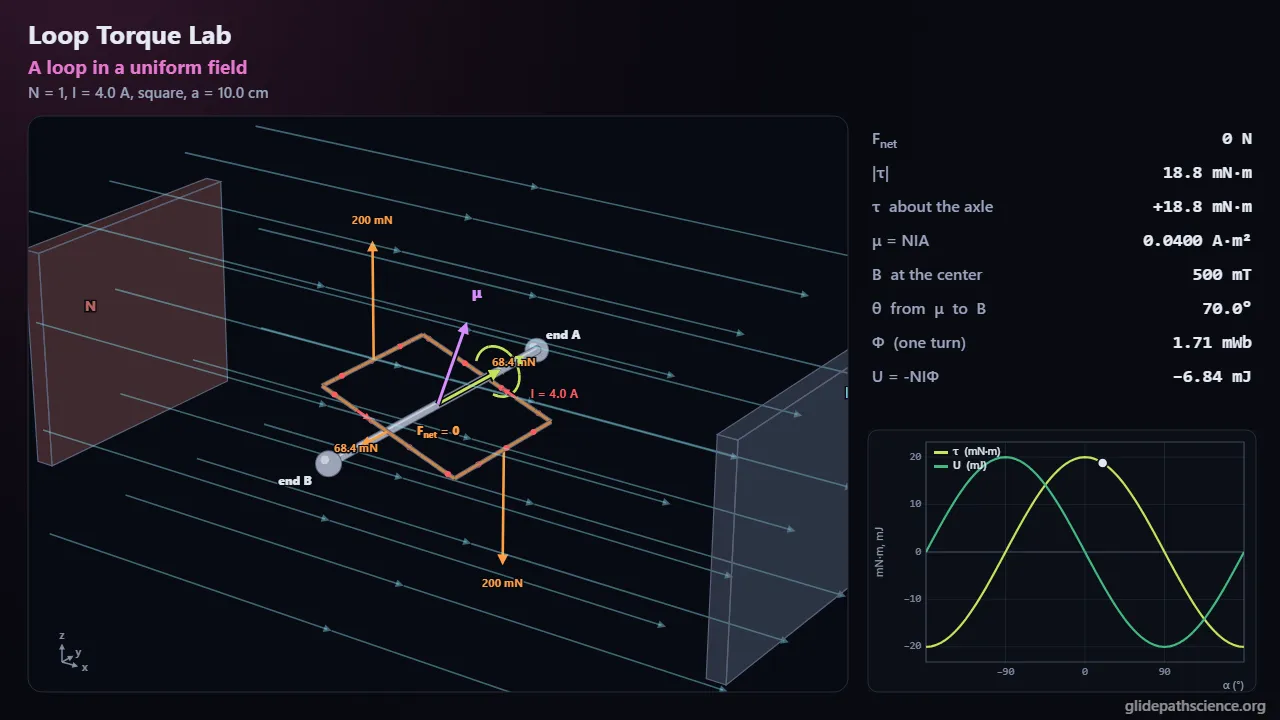
Add up qv × B along a wire, then close it into a loop: in a uniform field the forces cancel but a torque remains. Slide it partway out of the field or near a magnet or wire, then run a motor and a meter.
About this simulation
Every force and torque in this lab is the engine’s sum of NI dl × B over the real wire, in fields that obey Maxwell’s equations: a uniform field, a pole gap with a sharp edge or with Maxwell’s exact fringe, two linear gradients, a bar magnet modeled as a uniformly magnetized cylinder (an exact, divergence-free equivalent solenoid), and a long straight wire. A guided walkthrough at two levels builds from the drifting carriers to F = IL × B, then closes the wire into a loop: no net force in a uniform field, but a torque τ = NIAB sin θ that swings μ toward B, whatever the loop’s shape. Loops partly in a field, above a magnet, and beside a long wire feel a net force; a commutator turns the torque into a motor, and a radial field gives a moving-coil meter a linear scale. The Advanced track adds ∮ dl = 0 and τ = μ × B for any flat loop, U = −μ·B and the exact U = −NIΦ, small oscillations, F = ∇(μ·B) and virtual work F = NI∇Φ, how good the dipole estimate is beside a wire, why every real field fringes, Earnshaw’s theorem, the motor’s torque–speed line, ballistic throws, and critical damping. Every view can be turned, and no answer depends on the camera: a question that needs a vantage names it and holds the view there, and the forces, the torque, and any motion wait for the answer. The Sandbox offers every field and loop, free to turn and slide, with τ and U against angle, F against position, and a formula panel; the DC Motor runs on fixed wires, a split ring (one coil or two), or AC slip rings, with back EMF, power books, and the torque–speed line; the Galvanometer compares radial and uniform fields, damping by its own circuit, and a charge pulse. A Quick check, prediction rounds with fresh numbers, a turning drill, a force-or-torque sort, a current balance, and a meter design challenge complete it, with a printable Guide. Runs entirely offline in one file.
What you'll learn
- A wire full of moving charge: F = IL × B is the sum of qv_d × B over the carriers; only the part of the wire across B counts.
- Torque without force: in a uniform field a closed loop feels no net force, only τ = μ × B with μ = NIA, so τ = NIAB sin θ whatever its shape; μ along B is stable.
- A net force needs a changing field: a loop half in a field, or near a magnet or a wire, feels a net force; an aligned loop is pulled toward stronger field, F = ∇(μ·B) for a small one.
- Motors and meters: a commutator keeps a motor’s torque one way and back EMF limits its current; a radial field gives a moving-coil meter a linear scale.
What you can do
- Guided walkthroughStep-by-step, in Intro and Advanced tracks.
- SandboxEvery control of the model, to explore freely.
- Virtual labA realistic experiment with measurement noise and data analysis.
- Concept checksQuestions about ideas and vocabulary, with no calculating.
- PredictionCommit to a prediction, then see the result.
- Classroom demoProjector mode and recordable clips for slides.
- Works offlineA single downloadable file, verified to run without a network.
Before you start
- The magnetic force on a moving charge, F = qv × B, and the right-hand rule
- Vectors, the cross product, and torque as r × F
- Current, voltage, and resistance (Ohm’s law)
- For the Advanced track: line and surface integrals, gradients and the curl, and simple harmonic motion
Run or download
Run it in your browser
Nothing to install and no account. Works on laptops, Chromebooks, tablets, and phones.
Launch Loop Torque LabDownload for offline use
One HTML file (980 kB) that opens in any modern browser with no network: for rooms with unreliable Wi-Fi, or to keep a copy.
Download the fileFile details and checksum
- File
loop-torque-lab-v1.3.html- Version
- 1.3, released November 15, 2026
- Build
2578b92- Size
- 1,003,928 bytes
- SHA-256
9385b6ce0b96527ca2db899c8a0d7d1e661f5c93fcf957e37013b86273f8ac9e- Offline
- Checked to run with all network access blocked.
The model and its limits
What the model assumes
- A loop of N turns is one thin coil cut into 192 straight pieces (a round loop is a 192-sided polygon); force and torque are the sum of NI dl × B and (r − c) × dF, exact in the piecewise-uniform fields and by two-point Gauss–Legendre elsewhere.
- Flux through one turn is exact in the piecewise-uniform fields and by Gauss–Legendre quadrature elsewhere; U = −NIΦ at constant current, so F = NI∇Φ and τ = −∂U/∂α in every field.
- The fringe is Maxwell’s exact field at the edge of two thin, highly permeable plates; the bar magnet is a uniformly magnetized cylinder (Derby and Olbert’s closed form); the meter’s radial gap has the same |B| across it (idealized).
- Loops turn and slide with no gravity, as on an air table, by symplectic Euler; walls and the magnet’s face stop a sliding loop.
- The motor’s current is (V − back EMF)/R with inductance neglected; split-ring brushes leave a ±6° gap at each switch; the load is a steady friction torque.
- The meter’s damping is the former’s eddy currents plus (NAB)²/R_total from its own circuit; a charge pulse is an impulse NABQ.
What it leaves out
- No self-field or self-inductance of the loop, and no forces between its turns.
- Magnetic materials appear only as field sources; the magnet’s magnetization is rigid.
- No commutator sparking, brush friction, armature reaction, or change of resistance with temperature.
- No reaction on the magnet, no hidden momentum, and no induction beyond the motor’s back EMF and the meter’s damping.
- The sharp-edged field is the textbook idealization, impossible in nature; the real fringe is offered beside it.
- Copper’s free-electron density, the magnets’ remanences, the motor’s inertia, and the meter’s constants are typical illustrative values.
Cite this simulation
APA 7
Meier, D. (2026). Loop Torque Lab (Version 1.3) [Computer simulation]. Glidepath Science. https://glidepathscience.org/simulations/loop-torque-lab/
MLA 9
Meier, David. Loop Torque Lab. Version 1.3, Glidepath Science, 2026, glidepathscience.org/simulations/loop-torque-lab/.
AIP
D. Meier, Loop Torque Lab, version 1.3 (Glidepath Science, 2026), https://glidepathscience.org/simulations/loop-torque-lab/.
BibTeX
@misc{meier2026looptorquelab,
  author       = {Meier, David},
  title        = {{Loop Torque Lab}},
  year         = {2026},
  publisher    = {Glidepath Science},
  version      = {1.3},
  note         = {Interactive simulation, version 1.3},
  howpublished = {\url{https://glidepathscience.org/simulations/loop-torque-lab/}},
  url          = {https://glidepathscience.org/simulations/loop-torque-lab/}
}
Credits and license
Created by Dr. David Meier, Glidepath Science.
Licensed under Creative Commons Attribution-NonCommercial-ShareAlike 4.0 International (CC BY-NC-SA 4.0). You may share and adapt it for noncommercial purposes, such as teaching, with credit and under the same license. Licensing and reuse
AI tools (Claude, from Anthropic, and ChatGPT, from OpenAI) were used in developing Glidepath Science and its simulations. Dr. David Meier reviewed, edited, and modified every release version.