
NewVersion 1.1
Matter Waves & Quantum Tunneling
Find an electron’s wavelength and diffract it from a crystal, trap it in a box to see its energy come in steps, then watch a wave packet tunnel through a barrier too high to climb.
About this simulation
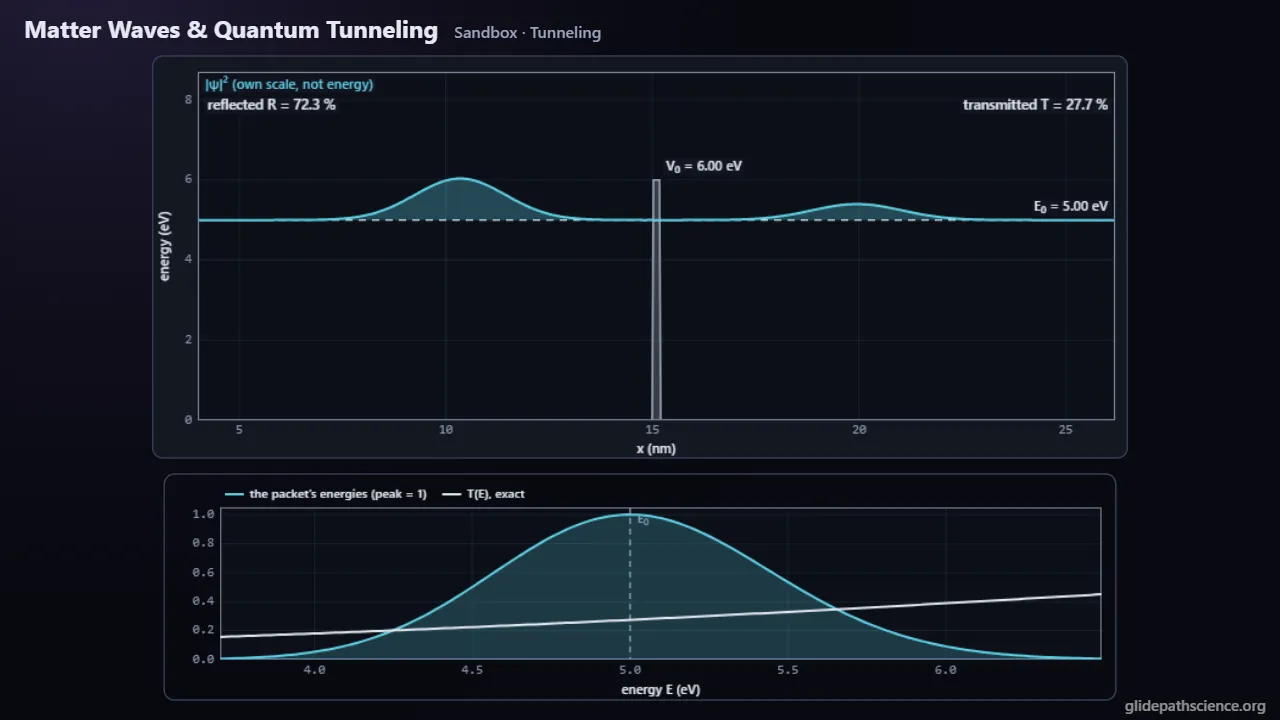
Every particle has a wavelength, λ = h/p, and this lab follows that idea from electron diffraction to the scanning tunneling microscope and alpha decay. A guided walkthrough at two levels covers electrons accelerated through a voltage, Davisson and Germer’s experiment, why baseballs never diffract, standing waves in a box and quantized energy, |ψ|² as a probability, and tunneling; the Advanced track adds the relativistic wavelength, Bragg’s law, the Schrödinger equation, finite wells, the exact barrier and its resonances, wave packets and the Gamow factor. The Sandbox launches an electron wave packet at a step, a barrier, a double barrier, a well, a box or a harmonic well, with the reflected and transmitted shares read against the exact transmission. A Diffraction Bench sweeps a detector around a nickel crystal and measures graphite’s rings with a caliper; Box & Well moves energy levels and superposes states; the Tunneling Range plots transmission on log axes, an STM’s current against its gap and nine alpha emitters against the Gamow estimate. A concept challenge and a prediction lab round it out.
What you'll learn
- Compute a particle’s wavelength, λ = h/p, from its speed or an accelerating voltage, and explain why electrons diffract from crystals while baseballs never do.
- Explain why a particle in a box holds whole half-wavelengths, so Eₙ = n²h²/8mL², and rank its energy levels by width, mass and n.
- Interpret |ψ|² as the probability of finding the particle, with nodes where it is never found, rather than as a path or a smeared charge.
- Explain how tunneling falls exponentially with a barrier’s width and height and the particle’s mass, which lets a scanning tunneling microscope see atoms and sets alpha half-lives from microseconds to billions of years.
What you can do
- Guided walkthroughStep-by-step, in Intro and Advanced tracks.
- SandboxEvery control of the model, to explore freely.
- Virtual labA realistic experiment with measurement noise and data analysis.
- Concept checksQuestions about ideas and vocabulary, with no calculating.
- PredictionCommit to a prediction, then see the result.
- Classroom demoProjector mode and recordable clips for slides.
- Works offlineA single downloadable file, verified to run without a network.
Before you start
- Waves: wavelength, interference and diffraction from a grating
- Momentum, kinetic energy and the electron volt; photons and E = hf
- For the Advanced track: complex numbers, second derivatives and a first look at differential equations
Run or download
Run it in your browser
Nothing to install and no account. Works on laptops, Chromebooks, tablets, and phones.
Launch Matter Waves & Quantum TunnelingDownload for offline use
One HTML file (715 kB) that opens in any modern browser with no network: for rooms with unreliable Wi-Fi, or to keep a copy.
Download the fileFile details and checksum
- File
matter-waves-tunneling-v1.1.html- Version
- 1.1, released November 15, 2026
- Build
f63cc2d- Size
- 731,784 bytes
- SHA-256
5d2229619c61ba91592edc8086981ec2258b40101143f244325a20ff0d7dbd93- Offline
- Checked to run with all network access blocked.
The model and its limits
What the model assumes
- The one-dimensional, nonrelativistic Schrödinger equation, with CODATA 2022 constants.
- Wave packets are solved by the Crank–Nicolson method on a grid fine enough that energies are right to 0.04 %, with absorbing layers at the window’s edges whose shares are counted, so R and T add to 1.
- Barriers and wells use closed forms; the finite well’s levels are found by bisection, and any profile of flat pieces by 2 × 2 transfer matrices.
- Diffraction uses nickel’s surface rows 0.215 nm apart and graphite’s planes 0.213 and 0.123 nm apart; the shape of the scattered intensity is illustrative.
- Alpha decay uses the WKB integral in closed form for a Coulomb barrier at R = r₀(A^(1/3) + 4^(1/3)), with r₀ = 1.2 fm, and an attempt rate v/2R; the STM current is scaled to an illustrative 1 nA at 0.50 nm.
What it leaves out
- One dimension only: no spin, no relativistic wave equations and no potentials that change in time.
- No inner potential of the crystal, no multiple scattering and not the real shape of nickel’s diffraction peaks.
- The STM leaves out the bias voltage, the image force that lowers the barrier, and the electronic structure of the tip and surface.
- The alpha-decay estimate leaves out the nuclear potential’s real shape, the chance that an alpha forms and angular momentum, so it is good to an order of magnitude or two.
- Wave packets are electrons only (heavier particles use the exact formula), and past κa ≈ 8 a narrow packet’s transmission can be off by tens of percent; the exact and averaged T are the numbers to read there.
Cite this simulation
APA 7
Meier, D. (2026). Matter Waves & Quantum Tunneling (Version 1.1) [Computer simulation]. Glidepath Science. https://glidepathscience.org/simulations/matter-waves-tunneling/
MLA 9
Meier, David. Matter Waves & Quantum Tunneling. Version 1.1, Glidepath Science, 2026, glidepathscience.org/simulations/matter-waves-tunneling/.
AIP
D. Meier, Matter Waves & Quantum Tunneling, version 1.1 (Glidepath Science, 2026), https://glidepathscience.org/simulations/matter-waves-tunneling/.
BibTeX
@misc{meier2026matterwavesquantumtunneling,
  author       = {Meier, David},
  title        = {{Matter Waves & Quantum Tunneling}},
  year         = {2026},
  publisher    = {Glidepath Science},
  version      = {1.1},
  note         = {Interactive simulation, version 1.1},
  howpublished = {\url{https://glidepathscience.org/simulations/matter-waves-tunneling/}},
  url          = {https://glidepathscience.org/simulations/matter-waves-tunneling/}
}
Credits and license
Created by Dr. David Meier, Glidepath Science.
Based on: OpenStax, University Physics Volume 3, by Samuel J. Ling, Jeff Sanny and William Moebs: Chapter 6, Photons and Matter Waves (6.5 De Broglie’s Matter Waves, 6.6 Wave–Particle Duality), and Chapter 7, Quantum Mechanics (7.1 Wave Functions to 7.4 The Quantum Particle in a Box, and 7.6 The Quantum Tunneling of Particles through Potential Barriers), an open textbook licensed CC BY-NC-SA 4.0 (openstax.org). The tracks follow its topics and notation; the wording, numbers, figures and simulations are the sim’s own. No endorsement by OpenStax or the authors is implied.
Licensed under Creative Commons Attribution-NonCommercial-ShareAlike 4.0 International (CC BY-NC-SA 4.0). You may share and adapt it for noncommercial purposes, such as teaching, with credit and under the same license. Licensing and reuse
AI tools (Claude, from Anthropic, and ChatGPT, from OpenAI) were used in developing Glidepath Science and its simulations. Dr. David Meier reviewed, edited, and modified every release version.