
NewVersion 1.7
Force on a Moving Charge
Steer protons, electrons, and ions through magnetic and crossed electric fields in 3-D: circles, helices, a velocity selector, a mass spectrometer, a cyclotron, and an e/m measurement.
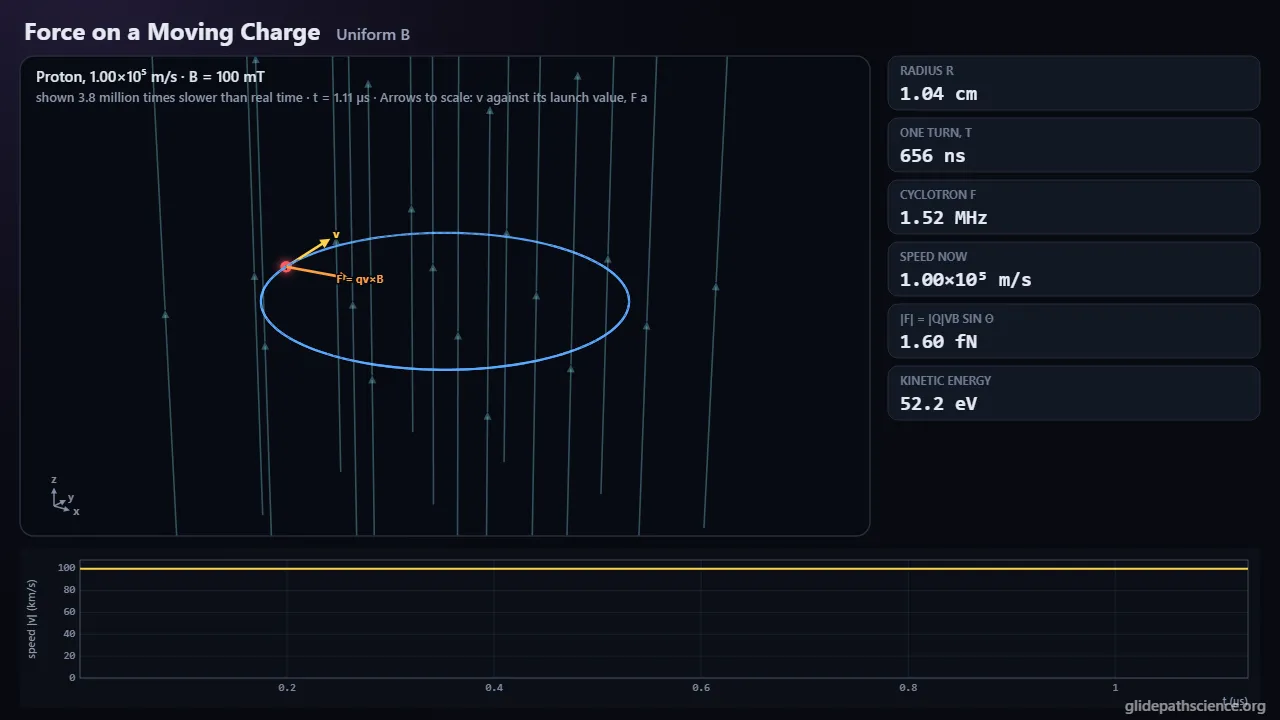
About this simulation
Starting from a magnet that falls slowly through a copper pipe, students build up the magnetic force F = qv × B: the right-hand rule, circles, the cyclotron period, helices, the velocity selector, and the mass spectrometer. The Advanced track adds the equations of motion, E × B drift and cycloids, selector acceptance, mass resolution, relativistic orbits, a cyclotron that falls out of step, radiation, the pipe in numbers, and the Hall effect. A six-scene Sandbox, an e/m bench with realistic measurement errors, concept checks, and prediction rounds with fresh numbers all run on one relativistic engine.
What you'll learn
- F = qv × B: only a moving charge feels a magnetic force, only the part of its velocity across B counts, and the force is at right angles to both v and B, along your thumb for a positive charge when your fingers point along v and curl toward B.
- No work, no speed change: because the force is always perpendicular to v, a magnetic field never changes a particle’s speed but bends its path into a circle of radius r = mv/|q|B, traced in a time T = 2πm/|q|B that does not depend on the speed.
- Crossed fields sort by speed: with an electric field at right angles to B, only particles at v = E/B fly straight, whatever their mass or charge, while everything else drifts at E/B as it circles, in a weave, a cycloid, or loops.
- Weighing with a magnet: ions accelerated through V and bent in B land 2√(2mV/q)/B from the entrance, so heavier ions land farther out, and near the speed of light γ stretches the period so that a fixed-frequency cyclotron falls out of step.
What you can do
- Guided walkthroughStep-by-step, in Intro and Advanced tracks.
- SandboxEvery control of the model, to explore freely.
- Virtual labA realistic experiment with measurement noise and data analysis.
- Concept checksQuestions about ideas and vocabulary, with no calculating.
- PredictionCommit to a prediction, then see the result.
- Classroom demoProjector mode and recordable clips for slides.
- Works offlineA single downloadable file, verified to run without a network.
Before you start
- vectors and the right-hand rule for cross products
- Newton’s second law and uniform circular motion
- electric field, potential difference, and work
- kinetic energy
Run or download
Run it in your browser
Nothing to install and no account. Works on laptops, Chromebooks, tablets, and phones.
Launch Force on a Moving ChargeDownload for offline use
One HTML file (884 kB) that opens in any modern browser with no network: for rooms with unreliable Wi-Fi, or to keep a copy.
Download the fileFile details and checksum
- File
force-on-a-moving-charge-v1.7.html- Version
- 1.7, released November 15, 2026
- Build
16c4d35- Size
- 904,976 bytes
- SHA-256
b823cff2044ca519d999b0f67cf88c685fcfd16cd3ce7b375ddd151163296b03- Offline
- Checked to run with all network access blocked.
The model and its limits
What the model assumes
- Each particle is a point charge in prescribed fields, moved by a relativistic Boris pusher on γv, with steps that keep ω_c h at or below 0.002.
- Where E = 0 the rotation uses its exact angle, so circles keep their phase and the speed never changes; where E ≠ 0 the standard Boris rotation makes the E × B drift exact.
- Field edges are sharp, and a step that would cross one is shortened to land on it, so no step straddles a plate edge, a slit, or the mass spectrometer’s entrance.
- The falling magnet is a point dipole on the axis of a thin-walled pipe, with drag F = kv and k = (45/1024)μ₀²m²σw/a⁴ (Levin, da Silveira, and Rizzato, 2006).
- Constants are CODATA 2018 values and ion masses are AME2020 atomic masses less one electron.
What it leaves out
- Particles never lose energy to radiation, though the Advanced track estimates when that would matter.
- Plates and magnets have sharp edges with no fringing fields, and gravity, collisions with residual gas, and space charge are left out.
- Changing a field in the Sandbox relaunches the particle instead of inducing an electric field.
- The cyclotron leaves out the dees’ real electrostatic fields, beam focusing, and extraction.
- Real magnets are not points, so measured fall times through a pipe differ from the model’s by tens of percent.
Cite this simulation
APA 7
Meier, D. (2026). Force on a Moving Charge (Version 1.7) [Computer simulation]. Glidepath Science. https://glidepathscience.org/simulations/force-on-a-moving-charge/
MLA 9
Meier, David. Force on a Moving Charge. Version 1.7, Glidepath Science, 2026, glidepathscience.org/simulations/force-on-a-moving-charge/.
AIP
D. Meier, Force on a Moving Charge, version 1.7 (Glidepath Science, 2026), https://glidepathscience.org/simulations/force-on-a-moving-charge/.
BibTeX
@misc{meier2026forceonamovingcharge,
  author       = {Meier, David},
  title        = {{Force on a Moving Charge}},
  year         = {2026},
  publisher    = {Glidepath Science},
  version      = {1.7},
  note         = {Interactive simulation, version 1.7},
  howpublished = {\url{https://glidepathscience.org/simulations/force-on-a-moving-charge/}},
  url          = {https://glidepathscience.org/simulations/force-on-a-moving-charge/}
}
Credits and license
Created by Dr. David Meier, Glidepath Science.
Licensed under Creative Commons Attribution-NonCommercial-ShareAlike 4.0 International (CC BY-NC-SA 4.0). You may share and adapt it for noncommercial purposes, such as teaching, with credit and under the same license. Licensing and reuse
AI tools (Claude, from Anthropic, and ChatGPT, from OpenAI) were used in developing Glidepath Science and its simulations. Dr. David Meier reviewed, edited, and modified every release version.