
NewVersion 1.6
Slinky Solenoid
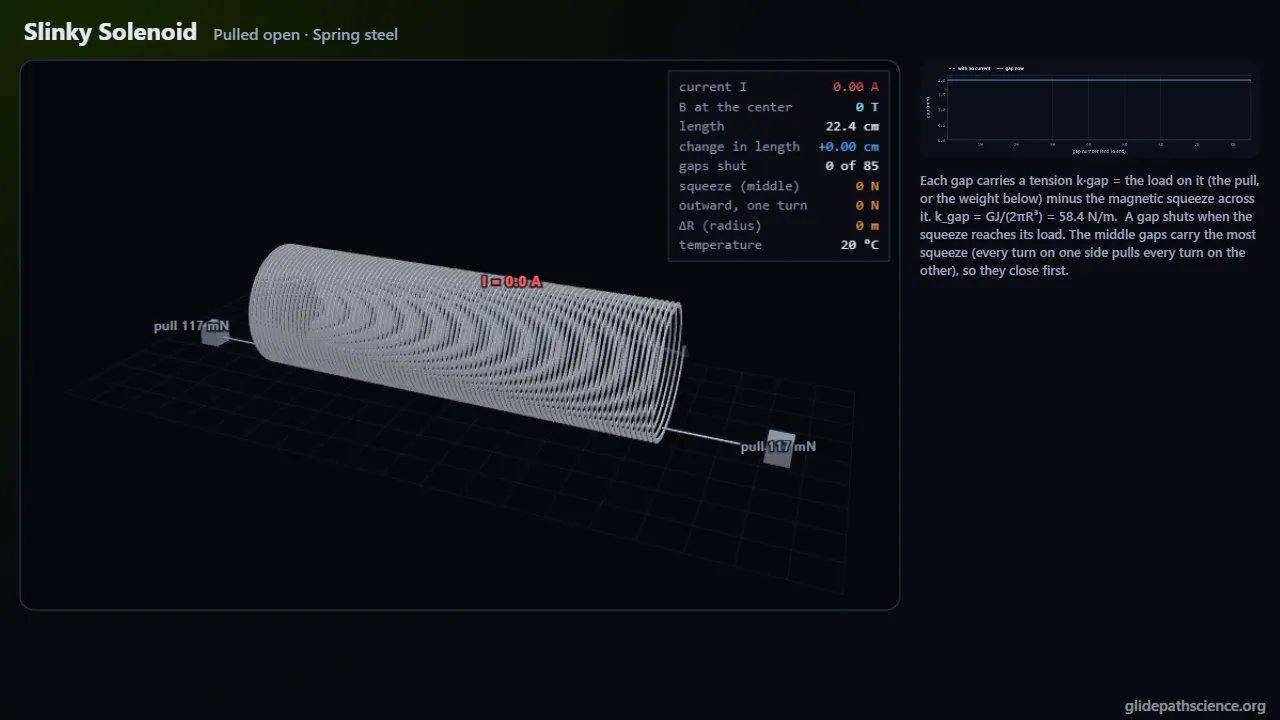
Run a current through a Slinky: measure B = μ₀nI as you stretch it, then watch every turn pull every other turn until the coil snaps shut.
About this simulation
A Slinky is a solenoid you can stretch: pull it to twice the length and the field inside halves, because only the turns per meter matter. Turn the current up and neighboring turns, carrying current the same way, attract; the squeeze grows faster than the spring can push back, and past a critical current the coil snaps shut, opening again only at a lower current. Students measure the field with a noisy Hall probe and fit μ₀, predict snap currents, and see why the coil's I²R heating makes short pulses the safe way to demonstrate it. Every number comes from the exact field and force of each turn.
What you'll learn
- Inside a long coil the field is uniform, B = μ₀nI, set only by the turns per meter and the current, so stretching the Slinky to twice the length halves the field, and at an end face it is about half.
- Parallel currents attract: neighboring turns carry current the same way and pull together, every pair pulls, and the squeeze across the middle gap approaches the magnetic pressure B²/2μ₀ times πR².
- Snap-through: as the gaps close the squeeze grows like 1/d² while the spring grows only in proportion to how far they closed, so past a critical current the balance is gone, the coil slams shut, and it opens again only at a lower current.
- I²R heating: eighteen meters of thin steel ribbon is about 2 Ω, so at 10 A it turns about 200 W into heat and soon becomes too hot to hold, which is why the demonstration uses short pulses.
What you can do
- Guided walkthroughStep-by-step, in Intro and Advanced tracks.
- SandboxEvery control of the model, to explore freely.
- Virtual labA realistic experiment with measurement noise and data analysis.
- Concept checksQuestions about ideas and vocabulary, with no calculating.
- PredictionCommit to a prediction, then see the result.
- Classroom demoProjector mode and recordable clips for slides.
- Works offlineA single downloadable file, verified to run without a network.
Before you start
- the magnetic field of a current loop and the right-hand rule
- Hooke's law and springs in series
- Ohm's law and electric power
- algebra; calculus for the Advanced track
Run or download
Run it in your browser
Nothing to install and no account. Works on laptops, Chromebooks, tablets, and phones.
Launch Slinky SolenoidDownload for offline use
One HTML file (872 kB) that opens in any modern browser with no network: for rooms with unreliable Wi-Fi, or to keep a copy.
Download the fileFile details and checksum
- File
slinky-solenoid-v1.6.html- Version
- 1.6, released November 15, 2026
- Build
f45dc28- Size
- 892,986 bytes
- SHA-256
81809676d53ce59d7148a156614c6378dd8f1eb38e437e1c7c50fd8eb9243ee3- Offline
- Checked to run with all network access blocked.
The model and its limits
What the model assumes
- Each turn is a flat ring of mean radius R at its own axial position, and the field is the sum over every ring, from each ring's exact flux function.
- The force between every pair of turns comes from the exact mutual inductance of coaxial rings, with a correction for two flat strips facing each other.
- The spring is closed-wound with its natural pitch equal to the ribbon thickness, the motion is along the axis only, and touching turns cannot overlap.
- The snap and reopen currents come from solving the same forces for a stable balance, and a very slow ramp in the full dynamics snaps within about 1 % of them.
- Heating uses one temperature for the whole coil: I²R(T) in, convection and radiation out from the exposed ribbon.
What it leaves out
- The steel is treated as non-magnetic, so a real steel Slinky, whose turns are magnetized by the coil's own field, would snap at a lower current and stay shut to a much lower current than shown.
- Pre-tension is left out: the model's turns just touch with no current, which changes only the pull needed to hold the coil open.
- Every turn stays on the axis, so a long squeezed coil cannot bow, buckle, or let turns slide across one another.
- The field of the leads, an uneven spread of current across the ribbon, friction between turns, air drag, and differences in temperature along the ribbon are left out.
- The material constants are typical handbook values, not measurements of one coil, so real snap currents and temperatures will differ by more than the model's own precision.
Cite this simulation
APA 7
Meier, D. (2026). Slinky Solenoid (Version 1.6) [Computer simulation]. Glidepath Science. https://glidepathscience.org/simulations/slinky-solenoid/
MLA 9
Meier, David. Slinky Solenoid. Version 1.6, Glidepath Science, 2026, glidepathscience.org/simulations/slinky-solenoid/.
AIP
D. Meier, Slinky Solenoid, version 1.6 (Glidepath Science, 2026), https://glidepathscience.org/simulations/slinky-solenoid/.
BibTeX
@misc{meier2026slinkysolenoid,
  author       = {Meier, David},
  title        = {{Slinky Solenoid}},
  year         = {2026},
  publisher    = {Glidepath Science},
  version      = {1.6},
  note         = {Interactive simulation, version 1.6},
  howpublished = {\url{https://glidepathscience.org/simulations/slinky-solenoid/}},
  url          = {https://glidepathscience.org/simulations/slinky-solenoid/}
}
Credits and license
Created by Dr. David Meier, Glidepath Science.
Licensed under Creative Commons Attribution-NonCommercial-ShareAlike 4.0 International (CC BY-NC-SA 4.0). You may share and adapt it for noncommercial purposes, such as teaching, with credit and under the same license. Licensing and reuse
AI tools (Claude, from Anthropic, and ChatGPT, from OpenAI) were used in developing Glidepath Science and its simulations. Dr. David Meier reviewed, edited, and modified every release version.