
NewVersion 1.1
Altitude & Hypoxia
Climb to 12,200 m and watch the air thin: oxygen’s partial pressure falls, hemoglobin holds on then lets go, sealed bags swell, and useful consciousness shrinks to seconds; then lose a cabin’s pressure.
About this simulation
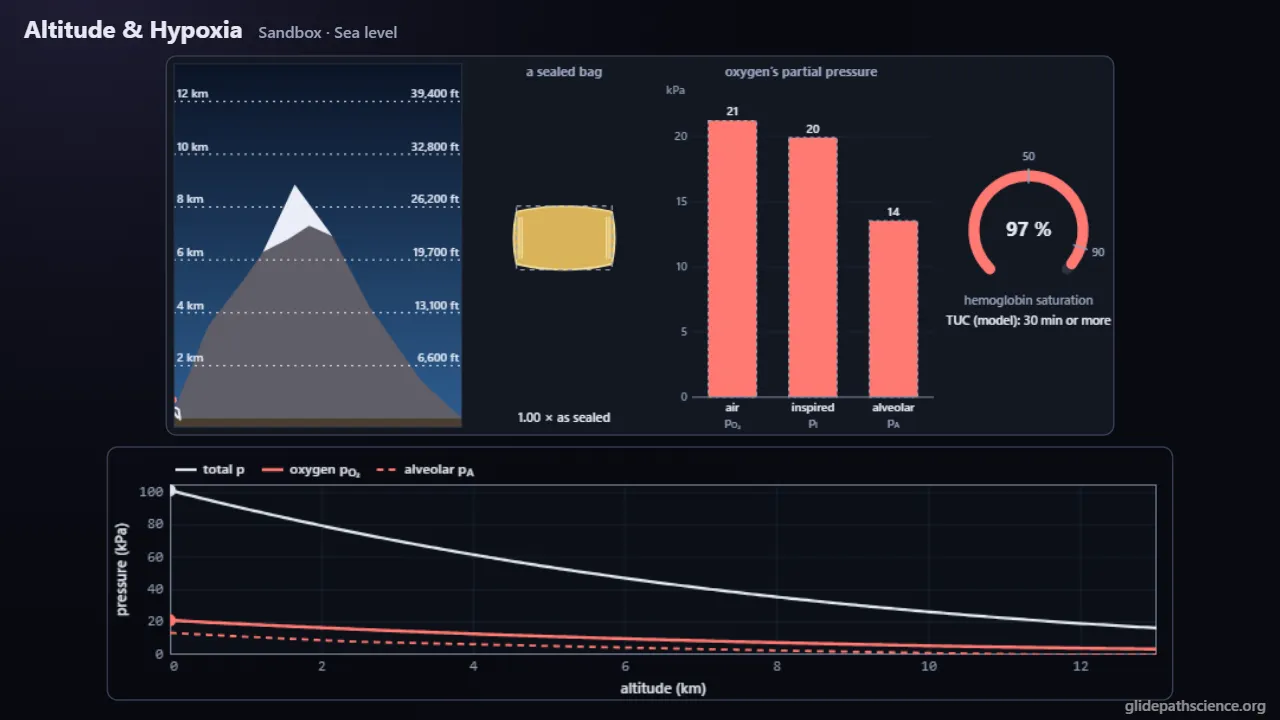
Oxygen is 21 % of the air at every altitude, so why does a climb starve the body of it? Students climb from sea level to 40,000 ft (12,200 m) and follow oxygen from the air to the lung to the blood: the total pressure halves about every 5.5 km, water vapor and carbon dioxide take their share in the lung, and hemoglobin stays nearly full on its plateau until the alveolar oxygen falls under about 8 kPa (60 mmHg). A guided walkthrough at two levels adds hypoxia, time of useful consciousness, trapped gas, oxygen masks and cabin pressurization; the Advanced track adds scale height, the alveolar gas equation, the Hill curve and its shifts, Fick’s law, equivalent altitude and choked decompression. The Sandbox reads every pressure from the air to the alveoli; a Flight Profile flies an airliner, opens a hole at cruise and races the masks against the clock; an Oxygen Cascade loads and unloads hemoglobin. A concept challenge and a prediction lab round it out. For learning, not for flight training or medical use.
What you'll learn
- Explain that air is 20.95 % oxygen at every altitude while the total pressure halves about every 5.5 km, so oxygen’s partial pressure falls with it.
- Follow oxygen from the air into the lung, where water vapor and carbon dioxide take their share, and explain why hemoglobin loads well on its plateau but poorly once alveolar oxygen falls under about 8 kPa (60 mmHg).
- Explain why hypoxia dulls the judgment that would notice it, and how the time of useful consciousness shrinks from many minutes near 18,000 ft to seconds near 40,000 ft.
- Use Boyle’s law to explain why trapped gas expands as the pressure falls, and explain why cabins are pressurized to about 2,400 m and why in a decompression your own mask goes on first.
What you can do
- Guided walkthroughStep-by-step, in Intro and Advanced tracks.
- SandboxEvery control of the model, to explore freely.
- Concept checksQuestions about ideas and vocabulary, with no calculating.
- PredictionCommit to a prediction, then see the result.
- Classroom demoProjector mode and recordable clips for slides.
- Works offlineA single downloadable file, verified to run without a network.
Before you start
- Pressure, its units, and Boyle’s law
- Breathing and the role of oxygen in the blood
- For the Advanced track: exponential functions, partial pressures in gas mixtures, and rates of flow
Run or download
Run it in your browser
Nothing to install and no account. Works on laptops, Chromebooks, tablets, and phones.
Launch Altitude & HypoxiaDownload for offline use
One HTML file (783 kB) that opens in any modern browser with no network: for rooms with unreliable Wi-Fi, or to keep a copy.
Download the fileFile details and checksum
- File
altitude-hypoxia-v1.1.html- Version
- 1.1, released November 15, 2026
- Build
9b787f3- Size
- 801,764 bytes
- SHA-256
627645eff96647d1cb38f1601ae47f301213f6dd77995f8d301524a4552d4d42- Offline
- Checked to run with all network access blocked.
The model and its limits
What the model assumes
- The atmosphere is the International Standard Atmosphere (the U.S. Standard Atmosphere 1976 up to 20 km), and air is 20.95 % oxygen at every altitude, saturated with water vapor at 37 °C in the airway.
- Alveolar oxygen comes from the full alveolar gas equation with a respiratory quotient of 0.8 and an illustrative breathing response below 60 mmHg; arterial oxygen equals alveolar.
- Hemoglobin follows a Hill curve with p₅₀ = 26.8 mmHg (3.57 kPa) and n = 2.7, shifted by temperature and pH.
- Trapped gas follows Boyle’s law at constant temperature, for dry gas or for body gas saturated with water vapor.
- The cabin holds its set altitude up to a maximum pressure differential; a decompression vents through a hole, choked and then subsonic.
- Time of useful consciousness is an illustrative curve through the middles of the FAA’s published ranges for a person at rest, applied to the equivalent altitude of the oxygen breathed.
What it leaves out
- No acclimatization and no differences between people (age, fitness, smoking, illness, alcohol, fatigue).
- A healthy, uniform lung: no gradient from alveolar gas to arterial blood, no uneven ventilation and blood flow, and no 2,3-DPG.
- No decompression sickness, no fog or cooling in a decompression, and no shortening of useful consciousness by exertion or a rapid decompression; flights are prescribed altitude histories.
- The standard atmosphere only, with no hot or cold days or latitude, so real pressures (on Everest’s summit, for example) differ.
- For learning, not for flight training or medical use: the time of useful consciousness is never a prediction for a person.
Cite this simulation
APA 7
Meier, D. (2026). Altitude & Hypoxia (Version 1.1) [Computer simulation]. Glidepath Science. https://glidepathscience.org/simulations/altitude-hypoxia/
MLA 9
Meier, David. Altitude & Hypoxia. Version 1.1, Glidepath Science, 2026, glidepathscience.org/simulations/altitude-hypoxia/.
AIP
D. Meier, Altitude & Hypoxia, version 1.1 (Glidepath Science, 2026), https://glidepathscience.org/simulations/altitude-hypoxia/.
BibTeX
@misc{meier2026altitudehypoxia,
  author       = {Meier, David},
  title        = {{Altitude & Hypoxia}},
  year         = {2026},
  publisher    = {Glidepath Science},
  version      = {1.1},
  note         = {Interactive simulation, version 1.1},
  howpublished = {\url{https://glidepathscience.org/simulations/altitude-hypoxia/}},
  url          = {https://glidepathscience.org/simulations/altitude-hypoxia/}
}
Credits and license
Created by Dr. David Meier, Glidepath Science.
Licensed under Creative Commons Attribution-NonCommercial-ShareAlike 4.0 International (CC BY-NC-SA 4.0). You may share and adapt it for noncommercial purposes, such as teaching, with credit and under the same license. Licensing and reuse
AI tools (Claude, from Anthropic, and ChatGPT, from OpenAI) were used in developing Glidepath Science and its simulations. Dr. David Meier reviewed, edited, and modified every release version.