
NewVersion 1.4
Diffusion & Osmosis Lab
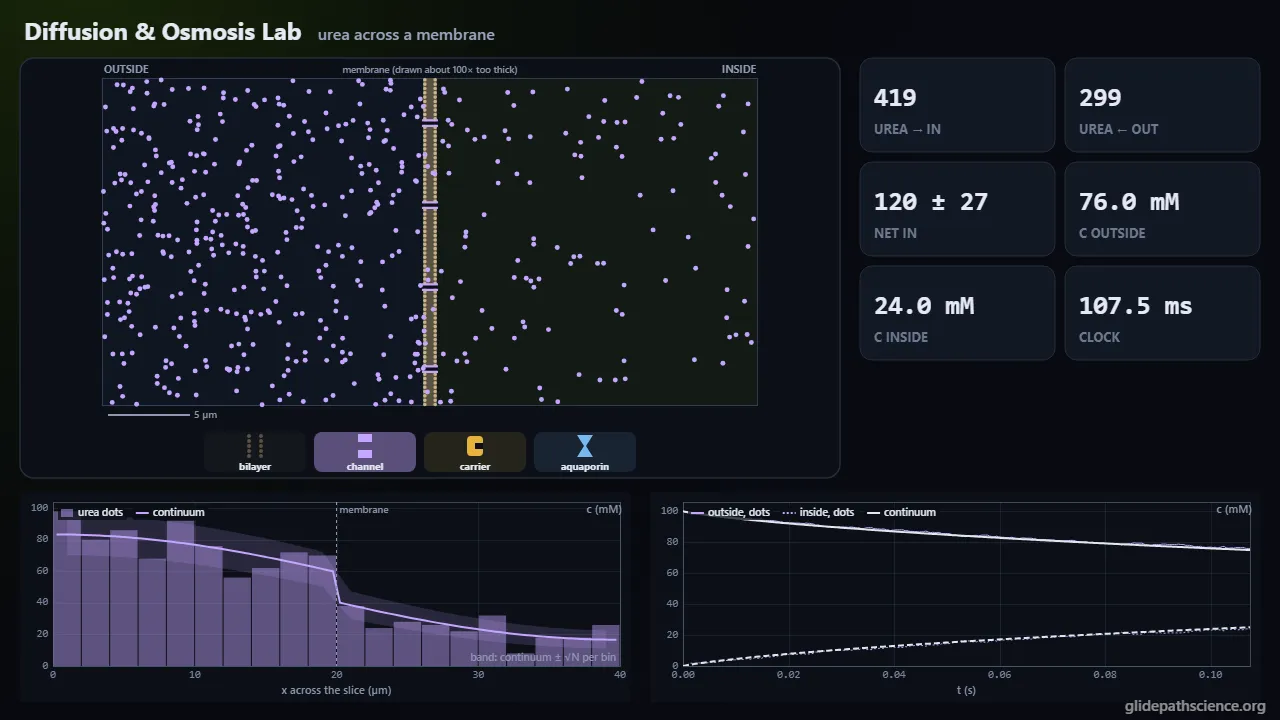
Molecules random-walk across a membrane through the bilayer, channels, carriers and aquaporins. Count crossings both ways, measure diffusion and saturation, and watch cells swell, shrink, burst or push back.
About this simulation
Seeded random walkers cross a membrane you build: a lipid bilayer with real permeabilities, urea channels, glucose carriers that saturate, and aquaporins, with or without a wall. Counters show crossings in both directions, so the net flow is visibly the difference of two random flows, and a smooth continuum curve (the master equation of the same walk) sits beside the noisy dots. Water moves by the pressure-driven Kedem–Katchalsky law, so the inside swells, builds turgor against an elastic wall, or drives a pressure gauge. A Random-Walk Lab compares coin-flip walkers with the binomial and Gaussian and fits bead tracks to find D, Boltzmann's constant and Avogadro's number. Cells in Solution puts a red blood cell and a plant cell in sucrose, salt, urea or glycerol, with water potentials in MPa and bars. An Osmosis Bench finds a potato's isotonic point with its standard error and follows dialysis bags. Two walkthrough tracks, a Concept Challenge and a Predict Lab with fresh numbers complete it.
What you'll learn
- Explain net diffusion as the difference of two random flows of molecules, and recognize equilibrium as continued crossing in both directions.
- Use ⟨x²⟩ = 2Dt and t ≈ x²/2D to show why diffusion is fast over a cell and slow over a body, and relate D to size and viscosity.
- Compare passive routes across a membrane: the lipid bilayer, channels, saturable carriers and aquaporins, and predict which route a molecule takes.
- Predict the direction of water movement from solute particles and water potential (Ψ = Ψs + Ψp, Ψs = −iCRT), and the fate of red blood cells and plant cells in different baths.
What you can do
- Guided walkthroughStep-by-step, in Intro and Advanced tracks.
- SandboxEvery control of the model, to explore freely.
- Virtual labA realistic experiment with measurement noise and data analysis.
- Concept checksQuestions about ideas and vocabulary, with no calculating.
- PredictionCommit to a prediction, then see the result.
- Classroom demoProjector mode and recordable clips for slides.
- Works offlineA single downloadable file, verified to run without a network.
Before you start
- Concentration in molarity (mol/L) and millimolar
- Basic cell structure: membranes, cytoplasm, the plant cell wall
- Proportional reasoning; for the Advanced track, logarithms and simple linear fits
Run or download
Run it in your browser
Nothing to install and no account. Works on laptops, Chromebooks, tablets, and phones.
Launch Diffusion & Osmosis LabDownload for offline use
One HTML file (853 kB) that opens in any modern browser with no network: for rooms with unreliable Wi-Fi, or to keep a copy.
Download the fileFile details and checksum
- File
diffusion-osmosis-lab-v1.4.html- Version
- 1.4, released November 15, 2026
- Build
82dac3d- Size
- 873,588 bytes
- SHA-256
7c4f304cd8d56d6469860cf9eb6f0a7eae79074e1afd114eb89ddd14a70a1d2b- Offline
- Checked to run with all network access blocked.
The model and its limits
What the model assumes
- Molecules take seeded random walks on a square lattice (0.5 µm sites); each dot stands for millions of molecules.
- A plain bilayer has realistic permeabilities (orders of magnitude); channels, carriers and aquaporins are patches with model values chosen so changes show within seconds.
- The continuum is the master equation of the same walk; it is exact for a uniform membrane and mean-field for carriers.
- Carriers follow the symmetric four-state cycle, J = Jmax[c_o/(K + c_o) − c_i/(K + c_i)].
- Water flow follows Kedem–Katchalsky with reflection coefficient 1; solutions are ideal (van 't Hoff, NaCl counted as two particles).
- Cells are continuum models with an osmotically inactive volume; a red cell lyses at the sphere of its fixed area, and a plant wall pushes back with ε ln(V/V₀).
- Diffusion coefficients scale with temperature as T/η(T), with the viscosity of water from IAPWS.
What it leaves out
- Passive transport only: no pumps, cotransport or vesicles.
- No charge or membrane potential beyond one Nernst step; ions are not in the Sandbox.
- No solvent drag, convection or stirring.
- Ideal solutions only (real NaCl has an osmotic coefficient near 0.93; sucrose departs from ideal above about 0.5 M).
- No channel gating, carrier asymmetry or carrier temperature dependence.
- Membrane, proteins and dots are drawn far larger than real; water is shown as a sparse sample.
- Several literature values (diffusion coefficients, permeabilities, red-cell and plant-cell parameters) are approximate and flagged for verification.
Cite this simulation
APA 7
Meier, D. (2026). Diffusion & Osmosis Lab (Version 1.4) [Computer simulation]. Glidepath Science. https://glidepathscience.org/simulations/diffusion-osmosis-lab/
MLA 9
Meier, David. Diffusion & Osmosis Lab. Version 1.4, Glidepath Science, 2026, glidepathscience.org/simulations/diffusion-osmosis-lab/.
AIP
D. Meier, Diffusion & Osmosis Lab, version 1.4 (Glidepath Science, 2026), https://glidepathscience.org/simulations/diffusion-osmosis-lab/.
BibTeX
@misc{meier2026diffusionosmosislab,
  author       = {Meier, David},
  title        = {{Diffusion & Osmosis Lab}},
  year         = {2026},
  publisher    = {Glidepath Science},
  version      = {1.4},
  note         = {Interactive simulation, version 1.4},
  howpublished = {\url{https://glidepathscience.org/simulations/diffusion-osmosis-lab/}},
  url          = {https://glidepathscience.org/simulations/diffusion-osmosis-lab/}
}
Credits and license
Created by Dr. David Meier, Glidepath Science.
Licensed under Creative Commons Attribution-NonCommercial-ShareAlike 4.0 International (CC BY-NC-SA 4.0). You may share and adapt it for noncommercial purposes, such as teaching, with credit and under the same license. Licensing and reuse
AI tools (Claude, from Anthropic, and ChatGPT, from OpenAI) were used in developing Glidepath Science and its simulations. Dr. David Meier reviewed, edited, and modified every release version.