
NewVersion 1.4
Buck & Boost Converters
A coil's kick sparks a gap; tamed by a diode, it runs buck, boost and inverting converters cycle by cycle: volt-second balance, ripple, energy books, a scope bench, a design desk and a closed-loop regulator.
About this simulation
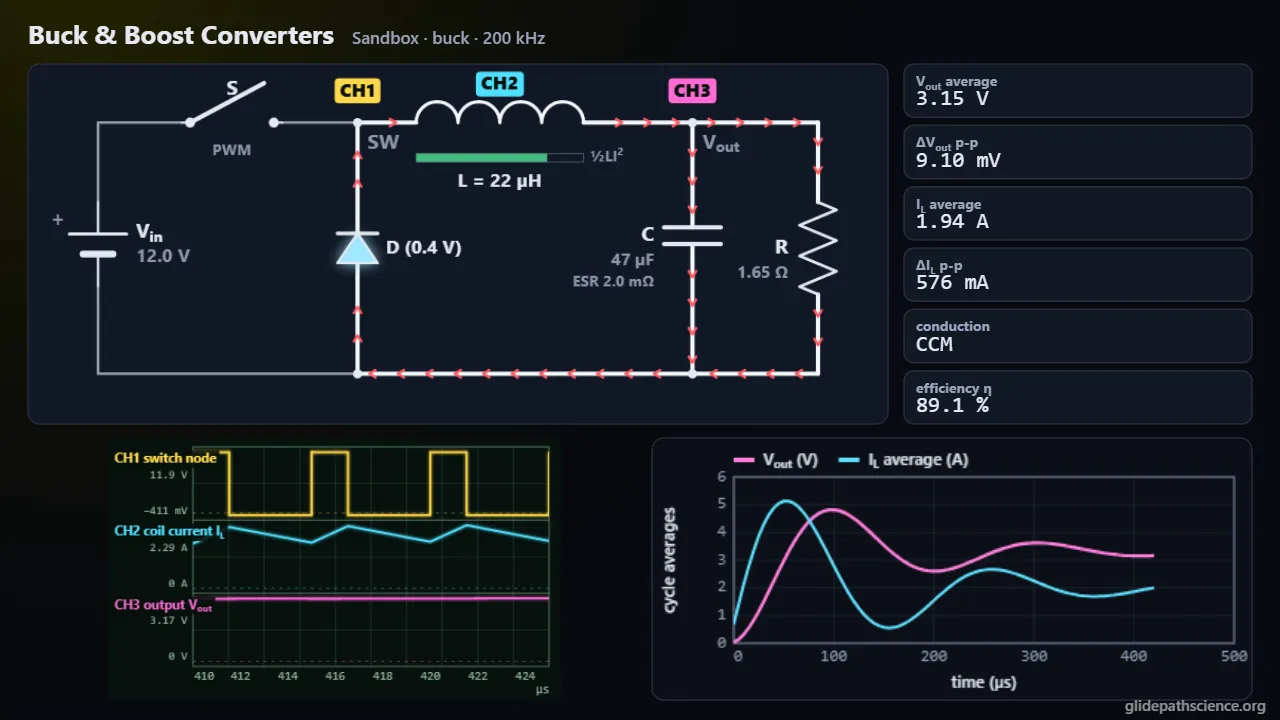
Every circuit in this lab is solved exactly, piece by piece: within each switch state the circuit is linear and is advanced by a matrix exponential, and the moments a diode stops conducting, a current is interrupted or a coil saturates are found on the exact solution. Each part keeps its own energy books, which balance to better than one part in a billion. A guided walkthrough at two levels follows OpenStax University Physics Volume 2, chapter 14: the inductor law V = L dI/dt, a coil's kick when its current is interrupted (a spark across a gap, or a diode to catch it), the energy ½LI² it stores, the buck converter's ramps and V_out = D·V_in from volt-second balance, the boost converter's V_in/(1 − D) from energy, the energy books and efficiency, and why a linear regulator runs hot. The Advanced track adds inductor and capacitor ripple (ΔV = ΔI/(8Cf) and ESR), discontinuous conduction and its boundary, the DCM gain, the losses part by part, synchronous rectification, efficiency against load, choosing L and C, saturation, sampled PI control with its load-step response and the boost's right-half-plane zero, and the inverting buck-boost. The stage draws the current's path and the energy in the coil, plays one cycle in slow motion, and keeps a four-channel scope strip. The Sandbox sets every part, from ideal to real, with presets. A Scope Bench measures duty, frequency and ripple with cursors and a trigger; a Design Desk meets power-supply specifications from an illustrative parts list; a Regulator tunes a feedback loop against load and line steps. A Quick check, Which trace?, Fault finder, prediction rounds with fresh numbers, Read the scope and Linear or switching? complete it, with a printable Guide. Runs entirely offline in one file.
What you'll learn
- A coil resists changes in its current: V = L dI/dt, so interrupting its current makes a large voltage, and a diode gives the current a path instead.
- A converter works by volt-second balance: in steady state the coil's average voltage is zero, which gives a buck's V_out = D·V_in and a boost's V_in/(1 − D).
- Energy is conserved part by part: the power in equals the power out plus each part's losses, so a switching converter runs cool where a linear regulator turns the dropped voltage into heat.
- Design is a set of trade-offs: frequency, inductance and capacitance set the ripple, the conduction mode, the size and the losses, and a feedback loop holds the output through load and line steps.
What you can do
- Guided walkthroughStep-by-step, in Intro and Advanced tracks.
- SandboxEvery control of the model, to explore freely.
- Virtual labA realistic experiment with measurement noise and data analysis.
- Concept checksQuestions about ideas and vocabulary, with no calculating.
- PredictionCommit to a prediction, then see the result.
- Classroom demoProjector mode and recordable clips for slides.
- Works offlineA single downloadable file, verified to run without a network.
Before you start
- Current, voltage, power and energy in DC circuits
- Capacitors and the idea of a time constant
- Reading graphs of a quantity against time
- For the Advanced track: inductance and RL circuits, and comfort with simple algebra on averages and slopes
Run or download
Run it in your browser
Nothing to install and no account. Works on laptops, Chromebooks, tablets, and phones.
Launch Buck & Boost ConvertersDownload for offline use
One HTML file (833 kB) that opens in any modern browser with no network: for rooms with unreliable Wi-Fi, or to keep a copy.
Download the fileFile details and checksum
- File
buck-boost-converters-v1.4.html- Version
- 1.4, released November 15, 2026
- Build
b447263- Size
- 853,292 bytes
- SHA-256
83f98697c93868dc48dae89bf1479b6841a0eb58d3d6af51740d3dc1b6833451- Offline
- Checked to run with all network access blocked.
The model and its limits
What the model assumes
- Piecewise-linear parts: a switch with an on resistance, a diode with a constant forward drop and a small series resistance (or ideal, or a synchronous switch with a body diode), a coil with series resistance and a two-slope saturation, a capacitor with ESR, a resistive load, and a source with internal resistance.
- Each switch state is solved exactly by a matrix exponential; diode turn-off, current interruption and saturation are found as events on the exact solution.
- Switching loss is booked as ½VI·t_sw per edge plus ½C_oss·V² per cycle, and the controller's quiescent and gate-drive power are charged to the source; the edges themselves are instantaneous.
- An interrupted current with no path charges a small stray capacitance until the gap breaks down at a fixed voltage and clamps (300 V for the gap, 40 V avalanche for a transistor).
- The Regulator samples the output once a cycle and sets the next duty by a PI law with feed-forward and anti-windup.
- Parts' ratings, sizes, prices and thermal resistances on the Design Desk are illustrative, as are the linear regulator's 0.3 V dropout and 5 mA quiescent current.
What it leaves out
- Low-voltage DC only; mains-powered supplies, isolation and transformers are described but not simulated.
- No switch-node ringing in discontinuous conduction, no dead time between synchronous switches and no reverse-recovery current.
- No core loss or temperature dependence; the coil saturates along two straight lines.
- The control loop is a sampled PI law, not a specific controller chip; no current-mode control or slope compensation.
- No electromagnetic interference, layout or parasitic inductance.
Cite this simulation
APA 7
Meier, D. (2026). Buck & Boost Converters (Version 1.4) [Computer simulation]. Glidepath Science. https://glidepathscience.org/simulations/buck-boost-converters/
MLA 9
Meier, David. Buck & Boost Converters. Version 1.4, Glidepath Science, 2026, glidepathscience.org/simulations/buck-boost-converters/.
AIP
D. Meier, Buck & Boost Converters, version 1.4 (Glidepath Science, 2026), https://glidepathscience.org/simulations/buck-boost-converters/.
BibTeX
@misc{meier2026buckboostconverters,
  author       = {Meier, David},
  title        = {{Buck & Boost Converters}},
  year         = {2026},
  publisher    = {Glidepath Science},
  version      = {1.4},
  note         = {Interactive simulation, version 1.4},
  howpublished = {\url{https://glidepathscience.org/simulations/buck-boost-converters/}},
  url          = {https://glidepathscience.org/simulations/buck-boost-converters/}
}
Credits and license
Created by Dr. David Meier, Glidepath Science.
Licensed under Creative Commons Attribution-NonCommercial-ShareAlike 4.0 International (CC BY-NC-SA 4.0). You may share and adapt it for noncommercial purposes, such as teaching, with credit and under the same license. Licensing and reuse
AI tools (Claude, from Anthropic, and ChatGPT, from OpenAI) were used in developing Glidepath Science and its simulations. Dr. David Meier reviewed, edited, and modified every release version.