
NewVersion 1.1
Flight Lab: Lift, Drag & Density Altitude
Fly a wing through smoke, raise its angle of attack until the flow lets go, find the speed of least drag, and take an illustrative trainer off a hot, high runway: the same indicated airspeed, a much longer roll.
About this simulation
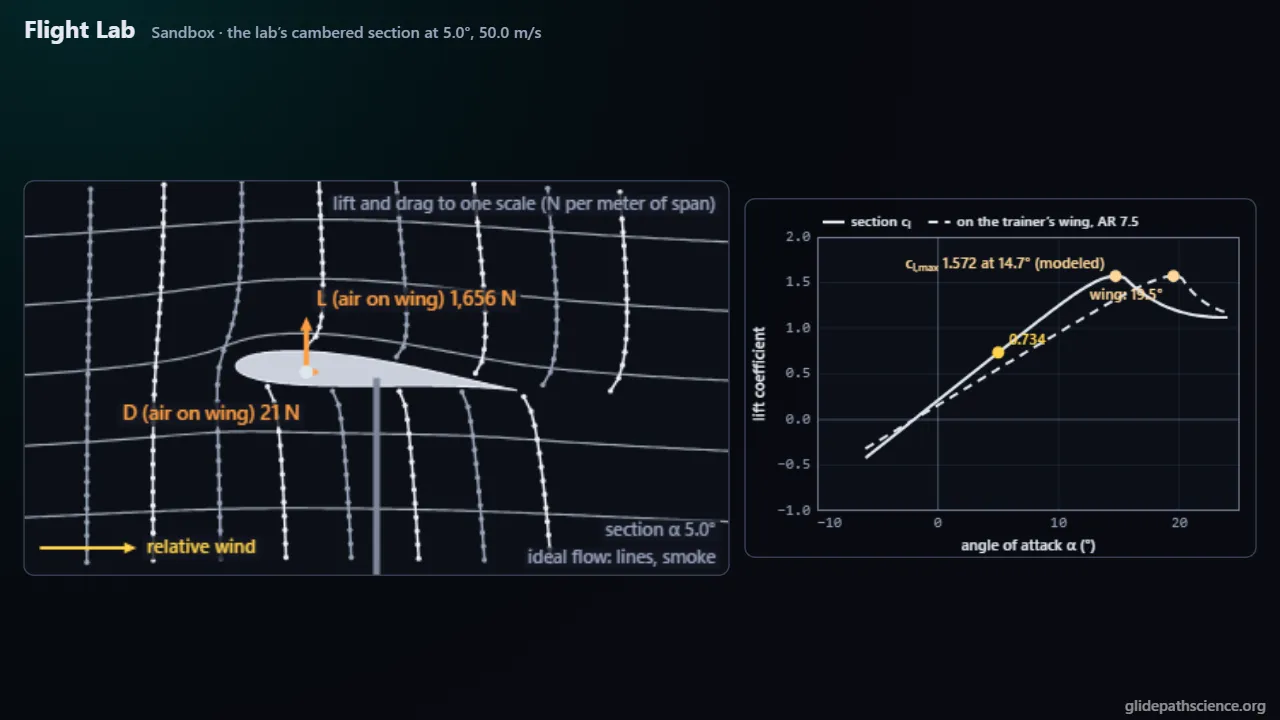
A wing holds an airplane up by turning the air downward, and this lab shows how without the equal-transit myth: smoke released together upstream reaches the trailing edge first over the top, and equal transit would need the illustrative trainer to fly several times faster than it does. The pictures come from ideal flow round a Joukowski section; the forces come from a fitted section whose stall is modeled (Kirchhoff's flat plate with Leishman and Beddoes' separation fit) and labeled so wherever it shows. A guided walkthrough at two levels follows the FAA's Pilot's Handbook of Aeronautical Knowledge with OpenStax University Physics Volume 1's notation: the four forces, what lifts a wing, angle of attack, the lift equation, the stall and stall speed, the stall at any speed, the drag curve and the region of reversed command, gliding, density altitude and the hot, high takeoff. The Advanced track adds circulation and the vortex system, thin-airfoil theory, the finite wing and induced drag, the polar, lift in a climb, power and the rate of climb, why the flow separates, ground effect, the altimeter to density altitude, the takeoff roll in closed form and wind. The Sandbox is a wind tunnel with streamlines, the pressure map, smoke, the modeled wake and the lift curve, polar and surface pressure beside it. The Polar Bench records lift and drag on a balance and fits the lift slope, the zero-lift angle and the polar's efficiency with honest error bars. Four Forces flies the trainer level, climbing, gliding and turning against its power curves and ceilings. Takeoff turns a field's elevation, altimeter setting and temperature into pressure and density altitude and runs the roll against a sea-level ghost, or against a reference day you keep, so one thing changes at a time. A Quick check, Stall or not?, Rank the rolls, prediction rounds with fresh numbers, Glide to the field and Mystery wing complete it, with a printable Guide. Every performance number belongs to an illustrative trainer, for learning only, never for flight planning. Runs entirely offline in one file.
What you'll learn
- Explain lift as a pressure difference made by turning the air, relate it to Bernoulli's equation, and show why equal transit fails.
- Use L = ½ρv²SC_L and explain why a wing stalls at its critical angle of attack at any speed.
- Separate parasite from induced drag, find the speed of least drag and the best glide, and read power curves for the climb.
- Find pressure and density altitude from the altimeter and temperature, and explain why a hot, high takeoff needs more runway.
What you can do
- Guided walkthroughStep-by-step, in Intro and Advanced tracks.
- SandboxEvery control of the model, to explore freely.
- Virtual labA realistic experiment with measurement noise and data analysis.
- Concept checksQuestions about ideas and vocabulary, with no calculating.
- PredictionCommit to a prediction, then see the result.
- Classroom demoProjector mode and recordable clips for slides.
- Works offlineA single downloadable file, verified to run without a network.
Before you start
- Newton's laws, forces in equilibrium and vectors
- Pressure, density and Bernoulli's equation (Fluid Flow & Bernoulli)
- For the Advanced track: radians and longer chains of formulas (no calculus)
Run or download
Run it in your browser
Nothing to install and no account. Works on laptops, Chromebooks, tablets, and phones.
Launch Flight Lab: Lift, Drag & Density AltitudeDownload for offline use
One HTML file (922 kB) that opens in any modern browser with no network: for rooms with unreliable Wi-Fi, or to keep a copy.
Download the fileFile details and checksum
- File
flight-lab-v1.1.html- Version
- 1.1, released November 15, 2026
- Build
f428283- Size
- 943,911 bytes
- SHA-256
ee8abf6efeae5978205696540ea30c78bd069762f891abc68d76a24b87af0f60- Offline
- Checked to run with all network access blocked.
The model and its limits
What the model assumes
- The ISA (ICAO Doc 7488); pressure altitude from the altimeter setting; density altitude exact, dry or humid; the 120 ft/°C rule shown beside it.
- Pictures from 2-D ideal flow round a Joukowski section with the Kutta condition; forces from a fitted section (Kirchhoff with Leishman and Beddoes' separation fit), labeled as modeled.
- Lifting-line wings with one span efficiency; McCormick's ground-effect factor.
- An illustrative four-seat trainer: a quadratic drag polar, a propeller thrust curve with Gagg and Ferrar's power lapse, climbs and glides solved exactly.
- The takeoff roll in closed form for forces quadratic in airspeed, liftoff at 1.1 times the stall speed, illustrative rolling friction.
- A teaching wind tunnel with an illustrative balance and least-squares fits whose error bars were checked by Monte Carlo.
What it leaves out
- No boundary layer, three-dimensional stall, spins, Reynolds-number or Mach effects, compressibility, flaps or slats.
- No propeller aerodynamics, engine details, tail, trim or stability: the four forces act at one point.
- No gusts, dynamic stall, rotation, climb to 50 ft, braking, contamination or icing.
- An illustrative trainer, never a real airplane: for learning only, not for flight planning.
Cite this simulation
APA 7
Meier, D. (2026). Flight Lab: Lift, Drag & Density Altitude (Version 1.1) [Computer simulation]. Glidepath Science. https://glidepathscience.org/simulations/flight-lab/
MLA 9
Meier, David. Flight Lab: Lift, Drag & Density Altitude. Version 1.1, Glidepath Science, 2026, glidepathscience.org/simulations/flight-lab/.
AIP
D. Meier, Flight Lab: Lift, Drag & Density Altitude, version 1.1 (Glidepath Science, 2026), https://glidepathscience.org/simulations/flight-lab/.
BibTeX
@misc{meier2026flightlabliftdragdensityaltitude,
  author       = {Meier, David},
  title        = {{Flight Lab: Lift, Drag & Density Altitude}},
  year         = {2026},
  publisher    = {Glidepath Science},
  version      = {1.1},
  note         = {Interactive simulation, version 1.1},
  howpublished = {\url{https://glidepathscience.org/simulations/flight-lab/}},
  url          = {https://glidepathscience.org/simulations/flight-lab/}
}
Credits and license
Created by Dr. David Meier, Glidepath Science.
Licensed under Creative Commons Attribution-NonCommercial-ShareAlike 4.0 International (CC BY-NC-SA 4.0). You may share and adapt it for noncommercial purposes, such as teaching, with credit and under the same license. Licensing and reuse
AI tools (Claude, from Anthropic, and ChatGPT, from OpenAI) were used in developing Glidepath Science and its simulations. Dr. David Meier reviewed, edited, and modified every release version.