
NewVersion 1.3
Millikan Oil-Drop Lab
Measure the electron’s charge as Millikan did: time oil drops falling and rising through a microscope with your own stopwatch, find e with an honest uncertainty, and re-analyze his 1913 drops.
About this simulation
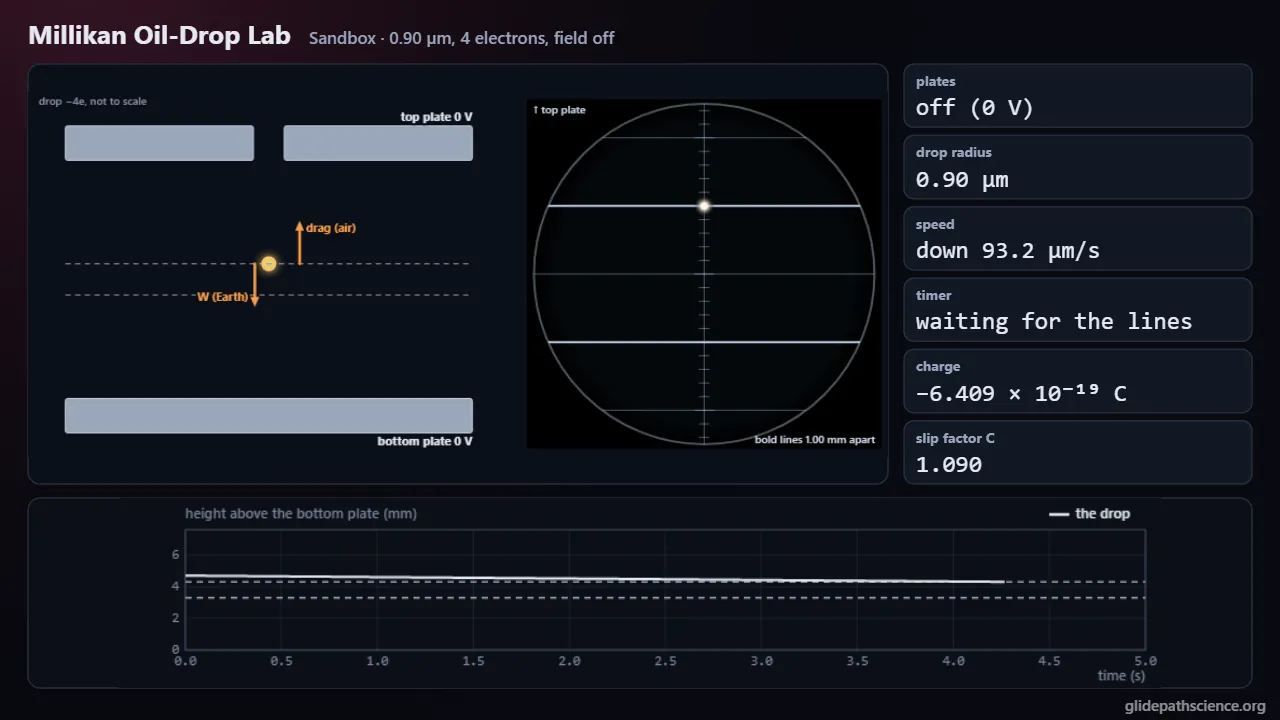
The library’s first sim-based lab. A puff from the atomizer fills a microscope’s eyepiece with oil drops, bright points on a dark field with a reticle. Students pick a drop and time it between the bold lines with their own stopwatch (or a lab partner’s, with a modeled reaction time), falling with the field off and climbing with it on, balance it with the plate voltage, and change its charge with an ionizer; every timing goes into a notebook. Notebook & Analysis turns the timings into each drop’s radius and charge with an error propagated from the stopwatch and Brownian motion, a histogram, and a fit for e by a comb likelihood that never quietly settles on half of e or twice it, with an uncertainty checked by Monte Carlo; Millikan’s slip line and a CSV export complete it. A guided walkthrough at two levels follows OpenStax Chemistry 2e, §2.2: the forces on a drop, terminal speed and a drop’s size from its fall, balancing it, charges in whole multiples of e, finding e, the all-even trap and the electron’s mass. The Advanced track covers Stokes’s law and its limits, the rise-and-fall method, slip and Millikan’s line, Brownian motion, choosing drops, each charge’s error, the likelihood scan, the weighted fit and what its ± promises, the viscosity of air as a systematic error, and the data-selection debate. The History tab tells 1909 to 1913 (water drops, Harvey Fletcher’s oil, Ehrenhaft’s subelectrons, the notebooks) and holds all 58 drops of Millikan’s 1913 Table XX to re-analyze and to leave drops out of. The Sandbox has every knob, Millikan’s own chamber among its presets. A Quick check, Which force wins?, Spot the quantum, prediction rounds with fresh numbers, Balance the drop and Replicate Millikan complete it, with a printable Guide. Runs entirely offline in one file.
What you'll learn
- Identify the forces on an oil drop and use terminal speed and Stokes's law to find a drop's size from its fall.
- Find a drop's charge by balancing it or by timing it falling and rising, and show that every charge is a whole number of e.
- Estimate e from a set of measured charges with an honest uncertainty, and tell random error from systematic error.
- Re-analyze Millikan's 1913 data and weigh the debate over the drops he left out.
What you can do
- Guided walkthroughStep-by-step, in Intro and Advanced tracks.
- SandboxEvery control of the model, to explore freely.
- Virtual labA realistic experiment with measurement noise and data analysis.
- Concept checksQuestions about ideas and vocabulary, with no calculating.
- PredictionCommit to a prediction, then see the result.
- Classroom demoProjector mode and recordable clips for slides.
- Works offlineA single downloadable file, verified to run without a network.
Before you start
- Forces and Newton's second law; weight and density
- Electric field between parallel plates, E = V/d, and the force qE
- For the Advanced track: logarithms, propagation of errors and weighted averages
Run or download
Run it in your browser
Nothing to install and no account. Works on laptops, Chromebooks, tablets, and phones.
Launch Millikan Oil-Drop LabDownload for offline use
One HTML file (816 kB) that opens in any modern browser with no network: for rooms with unreliable Wi-Fi, or to keep a copy.
Download the fileFile details and checksum
- File
millikan-oil-drop-v1.3.html- Version
- 1.3, released November 15, 2026
- Build
532825e- Size
- 835,512 bytes
- SHA-256
a080d5cd1d7ffdfa3f57855640584934b96af4d44225c512797c17f92470735b- Offline
- Checked to run with all network access blocked.
The model and its limits
What the model assumes
- Drops are uniform oil spheres moving at their terminal speed: weight, buoyancy, Stokes's drag reduced by the slip factor 1 + b/(pr), and qE, with the same physics as Parallel Plates & Uniform Fields.
- Air from Sutherland's viscosity formula and the ideal-gas density; plates 7.60 mm apart; drops timed over 1.00 mm.
- Brownian motion from seeded random numbers, with D = kTC/(6πηr).
- A person's stopwatch presses each late by an illustrative reaction time of 0.20 s with a 0.05 s scatter; the atomizer's sizes and charges and the ionizer's steps are illustrative.
- Each charge's error is propagated from its timings; e is fitted by a comb likelihood and a weighted least-squares line, its standard error checked by Monte Carlo.
- Millikan's Table XX is transcribed as printed from Physical Review 2, 109 (1913).
What it leaves out
- No evaporation, convection currents, image charges near the plates or forces between drops.
- Every drop carries extra electrons; real atomizers leave some drops positive.
- The first-order slip formula is outside its tested range at very low pressure or for very small drops, and the Sandbox says so.
- Only reaction-time scatter is modeled in a person's timing, not parallax or a habit of pressing early.
- The history is summarized from the cited sources; the notebooks themselves are not reproduced.
Cite this simulation
APA 7
Meier, D. (2026). Millikan Oil-Drop Lab (Version 1.3) [Computer simulation]. Glidepath Science. https://glidepathscience.org/simulations/millikan-oil-drop/
MLA 9
Meier, David. Millikan Oil-Drop Lab. Version 1.3, Glidepath Science, 2026, glidepathscience.org/simulations/millikan-oil-drop/.
AIP
D. Meier, Millikan Oil-Drop Lab, version 1.3 (Glidepath Science, 2026), https://glidepathscience.org/simulations/millikan-oil-drop/.
BibTeX
@misc{meier2026millikanoildroplab,
  author       = {Meier, David},
  title        = {{Millikan Oil-Drop Lab}},
  year         = {2026},
  publisher    = {Glidepath Science},
  version      = {1.3},
  note         = {Interactive simulation, version 1.3},
  howpublished = {\url{https://glidepathscience.org/simulations/millikan-oil-drop/}},
  url          = {https://glidepathscience.org/simulations/millikan-oil-drop/}
}
Credits and license
Created by Dr. David Meier, Glidepath Science.
Licensed under Creative Commons Attribution-NonCommercial-ShareAlike 4.0 International (CC BY-NC-SA 4.0). You may share and adapt it for noncommercial purposes, such as teaching, with credit and under the same license. Licensing and reuse
AI tools (Claude, from Anthropic, and ChatGPT, from OpenAI) were used in developing Glidepath Science and its simulations. Dr. David Meier reviewed, edited, and modified every release version.