
NewVersion 1.4
Motion Lab
One cart and three synchronized graphs: build a motion from its acceleration, read slopes and areas, match graphs by moving, and see why a motion detector's velocity and acceleration come out noisy.
About this simulation
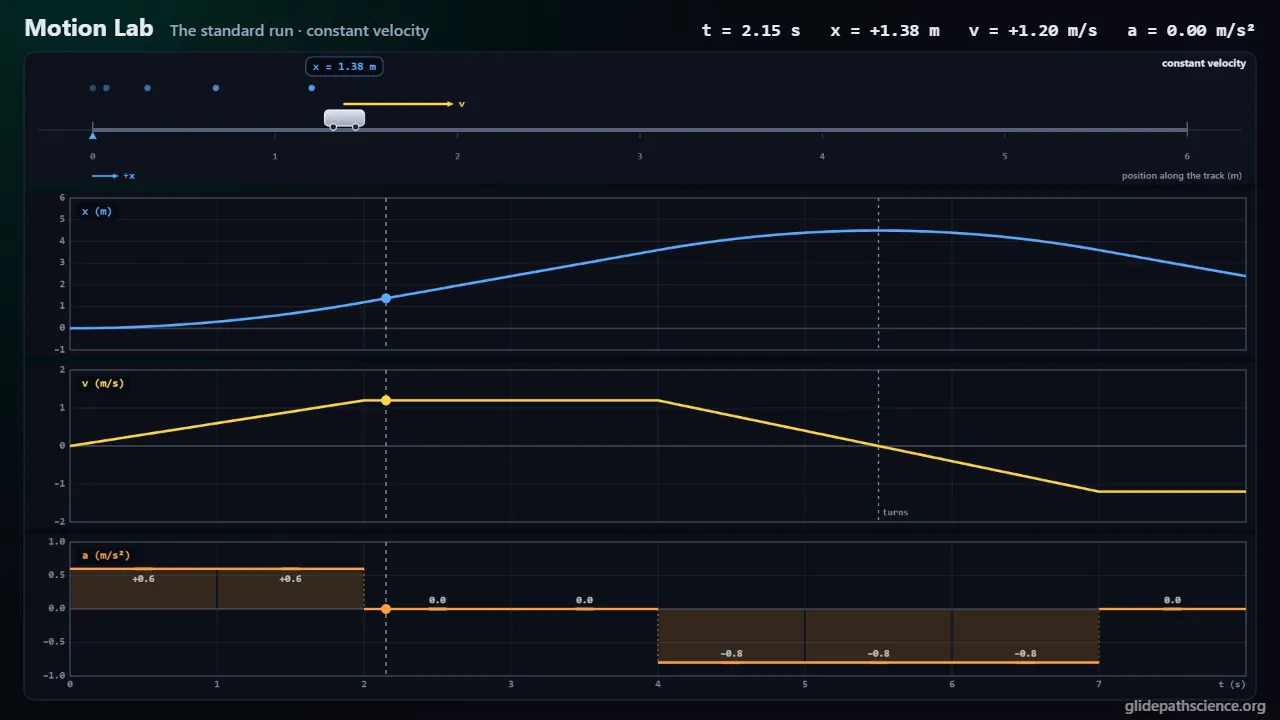
Motion Lab teaches one-dimensional kinematics through a cart on a level track and its position, velocity and acceleration graphs under one cursor. Students build motions bar by bar from the acceleration, watch a motion diagram with velocity and Δv arrows, draw tangents and signed areas, relabel the origin and the positive direction, and race a second cart. The Intro walkthrough takes apart one standard run: the graph is not the path, slopes and tangents, the sign rule, turning points, displacement against distance, areas under v–t and a–t, and the constant-acceleration equations. The Advanced track adds the calculus behind the graphs (two constants of integration, jerk, accelerations that depend on velocity or position) and the numerical side of real data. A Motion Detector bench records a cart, a walker or a bouncing ball through a simulated ultrasonic detector with adjustable rate, noise, dropouts and air temperature, then differentiates, smooths and fits the readings and compares them with the truth. Concept Challenge activities include Motion Match, Sketch it and Graph Surgery; the Predict Lab adds fresh-number rounds, Design a run and Read the detector.
What you'll learn
- Read velocity as the slope of a position graph and acceleration as the slope of a velocity graph, and tell a steep line from a high one.
- Find displacement and change in velocity from signed areas under velocity and acceleration graphs, and tell displacement from distance traveled.
- Decide whether an object is speeding up or slowing down from the signs of its velocity and acceleration together, including at turning points where v = 0 but a is not.
- Explain why velocity and acceleration computed from measured positions are noisy, and use smoothing and fitting to recover them, with their trade-offs in lag and in model assumptions.
What you can do
- Guided walkthroughStep-by-step, in Intro and Advanced tracks.
- SandboxEvery control of the model, to explore freely.
- Virtual labA realistic experiment with measurement noise and data analysis.
- Concept checksQuestions about ideas and vocabulary, with no calculating.
- PredictionCommit to a prediction, then see the result.
- Classroom demoProjector mode and recordable clips for slides.
- Works offlineA single downloadable file, verified to run without a network.
Before you start
- Position, displacement, velocity and acceleration as quantities with units and signs
- Reading coordinates and slopes on a graph
- For the Advanced track: derivatives and integrals of polynomials and exponentials, and the idea of a standard deviation
Run or download
Run it in your browser
Nothing to install and no account. Works on laptops, Chromebooks, tablets, and phones.
Launch Motion LabDownload for offline use
One HTML file (815 kB) that opens in any modern browser with no network: for rooms with unreliable Wi-Fi, or to keep a copy.
Download the fileFile details and checksum
- File
motion-lab-v1.4.html- Version
- 1.4, released November 15, 2026
- Build
a83f015- Size
- 834,191 bytes
- SHA-256
b60663cbfd2848b2bac26d8b710b8e65cf12f19eb55369f0751b0d69f4c49f83- Offline
- Checked to run with all network access blocked.
The model and its limits
What the model assumes
- Motion along one straight line, described by its kinematics only; causes are not modeled.
- The cart is a point; its acceleration is set directly, as constant bars, straight-line ramps, or a = −v/τ.
- Every motion is computed in closed form, with exact turning points, distances and meeting times.
- The toss and the bouncing ball use g = 9.81 m/s² and no air; each 2 ms bounce has a constant acceleration and a coefficient of restitution of 0.80.
- The detector samples the true position at 10–50 Hz, adds independent Gaussian noise of 0–5 mm, rounds to 1 mm, works from 0.15 m to 6 m, can drop about 3 % of readings, and scales every distance by c(20 °C)/c(T) with c ≈ 331.3 + 0.606 T m/s.
- Fit uncertainties are fit standard errors from the scatter of the readings, assuming the model is right.
What it leaves out
- Bars switch the acceleration instantly (infinite jerk); only Ramps keep it finite.
- No two-dimensional motion, friction or air drag beyond what a(t) or a = −v/τ builds in.
- The detector leaves out beam width, stray echoes, timing jitter, correlated noise, humidity and wind, and treats its 0.15 m minimum range as a hard cut-off.
- In Motion Match's Intro mapping the walker follows the pointer instantly, which a real walker cannot.
- Detector specifications are representative classroom values, not one product's.
Cite this simulation
APA 7
Meier, D. (2026). Motion Lab (Version 1.4) [Computer simulation]. Glidepath Science. https://glidepathscience.org/simulations/motion-lab/
MLA 9
Meier, David. Motion Lab. Version 1.4, Glidepath Science, 2026, glidepathscience.org/simulations/motion-lab/.
AIP
D. Meier, Motion Lab, version 1.4 (Glidepath Science, 2026), https://glidepathscience.org/simulations/motion-lab/.
BibTeX
@misc{meier2026motionlab,
  author       = {Meier, David},
  title        = {{Motion Lab}},
  year         = {2026},
  publisher    = {Glidepath Science},
  version      = {1.4},
  note         = {Interactive simulation, version 1.4},
  howpublished = {\url{https://glidepathscience.org/simulations/motion-lab/}},
  url          = {https://glidepathscience.org/simulations/motion-lab/}
}
Credits and license
Created by Dr. David Meier, Glidepath Science.
Licensed under Creative Commons Attribution-NonCommercial-ShareAlike 4.0 International (CC BY-NC-SA 4.0). You may share and adapt it for noncommercial purposes, such as teaching, with credit and under the same license. Licensing and reuse
AI tools (Claude, from Anthropic, and ChatGPT, from OpenAI) were used in developing Glidepath Science and its simulations. Dr. David Meier reviewed, edited, and modified every release version.