
NewVersion 1.0
Lasers & Stimulated Emission
Pump atoms into a population inversion, watch stimulated emission build a coherent beam between two mirrors, find the threshold, and compare pumping schemes, cavity modes and laser light against lamp light.
About this simulation
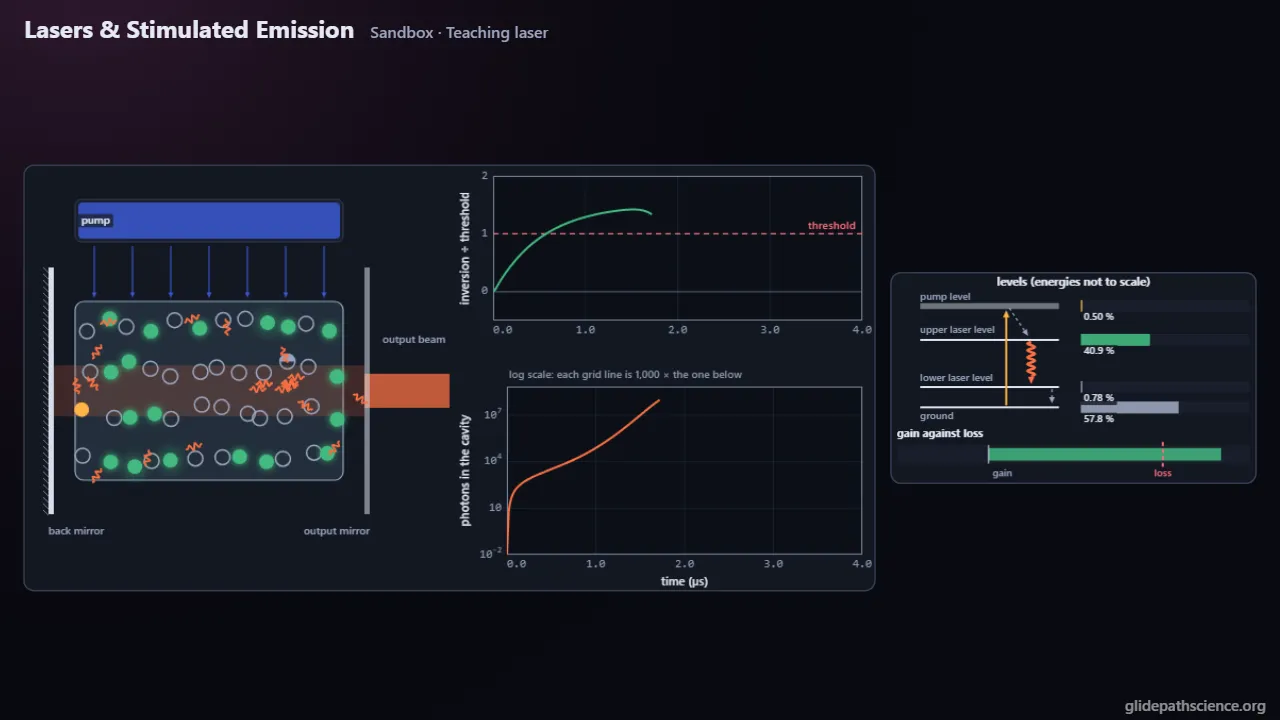
How does a laser make its light? Students pump a gain medium between two mirrors and watch atoms climb and photons multiply, choosing the scheme, the pump, the lifetime, the mirrors and the length, with the populations and photons charted in time and, in Advanced, a Q-switched pulse to fire. A guided walkthrough at two levels runs from light and energy levels through absorption, spontaneous and stimulated emission, why two levels are not enough, three- and four-level pumping, the cavity, threshold, and laser light against lamp light; the Advanced track adds Einstein’s A and B, rate equations, gain clamping, the threshold condition, photon lifetime and Q, slope efficiency, modes, coherence length, Gaussian beams, relaxation oscillations and Q-switching. A Pump Lab sets two-, three- and four-level schemes side by side; a Cavity Builder shows the threshold, the photon lifetime and the comb of modes under the gain curve; Laser vs Lamp sets a 1 mW laser beside a 1 mW lamp of the same color. A concept challenge and a prediction lab with fresh numbers on every run round it out.
What you'll learn
- Describe the three ways light meets an atom: absorption lifts it, spontaneous emission drops it at a random time in a random direction, and stimulated emission drops it by copying the passing photon exactly.
- Explain why a photon is amplified only where more atoms are up than down, why two levels can never reach that inversion, and why four levels reach it more easily than three.
- Explain how two mirrors set a threshold: above it, gain beats the mirrors’ losses, the inversion clamps, and every extra pumped atom feeds the beam.
- Explain that laser light differs from lamp light not in its photons but in how they are organized: one color, one direction and waves in step over meters, so a milliwatt can outshine a lamp.
What you can do
- Guided walkthroughStep-by-step, in Intro and Advanced tracks.
- SandboxEvery control of the model, to explore freely.
- Concept checksQuestions about ideas and vocabulary, with no calculating.
- PredictionCommit to a prediction, then see the result.
- Classroom demoProjector mode and recordable clips for slides.
- Works offlineA single downloadable file, verified to run without a network.
Before you start
- Photons, photon energy E = hf and atomic energy levels
- Algebra, powers of ten, exponentials and square roots
- For the Advanced track: derivatives, first-order differential equations, and logarithms
Run or download
Run it in your browser
Nothing to install and no account. Works on laptops, Chromebooks, tablets, and phones.
Launch Lasers & Stimulated EmissionDownload for offline use
One HTML file (746 kB) that opens in any modern browser with no network: for rooms with unreliable Wi-Fi, or to keep a copy.
Download the fileFile details and checksum
- File
lasers-stimulated-emission-v1.0.html- Version
- 1.0, released November 15, 2026
- Build
848a1c0- Size
- 764,395 bytes
- SHA-256
de4ca68f269f8702d9db239e0c3995ca572f44989aaa5406a5e5c6f46f7cd845- Offline
- Checked to run with all network access blocked.
The model and its limits
What the model assumes
- Rate equations for the fractions of atoms in each level and for the light in the cavity, integrated by a second-order Rosenbrock method with step control, since the photon lifetime can be a million times shorter than the upper level’s.
- Two-, three- and four-level schemes share one form: three levels pump from the ground, which is also the lower laser level, and two levels pump at the laser transition itself.
- The gain medium fills the cavity in one transverse mode, and the output power follows from the light in the cavity and the output mirror’s reflectance.
- Media values are typical or illustrative: the teaching laser (τ = 1.0 µs) is chosen so the inversion is large enough to see, beside ruby-like, helium–neon-like, Nd:YAG-like and diode-like media.
- The particle view draws 48 atoms that follow the populations; the Cavity Builder uses a Gaussian gain line, and Laser vs Lamp compares a Gaussian beam with a lamp radiating evenly in every direction, 1 mW each.
What it leaves out
- Degeneracy factors and line shapes are left out of the rate equations, which use one cross section at line center; linewidths are typical values, not worked out from the Schawlow–Townes limit or noise.
- No transverse modes, beam profile inside the medium, spatial hole burning, mode competition, thermal lensing or heating.
- The diode-like medium is a sketch that uses the same rate equations, and an equivalent pump rate stands in for the collisions that pump a helium–neon laser.
- Nonlinear optics, frequency doubling, mode locking, frequency combs and quantized light are not modeled.
- Its outline of laser hazard classes helps in reading a label; it is not laser-safety training, which anyone working with class 3B or class 4 lasers needs from their institution.
Cite this simulation
APA 7
Meier, D. (2026). Lasers & Stimulated Emission (Version 1.0) [Computer simulation]. Glidepath Science. https://glidepathscience.org/simulations/lasers-stimulated-emission/
MLA 9
Meier, David. Lasers & Stimulated Emission. Version 1.0, Glidepath Science, 2026, glidepathscience.org/simulations/lasers-stimulated-emission/.
AIP
D. Meier, Lasers & Stimulated Emission, version 1.0 (Glidepath Science, 2026), https://glidepathscience.org/simulations/lasers-stimulated-emission/.
BibTeX
@misc{meier2026lasersstimulatedemission,
  author       = {Meier, David},
  title        = {{Lasers & Stimulated Emission}},
  year         = {2026},
  publisher    = {Glidepath Science},
  version      = {1.0},
  note         = {Interactive simulation, version 1.0},
  howpublished = {\url{https://glidepathscience.org/simulations/lasers-stimulated-emission/}},
  url          = {https://glidepathscience.org/simulations/lasers-stimulated-emission/}
}
Credits and license
Created by Dr. David Meier, Glidepath Science.
Based on: OpenStax, University Physics Volume 3, by Samuel J. Ling, Jeff Sanny and William Moebs: Chapter 8, “Atomic Structure,” §8.6 “Lasers,” an open textbook licensed CC BY-NC-SA 4.0 (openstax.org). The Intro track’s first ideas and terms follow it: stimulated emission, population inversion, metastable states and coherent light. The pumping schemes, the cavity, threshold, modes and the Advanced track go beyond it; the wording, numbers, figures and simulations are this lab’s own. No endorsement by OpenStax or the authors is implied.
Licensed under Creative Commons Attribution-NonCommercial-ShareAlike 4.0 International (CC BY-NC-SA 4.0). You may share and adapt it for noncommercial purposes, such as teaching, with credit and under the same license. Licensing and reuse
AI tools (Claude, from Anthropic, and ChatGPT, from OpenAI) were used in developing Glidepath Science and its simulations. Dr. David Meier reviewed, edited, and modified every release version.