
NewVersion 1.1
Doppler Effect & Shock Waves
Drive a siren past a listener and watch its crests bunch ahead and stretch behind, push it past Mach 1 into a shock cone, clock cars with radar, and read a galaxy’s redshift.
About this simulation
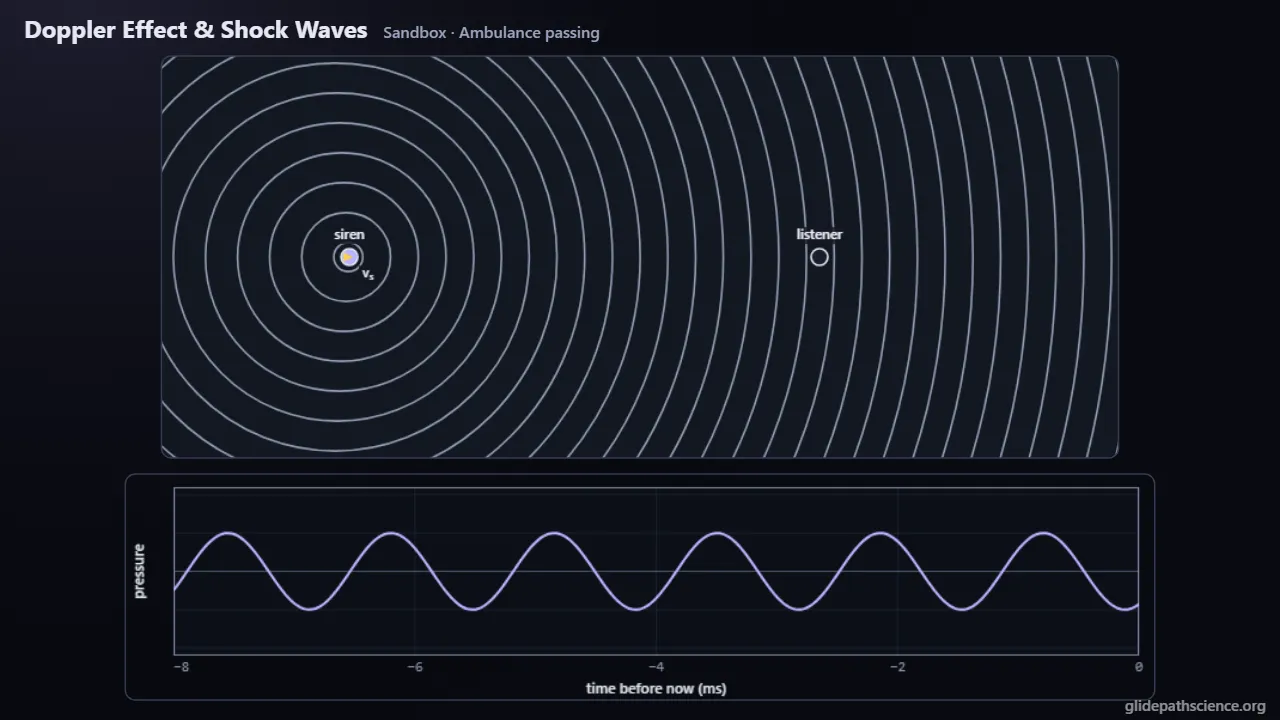
Why does a passing siren drop in pitch, and why does a sonic boom follow a jet across the ground? Students drive a siren along a street seen from above at any speed up to Mach 2, with a listener moving or not, and see every crest it sends and the pitch heard, with Hear it to listen. A guided walkthrough at two levels runs from a still siren’s wavelength through the moving-source and moving-observer formulas and the sign rule to a passing siren, Mach 1, the cone, the boom, radar guns and redshift; the Advanced track adds off-axis motion and the pitch sweep, wind, the retarded position, the N-wave, the relativistic and transverse shifts and Cherenkov light. Siren Street records a passing car’s pitch curve and fits a mystery car’s speed, siren and distance; Mach Cone times a jet’s boom at eight microphones; and Radar & Redshift clocks a mystery car and measures a galaxy’s speed from its spectral lines. Concept challenges and a prediction lab round it out.
What you'll learn
- Explain how a moving source squeezes its waves ahead, λ = (v − v_s)/f, and spreads them behind, and that a listener hears the frequency of the crests it meets.
- Use f′ = f(v ± v_o)/(v ∓ v_s) with the sign rule, motion toward raising the pitch and motion away lowering it, and show that a moving source and a moving listener at the same speed do not give the same shift.
- Explain how a source past Mach 1 outruns its sound so its crests share a cone with sin θ = 1/M, and why the ground hears a boom when the cone sweeps by, not when the jet breaks the sound barrier.
- Apply the Doppler shift to light: a radar return carries a doubled shift, Δf ≈ 2fu/c, and a receding galaxy’s light is redshifted, with z ≈ v/c at low speed.
What you can do
- Guided walkthroughStep-by-step, in Intro and Advanced tracks.
- SandboxEvery control of the model, to explore freely.
- Virtual labA realistic experiment with measurement noise and data analysis.
- Concept checksQuestions about ideas and vocabulary, with no calculating.
- PredictionCommit to a prediction, then see the result.
- Classroom demoProjector mode and recordable clips for slides.
- Works offlineA single downloadable file, verified to run without a network.
Before you start
- Waves: frequency, wavelength and v = fλ
- Speed, relative motion, and reading a graph against time
- For the Advanced track: vectors, the binomial approximation, and an introduction to special relativity
Run or download
Run it in your browser
Nothing to install and no account. Works on laptops, Chromebooks, tablets, and phones.
Launch Doppler Effect & Shock WavesDownload for offline use
One HTML file (754 kB) that opens in any modern browser with no network: for rooms with unreliable Wi-Fi, or to keep a copy.
Download the fileFile details and checksum
- File
doppler-shock-waves-v1.1.html- Version
- 1.1, released November 15, 2026
- Build
0388201- Size
- 772,077 bytes
- SHA-256
9626fe275829a9d2ca76a0557d3dcdc048c29a1071506cc6c69cd15b83de8b5a- Offline
- Checked to run with all network access blocked.
The model and its limits
What the model assumes
- Point sources and listeners move in straight lines at constant velocities through uniform air; the sound heard left the source at the retarded time, and the general formula reduces exactly to the textbook ones along a line.
- The speed of sound is 343 m/s at 20 °C and scales as the square root of the absolute temperature; soft tissue carries sound at 1,540 m/s.
- The pressure trace sums the arrivals of the source’s phase, every arrival drawn at the same strength.
- Radar uses the exact mirror formula, (1 + β)/(1 − β); spectral lines are standard air wavelengths of hydrogen, sodium and calcium.
- Mach number is the speed relative to the air, the frame in which the cone forms.
What it leaves out
- No shock physics: sound is a small, linear wave, so the cone’s geometry and arrival times are exact but a real shock’s strength, shape and rise time are not computed, and Hear it is silent past Mach 1.
- No loudness: the sound’s amplitude, its fall with distance and the strength of a boom are left out.
- The atmosphere is uniform at every height, so the bending of sound by temperature and wind, and the width of a boom’s carpet on the ground, are not modeled.
- Every motion is at constant velocity, so turning or accelerating sources and focused booms are left out.
- Cosmological and gravitational redshifts, which are different physics from the Doppler shift, are not included.
Cite this simulation
APA 7
Meier, D. (2026). Doppler Effect & Shock Waves (Version 1.1) [Computer simulation]. Glidepath Science. https://glidepathscience.org/simulations/doppler-shock-waves/
MLA 9
Meier, David. Doppler Effect & Shock Waves. Version 1.1, Glidepath Science, 2026, glidepathscience.org/simulations/doppler-shock-waves/.
AIP
D. Meier, Doppler Effect & Shock Waves, version 1.1 (Glidepath Science, 2026), https://glidepathscience.org/simulations/doppler-shock-waves/.
BibTeX
@misc{meier2026dopplereffectshockwaves,
  author       = {Meier, David},
  title        = {{Doppler Effect & Shock Waves}},
  year         = {2026},
  publisher    = {Glidepath Science},
  version      = {1.1},
  note         = {Interactive simulation, version 1.1},
  howpublished = {\url{https://glidepathscience.org/simulations/doppler-shock-waves/}},
  url          = {https://glidepathscience.org/simulations/doppler-shock-waves/}
}
Credits and license
Created by Dr. David Meier, Glidepath Science.
Based on: OpenStax, University Physics Volume 1, by William Moebs, Samuel J. Ling and Jeff Sanny: The chapter “Sound” (Chapter 17, §17.7 The Doppler Effect and §17.8 Shock Waves), an open textbook licensed CC BY-NC-SA 4.0 (openstax.org). The Intro track follows its order of topics and its notation; the text, numbers, figures and simulations are this lab’s own. No endorsement by OpenStax or the authors is implied.
Licensed under Creative Commons Attribution-NonCommercial-ShareAlike 4.0 International (CC BY-NC-SA 4.0). You may share and adapt it for noncommercial purposes, such as teaching, with credit and under the same license. Licensing and reuse
AI tools (Claude, from Anthropic, and ChatGPT, from OpenAI) were used in developing Glidepath Science and its simulations. Dr. David Meier reviewed, edited, and modified every release version.