
NewVersion 1.5
Photoelectric Effect
Shine light on a metal: electrons leave only above a threshold color, however bright the lamp. Stop them with a voltage, measure Planck's constant from a Millikan plot, and find whose work function the intercept gives.
About this simulation
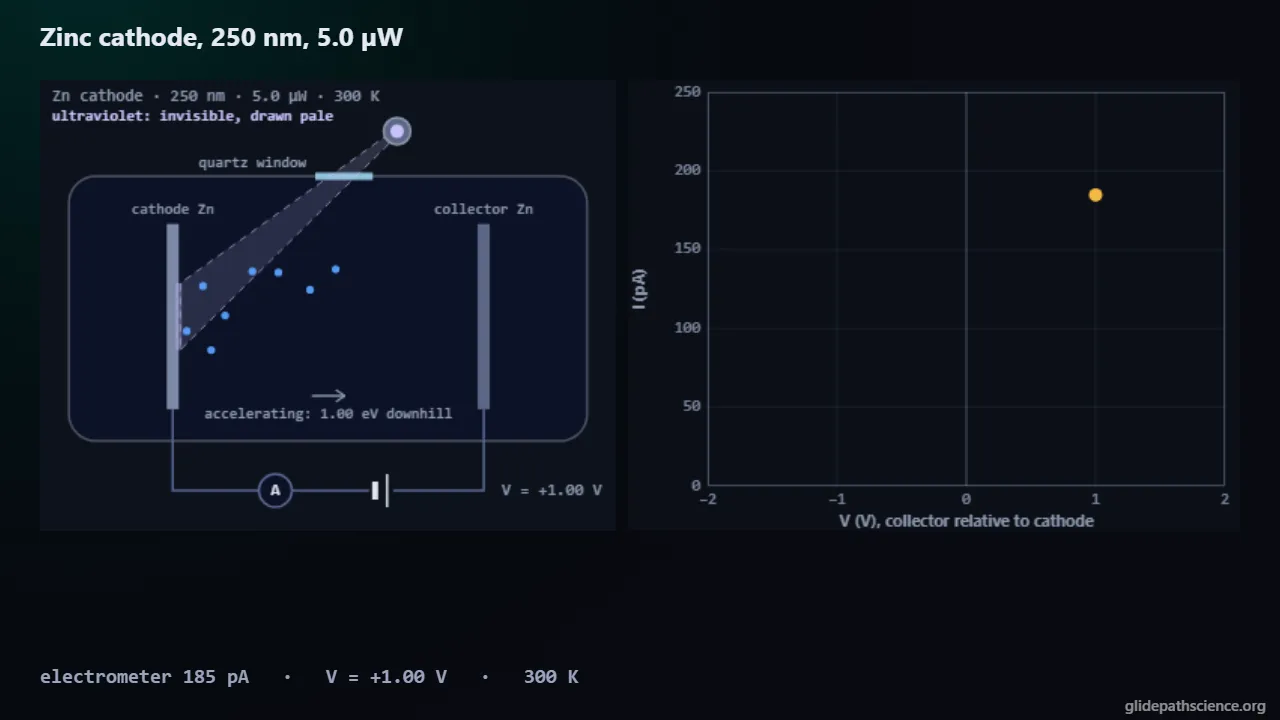
Every current in this lab comes from one model, the Fowler–DuBridge free-electron model of photoemission: electrons in a Fermi–Dirac distribution, a photon's energy going into motion normal to the surface, and the escaping flux integrated in closed form for parallel plates or a small emitter inside a spherical collector, with the contact potential between cathode and collector. A guided walkthrough at two levels builds from red light that frees nothing, the threshold, no partial credit, brightness against color, the wave picture's predicted delay and photon counting, to stopping the fastest electron and measuring Planck's constant from the student's own Millikan plot; the Advanced track adds the electron sea, what plates and spheres measure, the warm Fermi tail, Fowler's law, whose work function a stopping voltage gives, noise and the apparent cutoff, thermionic dark current and two-photon emission. The Sandbox offers six cathodes, any wavelength from 150 to 700 nm, three windows and a shutter, two collector shapes, a collector of another metal, the cathode's temperature and a noisy electrometer, with voltage sweeps and the model's curve. The Lab Bench repeats Millikan's h/e measurement with a mercury lamp and line filters or a monochromator, nulled by eye or, at the Advanced level, by whole-curve fits with standard errors checked against the scatter of repeated data sets, and Fowler's method for the cathode's own work function. Wave or Photon? runs the classical and photon pictures side by side on the same zinc surface. A Quick check, prediction rounds with fresh numbers, and activities (reading which curve a change gives, identifying a mystery cathode, designing a detector to a specification) complete it. Runs entirely offline in one file.
What you'll learn
- One photon, one electron: light delivers its energy in photons of E = hf, and below the threshold frequency no electron leaves, however bright the light or however long you wait.
- Brighter is more, bluer is faster: more power at one color means more photons and more current, while a higher frequency means faster electrons, K_max = hf − φ, whatever the brightness.
- Planck's constant from a straight line: the stopping voltage rises linearly with frequency with slope h/e for every metal, and a fit gives h with an honest uncertainty.
- Whose work function: the threshold belongs to the cathode, but the stopping voltage is set by the collector, because the contact potential cancels the cathode's work function; temperature, geometry and noise shape the cutoff too.
What you can do
- Guided walkthroughStep-by-step, in Intro and Advanced tracks.
- SandboxEvery control of the model, to explore freely.
- Virtual labA realistic experiment with measurement noise and data analysis.
- Concept checksQuestions about ideas and vocabulary, with no calculating.
- PredictionCommit to a prediction, then see the result.
- Classroom demoProjector mode and recordable clips for slides.
- Works offlineA single downloadable file, verified to run without a network.
Before you start
- Energy in electronvolts, and the work done on a charge by a potential difference
- Waves: wavelength, frequency and c = fλ
- Reading a straight-line graph: slope and intercepts
- For the advanced track: the Fermi–Dirac distribution and basic calculus
Run or download
Run it in your browser
Nothing to install and no account. Works on laptops, Chromebooks, tablets, and phones.
Launch Photoelectric EffectDownload for offline use
One HTML file (790 kB) that opens in any modern browser with no network: for rooms with unreliable Wi-Fi, or to keep a copy.
Download the fileFile details and checksum
- File
photoelectric-effect-v1.5.html- Version
- 1.5, released November 15, 2026
- Build
e276d00- Size
- 808,503 bytes
- SHA-256
9fddc444efc00a949daa989509f2fb7c9a08deeea4b88ef54e07227dfbe7b5bb- Offline
- Checked to run with all network access blocked.
The model and its limits
What the model assumes
- Fowler–DuBridge free-electron model: an absorbed photon's energy goes into motion normal to the surface; the escaping flux is uniform in normal and parallel energy, weighted by the Fermi function, and every current is its exact integral.
- Parallel plates cut on the normal energy and a small emitter inside a sphere on the total energy; the barrier includes the contact potential (φ_C − φ_E) between cathode and collector.
- One yield constant for every metal (α = 10⁻³ eV⁻², illustrative); work functions are typical polycrystalline handbook (CRC) values.
- Windows pass light by a smooth cutoff: glass about 310 nm, fused quartz about 190 nm (oxygen in the air path), MgF₂ with an evacuated path about 118 nm.
- Thermionic emission by Richardson–Dushman (A = 60.1 A cm⁻² K⁻², illustrative) over a 1 cm² cathode; electrometer noise Gaussian, 0.3 pA rms, from a seeded generator.
- Mercury lines at their air wavelengths; the 365 nm group represented by its strongest line and the yellow doublet by both lines at equal power.
- The wave picture is the classical expectation, deliberately simple: each atom of cross section 0.1 nm² collects energy at the rate IA until it has the work function.
What it leaves out
- No band structure, reflectivity or absorption depth: yields far above threshold are illustrative, and Spicer's three-step model is described, not modeled.
- Surface effects (crystal faces, contamination) that shift real work functions by tenths of an electronvolt are not modeled.
- No space charge, Schottky barrier lowering, collector reflection, secondary emission or photoemission from the collector.
- Multiphoton emission is a calculation only; the lamp is far too weak for it.
- Heating by the light and melting are ignored: above a metal's melting point the model keeps an ideal solid surface, and says so.
- The electrometer has no offset, drift or response time; lamp line widths and power drift are left out.
Cite this simulation
APA 7
Meier, D. (2026). Photoelectric Effect (Version 1.5) [Computer simulation]. Glidepath Science. https://glidepathscience.org/simulations/photoelectric-effect/
MLA 9
Meier, David. Photoelectric Effect. Version 1.5, Glidepath Science, 2026, glidepathscience.org/simulations/photoelectric-effect/.
AIP
D. Meier, Photoelectric Effect, version 1.5 (Glidepath Science, 2026), https://glidepathscience.org/simulations/photoelectric-effect/.
BibTeX
@misc{meier2026photoelectriceffect,
  author       = {Meier, David},
  title        = {{Photoelectric Effect}},
  year         = {2026},
  publisher    = {Glidepath Science},
  version      = {1.5},
  note         = {Interactive simulation, version 1.5},
  howpublished = {\url{https://glidepathscience.org/simulations/photoelectric-effect/}},
  url          = {https://glidepathscience.org/simulations/photoelectric-effect/}
}
Credits and license
Created by Dr. David Meier, Glidepath Science.
Licensed under Creative Commons Attribution-NonCommercial-ShareAlike 4.0 International (CC BY-NC-SA 4.0). You may share and adapt it for noncommercial purposes, such as teaching, with credit and under the same license. Licensing and reuse
AI tools (Claude, from Anthropic, and ChatGPT, from OpenAI) were used in developing Glidepath Science and its simulations. Dr. David Meier reviewed, edited, and modified every release version.