
NewVersion 1.0
Heat Transfer & Insulation
Stack a wall’s layers, choose a window’s panes and gas, and take a vacuum flask apart to see how conduction, convection and radiation carry heat from hot to cold, and how insulation slows it.
About this simulation
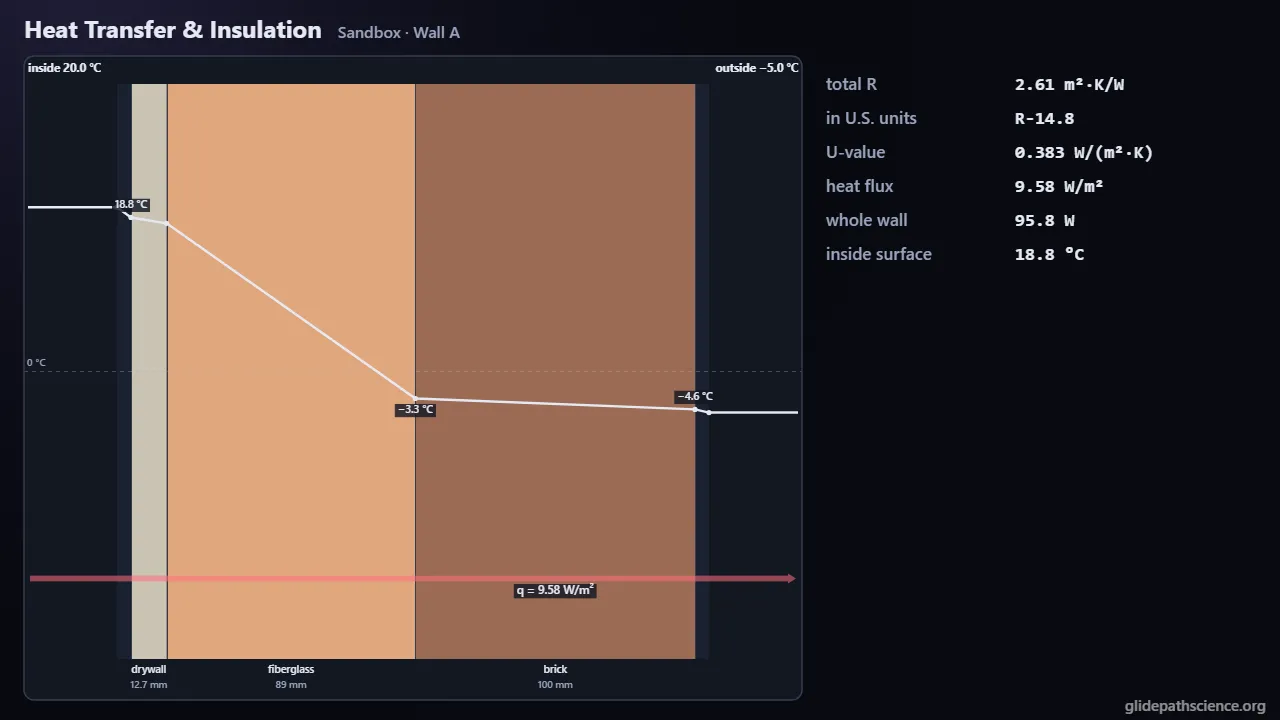
Heat always flows from hot to cold; insulation only slows it. Students build a wall of up to five layers, set the indoor and outdoor temperatures and the wind, and read R, U, the heat flux and the temperature profile, or cool a mug, a copper ball or a can. A guided walkthrough at two levels follows the three ways heat moves, Fourier’s law, conductors and insulators, R-values in series, the temperature profile, a window, convection, radiation and the vacuum flask; the Advanced track adds U-values, thermal bridging, a frosted pane, linearized radiation, radiation shields, the lumped time constant, the Biot number and diffusion time. A Wall Lab solves a stud bay in two dimensions to show what wood and steel studs cost against the label; a Window Lab compares one, two and three panes, air or argon and low-e coatings against the room’s dew point; a Flask Lab removes the vacuum, the silvering or the stopper to show which path each blocks. A concept challenge and a prediction lab with fresh numbers on every run round it out.
What you'll learn
- Explain that heat flows from hot to cold by conduction, convection and radiation until the temperatures are equal, and that cold never flows in.
- Add thermal resistances in series, q = ΔT/R with R = L/k for each layer plus the air films, and find the steepest temperature drop in the layer with the largest R.
- Compute the heat a surface loses by convection, P = hAΔT, and by radiation, P = εσA(T⁴ − Tₛ⁴), and explain why a vacuum flask is silvered.
- In Advanced, explain why studs in parallel with the insulation leave a wall’s R short of its label, and estimate how a body cools with τ = ρcV/(hA) and how heat soaks into a wall in about L²/α.
What you can do
- Guided walkthroughStep-by-step, in Intro and Advanced tracks.
- SandboxEvery control of the model, to explore freely.
- Concept checksQuestions about ideas and vocabulary, with no calculating.
- PredictionCommit to a prediction, then see the result.
- Classroom demoProjector mode and recordable clips for slides.
- Works offlineA single downloadable file, verified to run without a network.
Before you start
- Temperature, heat and thermal energy
- Algebra, unit conversions and fourth powers
- For the Advanced track: exponentials, derivatives and one partial differential equation
Run or download
Run it in your browser
Nothing to install and no account. Works on laptops, Chromebooks, tablets, and phones.
Launch Heat Transfer & InsulationDownload for offline use
One HTML file (738 kB) that opens in any modern browser with no network: for rooms with unreliable Wi-Fi, or to keep a copy.
Download the fileFile details and checksum
- File
heat-transfer-insulation-v1.0.html- Version
- 1.0, released November 15, 2026
- Build
72a3b48- Size
- 755,406 bytes
- SHA-256
a46e29f7c0bf1eb0835cfc0cbb760d3c099f677a382e33b246aed03be2e49a40- Offline
- Checked to run with all network access blocked.
The model and its limits
What the model assumes
- Walls are steady one-dimensional conduction through layers of constant conductivity between design-value surface films: 0.13 m²·K/W inside and 1/(9 + 4v) outside for a wind of v m/s.
- The stud bay is steady two-dimensional conduction on a finite-volume grid of about 3,000 cells, within 0.07 % of an independent, finer solve.
- Windows are modeled at the center of the glass: each gap passes gas conduction times a Nusselt number from Wright’s correlation for vertical cavities, plus exact gray radiation between the panes, solved together with the films.
- Cooling objects have one temperature each (lumped), a fixed h and gray radiation to surroundings that may differ from the air, stepped with fourth-order Runge–Kutta.
- The flask is 0.50 kg of water in a glass vessel with a 5 mm gap: radiation across the gap between silvered or plain glass through any foil shields, air conduction when the vacuum is lost, and illustrative conductances for the stopper and the neck.
- Heat soaking into a slab uses implicit finite differences, checked against the error-function solution for a semi-infinite solid.
What it leaves out
- Air leaks, moisture in walls and wind-washing of insulation, which often matter as much as conduction in a real building, are left out.
- Sunshine, window frames and spacers are left out; the U- and R-values are model values for comparing designs, not a product’s rating.
- Conductivities do not change with temperature or moisture, and the stud bay is a horizontal cut with no plates, headers or corners.
- No evaporation from an open cup, conduction into a table or real flask geometry; convection is a coefficient h except in a window’s gap, with no fins or forced-convection correlations.
Cite this simulation
APA 7
Meier, D. (2026). Heat Transfer & Insulation (Version 1.0) [Computer simulation]. Glidepath Science. https://glidepathscience.org/simulations/heat-transfer-insulation/
MLA 9
Meier, David. Heat Transfer & Insulation. Version 1.0, Glidepath Science, 2026, glidepathscience.org/simulations/heat-transfer-insulation/.
AIP
D. Meier, Heat Transfer & Insulation, version 1.0 (Glidepath Science, 2026), https://glidepathscience.org/simulations/heat-transfer-insulation/.
BibTeX
@misc{meier2026heattransferinsulation,
  author       = {Meier, David},
  title        = {{Heat Transfer & Insulation}},
  year         = {2026},
  publisher    = {Glidepath Science},
  version      = {1.0},
  note         = {Interactive simulation, version 1.0},
  howpublished = {\url{https://glidepathscience.org/simulations/heat-transfer-insulation/}},
  url          = {https://glidepathscience.org/simulations/heat-transfer-insulation/}
}
Credits and license
Created by Dr. David Meier, Glidepath Science.
Based on: OpenStax, University Physics Volume 2, by Samuel J. Ling, Jeff Sanny and William Moebs: Chapter 1, “Temperature and Heat”, §1.6 “Mechanisms of Heat Transfer”, an open textbook licensed CC BY-NC-SA 4.0 (openstax.org). The Intro track follows its order of topics (its thickness d and emissivity e are written L and ε here); the wording, numbers, figures and simulations are this lab’s own. No endorsement by OpenStax or the authors is implied.
Licensed under Creative Commons Attribution-NonCommercial-ShareAlike 4.0 International (CC BY-NC-SA 4.0). You may share and adapt it for noncommercial purposes, such as teaching, with credit and under the same license. Licensing and reuse
AI tools (Claude, from Anthropic, and ChatGPT, from OpenAI) were used in developing Glidepath Science and its simulations. Dr. David Meier reviewed, edited, and modified every release version.