
NewVersion 1.6
Springs & Elastic Potential Energy
Stretch, combine and hang springs: Hooke's law, series and parallel, energy as the area under F(x), the missing half, potential-energy wells and stability, and what real springs do.
About this simulation
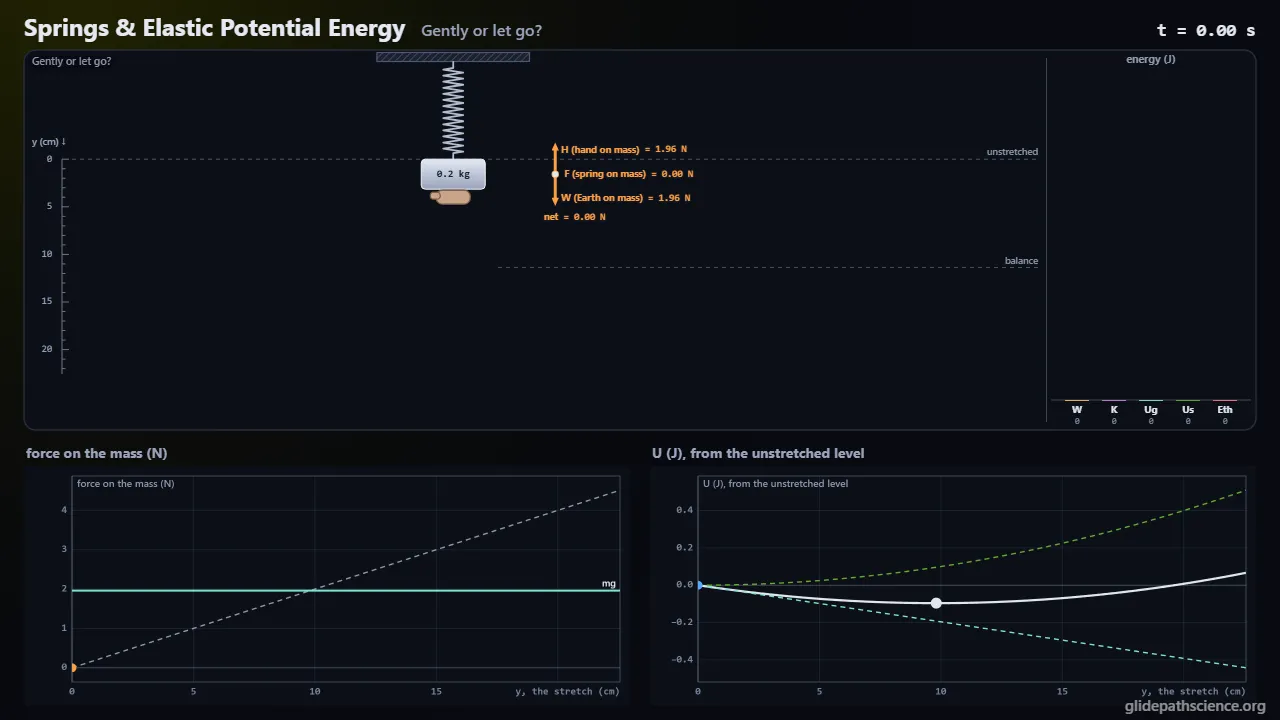
An interactive lab for springs and potential energy. Students pull, hang, pair, side-pull and launch springs drawn to scale, with force diagrams and energy bars that always balance. They find k from a hanging mass, see why springs side by side add their stiffnesses while springs end to end each carry the whole load, and read stored energy as the area under F(x): twice the stretch, four times the energy. Lowering a mass gently shows the missing half: the spring stores only half the energy gravity gives up, and the hand takes the rest. Energy Wells turns any potential-energy curve into equilibria, turning points and a fitted spring at every valley, k = U″, from a stretched pair of springs to a squeezed double well and a chemical bond. Real springs need a pull before they open, lose energy in a hysteresis loop and take a permanent set past their elastic limit, and the Force Sensor Lab asks students to measure all three with slotted masses or a force sensor and fit their own data. A walkthrough at two levels, concept activities and prediction rounds with fresh numbers round it out.
What you'll learn
- Use Hooke's law to find a spring constant from measurements, and explain why the spring force always points back toward the rest length.
- Combine springs in series and in parallel, and explain why springs end to end each carry the whole load while springs side by side share it.
- Calculate elastic potential energy as the area under F(x), and account for every joule when a mass is lowered gently or let go.
- Locate equilibria on a potential-energy curve, classify them as stable or unstable from the curvature, and find the effective spring constant k = U″ at a minimum.
What you can do
- Guided walkthroughStep-by-step, in Intro and Advanced tracks.
- SandboxEvery control of the model, to explore freely.
- Virtual labA realistic experiment with measurement noise and data analysis.
- Concept checksQuestions about ideas and vocabulary, with no calculating.
- PredictionCommit to a prediction, then see the result.
- Classroom demoProjector mode and recordable clips for slides.
- Works offlineA single downloadable file, verified to run without a network.
Before you start
- Newton's second law and free-body diagrams
- weight, mg
- work and kinetic energy
- reading the slope and the area of a graph
- for the Advanced track: derivatives
Run or download
Run it in your browser
Nothing to install and no account. Works on laptops, Chromebooks, tablets, and phones.
Launch Springs & Elastic Potential EnergyDownload for offline use
One HTML file (834 kB) that opens in any modern browser with no network: for rooms with unreliable Wi-Fi, or to keep a copy.
Download the fileFile details and checksum
- File
springs-elastic-energy-v1.6.html- Version
- 1.6, released November 15, 2026
- Build
50d8e69- Size
- 853,790 bytes
- SHA-256
8ad57b70334a959f3530474f83445a55d8cafecfe802ba098c9337e556e01b2f- Offline
- Checked to run with all network access blocked.
The model and its limits
What the model assumes
- A spring's force is F = Fi + kx + βx³ on its elastic stretch, with an elastic, perfectly plastic yield; series and parallel pairs are linear and combine in closed form.
- Hysteresis is a rate-independent Iwan model of eight friction elements; the heat is exactly the elements' work, so the energy books close.
- The hand moves quasi-statically; released motion is integrated with fourth-order Runge-Kutta at no more than 1/400 of a period, with light viscous friction optional.
- The side pull is two springs anchored either side of a bead on a frictionless table, solved exactly for its equilibria and their stability.
- A heavy spring is uniform and shown at rest only; its stretch uses the exact closed form.
- Lab data come from the same engine with hidden kit values, slotted masses within 1 percent, a ruler read to 1 mm and a noisy force sensor; uncertainties are propagated from those tolerances.
What it leaves out
- No motion of the spring itself: no waves along the coil and no spring-mass correction to any period.
- No coil binding, buckling of compression springs, end twisting or sag.
- Hysteresis does not depend on speed, and there is no creep, stress relaxation or recovery of a permanent set.
- Temperature effects, including rubber's stiffening when warmed, are described but not modeled.
- An overloaded spring keeps its pre-tension and never breaks; a runaway load stops at the end of the model's range.
- The potential-energy explorer is a bead on a wire: a ball rolling on a curved track would have different timing.
Cite this simulation
APA 7
Meier, D. (2026). Springs & Elastic Potential Energy (Version 1.6) [Computer simulation]. Glidepath Science. https://glidepathscience.org/simulations/springs-elastic-energy/
MLA 9
Meier, David. Springs & Elastic Potential Energy. Version 1.6, Glidepath Science, 2026, glidepathscience.org/simulations/springs-elastic-energy/.
AIP
D. Meier, Springs & Elastic Potential Energy, version 1.6 (Glidepath Science, 2026), https://glidepathscience.org/simulations/springs-elastic-energy/.
BibTeX
@misc{meier2026springselasticpotentialenergy,
  author       = {Meier, David},
  title        = {{Springs & Elastic Potential Energy}},
  year         = {2026},
  publisher    = {Glidepath Science},
  version      = {1.6},
  note         = {Interactive simulation, version 1.6},
  howpublished = {\url{https://glidepathscience.org/simulations/springs-elastic-energy/}},
  url          = {https://glidepathscience.org/simulations/springs-elastic-energy/}
}
Credits and license
Created by Dr. David Meier, Glidepath Science.
Licensed under Creative Commons Attribution-NonCommercial-ShareAlike 4.0 International (CC BY-NC-SA 4.0). You may share and adapt it for noncommercial purposes, such as teaching, with credit and under the same license. Licensing and reuse
AI tools (Claude, from Anthropic, and ChatGPT, from OpenAI) were used in developing Glidepath Science and its simulations. Dr. David Meier reviewed, edited, and modified every release version.