
NewVersion 1.2
Quantum Atom Lab
Follow the evidence from line spectra and Bohr's levels to electron waves, explore every hydrogen orbital from 1s to 4f in 3-D, and fill atoms from hydrogen to xenon to explain their ionization energies.
About this simulation
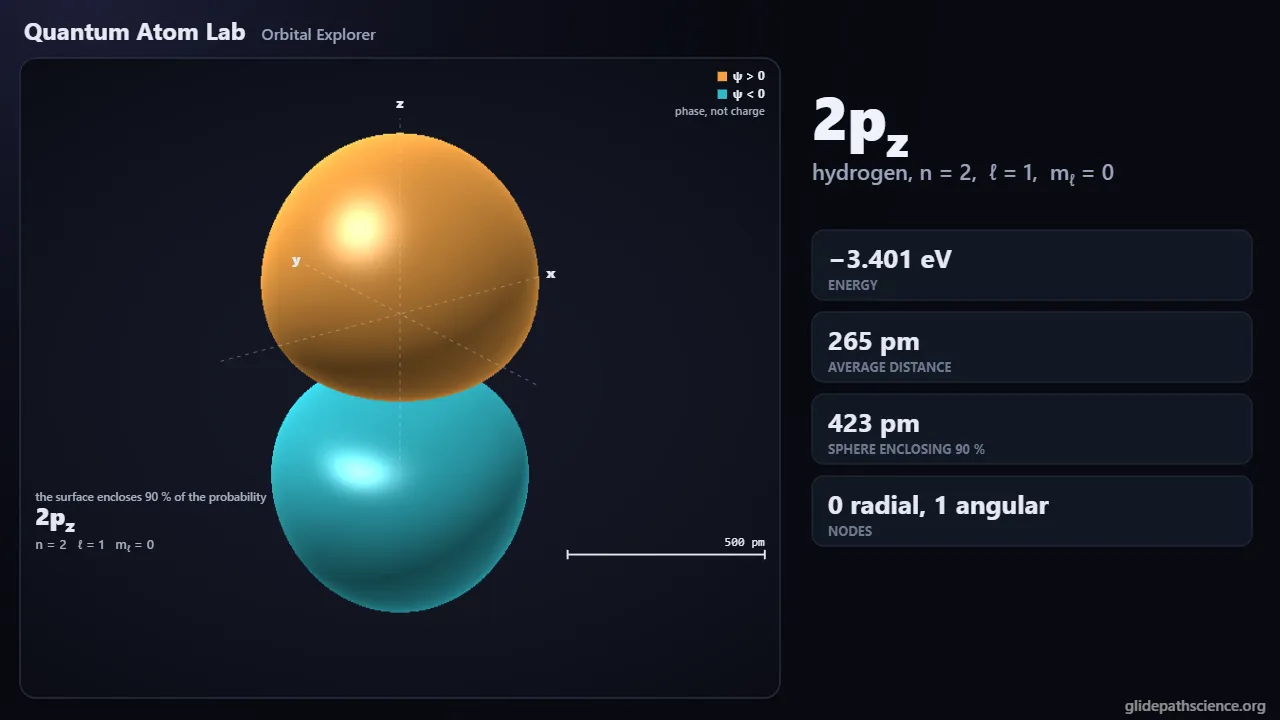
A lab built on the exact hydrogen-like wavefunctions. Students follow the evidence that classical physics fails inside the atom: a planetary electron that would collapse in about 10⁻¹¹ s, light that frees electrons one photon at a time, sharp line spectra, Bohr's energy levels and electron waves that join up around an orbit. Every hydrogen orbital from 1s to 4f, and one-electron ions up to C⁵⁺, can be turned in 3-D as a contour surface enclosing a chosen probability, a density cloud or a cloud of simulated measurements, with nodes, cutaways, radial charts and slices through the nucleus, the sign of the wavefunction shown as a phase rather than a charge. A Spectra Lab covers light across the electromagnetic spectrum, discharge tubes and the Sun, Bohr's hydrogen one jump at a time, and a Balmer bench where students measure hydrogen's lines with a grating, fit for the Rydberg constant and resolve deuterium. Electron Configurations fills atoms from hydrogen to xenon while naming aufbau, Hund and Pauli, with box diagrams, ions, the measured exceptions, effective nuclear charge by a simple model and by Slater's rules, ionization energies and photoelectron spectra. The Intro track follows Chapter 2 of the open textbook CLUE; the Advanced track adds the reduced mass, the uncertainty estimate, radial probability, real orbitals, selection rules, spin–orbit splitting, Slater's rules, penetration and the configuration exceptions.
What you'll learn
- Explain why sharp line spectra mean that electrons in atoms have only certain energies, and compute photon energies and wavelengths from Bohr's levels.
- Interpret an orbital as a map of probability, with its contour surface, its phase and its radial and angular nodes, and connect each to the quantum numbers.
- Write ground-state electron configurations and box diagrams for atoms and ions from hydrogen to xenon using the aufbau order, the Pauli principle and Hund's rule, and recognize the measured exceptions.
- Use shielding and effective nuclear charge to explain the trend in first ionization energies and its dips.
What you can do
- Guided walkthroughStep-by-step, in Intro and Advanced tracks.
- SandboxEvery control of the model, to explore freely.
- Virtual labA realistic experiment with measurement noise and data analysis.
- Concept checksQuestions about ideas and vocabulary, with no calculating.
- PredictionCommit to a prediction, then see the result.
- Classroom demoProjector mode and recordable clips for slides.
- Works offlineA single downloadable file, verified to run without a network.
Before you start
- Atoms as protons, neutrons and electrons (see Atomic Structure & Isotopes)
- Energy in electron-volts and joules; scientific notation
- For the Advanced track: the Coulomb interaction, angular momentum and some calculus
Run or download
Run it in your browser
Nothing to install and no account. Works on laptops, Chromebooks, tablets, and phones.
Launch Quantum Atom LabDownload for offline use
One HTML file (865 kB) that opens in any modern browser with no network: for rooms with unreliable Wi-Fi, or to keep a copy.
Download the fileFile details and checksum
- File
quantum-atom-lab-v1.2.html- Version
- 1.2, released November 15, 2026
- Build
99ac6f0- Size
- 885,977 bytes
- SHA-256
3702341043e6807ff52eea241d1cad2ade5d2f3025a398ea81d68beb9639f1f9- Offline
- Checked to run with all network access blocked.
The model and its limits
What the model assumes
- Orbitals are the exact hydrogen-like solutions of the Schrödinger equation for n ≤ 4 and Z ≤ 6, with the real angular functions chemists draw.
- The surface shown is the contour of |ψ|² that encloses a chosen probability (90 % by default), computed by quadrature; dot clouds are seeded samples drawn exactly from |ψ|².
- Bohr's levels use the infinite-mass Rydberg energy (13.606 eV); the reduced mass enters for hydrogen and deuterium in the Advanced track and on the Balmer bench.
- Many-electron atoms are drawn with hydrogen-like orbitals sized by Slater's effective nuclear charge: illustrative sizes.
- Configurations are measured ground states (NIST) for H to Xe and for the free ions the simple rules get wrong; other ions follow the stated rules.
- Spectral lines, ionization energies and covalent radii are measured values (NIST, Cordero et al.); line brightnesses are illustrative.
What it leaves out
- No electron correlation: real many-electron orbitals come from self-consistent calculations.
- No fine or hyperfine structure (apart from sodium's measured doublet), Lamb shift, relativistic effects, Zeeman or Stark shifts, or line widths.
- No continuum states and no time dependence; line intensities are not computed from first principles.
- The photoelectric scene frees an electron for every photon above threshold; the Photoelectric Effect lab models real yields.
- Orbitals to n = 4; configurations to xenon; photoelectron spectra to calcium.
Cite this simulation
APA 7
Meier, D. (2026). Quantum Atom Lab (Version 1.2) [Computer simulation]. Glidepath Science. https://glidepathscience.org/simulations/quantum-atom-lab/
MLA 9
Meier, David. Quantum Atom Lab. Version 1.2, Glidepath Science, 2026, glidepathscience.org/simulations/quantum-atom-lab/.
AIP
D. Meier, Quantum Atom Lab, version 1.2 (Glidepath Science, 2026), https://glidepathscience.org/simulations/quantum-atom-lab/.
BibTeX
@misc{meier2026quantumatomlab,
  author       = {Meier, David},
  title        = {{Quantum Atom Lab}},
  year         = {2026},
  publisher    = {Glidepath Science},
  version      = {1.2},
  note         = {Interactive simulation, version 1.2},
  howpublished = {\url{https://glidepathscience.org/simulations/quantum-atom-lab/}},
  url          = {https://glidepathscience.org/simulations/quantum-atom-lab/}
}
Credits and license
Created by Dr. David Meier, Glidepath Science.
Based on: Chemistry, Life, the Universe and Everything (CLUE), by Melanie M. Cooper and Michael W. Klymkowsky: Chapter 2, “Electrons and Orbitals,” an open textbook licensed CC BY-NC-SA 4.0. This lab follows the chapter’s order of topics, its simple model of effective nuclear charge, its form of the uncertainty principle and its ionization energies for helium and beryllium; the wording, figures and simulations are the lab’s own. No endorsement by the authors is implied.
Licensed under Creative Commons Attribution-NonCommercial-ShareAlike 4.0 International (CC BY-NC-SA 4.0). You may share and adapt it for noncommercial purposes, such as teaching, with credit and under the same license. Licensing and reuse
AI tools (Claude, from Anthropic, and ChatGPT, from OpenAI) were used in developing Glidepath Science and its simulations. Dr. David Meier reviewed, edited, and modified every release version.