
NewVersion 1.2
Fluid Flow & Bernoulli
Push water through pipes and constrictions: continuity speeds it up, Bernoulli’s equation lowers its pressure, meters read flow and airspeed, and a narrowed artery costs pressure.
About this simulation
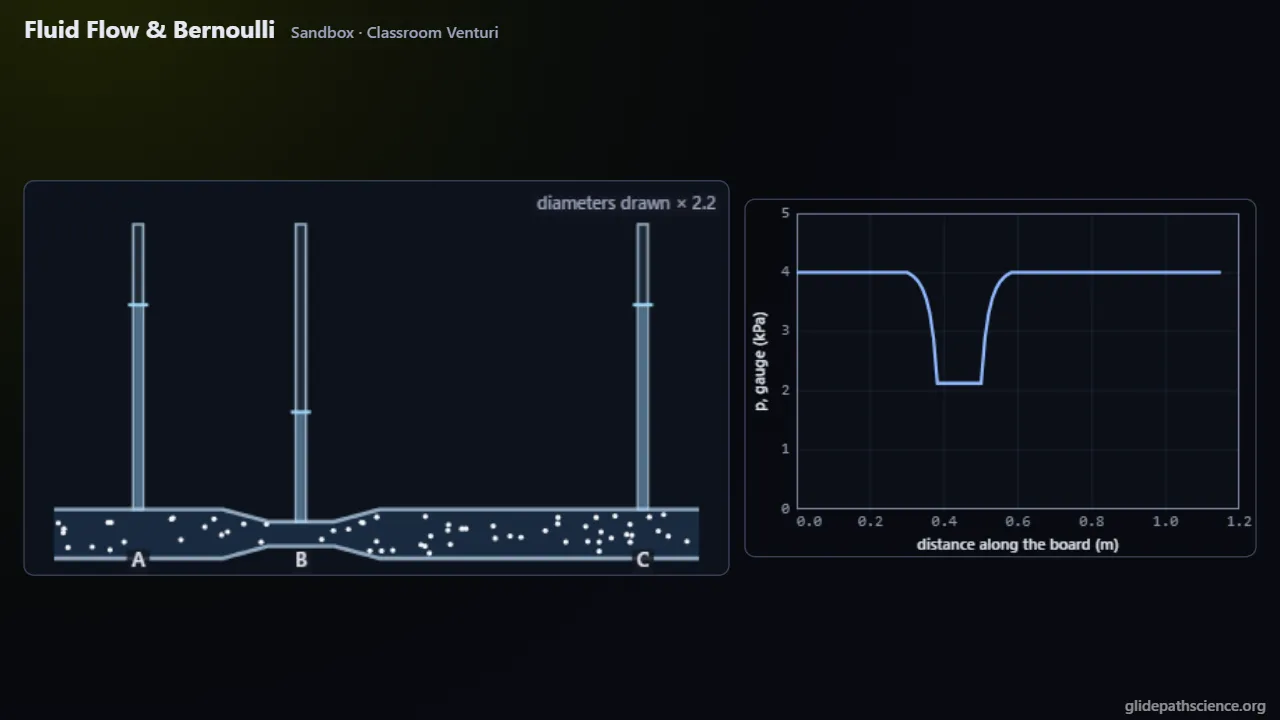
Flow is conserved, and a fluid speeds up only where its pressure falls. A guided walkthrough at two levels follows OpenStax University Physics Volume 1, §14.5–14.7: continuity, Bernoulli’s equation as the work–energy theorem per unit volume, its applications, viscosity, Poiseuille’s law and turbulence. The Advanced track adds the energy equation with losses, the compressible pitot correction, a tank that drains with a sealed top, and the Reynolds number. The Sandbox runs fluid through pipes and narrowings with pressure columns and tracers, and drains a tank through a jet. The Flow Bench is a classroom lab with honest instruments: read a Venturi or orifice meter’s columns against a timed bucket and fit its discharge coefficient, each reading keeping the timer it was taken with, and read an airspeed from a pitot tube in a wind tunnel. The Artery Lab narrows a carotid, coronary or femoral artery and shows what the narrowing costs in pressure and flow. The Flow Field draws ideal flow past a cylinder and an airfoil, and shows why lift has nothing to do with equal transit times. A Quick check, Read the columns, Bernoulli or not?, prediction rounds with Practice and Assessed modes, Hit the bucket and Mystery meter complete it, with a printable Guide. Runs entirely offline in one file.
What you'll learn
- Use continuity, Q = Av, to explain why the same volume per second passes every cross-section and a fluid speeds up where its path narrows.
- Apply Bernoulli’s equation as the work–energy theorem per unit volume, and explain why a fluid speeds up only where its pressure falls.
- Turn a pressure or a height into a speed with a Venturi meter, a pitot tube and a tank’s jet.
- Explain how viscosity, Poiseuille’s r⁴ and turbulence take pressure that never comes back, and what a narrowed artery costs.
What you can do
- Guided walkthroughStep-by-step, in Intro and Advanced tracks.
- SandboxEvery control of the model, to explore freely.
- Virtual labA realistic experiment with measurement noise and data analysis.
- Concept checksQuestions about ideas and vocabulary, with no calculating.
- PredictionCommit to a prediction, then see the result.
- Classroom demoProjector mode and recordable clips for slides.
- Works offlineA single downloadable file, verified to run without a network.
Before you start
- Pressure and density (Pressure & Buoyancy)
- Work and energy
- Area of a circle
- For the Advanced track: calculus
Run or download
Run it in your browser
Nothing to install and no account. Works on laptops, Chromebooks, tablets, and phones.
Launch Fluid Flow & BernoulliDownload for offline use
One HTML file (973 kB) that opens in any modern browser with no network: for rooms with unreliable Wi-Fi, or to keep a copy.
Download the fileFile details and checksum
- File
fluid-flow-bernoulli-v1.2.html- Version
- 1.2, released November 15, 2026
- Build
34ae8c2- Size
- 996,480 bytes
- SHA-256
700379cb46fe89ae2a4afee1ae3dd40ab4a810596408979bc4e5f2c9b197325d- Offline
- Checked to run with all network access blocked.
The model and its limits
What the model assumes
- Pipes carry steady one-dimensional flow; mass is conserved exactly and the energy equation runs between samples with stated losses.
- Water, blood and air have stated densities and viscosities (blood as a Newtonian fluid at high shear); air follows the International Standard Atmosphere.
- Tanks drain by quasi-steady Torricelli flow with stated contraction and velocity coefficients.
- A narrowing costs ΔP = aQ + bQ²: Poiseuille through the throat plus an expansion loss; the Flow Field is ideal potential flow with the Kutta condition.
- The Flow Bench’s discharge coefficients and instrument errors are illustrative, stated in the Field Manual.
What it leaves out
- Compressibility, except the Advanced pitot correction: air is treated as incompressible, fine below about Mach 0.3.
- Unsteady flow: start-up, water hammer and a pulsing heart (the Artery Lab is steady mean flow).
- Blood as a suspension that thins under shear, and elastic, branching arteries with collaterals.
- Cavitation’s own physics (the Sandbox only flags it), developing flow, the details of transition, and real minor-loss tables, which here are illustrative.
- Viscosity in the Flow Field (no boundary layers, separation or stall), surface tension, and a jet’s air drag and breakup.
Cite this simulation
APA 7
Meier, D. (2026). Fluid Flow & Bernoulli (Version 1.2) [Computer simulation]. Glidepath Science. https://glidepathscience.org/simulations/fluid-flow-bernoulli/
MLA 9
Meier, David. Fluid Flow & Bernoulli. Version 1.2, Glidepath Science, 2026, glidepathscience.org/simulations/fluid-flow-bernoulli/.
AIP
D. Meier, Fluid Flow & Bernoulli, version 1.2 (Glidepath Science, 2026), https://glidepathscience.org/simulations/fluid-flow-bernoulli/.
BibTeX
@misc{meier2026fluidflowbernoulli,
  author       = {Meier, David},
  title        = {{Fluid Flow & Bernoulli}},
  year         = {2026},
  publisher    = {Glidepath Science},
  version      = {1.2},
  note         = {Interactive simulation, version 1.2},
  howpublished = {\url{https://glidepathscience.org/simulations/fluid-flow-bernoulli/}},
  url          = {https://glidepathscience.org/simulations/fluid-flow-bernoulli/}
}
Credits and license
Created by Dr. David Meier, Glidepath Science.
Licensed under Creative Commons Attribution-NonCommercial-ShareAlike 4.0 International (CC BY-NC-SA 4.0). You may share and adapt it for noncommercial purposes, such as teaching, with credit and under the same license. Licensing and reuse
AI tools (Claude, from Anthropic, and ChatGPT, from OpenAI) were used in developing Glidepath Science and its simulations. Dr. David Meier reviewed, edited, and modified every release version.