
NewVersion 1.6
Accelerating Reference Frames
Ride an elevator on a bathroom scale and drive a van with a plumb bob, a balloon and coffee, seen from the ground and from inside: apparent weight, fictitious forces, effective gravity and rotating frames.
About this simulation
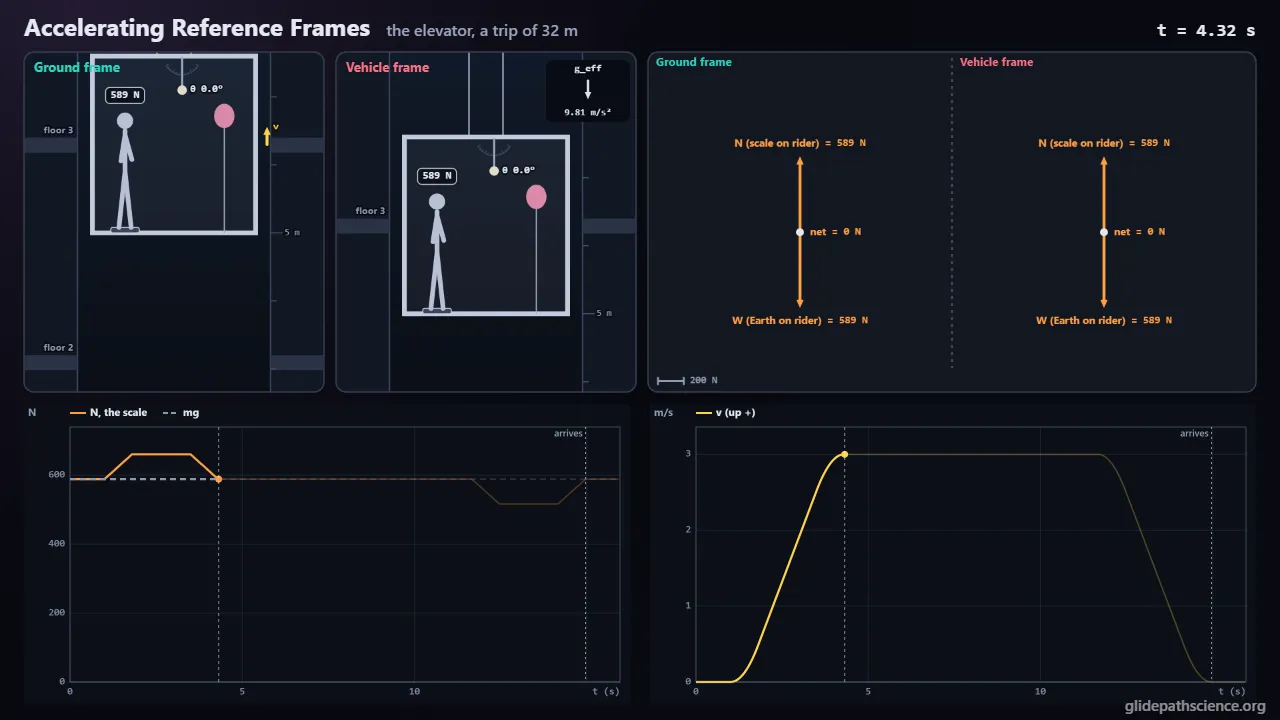
A bathroom scale reads the floor's push, not your weight. Students ride an elevator, a drop tower, a van and a rocket, each seen by two cameras at once: one that keeps the ground at rest and one fixed to the vehicle, where a dashed fictitious force, −ma, appears on everything inside. Live free-body diagrams in both frames show real forces labeled by type and agent, and the net force that is ma from the ground and zero from inside. An Intro walkthrough covers what a scale reads, speeding up and slowing down in an elevator, free fall, the view from inside, and effective gravity in a car: the plumb bob, the helium balloon, the coffee and a crate that slips. An Advanced track derives fictitious forces from a = A + a′ and treats effective gravity as a vector, buoyancy, what accelerometers read, integrating a scale log, the bob's overshoot, orbit, the equivalence principle and tides, then rotating frames: centrifugal and Coriolis forces, a coin that slips on a platter, and the spinning Earth. A Ride Log turns a noisy scale log into a building's height, with its uncertainty, and a Rotating Frame tab shows a puck on a spinning air table from both frames. Every answer comes from one engine.
What you'll learn
- Explain what a scale measures and use N = m(g + a) to predict its reading when a vehicle speeds up, slows down, cruises or falls freely, recognizing that the reading depends on the acceleration, not the velocity.
- Describe the same motion from the ground with real forces and from an accelerating vehicle with the fictitious force −ma, and draw both free-body diagrams correctly.
- Use effective gravity, g_eff = g − a, to predict how a plumb bob, a helium balloon, a liquid's surface and a crate on the floor respond to an acceleration, including tan θ = a/g and the slip limit μs·g.
- State the equivalence principle and its limits, and apply centrifugal and Coriolis forces to motion on a turntable and on the spinning Earth.
What you can do
- Guided walkthroughStep-by-step, in Intro and Advanced tracks.
- SandboxEvery control of the model, to explore freely.
- Virtual labA realistic experiment with measurement noise and data analysis.
- Concept checksQuestions about ideas and vocabulary, with no calculating.
- PredictionCommit to a prediction, then see the result.
- Classroom demoProjector mode and recordable clips for slides.
- Works offlineA single downloadable file, verified to run without a network.
Before you start
- Newton's second and third laws and free-body diagrams
- Velocity and acceleration in one dimension
- Vectors and their components, and right-triangle trigonometry
- Static and kinetic friction (for the crate)
Run or download
Run it in your browser
Nothing to install and no account. Works on laptops, Chromebooks, tablets, and phones.
Launch Accelerating Reference FramesDownload for offline use
One HTML file (852 kB) that opens in any modern browser with no network: for rooms with unreliable Wi-Fi, or to keep a copy.
Download the fileFile details and checksum
- File
accelerating-frames-v1.6.html- Version
- 1.6, released November 15, 2026
- Build
dd152ed- Size
- 872,853 bytes
- SHA-256
63ca8ff924ee7bdf530d4f73f941755c14c5aee3fd14dd14cdd36709efa12396- Offline
- Checked to run with all network access blocked.
The model and its limits
What the model assumes
- The vehicle's acceleration is piecewise linear in time (jerk-limited), so its velocity and position are exact closed forms; a trip brakes exactly when the distance left equals its stopping distance and arrives at rest.
- The scale reads the normal force N = m(g + A) instantly; in a car it reads mg and the floor's grip supplies the horizontal force.
- The plumb bob is the full nonlinear pendulum in the vehicle's frame, with air drag as viscous damping, integrated by RK4 in steps of 1 ms or less that never straddle a change in acceleration.
- The helium balloon, the coffee's surface and the rider's lean turn toward the direction of effective gravity with short display lags; their free-body diagrams use the settled forces.
- The crate obeys Coulomb friction with coefficients from the library's shared surface table, with exact slip, stop and wall events; the dropped ball feels only gravity and lands without bouncing.
- The Ride Log's data are the engine's exact ride read through a simulated scale with a calibration offset, Gaussian noise and 0.1 N rounding; the height's standard uncertainty is propagated exactly through the trapezoid sums.
- Rotating frames turn at a steady rate; the puck's path is closed form from the ground and checked against RK4 on the centrifugal and Coriolis equations; the Earth is a sphere with WGS 84's equatorial radius and GM.
What it leaves out
- Work and energy in accelerating frames are left to Frame Shift; circular motion seen from the ground is left to Circular Motion & Banked Turns, and oscillation periods to Simple Harmonic Motion & Pendulums.
- No relativity, no Euler force, and no tides except in the Advanced walkthrough and the Sealed room activity.
- The scale's spring, the floor's give, sloshing, the balloon's own swing, the ball's bounce and roll, and the car's pitching are left out.
- The Earth panel ignores the Earth's flattening, which about doubles the real plumb-line tilt.
- The Sandbox allows accelerations real elevators, vans and rockets could not hold, and the elevator shaft is an ideal 96 m.
- Elevator and drop-tower motions, the balloon's size and the Ride Log's noise and calibration errors are illustrative values.
Cite this simulation
APA 7
Meier, D. (2026). Accelerating Reference Frames (Version 1.6) [Computer simulation]. Glidepath Science. https://glidepathscience.org/simulations/accelerating-frames/
MLA 9
Meier, David. Accelerating Reference Frames. Version 1.6, Glidepath Science, 2026, glidepathscience.org/simulations/accelerating-frames/.
AIP
D. Meier, Accelerating Reference Frames, version 1.6 (Glidepath Science, 2026), https://glidepathscience.org/simulations/accelerating-frames/.
BibTeX
@misc{meier2026acceleratingreferenceframes,
  author       = {Meier, David},
  title        = {{Accelerating Reference Frames}},
  year         = {2026},
  publisher    = {Glidepath Science},
  version      = {1.6},
  note         = {Interactive simulation, version 1.6},
  howpublished = {\url{https://glidepathscience.org/simulations/accelerating-frames/}},
  url          = {https://glidepathscience.org/simulations/accelerating-frames/}
}
Credits and license
Created by Dr. David Meier, Glidepath Science.
Licensed under Creative Commons Attribution-NonCommercial-ShareAlike 4.0 International (CC BY-NC-SA 4.0). You may share and adapt it for noncommercial purposes, such as teaching, with credit and under the same license. Licensing and reuse
AI tools (Claude, from Anthropic, and ChatGPT, from OpenAI) were used in developing Glidepath Science and its simulations. Dr. David Meier reviewed, edited, and modified every release version.