
NewVersion 1.4
Frame Shift
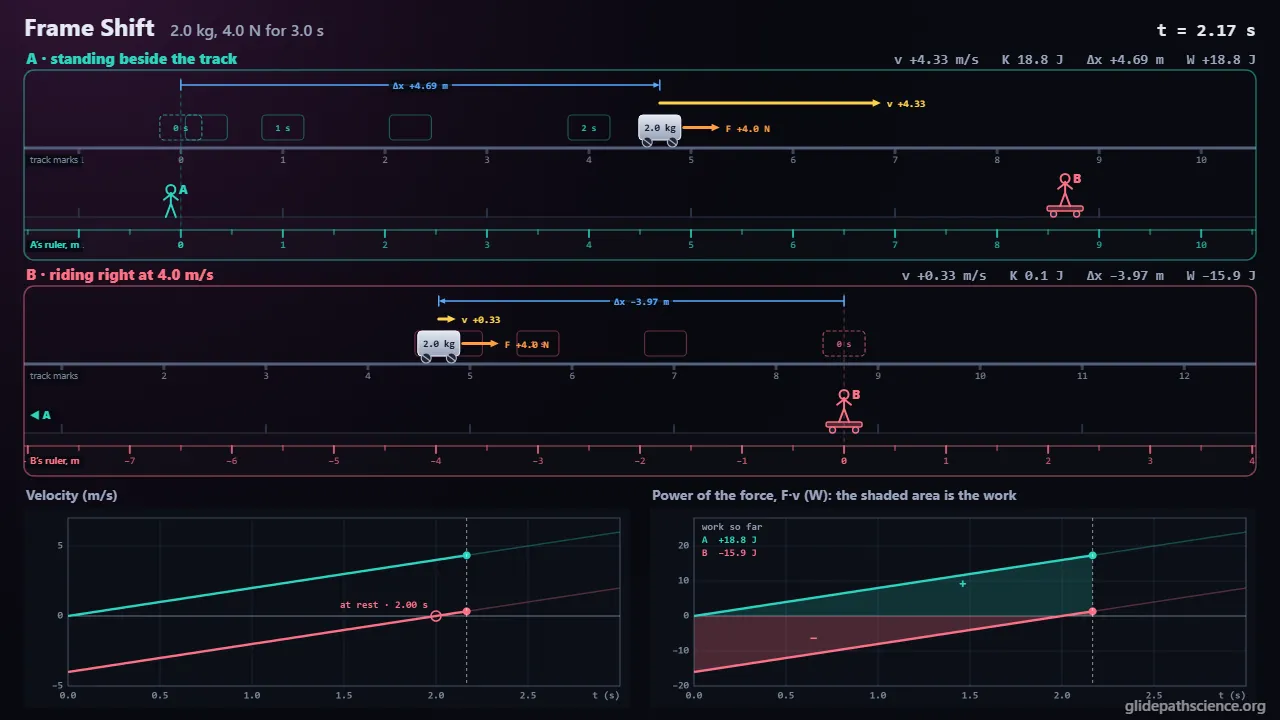
One cart, one push, two observers: see why velocity, displacement, kinetic energy, and work depend on the frame, while the work-energy theorem holds for every inertial observer.
About this simulation
A constant force pulls a cart along a track while two cameras film the same run, one standing beside the track and one riding past. The observers disagree about velocity, displacement, kinetic energy, and work, yet each finds that the net work equals the change in kinetic energy, and both agree on what the winch's battery spends. Students work through the classic case in an Intro and an Advanced walkthrough, explore every observer at once in Frame Scan, balance the energy books in the Energy Ledger, and test themselves in the Concept Challenge and the Predict Lab. The Advanced track adds the Galilean transformation of kinetic energy, work, and power; isolated systems; the Earth's share of the energy; and an accelerating observer with a fictitious force.
What you'll learn
- Agree or not: mass, force, elapsed time, acceleration, and Δp are the same for every inertial observer, while velocity, displacement, kinetic energy, and work belong to a frame.
- Work follows the ruler: W = FΔx with each observer's own ruler, which may be moving, so a force that points right the whole time can do negative work.
- W = ΔK in every inertial frame: no inertial observer catches the theorem failing because work and kinetic energy both shift by −uΔp, while an accelerating observer needs a fictitious force to keep it.
- Who pays: the battery spends F times the string wound in, the same for everyone, and a moving observer must also count the track and the Earth, whose kinetic energy changes by uFΔt.
What you can do
- Guided walkthroughStep-by-step, in Intro and Advanced tracks.
- SandboxEvery control of the model, to explore freely.
- Concept checksQuestions about ideas and vocabulary, with no calculating.
- PredictionCommit to a prediction, then see the result.
- Classroom demoProjector mode and recordable clips for slides.
- Works offlineA single downloadable file, verified to run without a network.
Before you start
- constant-acceleration kinematics in one dimension
- Newton's second law
- kinetic energy and work as force times displacement
- relative velocity in one dimension
Run or download
Run it in your browser
Nothing to install and no account. Works on laptops, Chromebooks, tablets, and phones.
Launch Frame ShiftDownload for offline use
One HTML file (741 kB) that opens in any modern browser with no network: for rooms with unreliable Wi-Fi, or to keep a copy.
Download the fileFile details and checksum
- File
frame-shift-v1.4.html- Version
- 1.4, released November 15, 2026
- Build
ef855b2- Size
- 758,356 bytes
- SHA-256
0a04a3966c5f58786a3f6099f889dfa78c230d92cc9e0035f2c7a177eb6cf425- Offline
- Checked to run with all network access blocked.
The model and its limits
What the model assumes
- The motion is computed in closed form, with no integrator: the cart accelerates at a = F/m from t = 0 until the force switches off at Δt, which ends the run.
- An observer moving at u, and accelerating at a_B when that option is on, measures the cart's position as x′(t) = v₀t + ½at² − ut − ½a_Bt², with each observer's ruler reading zero at the cart's starting point.
- Kinetic energy, the work done so far (FΔx′), the fictitious work (−ma_BΔx′), and the power (Fv′) follow exactly at any instant, and every Walkthrough and Predict Lab answer comes from these functions, with numeric answers accepted within ±5 %.
- The energy ledger charges the battery for the string wound in and gives the track and Earth uFt of kinetic energy, treating the Earth as infinitely massive; the exact correction is about 10⁻²³ J.
- Frame Scan and the Energy Ledger compare inertial observers only.
What it leaves out
- Relativity is left out: at the speeds here, up to about 100 m/s, the Galilean rules are off by about 10⁻¹³ or less.
- Friction, air drag, and rolling resistance are ignored, and the cart is treated as a particle, so its wheels' rotational kinetic energy is not counted.
- The string is massless and does not stretch, and the winch is ideal: it has no losses and works as a perfect regenerative brake when the string pays out, which a real winch would need to be built to do.
- The Earth's recoil is too small to draw, its rotation and orbit are ignored so the track frame is treated as inertial, and the force switches on and off instantly.
- The motion is in one dimension only, and accelerating observers appear only in the Sandbox option and Advanced walkthrough step 10.
Cite this simulation
APA 7
Meier, D. (2026). Frame Shift (Version 1.4) [Computer simulation]. Glidepath Science. https://glidepathscience.org/simulations/frame-shift/
MLA 9
Meier, David. Frame Shift. Version 1.4, Glidepath Science, 2026, glidepathscience.org/simulations/frame-shift/.
AIP
D. Meier, Frame Shift, version 1.4 (Glidepath Science, 2026), https://glidepathscience.org/simulations/frame-shift/.
BibTeX
@misc{meier2026frameshift,
  author       = {Meier, David},
  title        = {{Frame Shift}},
  year         = {2026},
  publisher    = {Glidepath Science},
  version      = {1.4},
  note         = {Interactive simulation, version 1.4},
  howpublished = {\url{https://glidepathscience.org/simulations/frame-shift/}},
  url          = {https://glidepathscience.org/simulations/frame-shift/}
}
Credits and license
Created by Dr. David Meier, Glidepath Science.
Licensed under Creative Commons Attribution-NonCommercial-ShareAlike 4.0 International (CC BY-NC-SA 4.0). You may share and adapt it for noncommercial purposes, such as teaching, with credit and under the same license. Licensing and reuse
AI tools (Claude, from Anthropic, and ChatGPT, from OpenAI) were used in developing Glidepath Science and its simulations. Dr. David Meier reviewed, edited, and modified every release version.