
NewVersion 1.2
Polarization Lab
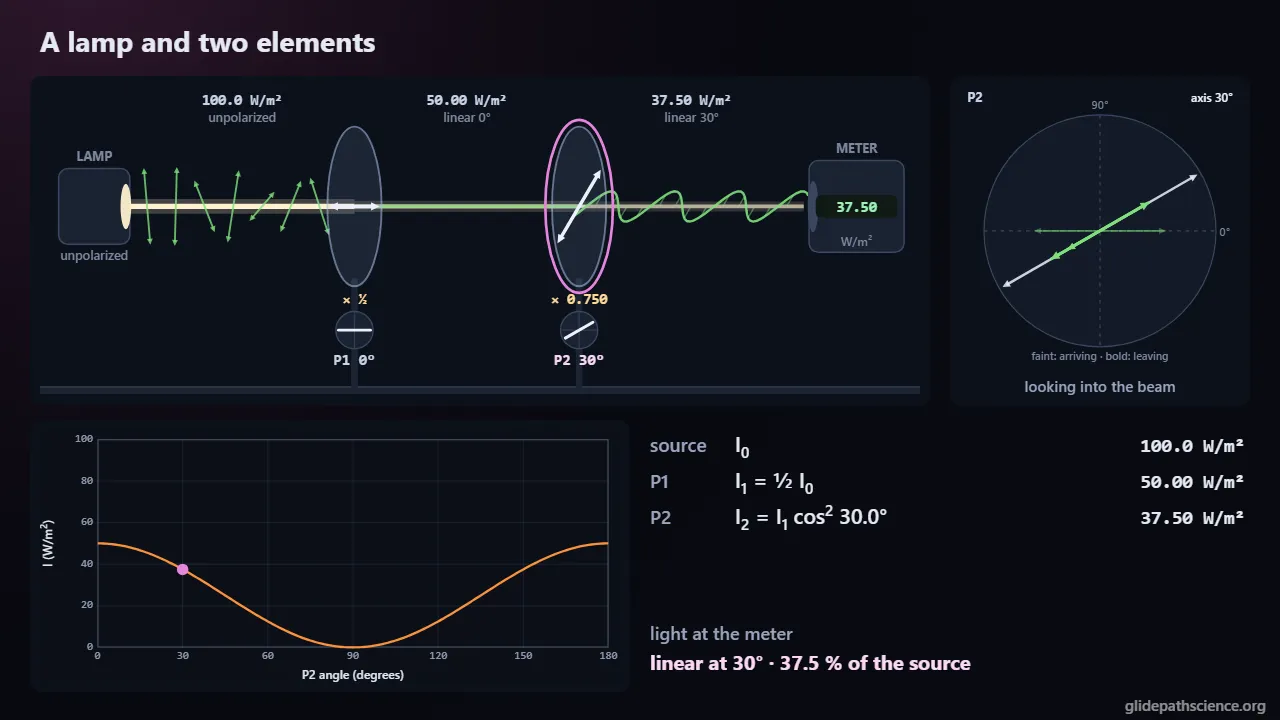
Turn polarizers and watch light follow cos²θ: crossed polarizers go dark until a third brings it back. Find Brewster’s angle in the glare off water, map the polarized sky, and fit real light-meter data.
About this simulation
Every beam in this lab comes from one engine: the light is carried as its Stokes vector, and every element acts through its Jones matrix on the coherency matrix, so unpolarized and partly polarized light, real polarizers that leak and wave plates are handled alike. A guided walkthrough at two levels builds from the half that any polarizer passes, Malus’s law and its square, chains of polarizers, crossed polarizers and the third one between them, and many gentle steps, to glare, Brewster’s angle and the polarized sky; the Advanced track adds Jones and Stokes calculus, leaky polarizers, a fit of real bench data, Fresnel’s equations and why p light vanishes at Brewster’s angle, a pile of plates, retardance, half- and quarter-wave plates, circular light, six-reading polarimetry, Rayleigh scattering and the twisted-nematic pixel. The Sandbox offers a lamp, a laser or partly polarized light and up to six elements (ideal, film, crystal or wire-grid polarizers, and in Advanced half- and quarter-wave plates), with the field drawn along the beam, a face-on view looking into it, the chain with live numbers, the Stokes vector and the Jones product, and a chart of the meter against any element’s angle. The Lab Bench measures Malus’s law with a noisy power meter in µW, a dark reading and a rotation mount whose zero is a little off; cos², |cos| and a straight line compete for the student’s points, and the Advanced fit of the floor is weighted by the meter’s known noise, with standard errors checked by Monte Carlo, or done with a photon counter in dim light. Glare & Sky shows reflection at water, glass, acrylic or diamond with s and p light drawn by symbol, Fresnel’s curves, sunglasses, internal reflection and a pile of plates, and scattering in a tank and across the sky dome. A Quick check, prediction rounds with fresh numbers, and activities (picking the curve a change gives, sorting light by its polarization, a polarizer puzzle through crossed polarizers, and a mystery beam to identify) complete it. Runs entirely offline in one file.
What you'll learn
- Half, whatever the angle: an ideal polarizer passes half of unpolarized light at any orientation and leaves it polarized along its axis; real polarizer film passes about 38 %.
- cos², not cos: Malus’s law, I = I₀cos²θ, acts on the angle between the light’s polarization and the axis, and in a chain on the angle between successive axes.
- A third polarizer: between crossed polarizers, a middle one at θ passes (I₀/8)sin²2θ, at most I₀/8 at 45°, and many gentle steps lose less.
- Glare and sky: reflected light is fully polarized at Brewster’s angle, tan θ_B = n₂/n₁, and skylight is most polarized 90° from the Sun.
What you can do
- Guided walkthroughStep-by-step, in Intro and Advanced tracks.
- SandboxEvery control of the model, to explore freely.
- Virtual labA realistic experiment with measurement noise and data analysis.
- Concept checksQuestions about ideas and vocabulary, with no calculating.
- PredictionCommit to a prediction, then see the result.
- Classroom demoProjector mode and recordable clips for slides.
- Works offlineA single downloadable file, verified to run without a network.
Before you start
- Light as a wave with an electric field across its direction of travel
- Angles and the cosine; squaring a ratio
- Snell’s law of refraction (for the reflection topics)
- For the Advanced track: complex numbers, 2 × 2 matrices and basic statistics
Run or download
Run it in your browser
Nothing to install and no account. Works on laptops, Chromebooks, tablets, and phones.
Launch Polarization LabDownload for offline use
One HTML file (812 kB) that opens in any modern browser with no network: for rooms with unreliable Wi-Fi, or to keep a copy.
Download the fileFile details and checksum
- File
polarization-lab-v1.2.html- Version
- 1.2, released November 15, 2026
- Build
7c5342c- Size
- 831,795 bytes
- SHA-256
8c8fd2e6025acb710f8dad675dccd6fa85f70e2c68d9d7430aba5e3a8d2c81aa- Offline
- Checked to run with all network access blocked.
The model and its limits
What the model assumes
- Light is a classical wave; each beam is a Stokes vector, and each element acts through its Jones matrix on the coherency matrix (equivalent to its Mueller matrix).
- Angles from the horizontal, counterclockwise looking into the beam; right-circular light turns clockwise looking into the beam (Hecht’s naming).
- Polarizers have principal transmittances k₁ along and k₂ across the axis; the film, crystal and wire-grid values are illustrative.
- Wave plates are zero order, made for 633 nm; at other wavelengths the retardance scales as 633 nm/λ (the birefringence’s dispersion neglected).
- Reflection follows Fresnel’s equations for nonabsorbing media; a pile of plates adds its surfaces' reflections incoherently.
- Skylight is single dipole (Rayleigh) scattering of unpolarized sunlight, with an optional depolarization ratio and an illustrative haze factor.
- The bench’s meter has an illustrative dark offset and Gaussian noise, the photon counter Poisson counts; all noise is seeded.
What it leaves out
- Polarizer film’s dependence on wavelength and angle of incidence is left out, and each element’s own surface reflections are folded into k₁.
- No interference between multiple reflections, no absorbing media or metals, no optical activity or Faraday rotation.
- Beams are plane waves met face-on: no divergence or finite beam size.
- The sky’s multiple scattering, aerosols and ground light appear only as a labeled, illustrative haze factor.
- The twisted-nematic cell is ideal; the detector has no polarization sensitivity, drift or response time.
- The single-photon picture belongs to the Quantum Eraser Lab; here photons appear only as counting noise.
Cite this simulation
APA 7
Meier, D. (2026). Polarization Lab (Version 1.2) [Computer simulation]. Glidepath Science. https://glidepathscience.org/simulations/polarization-lab/
MLA 9
Meier, David. Polarization Lab. Version 1.2, Glidepath Science, 2026, glidepathscience.org/simulations/polarization-lab/.
AIP
D. Meier, Polarization Lab, version 1.2 (Glidepath Science, 2026), https://glidepathscience.org/simulations/polarization-lab/.
BibTeX
@misc{meier2026polarizationlab,
  author       = {Meier, David},
  title        = {{Polarization Lab}},
  year         = {2026},
  publisher    = {Glidepath Science},
  version      = {1.2},
  note         = {Interactive simulation, version 1.2},
  howpublished = {\url{https://glidepathscience.org/simulations/polarization-lab/}},
  url          = {https://glidepathscience.org/simulations/polarization-lab/}
}
Credits and license
Created by Dr. David Meier, Glidepath Science.
Licensed under Creative Commons Attribution-NonCommercial-ShareAlike 4.0 International (CC BY-NC-SA 4.0). You may share and adapt it for noncommercial purposes, such as teaching, with credit and under the same license. Licensing and reuse
AI tools (Claude, from Anthropic, and ChatGPT, from OpenAI) were used in developing Glidepath Science and its simulations. Dr. David Meier reviewed, edited, and modified every release version.