
NewVersion 1.3
Connected Masses & Pulley Systems
Hang masses over pulleys: Atwood machines, a train of carts, blocks pulled across tables and up ramps, heavy pulleys with unequal tensions, block and tackle, and a lab bench that measures g.
About this simulation
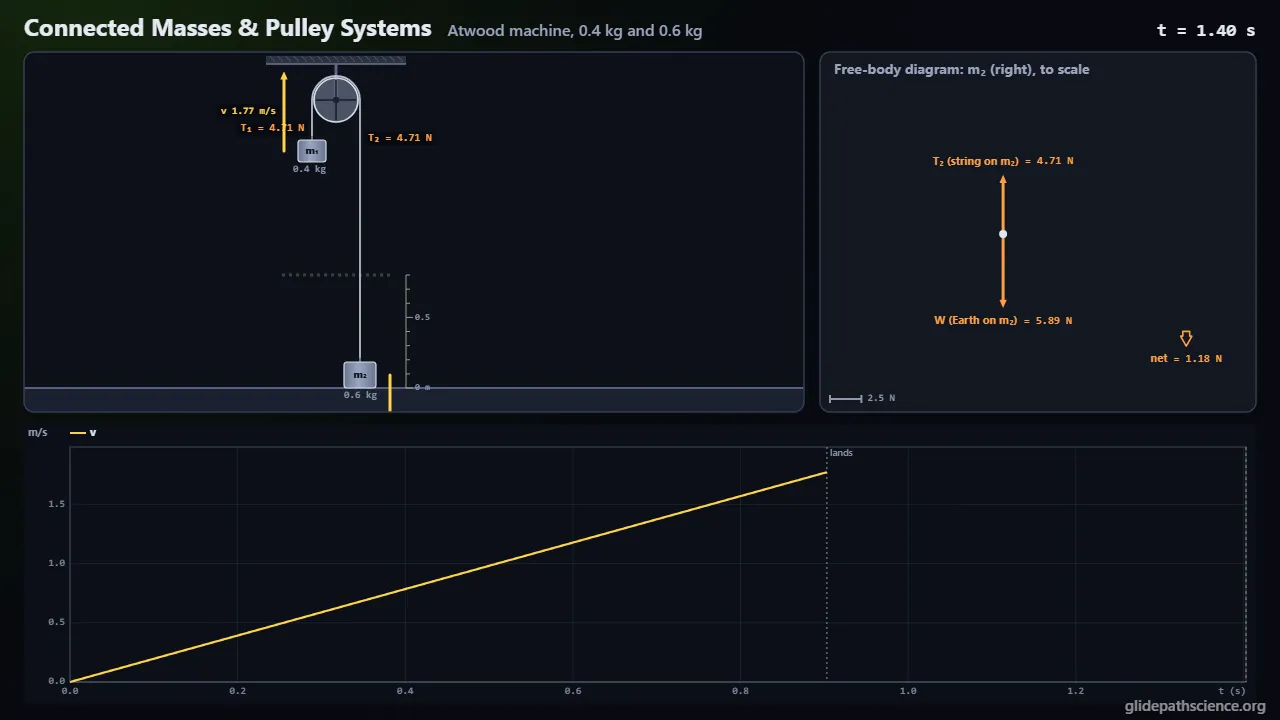
A string ties bodies into one system with one acceleration, and its tension lies between the weights it carries, equal to neither. Students release Atwood machines, pull a train of carts, drag blocks across tables and up ramps with hanging masses, and watch live free-body diagrams labeled by type and agent. Static friction can hold a heavier hanging mass still, and decides whether anything moves and which way. A pulley with mass needs unequal tensions to spin up, and bearing friction resists small imbalances. An Intro walkthrough covers one system and one acceleration, tension, limiting cases, the train of carts, tables and ramps with and without friction, a pulley with mass, and timing a fall to measure g; an Advanced track adds the rotating pulley body by body, disk against ring, a rope over a fixed rod (the capstan rule), bearing friction, fitting measured data for g and friction, the full incline map, a launch against the drive, movable pulleys and tackles with sheave friction, a chain over a peg that lifts off before it can slide off, and the double Atwood. An Atwood Bench measures g with slotted masses and a photogate or motion sensor, with uncertainties from the equipment's tolerances, and Pulley Rigs compares six rigs. Every answer comes from an exact, event-driven engine with no step size.
What you'll learn
- Treat bodies tied by a light string as one system: find the common acceleration from the net external force along the string and the total mass it moves, and find each tension from one body's free-body diagram.
- Explain why the tension lies between the weights it carries while masses accelerate, why each link in a train carries only what accelerates the carts behind it, and why the support holds less than the total weight.
- Use static and kinetic friction to decide whether a table or ramp system moves and which way, including the band of hanging masses that leaves a block at rest.
- Analyze pulleys that are not ideal: unequal tensions on a pulley with mass, bearing friction, a rope gripping a fixed rod, movable pulleys and tackles with sheave friction, and measure g and friction from fitted data.
What you can do
- Guided walkthroughStep-by-step, in Intro and Advanced tracks.
- SandboxEvery control of the model, to explore freely.
- Virtual labA realistic experiment with measurement noise and data analysis.
- Concept checksQuestions about ideas and vocabulary, with no calculating.
- PredictionCommit to a prediction, then see the result.
- Classroom demoProjector mode and recordable clips for slides.
- Works offlineA single downloadable file, verified to run without a network.
Before you start
- Newton's second law and free-body diagrams
- Static and kinetic friction
- Vectors and their components on an incline
- Constant-acceleration kinematics
- Torque and moment of inertia (for the Advanced track)
Run or download
Run it in your browser
Nothing to install and no account. Works on laptops, Chromebooks, tablets, and phones.
Launch Connected Masses & Pulley SystemsDownload for offline use
One HTML file (876 kB) that opens in any modern browser with no network: for rooms with unreliable Wi-Fi, or to keep a copy.
Download the fileFile details and checksum
- File
connected-masses-pulleys-v1.3.html- Version
- 1.3, released November 15, 2026
- Build
b7282c4- Size
- 896,610 bytes
- SHA-256
6300e5abe09e7b62d183cd9bd1d152a321a1efa3af2832e89cdddd81265f4fbc- Offline
- Checked to run with all network access blocked.
The model and its limits
What the model assumes
- Strings are light and inextensible, never slip on pulleys and never go slack during a run; strands hang straight and masses are points that do not swing.
- Each setup reduces to one coordinate along the string (two for the double Atwood) with an effective mass that includes a pulley's I/R², so motion between events is exact and in closed form.
- Amontons–Coulomb friction with coefficients from the library's shared surface table; bearing friction is a fixed torque, at most τs while still and τk while turning; a rope over a fixed rod follows the capstan rule.
- When two static frictions share the holding, the model has each use the same share of its limit (the real split is statically indeterminate).
- Pulley rigs are quasi-static, with each sheave passing on a fixed fraction η of the tension while the load is raised.
- Runs end for a physical reason: a mass lands or reaches a pulley, a block reaches the end of its table or ramp, the system comes to rest for good, or the chain's peg can no longer hold it.
What it leaves out
- No string stretch or mass (except the chain), no string slip on pulleys, no bearing friction that grows with load or speed, no air drag and no swinging masses.
- Nothing after a run ends: landings, slack strings and the chain's flight off the peg are not modeled.
- The bench's equipment values (a lab pulley's I/R² of 3.0 g, bearing torques of a few mN·m, ±0.1 g mass tolerances, 0.1 ms photogate timing, a 1 mm motion sensor at 50 Hz), the sheave efficiency η and the rope-on-rod friction pair are illustrative.
- Elevators and apparent weight, the friction model in full, and the energy accounting of these systems are covered by other simulations in the library.
Cite this simulation
APA 7
Meier, D. (2026). Connected Masses & Pulley Systems (Version 1.3) [Computer simulation]. Glidepath Science. https://glidepathscience.org/simulations/connected-masses-pulleys/
MLA 9
Meier, David. Connected Masses & Pulley Systems. Version 1.3, Glidepath Science, 2026, glidepathscience.org/simulations/connected-masses-pulleys/.
AIP
D. Meier, Connected Masses & Pulley Systems, version 1.3 (Glidepath Science, 2026), https://glidepathscience.org/simulations/connected-masses-pulleys/.
BibTeX
@misc{meier2026connectedmassespulleysystems,
  author       = {Meier, David},
  title        = {{Connected Masses & Pulley Systems}},
  year         = {2026},
  publisher    = {Glidepath Science},
  version      = {1.3},
  note         = {Interactive simulation, version 1.3},
  howpublished = {\url{https://glidepathscience.org/simulations/connected-masses-pulleys/}},
  url          = {https://glidepathscience.org/simulations/connected-masses-pulleys/}
}
Credits and license
Created by Dr. David Meier, Glidepath Science.
Licensed under Creative Commons Attribution-NonCommercial-ShareAlike 4.0 International (CC BY-NC-SA 4.0). You may share and adapt it for noncommercial purposes, such as teaching, with credit and under the same license. Licensing and reuse
AI tools (Claude, from Anthropic, and ChatGPT, from OpenAI) were used in developing Glidepath Science and its simulations. Dr. David Meier reviewed, edited, and modified every release version.