
NewVersion 1.2
Torque & Static Equilibrium
Push a door, balance a seesaw, hang a sign from a strut, climb a ladder until it slips, hold a dumbbell, and load an airplane inside its CG envelope: torque, both equilibrium conditions, and tipping.
About this simulation
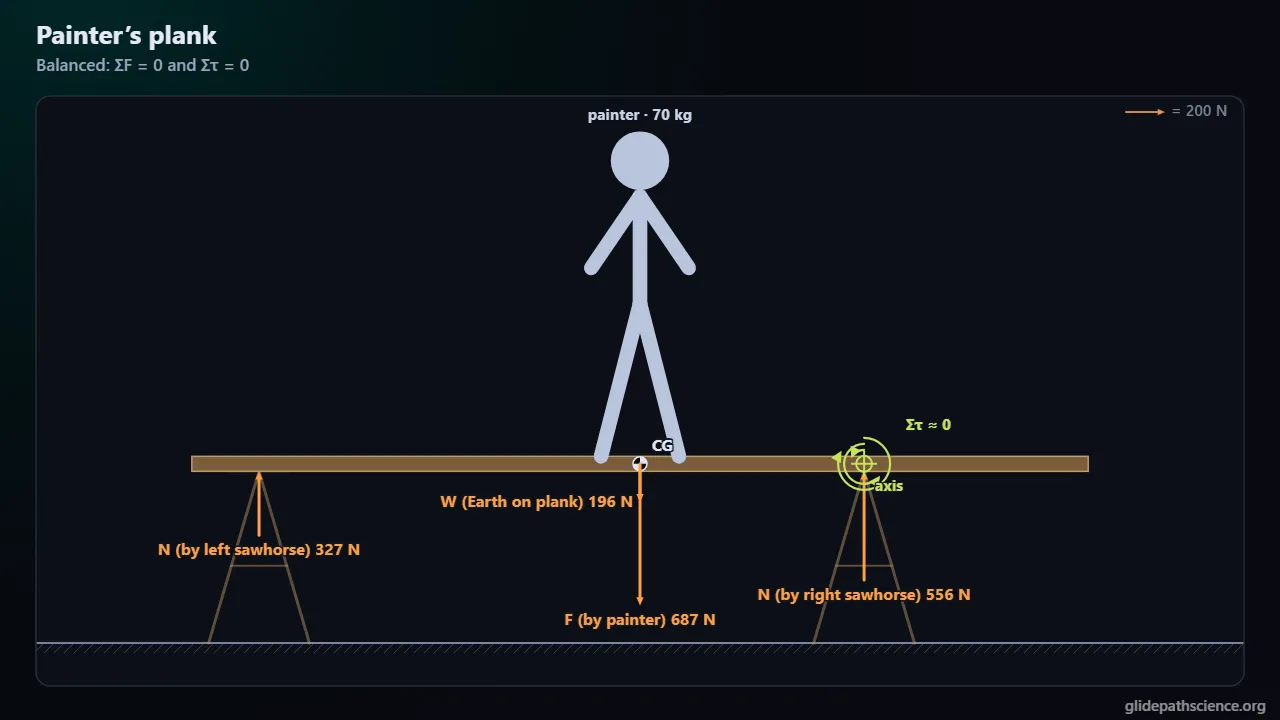
Every force is drawn where it acts on a body with size, labeled by type and agent, with lever arms in blue and torques as lime arcs about an axis the student can drag anywhere. A statics engine treats supports as what they are (knife edges only push, cables only pull) and finds every set of reactions that balances a beam: one value when it is determinate, a band when it is not, and, when nothing balances it, which support would have to pull before it tips. The Beam Bench builds seesaws, painter’s planks, diving boards, wheelbarrows, clamped shelves, signs on struts, and steelyards; it also hangs shapes from two holes to find a center of gravity in empty space. Ladder & Wall climbs until the floor’s grip runs out, with friction at the wall leaving the shares indeterminate; The Body as a Lever shows why muscles pull many times the load; and Aircraft Weight & Balance loads a fictional trainer inside its CG envelope from takeoff to landing, in kilograms and meters or pounds and inches. The Advanced track adds the cross product, couples and moving the axis, CG by integration, three-force members, What flexes (an elastic plank on springy supports), tip or slide, the energy to tip, a crane’s counterweight band, the hip and a cane, and why an airplane’s tail pushes down.
What you'll learn
- Calculate a torque as force times lever arm, τ = r⊥F = rF sin θ, and give its sign (counterclockwise positive).
- Apply both conditions of equilibrium, ΣF = 0 and Στ = 0, choosing the axis that removes the most unknowns.
- Find a center of gravity, recognize when it lies in empty space, and predict when a body tips.
- Analyze real cases: struts and cables, ladders and friction, muscles on short lever arms, indeterminate supports, and an airplane’s CG envelope.
What you can do
- Guided walkthroughStep-by-step, in Intro and Advanced tracks.
- SandboxEvery control of the model, to explore freely.
- Virtual labA realistic experiment with measurement noise and data analysis.
- Concept checksQuestions about ideas and vocabulary, with no calculating.
- PredictionCommit to a prediction, then see the result.
- Classroom demoProjector mode and recordable clips for slides.
- Works offlineA single downloadable file, verified to run without a network.
Before you start
- Forces, free-body diagrams, and Newton’s laws for a particle
- Static friction, f ≤ μₛN
- Right-triangle trigonometry
- For the Advanced track: vectors and the cross product, and basic calculus
Run or download
Run it in your browser
Nothing to install and no account. Works on laptops, Chromebooks, tablets, and phones.
Launch Torque & Static EquilibriumDownload for offline use
One HTML file (883 kB) that opens in any modern browser with no network: for rooms with unreliable Wi-Fi, or to keep a copy.
Download the fileFile details and checksum
- File
torque-static-equilibrium-v1.2.html- Version
- 1.2, released November 15, 2026
- Build
233f402- Size
- 904,106 bytes
- SHA-256
d64bcc62f70883fb909df79c26a56735a9f1e0bfb5009388175fb597b9518946- Offline
- Checked to run with all network access blocked.
The model and its limits
What the model assumes
- Rigid bodies in a plane, statics only, g = 9.81 m/s² (or the Moon’s or Mars’s).
- Thin beams and ladders: forces act on the center line.
- Supports as inequalities (pushes only, pulls only, or either way); the feasible set of reactions found exactly by a small linear program, shown as a band when indeterminate.
- What flexes: an Euler–Bernoulli beam on linear springs, solved by beam finite elements, exact at the nodes.
- Ladders: Coulomb friction at both ends; past the limit, a one-degree-of-freedom slide with kinetic friction (illustrative motion, exact thresholds).
- The body’s levers use fixed, illustrative textbook geometry; the trainer is fictional, with point masses at station arms.
What it leaves out
- No deformation except in What flexes; supports have no area and beams no thickness.
- No loads out of the plane, twisting, wind, or dynamic loads.
- The band says what rigid statics allows, not how the body was placed.
- Body models leave out co-contraction, tendon wrapping, and muscle force limits: illustrative, not clinical guidance.
- Crane load charts derate well below the tipping limit; the crane is illustrative.
- The trainer is invented for teaching: no real type’s data, lateral CG, fuel slosh, or wing pitching moment. Not for flight planning.
Cite this simulation
APA 7
Meier, D. (2026). Torque & Static Equilibrium (Version 1.2) [Computer simulation]. Glidepath Science. https://glidepathscience.org/simulations/torque-static-equilibrium/
MLA 9
Meier, David. Torque & Static Equilibrium. Version 1.2, Glidepath Science, 2026, glidepathscience.org/simulations/torque-static-equilibrium/.
AIP
D. Meier, Torque & Static Equilibrium, version 1.2 (Glidepath Science, 2026), https://glidepathscience.org/simulations/torque-static-equilibrium/.
BibTeX
@misc{meier2026torquestaticequilibrium,
  author       = {Meier, David},
  title        = {{Torque & Static Equilibrium}},
  year         = {2026},
  publisher    = {Glidepath Science},
  version      = {1.2},
  note         = {Interactive simulation, version 1.2},
  howpublished = {\url{https://glidepathscience.org/simulations/torque-static-equilibrium/}},
  url          = {https://glidepathscience.org/simulations/torque-static-equilibrium/}
}
Credits and license
Created by Dr. David Meier, Glidepath Science.
Based on: OpenStax, University Physics Volume 1, by Samuel J. Ling, Jeff Sanny and William Moebs: §10.6, “Torque,” and §12.1–12.2, “Conditions for Static Equilibrium” and “Examples of Static Equilibrium,” an open textbook licensed CC BY-NC-SA 4.0. The Walkthrough follows their order of topics and their notation; the text, numbers, figures, and simulations are this lab’s own. No endorsement by the authors or OpenStax is implied.
Licensed under Creative Commons Attribution-NonCommercial-ShareAlike 4.0 International (CC BY-NC-SA 4.0). You may share and adapt it for noncommercial purposes, such as teaching, with credit and under the same license. Licensing and reuse
AI tools (Claude, from Anthropic, and ChatGPT, from OpenAI) were used in developing Glidepath Science and its simulations. Dr. David Meier reviewed, edited, and modified every release version.