
NewVersion 1.2
Coulomb's Law & Electric Fields
Charge objects by friction, contact, and induction, measure Coulomb’s inverse-square law on a torsion balance, and build electric fields from point charges with vectors, field lines, and a test charge.
About this simulation
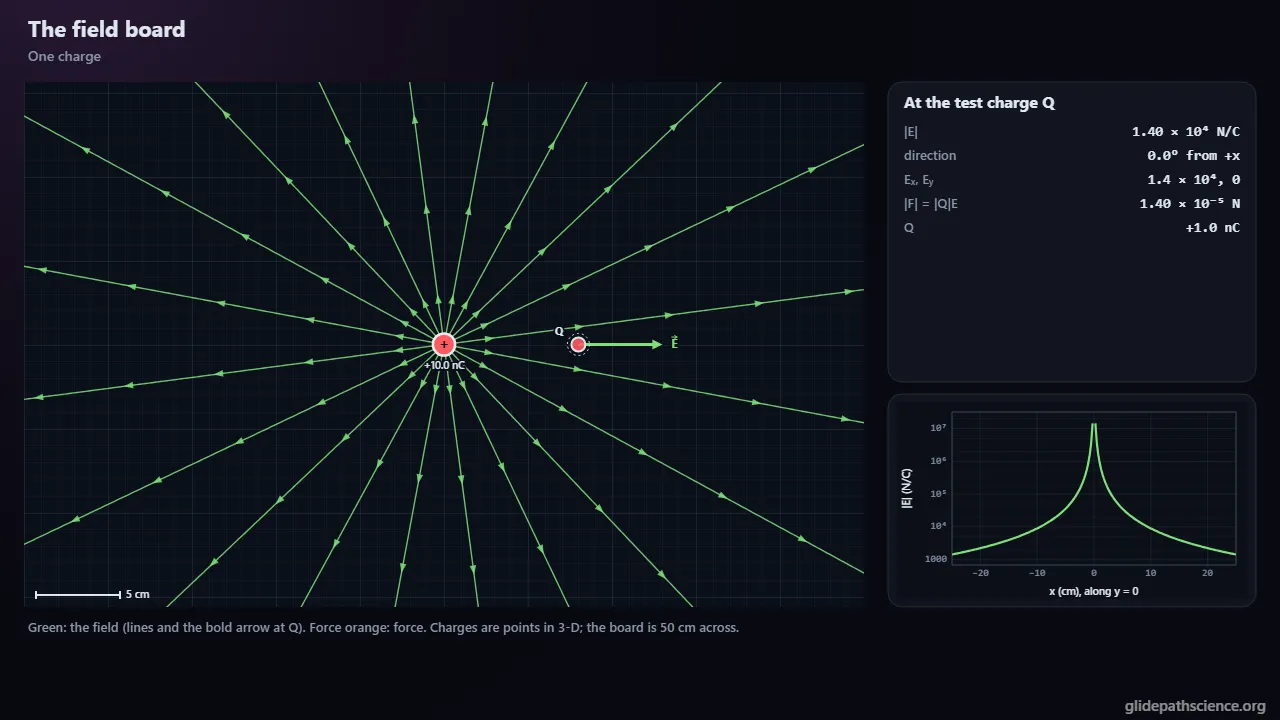
A lab for electric charge, Coulomb’s law, and the electric field, following OpenStax University Physics Volume 2, Chapter 5. On a Charging Bench students rub rods with cloths along a triboelectric ladder, share charge by contact, charge spheres by induction with a ground wire that counts the electrons, and read a Faraday pail, an electroscope, and a ball on a thread; conducting spheres are solved exactly by image charges. A classroom torsion balance with conducting spheres is nulled, recharged, and recorded, and the exponent is fitted with and without the spheres’ correction (about 1.88 uncorrected, 2.00 corrected), beside Coulomb’s own readings of 1785. A field board takes up to eight point charges and a test charge, with field lines, a vector grid to scale, component arrows, forces, null points, and a chart of the field along a line; it releases the test charge to show that field lines are not paths. An Advanced track covers the vector form, image charges, like charges that attract, the 1/d⁵ pull on neutral bodies, calibrating and fitting the balance, dipoles, a ring by superposition, when charges follow lines, Earnshaw’s theorem, and how well 1/r² is known.
What you'll learn
- Explain charging by friction, contact, and induction as the movement of electrons, with the total charge conserved and quantized.
- Apply Coulomb’s law, F = k|q₁q₂|/r², including the third law and the inverse-square dependence, and measure it on a torsion balance.
- Find the electric field as force per unit test charge and add the fields of several charges as vectors.
- Read and draw field lines, and explain why charges released in a field do not follow them.
What you can do
- Guided walkthroughStep-by-step, in Intro and Advanced tracks.
- SandboxEvery control of the model, to explore freely.
- Virtual labA realistic experiment with measurement noise and data analysis.
- Concept checksQuestions about ideas and vocabulary, with no calculating.
- PredictionCommit to a prediction, then see the result.
- Classroom demoProjector mode and recordable clips for slides.
- Works offlineA single downloadable file, verified to run without a network.
Before you start
- Vectors and their components
- Newton’s laws of motion
- For the Advanced track: calculus and the idea of potential energy
Run or download
Run it in your browser
Nothing to install and no account. Works on laptops, Chromebooks, tablets, and phones.
Launch Coulomb's Law & Electric FieldsDownload for offline use
One HTML file (1.0 MB) that opens in any modern browser with no network: for rooms with unreliable Wi-Fi, or to keep a copy.
Download the fileFile details and checksum
- File
coulombs-law-electric-fields-v1.2.html- Version
- 1.2, released November 15, 2026
- Build
27f89ae- Size
- 1,059,956 bytes
- SHA-256
b4c4474e18b1293416630712bdca02558bd69ab4506b92179aa5868af1073df2- Offline
- Checked to run with all network access blocked.
The model and its limits
What the model assumes
- Point charges in three dimensions in a two-dimensional view, softened inside 2 mm; field lines traced in the page plane and never re-routed.
- Conducting spheres solved by successive image charges; touching spheres by the closed form (Maxwell, Smythe).
- Rubbing moves charge toward an equilibrium set by an illustrative triboelectric ladder, capped by air’s breakdown; the cloth always takes the opposite charge.
- A lumped electroscope in a shielding case; a ball on a thread as a pendulum; an ideal Faraday pail with a small drift.
- A classroom torsion balance with the exact two-sphere force, a drifting zero, 0.15° reading jitter, and humidity-dependent leakage (illustrative constants).
- The test charge does not disturb the sources; it moves under QE and optional Stokes drag, integrated with energy held to 1 part in 10⁹.
What it leaves out
- Contact charging is not modeled at the atomic scale, and published triboelectric series disagree.
- No sparks or corona beyond the surface-charge cap; humidity acts only as a leakage time.
- Real shapes are simplified to spheres, lumped parts, and point charges; stands and air are not dielectrics here.
- No gravity in the Sandbox, no magnetic forces, no retardation, and no radiation.
- The torsion wire’s creep, air currents, and the Earth’s fair-weather field are left out.
Cite this simulation
APA 7
Meier, D. (2026). Coulomb's Law & Electric Fields (Version 1.2) [Computer simulation]. Glidepath Science. https://glidepathscience.org/simulations/coulombs-law-electric-fields/
MLA 9
Meier, David. Coulomb's Law & Electric Fields. Version 1.2, Glidepath Science, 2026, glidepathscience.org/simulations/coulombs-law-electric-fields/.
AIP
D. Meier, Coulomb's Law & Electric Fields, version 1.2 (Glidepath Science, 2026), https://glidepathscience.org/simulations/coulombs-law-electric-fields/.
BibTeX
@misc{meier2026coulombslawelectricfields,
  author       = {Meier, David},
  title        = {{Coulomb's Law & Electric Fields}},
  year         = {2026},
  publisher    = {Glidepath Science},
  version      = {1.2},
  note         = {Interactive simulation, version 1.2},
  howpublished = {\url{https://glidepathscience.org/simulations/coulombs-law-electric-fields/}},
  url          = {https://glidepathscience.org/simulations/coulombs-law-electric-fields/}
}
Credits and license
Created by Dr. David Meier, Glidepath Science.
Based on: OpenStax, University Physics Volume 2, by Samuel J. Ling, Jeff Sanny and William Moebs: Chapter 5, “Electric Charges and Fields,” an open textbook licensed CC BY-NC-SA 4.0 (openstax.org). The walkthrough follows its order of topics (charge; conductors, insulators, and induction; Coulomb’s law; the field; distributions; field lines; dipoles) and its notation: k = 1/4πε₀, r̂ from the source to the field point, and E = F/Q with Q the test charge. The wording, numbers, figures, and simulations are the sim’s own. No endorsement by OpenStax or the authors is implied.
Licensed under Creative Commons Attribution-NonCommercial-ShareAlike 4.0 International (CC BY-NC-SA 4.0). You may share and adapt it for noncommercial purposes, such as teaching, with credit and under the same license. Licensing and reuse
AI tools (Claude, from Anthropic, and ChatGPT, from OpenAI) were used in developing Glidepath Science and its simulations. Dr. David Meier reviewed, edited, and modified every release version.