
NewVersion 1.3
Angular Momentum & Gyroscopes
Spin a skater, flip a wheel on a turntable and release a gyroscope: angular momentum is conserved, a torque turns it into precession, and pilots fly by gyro instruments.
About this simulation
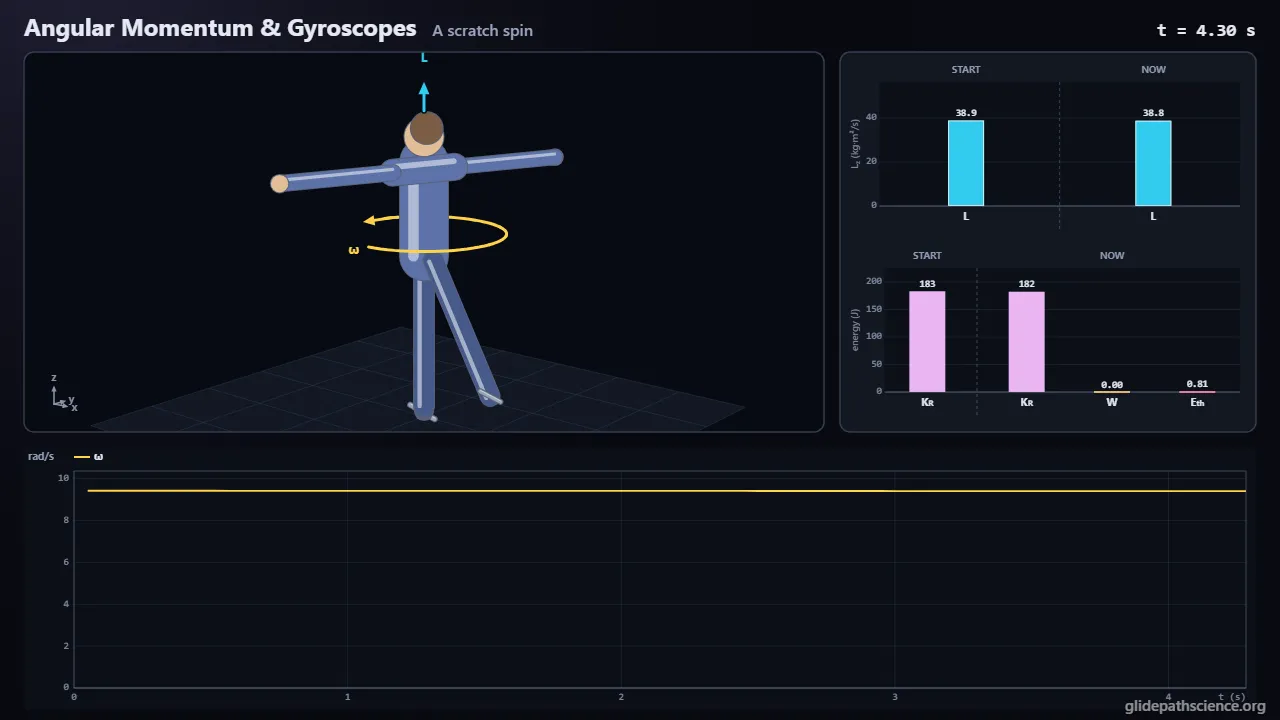
Angular momentum keeps its size and direction while nothing outside twists, and a torque turns it sideways. A guided walkthrough at two levels follows OpenStax University Physics Volume 1, §11.2–11.4: angular momentum as a vector, torque as its rate of change, conservation, and the precession of a gyroscope. The Advanced track adds rigid bodies whose angular momentum is not along their spin, nutation, free bodies and Euler’s equations, a satellite with a reaction wheel, the Earth’s precession and the gyroscopic part of an airplane’s left-turning tendency. The Sandbox spins a skater who pulls in her arms, a student on a stool flipping a wheel, a turntable that catches a ring, a door hit off center, a top and a gyroscope released at any spin. The Spin Bench is a classroom lab with honest instruments: drop a ring on a spinning disc and fit the encoder’s record, and time a gyroscope’s precession with a stopwatch or a photogate at several arm positions; each reading keeps the settings it was taken with. Flight Instruments flies a turn coordinator, an attitude indicator and a heading indicator that drifts. A Quick check, Which way?, What’s conserved?, prediction rounds with Practice and Assessed modes, Spin to target and Mystery rotor complete it, with a printable Guide. Runs entirely offline in one file.
What you'll learn
- Find angular momentum as l = r × p for a moving body and L = Iω for a body spinning about a symmetry axis, pointing along that axis by the right-hand rule.
- Use Στ = dL/dt, and explain why angular momentum keeps its size and direction when no outside torque acts.
- Explain why pulling the arms in keeps L but raises the kinetic energy L²/2I by the muscles’ work, and why a catch keeps L but turns kinetic energy into heat.
- Explain precession as a torque at right angles to L turning it without changing its size, at ω_P = rMg/(Iω) while the precession is slow.
What you can do
- Guided walkthroughStep-by-step, in Intro and Advanced tracks.
- SandboxEvery control of the model, to explore freely.
- Virtual labA realistic experiment with measurement noise and data analysis.
- Concept checksQuestions about ideas and vocabulary, with no calculating.
- PredictionCommit to a prediction, then see the result.
- Classroom demoProjector mode and recordable clips for slides.
- Works offlineA single downloadable file, verified to run without a network.
Before you start
- Newton’s laws and torque
- Rotational kinematics and moment of inertia
- Vectors and the cross product
- For the Advanced track: calculus and vector derivatives
Run or download
Run it in your browser
Nothing to install and no account. Works on laptops, Chromebooks, tablets, and phones.
Launch Angular Momentum & GyroscopesDownload for offline use
One HTML file (1.1 MB) that opens in any modern browser with no network: for rooms with unreliable Wi-Fi, or to keep a copy.
Download the fileFile details and checksum
- File
angular-momentum-gyroscopes-v1.3.html- Version
- 1.3, released November 15, 2026
- Build
81015d9- Size
- 1,198,319 bytes
- SHA-256
d6feb14b6d7e791edaa5ecf700d87dcc98748b4fdf3f8253c9b210c5435aa5c6- Offline
- Checked to run with all network access blocked.
The model and its limits
What the model assumes
- Bodies on one axis are integrated so that with no outside torque their total angular momentum is kept exactly, and ω = L/I.
- The gyroscope and the top are a heavy symmetric top on a fixed pivot under gravity, integrated in exact pieces; free bodies are the same top with no pivot (Euler’s equations).
- A hit on a hinged door is solved as a rigid impact with the hinge as a pivot, sticking or with a coefficient of restitution.
- The flight instruments, the Spin Bench’s disc, ring and bearing friction, and the gyroscope’s arm are illustrative values, stated in the Field Manual.
What it leaves out
- The skater’s real body (segments of illustrative mass and size), the skate’s blade and air drag, and real bearings whose friction grows with load and speed.
- The gyroscope’s flexing, its rotor’s imbalance and air drag; a top’s tip that rolls and slides (its rising to upright is told in the Guide, not modeled).
- Energy loss in a free body, and the Earth’s rotation everywhere except Flight Instruments.
- Real instruments’ erection mechanisms, latitude nuts and acceleration errors; propeller torque, P-factor and slipstream (only the gyroscopic part of the left-turning tendency is shown).
- The Earth’s 18.6-year nutation, the planets’ pull and the Chandler wobble.
Cite this simulation
APA 7
Meier, D. (2026). Angular Momentum & Gyroscopes (Version 1.3) [Computer simulation]. Glidepath Science. https://glidepathscience.org/simulations/angular-momentum-gyroscopes/
MLA 9
Meier, David. Angular Momentum & Gyroscopes. Version 1.3, Glidepath Science, 2026, glidepathscience.org/simulations/angular-momentum-gyroscopes/.
AIP
D. Meier, Angular Momentum & Gyroscopes, version 1.3 (Glidepath Science, 2026), https://glidepathscience.org/simulations/angular-momentum-gyroscopes/.
BibTeX
@misc{meier2026angularmomentumgyroscopes,
  author       = {Meier, David},
  title        = {{Angular Momentum & Gyroscopes}},
  year         = {2026},
  publisher    = {Glidepath Science},
  version      = {1.3},
  note         = {Interactive simulation, version 1.3},
  howpublished = {\url{https://glidepathscience.org/simulations/angular-momentum-gyroscopes/}},
  url          = {https://glidepathscience.org/simulations/angular-momentum-gyroscopes/}
}
Credits and license
Created by Dr. David Meier, Glidepath Science.
Licensed under Creative Commons Attribution-NonCommercial-ShareAlike 4.0 International (CC BY-NC-SA 4.0). You may share and adapt it for noncommercial purposes, such as teaching, with credit and under the same license. Licensing and reuse
AI tools (Claude, from Anthropic, and ChatGPT, from OpenAI) were used in developing Glidepath Science and its simulations. Dr. David Meier reviewed, edited, and modified every release version.