
NewVersion 1.0
Physical Pendulums & Torsion
Swing rods, disks and hoops from different pivots to find where each swings fastest, tune a reversible pendulum to measure g, and weigh rotational inertia by twisting a wire.
About this simulation
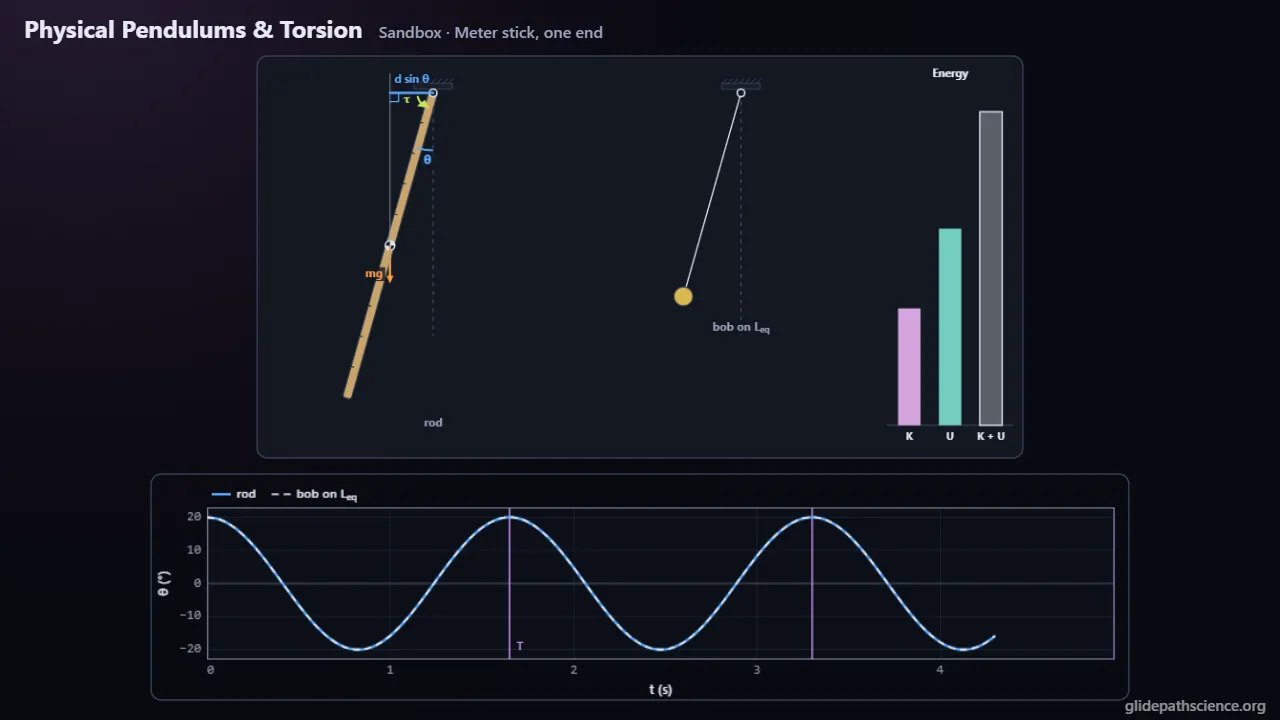
A rigid body swinging on a pivot is a pendulum whose length is hidden in its shape. Students swing a rod, a disk, a hoop or a clock rod with a sliding weight, or twist a disk on a wire, move the pivot and the release angle, and race each body against its equivalent simple pendulum. A guided walkthrough at two levels runs from a stick against a bob through gravity’s torque, inertia about the pivot, moving the pivot, the equivalent length and a torsion pendulum; the Advanced track adds the radius of gyration, conjugate pivots, Bessel’s formula, wide swings, weighing an inertia and the sweet spot. A Pivot Scan times ten swings with a photogate at each pivot and plots the period against the pivot; Kater’s Pendulum tunes a reversible pendulum to measure g on Earth, the Moon, Mars and a mystery planet; a Torsion Balance calibrates a wire with a ring of known inertia and weighs three mystery objects by their periods. A concept challenge and a prediction lab with fresh numbers on every run round it out.
What you'll learn
- Find a swinging body’s period, T = 2π√(I/mgd), with I about the pivot from the parallel-axis theorem, I = I_cm + md², and explain why the mass cancels but the shape does not.
- Explain how the pivot sets the period: moving it toward the center of mass first shortens the period, then lengthens it without bound, with the shortest period where d equals the radius of gyration and two pivots sharing every period.
- Find the length L_eq = I/md of the simple pendulum that keeps time with a physical pendulum, and use Kater’s reversible pendulum to measure g from one length and one period.
- Explain why a torsion pendulum’s period, T = 2π√(I/κ), depends on neither the twist nor g, and use it to weigh a rotational inertia.
What you can do
- Guided walkthroughStep-by-step, in Intro and Advanced tracks.
- SandboxEvery control of the model, to explore freely.
- Virtual labA realistic experiment with measurement noise and data analysis.
- Concept checksQuestions about ideas and vocabulary, with no calculating.
- PredictionCommit to a prediction, then see the result.
- Classroom demoProjector mode and recordable clips for slides.
- Works offlineA single downloadable file, verified to run without a network.
Before you start
- Torque, rotational inertia and the simple pendulum
- Algebra, square roots and the sine of an angle
- For the Advanced track: derivatives to find a minimum, the equation of motion as a differential equation, and energy conservation
Run or download
Run it in your browser
Nothing to install and no account. Works on laptops, Chromebooks, tablets, and phones.
Launch Physical Pendulums & TorsionDownload for offline use
One HTML file (709 kB) that opens in any modern browser with no network: for rooms with unreliable Wi-Fi, or to keep a copy.
Download the fileFile details and checksum
- File
physical-pendulums-torsion-v1.0.html- Version
- 1.0, released November 15, 2026
- Build
818919d- Size
- 726,423 bytes
- SHA-256
507ee541535e6338ca7a21485c68420dd9ab5f4b8e0389e04dd48a13bcbb1668- Offline
- Checked to run with all network access blocked.
The model and its limits
What the model assumes
- A rigid body turns about a fixed horizontal axis, or a rigid disk about a vertical wire; the equation of motion, with gravity’s or the wire’s torque and optional friction, is integrated by fourth-order Runge–Kutta, keeping the energy to better than one part in a million.
- The exact undamped period comes from the arithmetic–geometric mean, and the fastest pivot from a golden-section search rather than from the formula d = k.
- Optional light pivot friction is a viscous torque set so that Q = 40.
- The photogate adds Gaussian jitter of 0.5 ms, an illustrative value, to each start and stop; lab bodies are released from 5° or 3°, so their periods are slightly longer than the small-swing value.
- Typical values: a 0.150 kg meter stick, a shear modulus of 79 GPa for steel, and g = 9.81 m/s² on Earth, 1.62 on the Moon and 3.71 on Mars; the Kater bar, the wire, the ring and the mystery objects are illustrative.
What it leaves out
- Pivots and knife edges are ideal: they never roll or slip, with no friction beyond the one viscous option; damping and driving are taught in Simple Harmonic Motion & Pendulums.
- Bodies never bend, pivots never move, and air drag, buoyancy and any change of g along the body are left out.
- A wire has no inertia of its own, no slow creep or internal friction, no elastic limit and no stretch under the disk’s weight.
- Only random photogate jitter is modeled, not a real gate’s systematic errors; releases are limited to 175°, so nothing swings over the top.
Cite this simulation
APA 7
Meier, D. (2026). Physical Pendulums & Torsion (Version 1.0) [Computer simulation]. Glidepath Science. https://glidepathscience.org/simulations/physical-pendulums-torsion/
MLA 9
Meier, David. Physical Pendulums & Torsion. Version 1.0, Glidepath Science, 2026, glidepathscience.org/simulations/physical-pendulums-torsion/.
AIP
D. Meier, Physical Pendulums & Torsion, version 1.0 (Glidepath Science, 2026), https://glidepathscience.org/simulations/physical-pendulums-torsion/.
BibTeX
@misc{meier2026physicalpendulumstorsion,
  author       = {Meier, David},
  title        = {{Physical Pendulums & Torsion}},
  year         = {2026},
  publisher    = {Glidepath Science},
  version      = {1.0},
  note         = {Interactive simulation, version 1.0},
  howpublished = {\url{https://glidepathscience.org/simulations/physical-pendulums-torsion/}},
  url          = {https://glidepathscience.org/simulations/physical-pendulums-torsion/}
}
Credits and license
Created by Dr. David Meier, Glidepath Science.
Licensed under Creative Commons Attribution-NonCommercial-ShareAlike 4.0 International (CC BY-NC-SA 4.0). You may share and adapt it for noncommercial purposes, such as teaching, with credit and under the same license. Licensing and reuse
AI tools (Claude, from Anthropic, and ChatGPT, from OpenAI) were used in developing Glidepath Science and its simulations. Dr. David Meier reviewed, edited, and modified every release version.