
NewVersion 1.0
Coriolis & Global Winds
Watch a puck from the room and from a spinning turntable, then let air feel a pressure gradient and the Coriolis effect until it blows along the isobars, and see why storms spin.
About this simulation
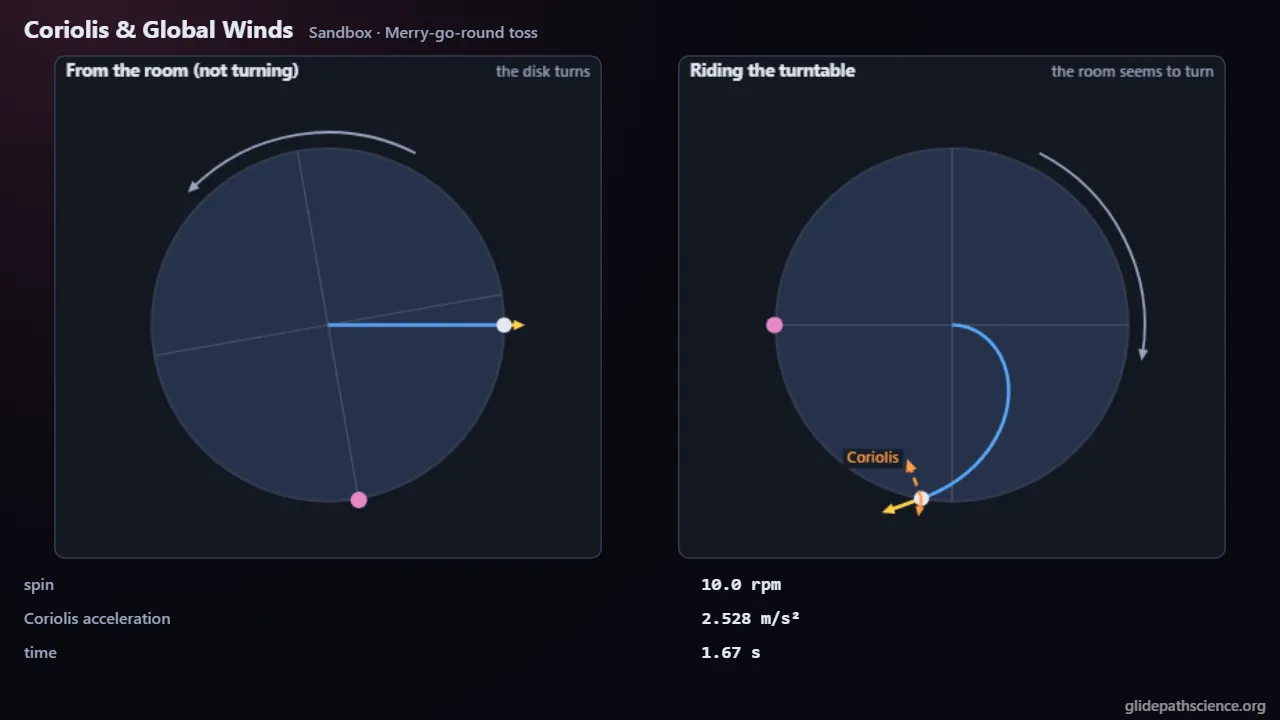
Why does moving air curve on a turning Earth? Students launch a puck across a turntable and watch it from the room and from the rider’s seat, then move to Earth at one latitude, release air between isobars, add friction, and watch it circle, swing into geostrophic balance or spiral toward the low, with the forces drawn. A guided walkthrough at two levels runs from the two frames through right in the north and left in the south, f = 2Ω sin φ, the pressure-gradient force, geostrophic wind, Buys Ballot’s law, friction, storm spin, the trade winds and the bathtub-drain myth; the Advanced track adds inertial circles, the Rossby number, gradient and cyclostrophic balance, thermal wind, the Hadley cell’s edge and vorticity. A Geostrophic Map lets students drag a high and a low and probe the winds in either hemisphere; Storm Spin shows when Coriolis sets a vortex’s spin and when it does not; Global Circulation draws the three-cell picture. A concept challenge and a prediction lab with fresh numbers on every run round it out.
What you'll learn
- Explain that a puck moving straight in the room curves for a rider on a turntable: the Coriolis effect belongs to the turning frame, bending motion to the right in the Northern Hemisphere and to the left in the Southern.
- Use the Coriolis parameter f = 2Ω sin φ, zero at the equator and largest at the poles, to estimate the Coriolis acceleration fU: small, but acting for hours.
- Explain geostrophic balance: Coriolis balances the push from high to low pressure, so winds blow along the isobars with the low on the left in the north, and friction turns them toward the low, so storms spin.
- Describe how the Hadley, Ferrel and polar cells, turned by Coriolis, give the trade winds and the westerlies, and in Advanced use inertial circles, the Rossby number, and gradient and thermal winds.
What you can do
- Guided walkthroughStep-by-step, in Intro and Advanced tracks.
- SandboxEvery control of the model, to explore freely.
- Concept checksQuestions about ideas and vocabulary, with no calculating.
- PredictionCommit to a prediction, then see the result.
- Classroom demoProjector mode and recordable clips for slides.
- Works offlineA single downloadable file, verified to run without a network.
Before you start
- Velocity, acceleration and Newton’s second law
- Pressure, and the sine of an angle
- For the Advanced track: vectors and the cross product, derivatives, and a pair of first-order differential equations
Run or download
Run it in your browser
Nothing to install and no account. Works on laptops, Chromebooks, tablets, and phones.
Launch Coriolis & Global WindsDownload for offline use
One HTML file (715 kB) that opens in any modern browser with no network: for rooms with unreliable Wi-Fi, or to keep a copy.
Download the fileFile details and checksum
- File
coriolis-global-winds-v1.0.html- Version
- 1.0, released November 15, 2026
- Build
f73c9ea- Size
- 731,857 bytes
- SHA-256
f4fd5c93fae84664fa2851130cf15a964a3814809f1cd599c4afaff31f526b6d- Offline
- Checked to run with all network access blocked.
The model and its limits
What the model assumes
- An air parcel on an f-plane feels the Coriolis effect, a pressure-gradient acceleration and a linear drag, solved exactly in closed form and checked by an RK4 integration.
- The turntable is a flat, frictionless 1 m disk, on which the puck moves in a straight line in the room, or a dish whose slope supplies the centripetal force; the rider’s view is the room’s path turned back with the disk.
- Storm Spin draws parcels into an idealized round low, integrated by RK4 with Coriolis and linear drag; the leftover swirl at small scales is illustrative.
- The Geostrophic Map has two round pressure centers, 20 hPa deep and 450 km across; each arrow is the steady wind for the local gradient, geostrophic aloft or with drag near the ground, and none is drawn within 5° of the equator.
- Earth turns once per sidereal day (Ω = 7.292115 × 10⁻⁵ rad/s), with air of 1.225 kg/m³ for every surface-pressure calculation; everyday speeds and sizes are typical values.
What it leaves out
- f is constant in each scene, so the β effect, Rossby waves and the stronger currents on the western sides of ocean basins are left out.
- No vertical motion, 2Ω cos φ terms, density changes, moisture, clouds or stability; friction is one linear drag, not a turbulent boundary layer with an Ekman spiral.
- Real weather’s fronts, terrain, land and sea, seasons and eddies are left out; the three-cell picture is a schematic yearly average, and the estimate of the Hadley cell’s edge assumes an atmosphere with no eddies.
- Tornadoes and drains get their spin from the storm above them or from how the water was set moving, not from Earth’s rotation; the sim’s leftover swirl stands in for that.
Cite this simulation
APA 7
Meier, D. (2026). Coriolis & Global Winds (Version 1.0) [Computer simulation]. Glidepath Science. https://glidepathscience.org/simulations/coriolis-global-winds/
MLA 9
Meier, David. Coriolis & Global Winds. Version 1.0, Glidepath Science, 2026, glidepathscience.org/simulations/coriolis-global-winds/.
AIP
D. Meier, Coriolis & Global Winds, version 1.0 (Glidepath Science, 2026), https://glidepathscience.org/simulations/coriolis-global-winds/.
BibTeX
@misc{meier2026coriolisglobalwinds,
  author       = {Meier, David},
  title        = {{Coriolis & Global Winds}},
  year         = {2026},
  publisher    = {Glidepath Science},
  version      = {1.0},
  note         = {Interactive simulation, version 1.0},
  howpublished = {\url{https://glidepathscience.org/simulations/coriolis-global-winds/}},
  url          = {https://glidepathscience.org/simulations/coriolis-global-winds/}
}
Credits and license
Created by Dr. David Meier, Glidepath Science.
Licensed under Creative Commons Attribution-NonCommercial-ShareAlike 4.0 International (CC BY-NC-SA 4.0). You may share and adapt it for noncommercial purposes, such as teaching, with credit and under the same license. Licensing and reuse
AI tools (Claude, from Anthropic, and ChatGPT, from OpenAI) were used in developing Glidepath Science and its simulations. Dr. David Meier reviewed, edited, and modified every release version.