
NewVersion 1.1
Pressure & Buoyancy
Dive into a tank with a pressure probe, lift a car with a hydraulic press, weigh a crown in water, load a barge to its marks and fly a hot-air balloon: pressure with depth, Pascal’s principle, buoyancy and stability.
About this simulation
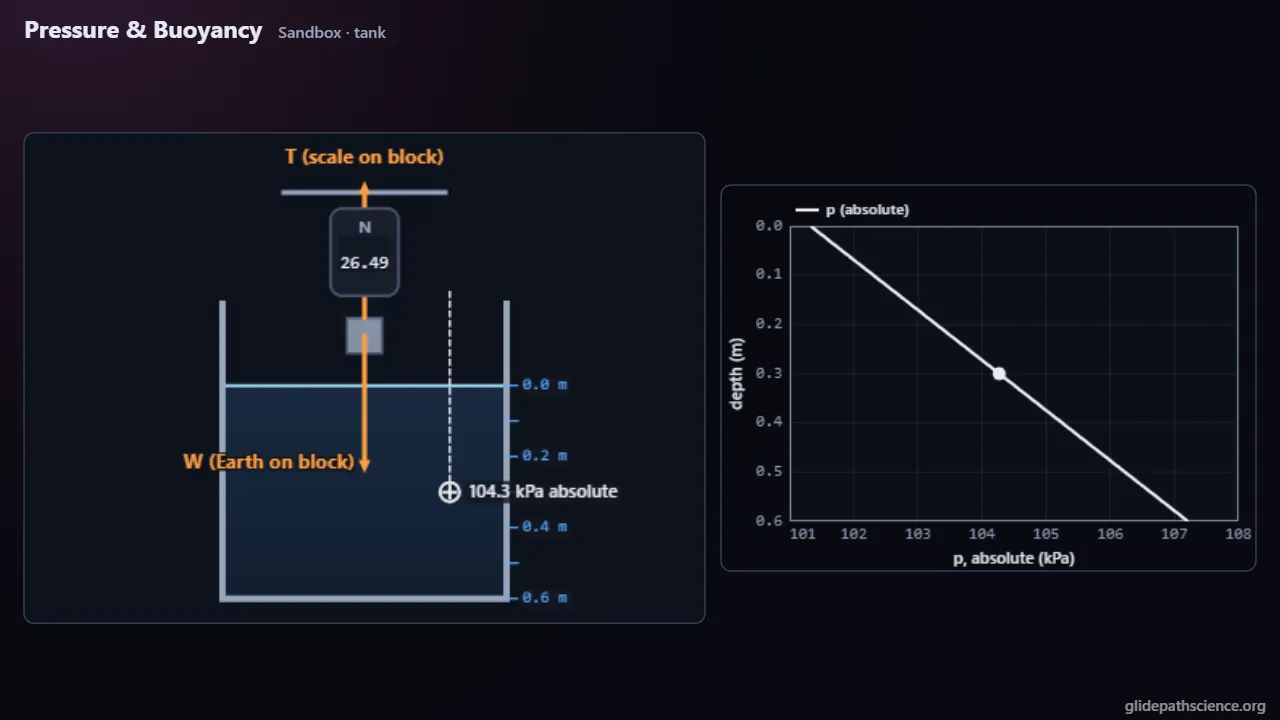
Every tank, press, hull and balloon in this lab runs on one engine, the library’s fluids module: layered liquids integrated exactly, buoyancy as the pressure integral over each body’s wetted surface (equal to Archimedes’ ρV_sub g to one part in 10¹⁰), released bodies that settle with added mass and drag, and the standard atmosphere. A guided walkthrough at two levels follows OpenStax University Physics Volume 1, chapter 14, §14.1–14.4: density, pressure as force per area, pressure with depth, why a container’s shape does not matter, gauges and the barometer, Pascal’s principle and the hydraulic lift, where buoyancy comes from, Archimedes’ principle, float or sink, the iceberg and the hot-air balloon. The Advanced track adds the hydrostatic equation, compressible water and air, the push on a dam, heights in a press, weighing in air, balloons that expand and float, the Cartesian diver, the metacenter, bobbing and added mass. The Sandbox has a tank of any liquid, layered or not, with a pressure probe to drag anywhere and objects of any material hung from a spring scale, held under or let go; a hydraulic press with a car on it; and a U-tube, a barometer, a well pump and three vessels. The Buoyancy Bench is a classroom Archimedes lab with honest instruments, a force sensor, a lab jack, a beaker on a balance and an overflow can: lower a cylinder into a liquid, fit the readings for its density (each reading keeps the calibration it was taken under), catch the water it pushes out and weigh a crown to see if it is gold. The Shipyard loads barges, round, V and twin hulls, a log and a square timber, heels them and reads their GZ curves: where a hull rights itself, where it lists and where it capsizes. The Balloon Lab flies a hot-air balloon on its burner, a weather balloon that swells until it bursts and a sealed balloon that finds its ceiling, on a standard, hot or cold day. A Quick check, Rise, fall or stay?, Rank the pressures, prediction rounds with fresh numbers, Is it gold? and Load the barge complete it, with a printable Guide. Runs entirely offline in one file.
What you'll learn
- Use p = p₀ + ρgh to find the pressure at any depth in one or more layers of liquid, whatever the container’s shape, and tell gauge pressure from absolute pressure.
- Apply Pascal’s principle to an enclosed fluid, and explain how a hydraulic lift multiplies force by the ratio of its areas while dividing the distance moved by the same ratio.
- Explain buoyancy as the difference between the pressures on a body’s lower and upper faces, and use Archimedes’ principle, F_B = ρ_fl V_sub g, to measure density and to weigh a crown.
- Decide whether a body floats, sinks or hovers from its average density, find how deep a floating body sits, and judge a hull’s stability from its metacenter and GZ curve.
What you can do
- Guided walkthroughStep-by-step, in Intro and Advanced tracks.
- SandboxEvery control of the model, to explore freely.
- Virtual labA realistic experiment with measurement noise and data analysis.
- Concept checksQuestions about ideas and vocabulary, with no calculating.
- PredictionCommit to a prediction, then see the result.
- Classroom demoProjector mode and recordable clips for slides.
- Works offlineA single downloadable file, verified to run without a network.
Before you start
- Newton’s laws and free-body diagrams
- Weight, mass and density
- Area and volume of simple shapes
- For the Advanced track: integrals and exponential functions
Run or download
Run it in your browser
Nothing to install and no account. Works on laptops, Chromebooks, tablets, and phones.
Launch Pressure & BuoyancyDownload for offline use
One HTML file (1003 kB) that opens in any modern browser with no network: for rooms with unreliable Wi-Fi, or to keep a copy.
Download the fileFile details and checksum
- File
pressure-buoyancy-v1.1.html- Version
- 1.1, released November 15, 2026
- Build
91466ac- Size
- 1,027,497 bytes
- SHA-256
e366f314ff28240c93912940b12cb1eac890c716ba8fbf4b681aa6093f512526- Offline
- Checked to run with all network access blocked.
The model and its limits
What the model assumes
- Liquids are incompressible layers with flat interfaces, each integrated exactly; a constant bulk modulus for the deep sea; SI units, y up, the free surface at y = 0.
- Buoyancy is the pressure integral over the wetted surface, exact for polygon and prism cross-sections and in closed form for spheres and upright cylinders.
- A finite tank’s level rises by the volume an object submerges; a lake has no walls.
- Released bodies obey (m + m_a)ÿ = F_B − mg − D, with stated added masses, drag coefficients and a damping ratio for floating bodies.
- The atmosphere is the U.S. Standard Atmosphere 1976 to 47 km, with a hot or cold day; illustrative bench, hull, burner and balloon values, stated in the Field Manual.
What it leaves out
- No surface tension: no floating needles, capillary rise or meniscus.
- No waves or sloshing, apart from a slack tank’s free-surface correction and the stated damping of bobbing and rolling.
- No flowing fluids: viscosity in pipes and Bernoulli’s equation are left out.
- Ships are cross-sections: no length, trim or waves of their own, and no accelerating or turning tanks.
- One density per liquid, with no temperature dependence, humidity or vapor pressure in the barometer.
Cite this simulation
APA 7
Meier, D. (2026). Pressure & Buoyancy (Version 1.1) [Computer simulation]. Glidepath Science. https://glidepathscience.org/simulations/pressure-buoyancy/
MLA 9
Meier, David. Pressure & Buoyancy. Version 1.1, Glidepath Science, 2026, glidepathscience.org/simulations/pressure-buoyancy/.
AIP
D. Meier, Pressure & Buoyancy, version 1.1 (Glidepath Science, 2026), https://glidepathscience.org/simulations/pressure-buoyancy/.
BibTeX
@misc{meier2026pressurebuoyancy,
  author       = {Meier, David},
  title        = {{Pressure & Buoyancy}},
  year         = {2026},
  publisher    = {Glidepath Science},
  version      = {1.1},
  note         = {Interactive simulation, version 1.1},
  howpublished = {\url{https://glidepathscience.org/simulations/pressure-buoyancy/}},
  url          = {https://glidepathscience.org/simulations/pressure-buoyancy/}
}
Credits and license
Created by Dr. David Meier, Glidepath Science.
Licensed under Creative Commons Attribution-NonCommercial-ShareAlike 4.0 International (CC BY-NC-SA 4.0). You may share and adapt it for noncommercial purposes, such as teaching, with credit and under the same license. Licensing and reuse
AI tools (Claude, from Anthropic, and ChatGPT, from OpenAI) were used in developing Glidepath Science and its simulations. Dr. David Meier reviewed, edited, and modified every release version.