NewVersion 1.2
Electromagnetic Waves & the Spectrum
Jerk a charge and watch the kink in its field race outward, launch waves from an antenna, tune from radio to gamma rays, find where photons ionize, and fly a light sail.
About this simulation
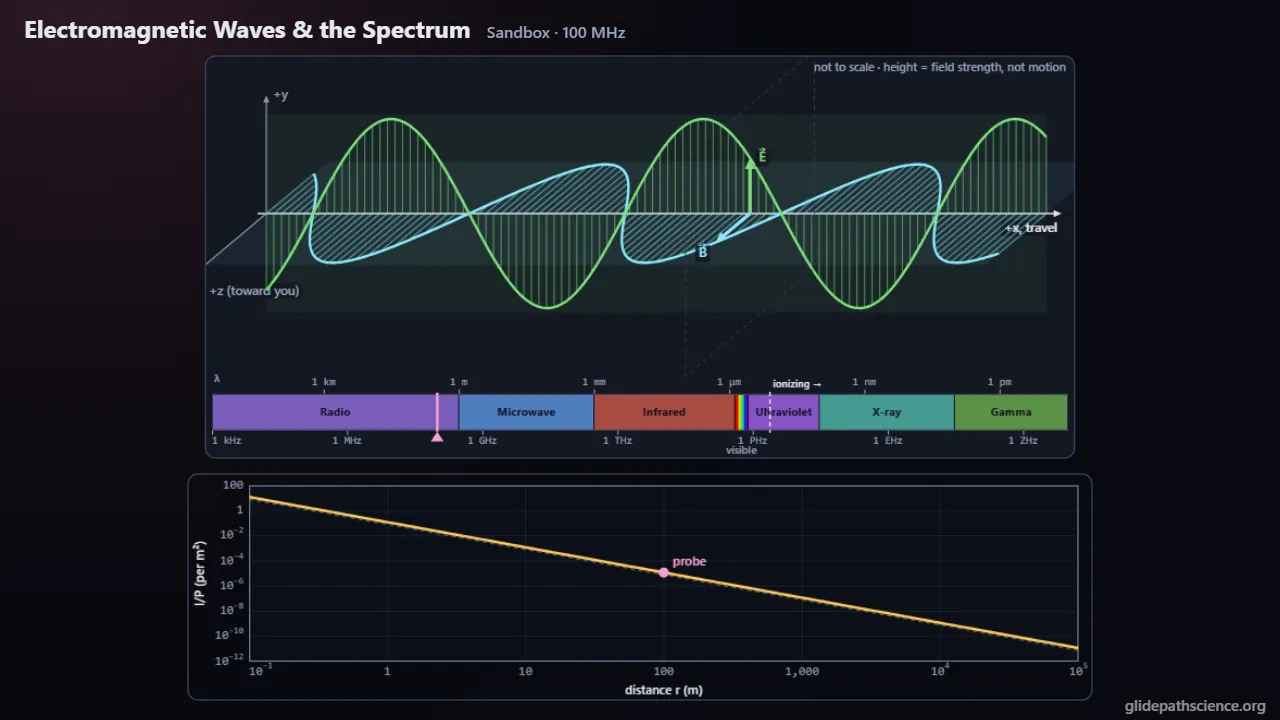
How does light carry energy and momentum across empty space? Students set a dipole antenna or a lamp at any frequency from 1 kHz to 10²² Hz and any power, place a probe at any distance and angle, and read the wave there: its E and B fields, wavelength, photon energy, band and intensity. A guided walkthrough at two levels runs from a jerked charge’s kink through the antenna, E and B in step, the speed of light from ε₀ and μ₀, c = fλ and the spectrum to photon energy, ionizing radiation and the inverse-square law; the Advanced track adds Maxwell’s equations, the wave equation, the Poynting vector, radiation pressure, near and far fields and photons in a beam. An Antenna Lab maps a dipole’s field and its sin²θ pattern from the near field to the far field; a Spectrum Tour stops at fifteen sources from AM radio to a cobalt-60 gamma ray; and a Light Sail finds the mass per area at which sunlight’s push balances the Sun’s pull. A concept challenge and a prediction lab with fresh numbers round it out.
What you'll learn
- Explain how an accelerating charge sends a kink through its field at c, and how an antenna’s oscillating current radiates waves at its own frequency, strongest broadside and none along its axis.
- Describe a light wave’s E and B as perpendicular to each other and to the direction of travel and in step, with E = cB and c = 1/√(ε₀μ₀).
- Use c = fλ and E = hf across the spectrum from radio to gamma rays, and explain why only photons above about 10 eV ionize, whatever the power.
- Show that intensity falls as 1/r² from a small source, relate it to the field by I = ½cε₀E₀², and explain how light pushes with I/c, twice that on a mirror, enough to fly a sail.
What you can do
- Guided walkthroughStep-by-step, in Intro and Advanced tracks.
- SandboxEvery control of the model, to explore freely.
- Virtual labA realistic experiment with measurement noise and data analysis.
- Concept checksQuestions about ideas and vocabulary, with no calculating.
- PredictionCommit to a prediction, then see the result.
- Classroom demoProjector mode and recordable clips for slides.
- Works offlineA single downloadable file, verified to run without a network.
Before you start
- Waves: frequency, wavelength and v = fλ
- Electric and magnetic fields, and the energy of a photon
- For the Advanced track: Maxwell’s equations in integral form, vector calculus, and partial derivatives
Run or download
Run it in your browser
Nothing to install and no account. Works on laptops, Chromebooks, tablets, and phones.
Launch Electromagnetic Waves & the SpectrumDownload for offline use
One HTML file (697 kB) that opens in any modern browser with no network: for rooms with unreliable Wi-Fi, or to keep a copy.
Download the fileFile details and checksum
- File
em-waves-spectrum-v1.2.html- Version
- 1.2, released November 15, 2026
- Build
e25c0bf- Size
- 713,504 bytes
- SHA-256
c9b10a2ffe9a7bd6656422c1f912493178ed9b7fb68075e102d97cc521d10b27- Offline
- Checked to run with all network access blocked.
The model and its limits
What the model assumes
- Constants are the exact SI 2019 values with μ₀ from CODATA 2022, so ε₀ = 1/(μ₀c²) and the impedance of free space is 376.730 Ω.
- The lamp radiates equally in every direction; the dipole is a short (Hertzian) dipole in free space whose far-field intensity goes as sin²θ, and the Antenna Lab draws all three terms of its field.
- The Sandbox draws a plane wave at the probe, which is right only in the far field, and says so within a few wavelengths of the source; the average power flow it reads is exact at every distance.
- Media are lossless, non-magnetic and free of dispersion, with the same index at every frequency.
- Bands follow one convention (radio above 1 m, visible light 380–750 nm, gamma rays below 10 pm), and the ionizing threshold of 10 eV is a convention.
What it leaves out
- Polarization beyond the direction of E, reflection and refraction, thermal spectra and the photoelectric effect are left to their own sims.
- No absorption or scattering in the atmosphere, and no real material’s frequency-dependent index.
- Real antennas, with their length, ground planes, arrays and matching, are not modeled.
- Biological effects go no further than one line per band: exposure limits and doses are not modeled.
- The kink sketch assumes a slowly moving charge, with no relativistic effects.
Cite this simulation
APA 7
Meier, D. (2026). Electromagnetic Waves & the Spectrum (Version 1.2) [Computer simulation]. Glidepath Science. https://glidepathscience.org/simulations/em-waves-spectrum/
MLA 9
Meier, David. Electromagnetic Waves & the Spectrum. Version 1.2, Glidepath Science, 2026, glidepathscience.org/simulations/em-waves-spectrum/.
AIP
D. Meier, Electromagnetic Waves & the Spectrum, version 1.2 (Glidepath Science, 2026), https://glidepathscience.org/simulations/em-waves-spectrum/.
BibTeX
@misc{meier2026electromagneticwavesthespectrum,
  author       = {Meier, David},
  title        = {{Electromagnetic Waves & the Spectrum}},
  year         = {2026},
  publisher    = {Glidepath Science},
  version      = {1.2},
  note         = {Interactive simulation, version 1.2},
  howpublished = {\url{https://glidepathscience.org/simulations/em-waves-spectrum/}},
  url          = {https://glidepathscience.org/simulations/em-waves-spectrum/}
}
Credits and license
Created by Dr. David Meier, Glidepath Science.
Based on: OpenStax, University Physics Volume 2, by Samuel J. Ling, Jeff Sanny and William Moebs: Chapter 16, “Electromagnetic Waves,” §16.1–16.5, an open textbook licensed CC BY-NC-SA 4.0 (openstax.org). The Intro track follows its order of topics; the wording, numbers, figures and simulations are the sim’s own. No endorsement by OpenStax or the authors is implied.
Licensed under Creative Commons Attribution-NonCommercial-ShareAlike 4.0 International (CC BY-NC-SA 4.0). You may share and adapt it for noncommercial purposes, such as teaching, with credit and under the same license. Licensing and reuse
AI tools (Claude, from Anthropic, and ChatGPT, from OpenAI) were used in developing Glidepath Science and its simulations. Dr. David Meier reviewed, edited, and modified every release version.