
NewVersion 1.3
Rotational Dynamics & Rolling
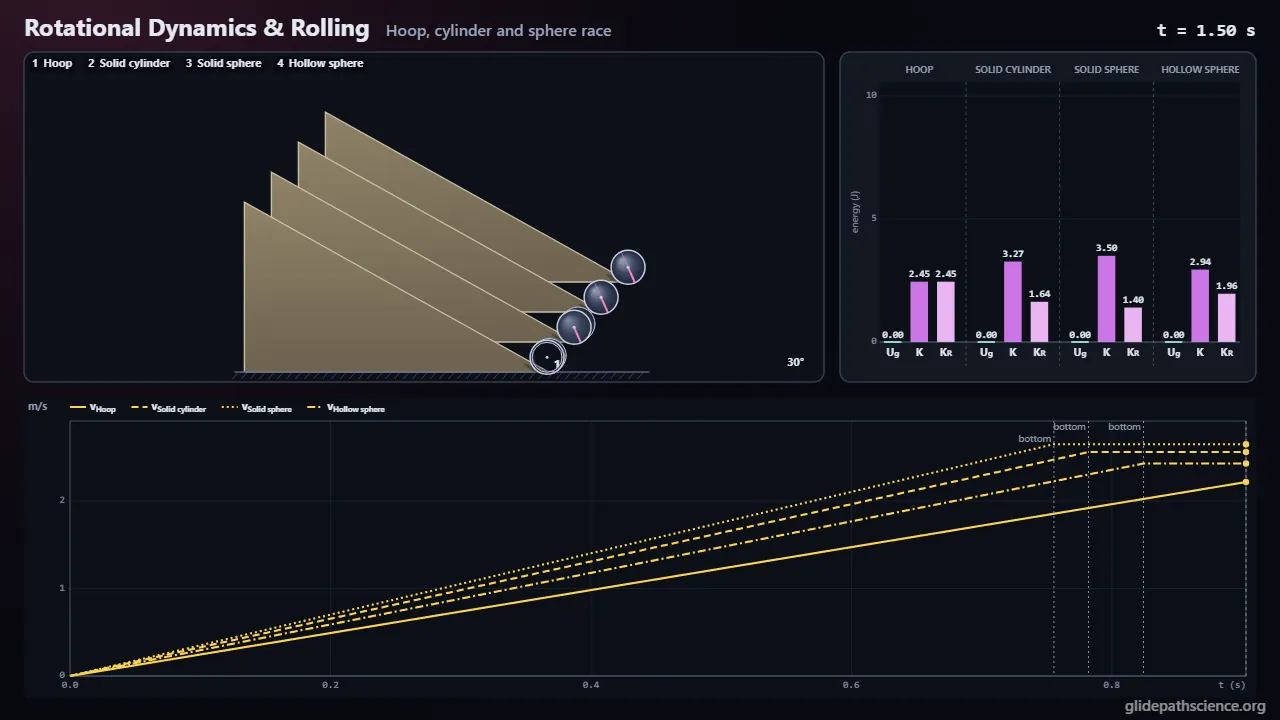
Spin hoops, disks and spheres: torque and angular acceleration, moment of inertia by shape, a heavy pulley, rolling races where the hoop always loses, skids, backspin, a lab bench that measures I and a race track.
About this simulation
Every turning body in this lab runs on one exact, event-driven engine, the library’s rotation module: wheels on fixed axles with pushes, strings, hanging masses, motors and bearing friction; an Atwood machine whose pulley turns; and round bodies rolling, slipping and skidding on ramps and floors, with every grip, slip and landing found exactly and the energy books kept to rounding. A guided walkthrough at two levels follows OpenStax University Physics Volume 1, §10.1–10.8 and §11.1: angles in radians and the rotational kinematic equations, one ω for every point of a body, the two accelerations at a rim, moment of inertia and why the axis matters, τ = Iα, a pulley with mass whose two tensions differ, work and energy in spin, the bottom of a rolling tire at rest, the energy split between moving and spinning, the race and the speed at the bottom. The Advanced track adds ω, α and τ as vectors, the parallel-axis theorem and thick rings, measuring I from a falling mass, torques about the contact point and the spool paradox, the grip limit and slipping, a bowling ball’s skid that always costs 2/7 of its energy, backspin that brings a hoop back, flywheels and constant-power motors, and where rigid rolling ends. The Sandbox has a spin table, a ramp and floor with topspin, backspin, the spool’s pull and an axle drive, and a pulley, with live energy bars, rim velocities, the spoke’s cycloid and charts. The Inertia Lab measures a turntable’s moment of inertia with a rotary sensor or a stopwatch and a torque–α line whose intercept is the bearing’s friction; the Race Track runs up to four lanes, sealed mystery cans included, with photogates, a level run-out and a vertical loop. A Quick check, Which way will it roll?, Rank the racers, prediction rounds with fresh numbers, Mystery can and Spin to spec complete it, with a printable Guide. Runs entirely offline in one file.
What you'll learn
- Describe a turning body with θ, ω and α in radians, and relate them to each point’s v, a_t and a_c.
- Use τ_net = Iα with moments of inertia by shape and the parallel-axis theorem, including a pulley with mass.
- Apply W = τθ, K_R = ½Iω² and P = τω, and split a rolling body’s kinetic energy between moving and spinning.
- Explain the rolling race, the grip a roller needs, and how a skidding or backspinning ball works its way to rolling.
What you can do
- Guided walkthroughStep-by-step, in Intro and Advanced tracks.
- SandboxEvery control of the model, to explore freely.
- Virtual labA realistic experiment with measurement noise and data analysis.
- Concept checksQuestions about ideas and vocabulary, with no calculating.
- PredictionCommit to a prediction, then see the result.
- Classroom demoProjector mode and recordable clips for slides.
- Works offlineA single downloadable file, verified to run without a network.
Before you start
- Newton’s laws and free-body diagrams
- Kinetic and potential energy, and the work–energy theorem
- Static and kinetic friction
- For the Advanced track: integrals and vectors (the cross product)
Run or download
Run it in your browser
Nothing to install and no account. Works on laptops, Chromebooks, tablets, and phones.
Launch Rotational Dynamics & RollingDownload for offline use
One HTML file (1.1 MB) that opens in any modern browser with no network: for rooms with unreliable Wi-Fi, or to keep a copy.
Download the fileFile details and checksum
- File
rotational-dynamics-rolling-v1.3.html- Version
- 1.3, released November 15, 2026
- Build
63471a8- Size
- 1,106,283 bytes
- SHA-256
35f3a530f6e9bc67f037dc4e84a3b251ae21d86cdd23fc153efd1173c8fc4f40- Offline
- Checked to run with all network access blocked.
The model and its limits
What the model assumes
- Rigid bodies on fixed axles or rolling in a plane; SI units, radians, counterclockwise positive.
- Coulomb friction: static friction up to μsN, kinetic μkN against the slip; Coulomb bearing torques.
- Exact event-driven closed forms on axles and straight tracks; Dormand–Prince with events located on the path for curved tracks.
- Massless strings that neither stretch nor slip; a landing mass stops at once.
- Illustrative apparatus, bowling-lane and mystery-can values, stated in the Field Manual.
What it leaves out
- No rolling resistance, air drag or tire slip curves: a ball rolling on level ground rolls forever.
- Bearing friction is a constant torque; strings have no mass.
- No wobble or motion out of the plane (precession is Angular Momentum & Gyroscopes’ subject).
- Liquid in a can is held still while the can turns, an idealization.
- A spool that would lift off the table ends its run; lift-off is not modeled.
Cite this simulation
APA 7
Meier, D. (2026). Rotational Dynamics & Rolling (Version 1.3) [Computer simulation]. Glidepath Science. https://glidepathscience.org/simulations/rotational-dynamics-rolling/
MLA 9
Meier, David. Rotational Dynamics & Rolling. Version 1.3, Glidepath Science, 2026, glidepathscience.org/simulations/rotational-dynamics-rolling/.
AIP
D. Meier, Rotational Dynamics & Rolling, version 1.3 (Glidepath Science, 2026), https://glidepathscience.org/simulations/rotational-dynamics-rolling/.
BibTeX
@misc{meier2026rotationaldynamicsrolling,
  author       = {Meier, David},
  title        = {{Rotational Dynamics & Rolling}},
  year         = {2026},
  publisher    = {Glidepath Science},
  version      = {1.3},
  note         = {Interactive simulation, version 1.3},
  howpublished = {\url{https://glidepathscience.org/simulations/rotational-dynamics-rolling/}},
  url          = {https://glidepathscience.org/simulations/rotational-dynamics-rolling/}
}
Credits and license
Created by Dr. David Meier, Glidepath Science.
Licensed under Creative Commons Attribution-NonCommercial-ShareAlike 4.0 International (CC BY-NC-SA 4.0). You may share and adapt it for noncommercial purposes, such as teaching, with credit and under the same license. Licensing and reuse
AI tools (Claude, from Anthropic, and ChatGPT, from OpenAI) were used in developing Glidepath Science and its simulations. Dr. David Meier reviewed, edited, and modified every release version.