
NewVersion 1.2
Fourier Synthesis & Signals
Build any periodic wave from sine waves and hear it: harmonics and timbre, phase, beats, filters, and a spectrum analyzer that shows bins, leakage and aliasing.
About this simulation
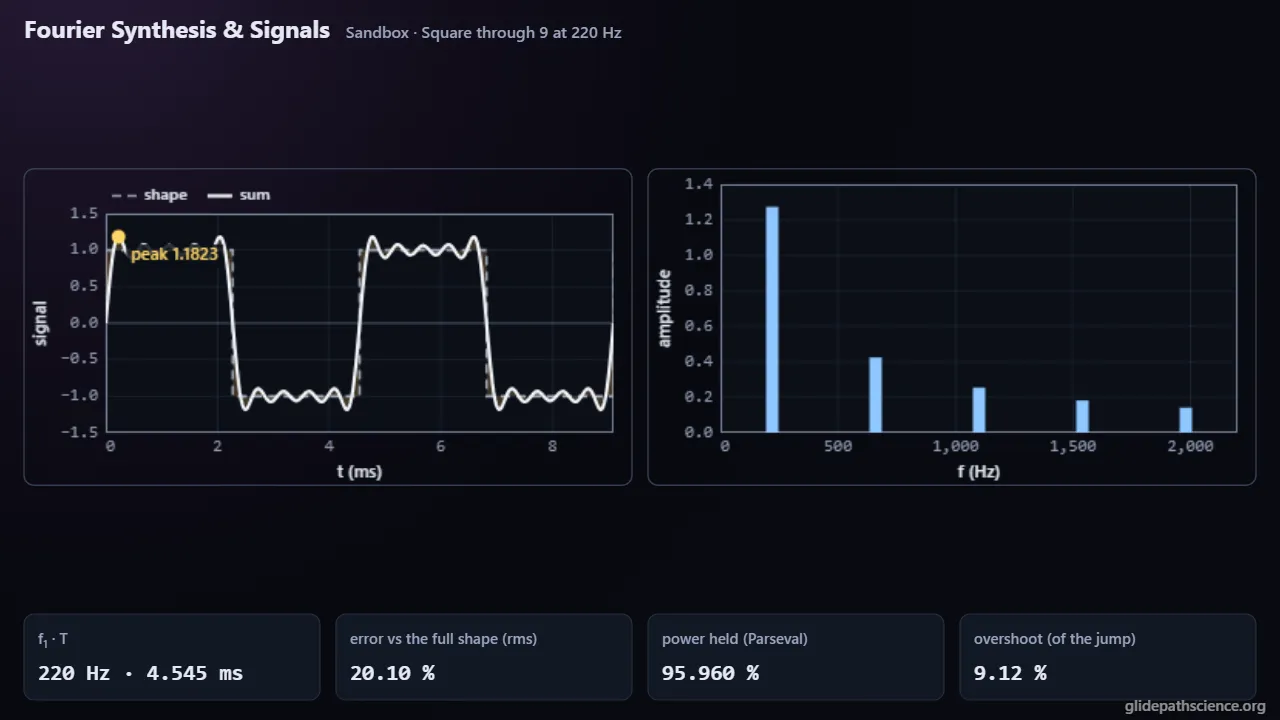
Every wave in this lab is a sum of sines, drawn and played on one fixed scale. A guided walkthrough at two levels follows OpenStax University Physics Volume 1, §16.5 and §17.5–17.6: harmonics and the fundamental, timbre from the harmonics’ strengths, phase, beats and filtering. The Advanced track adds the Fourier coefficients and orthogonality, the Gibbs overshoot, Parseval’s theorem, sampling and aliasing, the discrete Fourier transform, leakage and windows. The Sandbox sums seven shapes through any number of harmonics with the target, the parts and the spectrum beside them. The Harmonic Builder sets twelve amplitudes and, in Advanced, their phases, with recipes, a target and a held wave to compare against, and every phase change is heard as drawn. Beats & Filters plays two close tones and passes a wave through low-pass, high-pass and band-pass filters, with the input and output side by side. The Spectrum Analyzer samples a sound at a chosen rate and record length, shows its bins, leakage and aliases, plays both the source and the samples themselves, and can record three seconds from the microphone, kept in the page’s memory only. Readings keep the settings they were taken with. A Quick check, Match the spectrum, Filter it, prediction rounds with Practice and Assessed modes, Build the target wave, Mystery signal and Alias hunt complete it, with a printable Guide. Runs entirely offline in one file.
What you'll learn
- Describe a periodic wave of fundamental f₁ as a sum of harmonics nf₁, each with its amplitude and phase, and read its spectrum.
- Relate a wave’s shape to its spectrum: jumps give harmonics falling as 1/n, corners as 1/n², and a jump’s overshoot approaches a nonzero limit, about 9 % of the jump.
- Tell what the ear hears: pitch from f₁, timbre from the harmonics’ strengths, beats at |f₂ − f₁|, and why in a steady tone phase changes the shape far more than the sound.
- Read a measured spectrum: bins Δf = 1/T_rec apart, leakage when a record holds a non-integer number of periods, and a tone above fₛ/2 folded down when nothing filters it first.
What you can do
- Guided walkthroughStep-by-step, in Intro and Advanced tracks.
- SandboxEvery control of the model, to explore freely.
- Virtual labA realistic experiment with measurement noise and data analysis.
- Concept checksQuestions about ideas and vocabulary, with no calculating.
- PredictionCommit to a prediction, then see the result.
- Classroom demoProjector mode and recordable clips for slides.
- Works offlineA single downloadable file, verified to run without a network.
Before you start
- Waves: frequency, period, amplitude and wavelength
- Sine and cosine functions
- For the Advanced track: integrals, and complex numbers as arrows
Run or download
Run it in your browser
Nothing to install and no account. Works on laptops, Chromebooks, tablets, and phones.
Launch Fourier Synthesis & SignalsDownload for offline use
One HTML file (1.0 MB) that opens in any modern browser with no network: for rooms with unreliable Wi-Fi, or to keep a copy.
Download the fileFile details and checksum
- File
fourier-synthesis-signals-v1.2.html- Version
- 1.2, released November 15, 2026
- Build
3a13493- Size
- 1,052,197 bytes
- SHA-256
48ff70a40802ad57815b39c7c0354e92fe8db1bc34a41ee475616753eb651274- Offline
- Checked to run with all network access blocked.
The model and its limits
What the model assumes
- Series are summed exactly; the preset shapes’ coefficients are exact, and errors and power come from Parseval with each shape’s exact mean square.
- Filters are first order (the band-pass is a high-pass then a low-pass, buffered) and act in steady state on each harmonic.
- The analyzer samples each sound’s formula ideally at tₘ = m/fₛ, with optional seeded noise, and takes its spectrum with a radix-2 FFT and a rectangular or Hann window.
- Instrument recipes are steady and illustrative, not measurements; sound plays at a fixed relative scale, never normalized, and the samples are heard as an ideal low-pass at fₛ/2 would reconstruct them.
What it leaves out
- Real instruments’ attacks, decays, vibrato, noise and slightly inharmonic overtones.
- A real ear’s frequency-dependent loudness and masking, and the cases where phase is audible; levels are relative and your speakers shape them.
- Nonlinear or time-varying systems: distortion, compressors and a filter’s start-up transient.
- Real converters: the anti-alias filter before a sampler (described, not modeled), quantization and clock jitter.
- A recording’s own path: the microphone’s response, the browser’s processing and the codec it records in.
Cite this simulation
APA 7
Meier, D. (2026). Fourier Synthesis & Signals (Version 1.2) [Computer simulation]. Glidepath Science. https://glidepathscience.org/simulations/fourier-synthesis-signals/
MLA 9
Meier, David. Fourier Synthesis & Signals. Version 1.2, Glidepath Science, 2026, glidepathscience.org/simulations/fourier-synthesis-signals/.
AIP
D. Meier, Fourier Synthesis & Signals, version 1.2 (Glidepath Science, 2026), https://glidepathscience.org/simulations/fourier-synthesis-signals/.
BibTeX
@misc{meier2026fouriersynthesissignals,
  author       = {Meier, David},
  title        = {{Fourier Synthesis & Signals}},
  year         = {2026},
  publisher    = {Glidepath Science},
  version      = {1.2},
  note         = {Interactive simulation, version 1.2},
  howpublished = {\url{https://glidepathscience.org/simulations/fourier-synthesis-signals/}},
  url          = {https://glidepathscience.org/simulations/fourier-synthesis-signals/}
}
Credits and license
Created by Dr. David Meier, Glidepath Science.
Licensed under Creative Commons Attribution-NonCommercial-ShareAlike 4.0 International (CC BY-NC-SA 4.0). You may share and adapt it for noncommercial purposes, such as teaching, with credit and under the same license. Licensing and reuse
AI tools (Claude, from Anthropic, and ChatGPT, from OpenAI) were used in developing Glidepath Science and its simulations. Dr. David Meier reviewed, edited, and modified every release version.