
NewVersion 1.1
Feedback, Delay & Oscillation
Turn a shower’s mix with water that arrives late and see a delayed loop settle, ring or run away past kτ = π/2; then measure your reaction time and balance a stick.
About this simulation
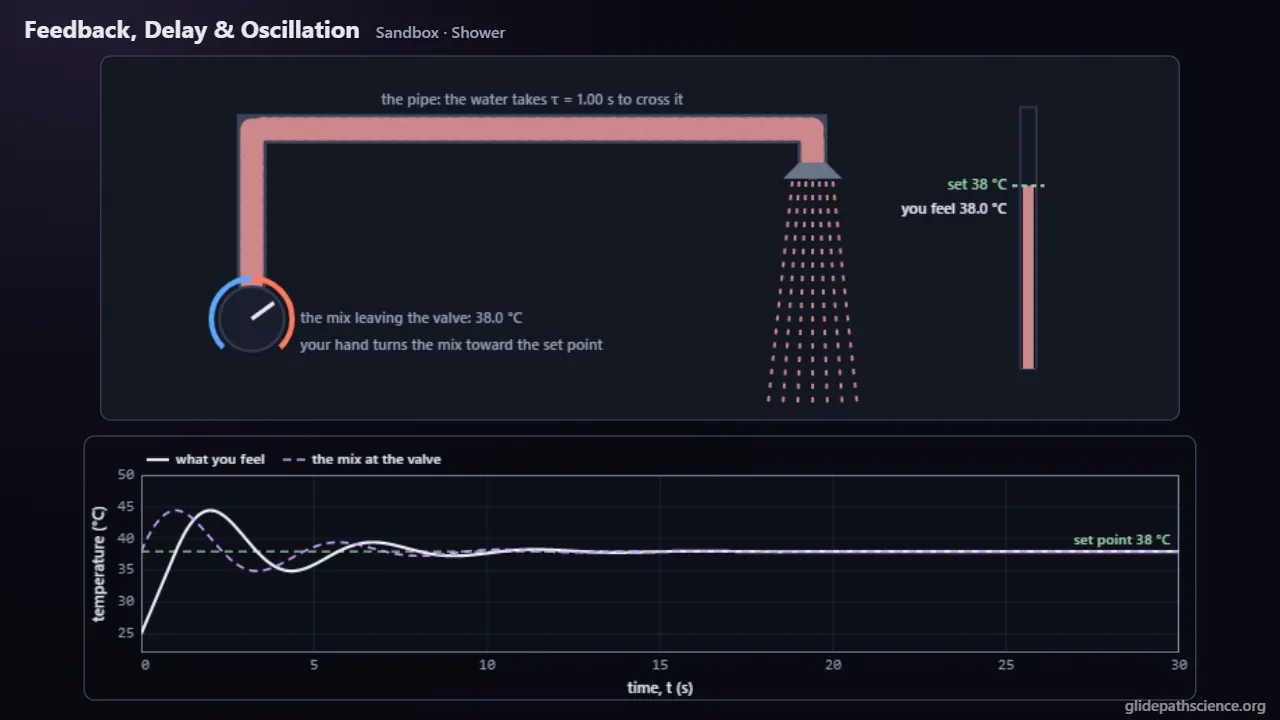
A feedback loop measures, compares with a set point and acts on the error, and when it acts on old information it overshoots. Students turn a shower’s mix toward the temperature they want, with water that takes a second to arrive: turned gently, it settles; eagerly, it rings; too eagerly, it swings wider and wider, with the onset at kτ = π/2 and a period of 4τ. A guided walkthrough at two levels covers negative and positive feedback, on/off and proportional control, the time constant, cruise control, reaction time and the shortest stick a hand can balance; the Advanced track adds the delay differential equation, the method of steps, Lambert W roots, limit cycles, phase and delay margins, the Nyquist picture and delayed PD control. The Sandbox runs a shower, a thermostat, a cruise control, a stick on a hand and a delayed damper. A Reaction Lab measures each student’s own delay, which then feeds the Stick Balancer and the Stability Map, which shows where a loop settles or runs away. A concept challenge and a prediction lab round it out.
What you'll learn
- Describe a feedback loop as measuring, comparing with a set point and acting on the difference, and explain why proportional control with no delay closes the error with time constant 1/k and never overshoots.
- Explain why acting on old information overshoots, and use the product kτ to predict no overshoot below 1/e, a decaying swing up to π/2 and a growing one beyond, with a period of 4τ at the onset.
- Measure a reaction time with a ruler drop, t = √(2d/g), and explain why the shortest stick a hand can balance is about ¾gτ² long.
- Find the roots of s + ke^(−sτ) = 0 as Lambert W values, and use phase, gain and delay margins to say how far a loop is from the onset of oscillation.
What you can do
- Guided walkthroughStep-by-step, in Intro and Advanced tracks.
- SandboxEvery control of the model, to explore freely.
- Virtual labA realistic experiment with measurement noise and data analysis.
- Concept checksQuestions about ideas and vocabulary, with no calculating.
- PredictionCommit to a prediction, then see the result.
- Classroom demoProjector mode and recordable clips for slides.
- Works offlineA single downloadable file, verified to run without a network.
Before you start
- Rates of change and graphs against time
- Exponential decay and time constants; free fall
- For the Advanced track: differential equations, complex numbers and a first look at transfer functions
Run or download
Run it in your browser
Nothing to install and no account. Works on laptops, Chromebooks, tablets, and phones.
Launch Feedback, Delay & OscillationDownload for offline use
One HTML file (701 kB) that opens in any modern browser with no network: for rooms with unreliable Wi-Fi, or to keep a copy.
Download the fileFile details and checksum
- File
feedback-delay-oscillation-v1.1.html- Version
- 1.1, released November 15, 2026
- Build
f9e50dc- Size
- 717,511 bytes
- SHA-256
80a6337772e398354b58839c3c31ef6ac876ce858f160166e35be58a050ed280- Offline
- Checked to run with all network access blocked.
The model and its limits
What the model assumes
- Delay differential equations are integrated by fourth-order Runge–Kutta with a history buffer and cubic Hermite interpolation, matching the exact method-of-steps solution to about 10⁻¹⁰; the history before t = 0 is constant.
- The roots come from the Lambert W function; the onset, the no-overshoot limit, the margins and the critical length are found numerically and agree with the closed forms.
- The shower is T′ = k(T_set − T(t − τ)), with the pipe a pure delay; the thermostat is an on/off relay on a room with a one-hour time constant and a sensor that reports late.
- The car has a mass of 1,500 kg, aerodynamic drag and rolling resistance, and a proportional (or PI) controller acting τ late, limited to ±6,000 N, with anti-windup.
- The stick obeys the full pendulum equation, with the hand’s acceleration from delayed PD control limited to ±30 m/s²; the robot uses gains at the middle of the linear model’s stable region.
What it leaves out
- No noise in sensing or acting and no varying human gains; the critical length assumes perfect gains, which is why real people need a longer stick.
- No digital sampling (except the thermostat’s one-second check), quantization or actuator dynamics beyond a limit.
- A click test measures a reaction to a surprise, including the screen’s and mouse’s own delays; steady balancing uses a somewhat shorter loop delay.
- No friction or mass at the hand and no motion out of the plane; no mixing in the shower’s pipe, and no gears or engine response in the car.
Cite this simulation
APA 7
Meier, D. (2026). Feedback, Delay & Oscillation (Version 1.1) [Computer simulation]. Glidepath Science. https://glidepathscience.org/simulations/feedback-delay-oscillation/
MLA 9
Meier, David. Feedback, Delay & Oscillation. Version 1.1, Glidepath Science, 2026, glidepathscience.org/simulations/feedback-delay-oscillation/.
AIP
D. Meier, Feedback, Delay & Oscillation, version 1.1 (Glidepath Science, 2026), https://glidepathscience.org/simulations/feedback-delay-oscillation/.
BibTeX
@misc{meier2026feedbackdelayoscillation,
  author       = {Meier, David},
  title        = {{Feedback, Delay & Oscillation}},
  year         = {2026},
  publisher    = {Glidepath Science},
  version      = {1.1},
  note         = {Interactive simulation, version 1.1},
  howpublished = {\url{https://glidepathscience.org/simulations/feedback-delay-oscillation/}},
  url          = {https://glidepathscience.org/simulations/feedback-delay-oscillation/}
}
Credits and license
Created by Dr. David Meier, Glidepath Science.
Licensed under Creative Commons Attribution-NonCommercial-ShareAlike 4.0 International (CC BY-NC-SA 4.0). You may share and adapt it for noncommercial purposes, such as teaching, with credit and under the same license. Licensing and reuse
AI tools (Claude, from Anthropic, and ChatGPT, from OpenAI) were used in developing Glidepath Science and its simulations. Dr. David Meier reviewed, edited, and modified every release version.