
NewVersion 1.4
Molecular Geometry & VSEPR
Build molecules around a central atom and watch electron pairs relax into shape. Count domains from Lewis structures, see lone pairs squeeze angles, compare the model with measured molecules, and add bond dipoles in 3-D.
About this simulation
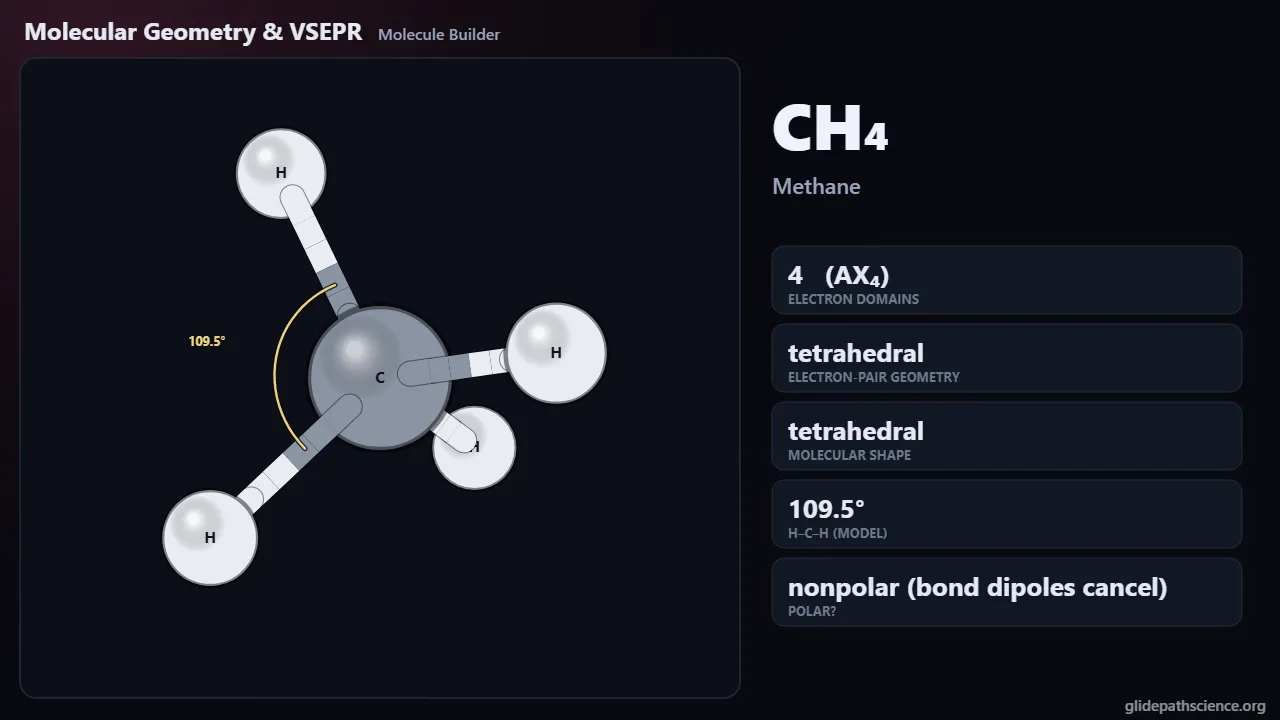
A 3-D molecule builder and guided lab for VSEPR. Students count valence electrons and draw Lewis structures, count the electron domains around a central atom, and watch the domains relax on a sphere into the five electron-pair geometries and the shapes that lone pairs leave behind. A Shape Gallery lays the model over about forty measured molecules, including the cases where VSEPR fails, and a Polarity Lab adds bond dipoles tip to tail. Intro and Advanced tracks, a Concept Challenge with spatial drills, and a Predict Lab with fresh species every run. Runs offline in one file.
What you'll learn
- Count the electron domains around a central atom from its Lewis structure, counting each bonded atom once whatever the bond order, and each lone pair.
- Predict the electron-pair geometry for two to six domains and the molecular shape that lone pairs leave, including where lone pairs go in trigonal bipyramidal and octahedral arrangements.
- Explain how lone pairs and multiple bonds distort bond angles, and compare a repulsion model's angles with measured ones, including where VSEPR fails.
- Decide whether a molecule is polar by adding its bond dipoles as vectors, and explain why polar bonds can give a nonpolar molecule.
What you can do
- Guided walkthroughStep-by-step, in Intro and Advanced tracks.
- SandboxEvery control of the model, to explore freely.
- Virtual labA realistic experiment with measurement noise and data analysis.
- Concept checksQuestions about ideas and vocabulary, with no calculating.
- PredictionCommit to a prediction, then see the result.
- Classroom demoProjector mode and recordable clips for slides.
- Works offlineA single downloadable file, verified to run without a network.
Before you start
- Atoms, protons, neutrons and electrons
- Electron configurations and valence electrons (Atomic Structure & Isotopes)
- Ionic and covalent bonds, and the octet rule
- Adding vectors
Run or download
Run it in your browser
Nothing to install and no account. Works on laptops, Chromebooks, tablets, and phones.
Launch Molecular Geometry & VSEPRDownload for offline use
One HTML file (877 kB) that opens in any modern browser with no network: for rooms with unreliable Wi-Fi, or to keep a copy.
Download the fileFile details and checksum
- File
molecular-geometry-vsepr-v1.4.html- Version
- 1.4, released November 15, 2026
- Build
5d94265- Size
- 898,313 bytes
- SHA-256
8fc6663eaa27fce0b85b30c312bd2f93ba6b78645c8c52546b24f489ff552434- Offline
- Checked to run with all network access blocked.
The model and its limits
What the model assumes
- Each electron domain (bonding pair, lone pair or single electron) is a point on a sphere around the central atom; the shape minimizes the repulsion energy, the sum of w_i w_j / r^2 over every pair of domains.
- Bonding pairs sit at distance 1 from the center and lone pairs nearer, at 0.70; a double bond weighs 1.2, a triple bond 1.4, a single electron 0.5. These are model choices fitted to ammonia and water.
- Bonds of one element with different orders in a Lewis structure are given their resonance-averaged order.
- Bond dipoles lie along the bonds, proportional to the Pauling electronegativity difference and pointing toward the more electronegative atom; their vector sum decides polarity, in model units rather than debyes.
- Measured geometries and dipole moments are standard gas-phase values (crystal structures for ions), shown beside the model and never changed by it.
What it leaves out
- Atomic size and ligand electronegativity do not enter the model's angles, so it gives NH3 and NF3, or H2O and H2S, the same angle.
- The model predicts shapes and the direction of distortions, not every angle: SF4's equatorial F-S-F is 121 degrees in the model and 101.6 degrees measured.
- VSEPR fails for mostly ionic molecules (Li2O, the alkaline-earth dihalides), for heavy atoms whose lone pair stays in an s orbital ([TeCl6]2-, gaseous SnCl2), for N(SiH3)3, for seven-domain molecules such as XeF6, and for transition-metal complexes; the sim shows and explains these cases.
- Electronegativity differences give a bond dipole's direction but not its size: the model does not reproduce the measured order of the chloromethanes' dipoles.
- One central atom only in the builder; vibration, crystal packing and electron densities are left out.
- Measured values in this draft are standard values still to be checked against their sources.
Cite this simulation
APA 7
Meier, D. (2026). Molecular Geometry & VSEPR (Version 1.4) [Computer simulation]. Glidepath Science. https://glidepathscience.org/simulations/molecular-geometry-vsepr/
MLA 9
Meier, David. Molecular Geometry & VSEPR. Version 1.4, Glidepath Science, 2026, glidepathscience.org/simulations/molecular-geometry-vsepr/.
AIP
D. Meier, Molecular Geometry & VSEPR, version 1.4 (Glidepath Science, 2026), https://glidepathscience.org/simulations/molecular-geometry-vsepr/.
BibTeX
@misc{meier2026moleculargeometryvsepr,
  author       = {Meier, David},
  title        = {{Molecular Geometry & VSEPR}},
  year         = {2026},
  publisher    = {Glidepath Science},
  version      = {1.4},
  note         = {Interactive simulation, version 1.4},
  howpublished = {\url{https://glidepathscience.org/simulations/molecular-geometry-vsepr/}},
  url          = {https://glidepathscience.org/simulations/molecular-geometry-vsepr/}
}
Credits and license
Created by Dr. David Meier, Glidepath Science.
Licensed under Creative Commons Attribution-NonCommercial-ShareAlike 4.0 International (CC BY-NC-SA 4.0). You may share and adapt it for noncommercial purposes, such as teaching, with credit and under the same license. Licensing and reuse
AI tools (Claude, from Anthropic, and ChatGPT, from OpenAI) were used in developing Glidepath Science and its simulations. Dr. David Meier reviewed, edited, and modified every release version.