
NewVersion 1.2
DC Circuit Lab
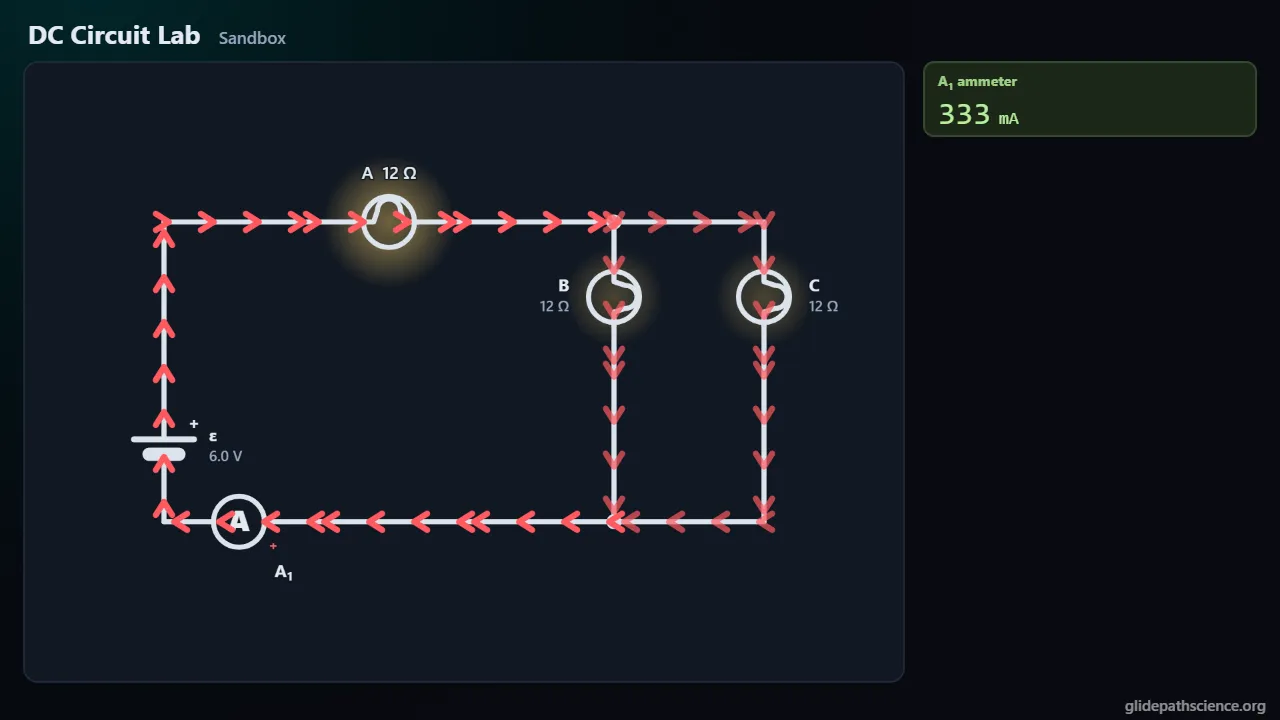
Wire batteries, bulbs, resistors, switches, and meters on a phone-sized grid: current is not used up, a battery holds a voltage, and every meter is part of the circuit. Then a lab bench, a breadboard, and mystery boxes.
About this simulation
Every circuit in this lab is solved by modified nodal analysis, with each battery’s own current as an unknown, and checked by Kirchhoff’s rules and the energy books. A guided walkthrough at two levels follows OpenStax University Physics Volume 2, chapters 9 and 10: current that is not used up, Ohm’s law and power, series and parallel with the classic bulb rankings, a battery that holds its voltage rather than its current, equivalent resistance, the junction and loop rules with two batteries, where meters go, and real batteries with internal resistance. The Advanced track adds nodal analysis, superposition, Thévenin and maximum power, voltmeter loading and ammeter burden, building meters from a movement, the Wheatstone bridge, four-wire measurement, and real tungsten filaments: non-ohmic curves, load lines, and inrush. Readings, glow, and current stay dark until each question is answered. The Sandbox is a circuit editor on a grid of dots sized for a phone, with constant-resistance or real-filament bulbs, ideal or real batteries, ideal, digital, or analog meters, a loop walk of the potential, a series–parallel reduction with live numbers, circuit links to assign an exact circuit, and a step-by-step two-loop Challenge Circuit. A Lab Bench measures a cell’s emf and internal resistance from a fit of noisy 3½-digit readings, traces resistor and bulb I–V curves, and infers a meter’s own resistance from how it loads a divider. A Breadboard turns six schematic cards into builds, checks them against the card, and hides six faults to find with a voltmeter. A Quick check, prediction rounds with fresh numbers, Rank the bulbs, What changes?, sealed mystery boxes, and design-to-spec challenges complete it, with a printable Guide. Runs entirely offline in one file.
What you'll learn
- Current is not used up: every ammeter in a single loop reads the same, and a bulb converts energy at the rate P = IΔV.
- A battery holds a voltage: an ideal one keeps ΔV = ε whatever it drives, a real one sags to ε − Ir, and the circuit sets the current.
- Kirchhoff’s rules: charge is conserved at every junction and energy around every loop, and the series and parallel rules follow from them.
- Meters are part of the circuit: an ammeter goes in series with a small resistance, a voltmeter in parallel with a large one, and each changes what it measures.
What you can do
- Guided walkthroughStep-by-step, in Intro and Advanced tracks.
- SandboxEvery control of the model, to explore freely.
- Virtual labA realistic experiment with measurement noise and data analysis.
- Concept checksQuestions about ideas and vocabulary, with no calculating.
- PredictionCommit to a prediction, then see the result.
- Classroom demoProjector mode and recordable clips for slides.
- Works offlineA single downloadable file, verified to run without a network.
Before you start
- Charge, energy, and the idea of potential difference as energy per charge
- Solving one or two linear equations
- For the Advanced track: systems of linear equations and reading graphs of nonlinear functions
Run or download
Run it in your browser
Nothing to install and no account. Works on laptops, Chromebooks, tablets, and phones.
Launch DC Circuit LabDownload for offline use
One HTML file (963 kB) that opens in any modern browser with no network: for rooms with unreliable Wi-Fi, or to keep a copy.
Download the fileFile details and checksum
- File
dc-circuit-lab-v1.2.html- Version
- 1.2, released November 15, 2026
- Build
050f0df- Size
- 986,446 bytes
- SHA-256
7513576dacf12ab1d284a2df475a4db818ae59fb2087f1c1fdc906d7bbd0d951- Offline
- Checked to run with all network access blocked.
The model and its limits
What the model assumes
- Ideal wires and switches; resistors obey Ohm’s law; a battery is a constant emf in series with a constant internal resistance (zero when ideal).
- Constant-resistance bulbs (12.0 Ω classroom bulbs) by default; real tungsten filaments have R(T) = R_hot (T/T_r)^1.2 and lose heat by radiation with a 10 % conduction share, calibrated to each bulb’s rating.
- The DC operating point by modified nodal analysis with Newton’s method for filaments; only the filaments’ temperatures change with time, on a trapezoidal stepper.
- Fuses and meter fuses blow instantly at their rating; a filament burns out above 3,400 K, a constant-resistance bulb above 3.4 times its rated power.
- Meters: ideal, a 10 MΩ digital multimeter with 3½-digit ranges, or an analog meter on a 50 µA, 2 kΩ movement (20 kΩ/V).
- The Lab Bench adds a fixed calibration error within ±(0.5 % + 2 counts) and a last-digit jitter per reading, seeded so a data set can be repeated.
What it leaves out
- No wire resistance (except the bench’s clip leads), switch bounce, or arcing.
- No battery chemistry: no discharge, recovery, or temperature effects.
- Fuses have no time–current curve; slow-blow behavior is only described.
- The bulb glow follows power, not light output or spectrum.
- No capacitors, inductors, alternating current, magnetic effects, or semiconductors.
- The cells’, meters’, and lamps’ constants are typical illustrative values.
Cite this simulation
APA 7
Meier, D. (2026). DC Circuit Lab (Version 1.2) [Computer simulation]. Glidepath Science. https://glidepathscience.org/simulations/dc-circuit-lab/
MLA 9
Meier, David. DC Circuit Lab. Version 1.2, Glidepath Science, 2026, glidepathscience.org/simulations/dc-circuit-lab/.
AIP
D. Meier, DC Circuit Lab, version 1.2 (Glidepath Science, 2026), https://glidepathscience.org/simulations/dc-circuit-lab/.
BibTeX
@misc{meier2026dccircuitlab,
  author       = {Meier, David},
  title        = {{DC Circuit Lab}},
  year         = {2026},
  publisher    = {Glidepath Science},
  version      = {1.2},
  note         = {Interactive simulation, version 1.2},
  howpublished = {\url{https://glidepathscience.org/simulations/dc-circuit-lab/}},
  url          = {https://glidepathscience.org/simulations/dc-circuit-lab/}
}
Credits and license
Created by Dr. David Meier, Glidepath Science.
Based on: OpenStax, University Physics Volume 2, by Samuel J. Ling, Jeff Sanny and William Moebs: Chapters 9, “Current and Resistance” (§9.1, 9.4, and 9.5), and 10, “Direct-Current Circuits” (§10.1–10.4), an open textbook licensed CC BY-NC-SA 4.0 (openstax.org). The Intro track follows its order of ideas and its terms: emf, terminal voltage, internal resistance, equivalent resistance, the junction rule, and the loop rule. Two changes: ideal batteries come first and internal resistance last, as AP courses order it, and a potential difference across a part is written ΔV, as AP writes it. The wording, numbers, figures, and simulations are the sim’s own. No endorsement by OpenStax or the authors is implied.
Licensed under Creative Commons Attribution-NonCommercial-ShareAlike 4.0 International (CC BY-NC-SA 4.0). You may share and adapt it for noncommercial purposes, such as teaching, with credit and under the same license. Licensing and reuse
AI tools (Claude, from Anthropic, and ChatGPT, from OpenAI) were used in developing Glidepath Science and its simulations. Dr. David Meier reviewed, edited, and modified every release version.